

Last Updated on July 20, 2026
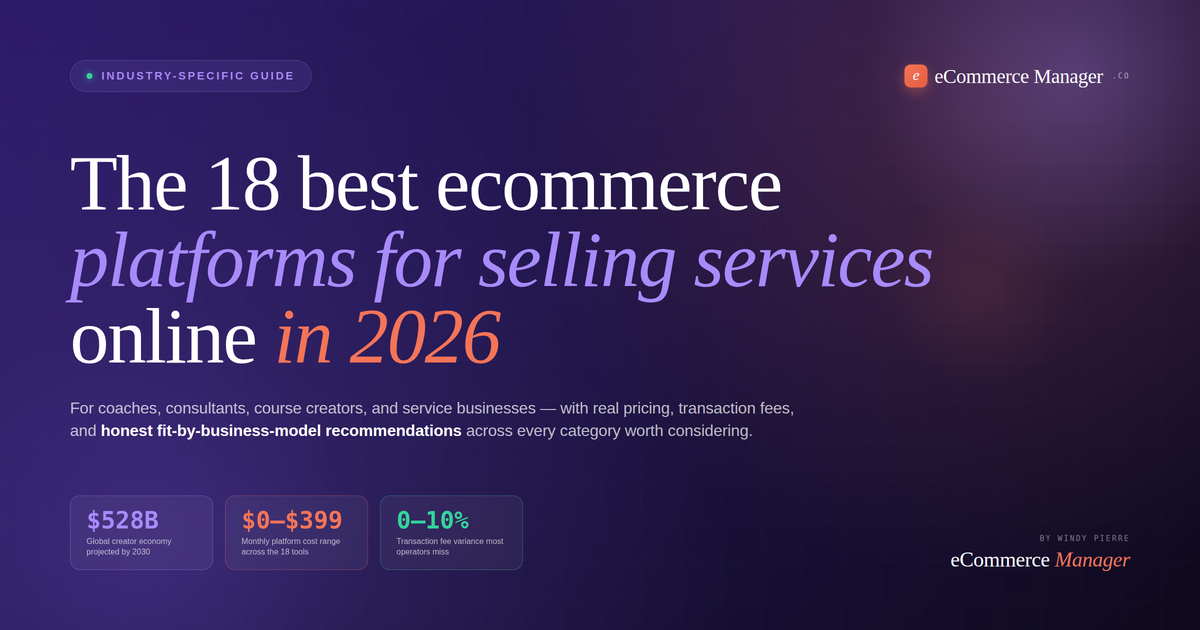
The 18 best ecommerce platforms for selling services online in 2026 — and which one actually fits your business model
The creator economy is projected to hit $528 billion by 2030, and every one of those creators, coaches, consultants, and service providers needs a platform to sell on. Most listicles recommend the same five tools regardless of whether you're a solo coach, a course creator, or a salon owner. This one doesn't. Every pick below is matched to a specific business model with real pricing, real transaction fees, and the honest operator take on where each platform quietly falls apart.
- Why business model matters more than platform features
- The full comparison table
- All-in-one platforms for multi-product creators
- Course-focused platforms
- Coaching & client-services platforms
- Appointment booking & scheduling platforms
- Industry-specific platforms
- 5 filters before you pick a platform
- Stack recommendations by revenue stage
- FAQ
Why business model matters more than platform features
Selling services online is not one job. It's eight different jobs, and every "best platforms for services" listicle pretends it's one. That's how coaches end up on Shopify and salon owners end up on Kajabi.
Here's the thing about service business platforms in 2026. A coach selling three tiers of 1-on-1 packages needs completely different infrastructure than a course creator dropping a self-paced program every 90 days. A salon owner needs completely different infrastructure than a consultant billing hourly. A membership community operator needs completely different infrastructure than a spa. Every platform on this list is genuinely great — for a specific business model. Applied to the wrong model, the same platform becomes an expensive frustration that you'll churn off in six months.
The 18 platforms below cover five categories that solve genuinely different problems. All-in-one creator platforms (Kajabi, Podia, Kartra, Systeme.io) are built for solopreneurs running multiple revenue streams from one dashboard — courses plus coaching plus community plus digital products. Course-focused platforms (Teachable, Thinkific, LearnWorlds) go deeper on course delivery, student experience, and learning outcomes than the all-in-one tools do. Coaching and client-services platforms (Paperbell, Practice, Dubsado, HoneyBook) are built around the specific workflow of high-touch client relationships with proposals, contracts, invoicing, and session management. Booking platforms (Acuity, SimplyBook.me, Calendly, Square Appointments) exist because appointment-based businesses have completely different needs than content-based ones. And industry-specific platforms (Fresha for salons, Vagaro for beauty and fitness) exist because the workflows of specific service verticals are different enough to justify purpose-built tools.
Pick the wrong category and even the best platform in it will feel like a fight. Pick the right category and even a mid-tier tool will feel like it was built for you. That's what this guide is about.
The full comparison table
All 18 platforms grouped by category, with entry pricing, transaction fees, primary use case, and best-fit business model. Full write-ups follow below.
| Platform | Category | Entry / Fees | Best-fit model |
|---|---|---|---|
| Kajabi | All-in-one | $149/mo, 0% fees | Multi-product $50K+ |
| Podia | All-in-one | $33/mo, 0% fees | Budget solopreneurs |
| Kartra | All-in-one | $119/mo, 0% fees | Funnel-heavy creators |
| Systeme.io | All-in-one | Free / $27/mo | Bootstrappers |
| Teachable | Course | $59/mo + 5% (Basic) | Course-first $50K–$500K |
| Thinkific | Course | $74/mo, 0% fees | Course-first $100K+ |
| LearnWorlds | Course | $99/mo + $5/enrolled | Corporate training |
| Mighty Networks | Community | $41/mo, 2–3% fees | Community-first |
| Circle | Community | $99/mo, 4% fees | Premium community |
| Paperbell | Coaching | $49/mo flat | Solo coaches |
| Practice | Coaching | $39/mo per user | Coaching teams |
| HoneyBook | Client services | $16–$78/mo | Freelance/agencies |
| Dubsado | Client services | $20–$40/mo | Creative freelancers |
| Acuity Scheduling | Booking | $20–$61/mo | Structured sessions |
| SimplyBook.me | Booking | Free / $9.90–$60/mo | Multi-service ops |
| Calendly | Booking | Free / $12–$20/mo | Consultants + sales |
| Fresha | Industry | Free + marketplace fees | Salons + spas |
| Vagaro | Industry | $30–$105/mo | Beauty + fitness |
All-in-one platforms for multi-product creators
These four platforms compete for the operator running two or more revenue streams from one dashboard — courses plus coaching plus community plus digital products. The trade-off is real: nothing goes as deep as specialized tools, but you consolidate to one login, one billing relationship, and one integrated customer database. For solopreneurs running mature multi-product businesses, that consolidation is worth real money.
01Kajabi
Kajabi is the premium all-in-one platform coaches, consultants, and course creators consolidate on when they're tired of stitching together six different tools. It handles courses, memberships, communities, coaching, podcasts, digital downloads, email marketing, sales funnels, and native mobile apps — all from one platform with a genuinely integrated customer database. That last part matters more than the feature list: your student in the course, your client in the coaching program, and your subscriber to your email list are the same customer record, not three separate ones.
The pricing tells you who Kajabi is for. Basic at $149/month with a single admin and three products is the entry point most creators start on. Growth at $199/month adds advanced automations and affiliate management. Pro at $399/month scales to multi-team operations with dedicated success support. Compare that to Thinkific ($74/mo) + ConvertKit ($49/mo) + Circle ($99/mo) + Calendly ($20/mo) = $242/month for a similar feature set, and Kajabi's pricing suddenly looks reasonable rather than expensive.
Kajabi's math only works once you're running multiple revenue streams. If you sell one course and nothing else, Thinkific plus an email tool is cheaper and equally functional. The break-even point is roughly two products or $50K in annual revenue — below that Kajabi is over-buying; above it, the consolidation savings are real.
02Podia
Podia is the budget-conscious all-in-one platform for creators who like Kajabi's approach but hate Kajabi's pricing. It handles courses, digital downloads, coaching, webinars, community, memberships, and a basic online store — with a community-first UI redesign that landed in 2026 emphasizing shared discussions and events over pure course delivery. At $33/month for Mover, $75/month for Shaker, and $89/month for Earthquaker (which includes affiliate management), the pricing lands roughly one-third to one-half of Kajabi's for a genuinely functional feature set.
The tradeoff is depth. Everything Podia offers works, but nothing goes as deep as specialized alternatives. The course delivery isn't as sophisticated as Thinkific's. The email marketing isn't as powerful as ConvertKit's. The community isn't as feature-rich as Circle's. For solopreneurs earning under $250K annually who need multi-product functionality without paying premium prices, Podia is the right pick almost every time. For creators pushing past $500K who need advanced features, the depth gap starts to matter.
Podia dropped its permanent free plan in 2026 — the current entry point is a 30-day trial only. Budget it accordingly and don't count on the freemium experience some older reviews reference.
03Kartra
Kartra is the platform that positioned itself around sales funnels first and course delivery second. The DNA shows in the tooling: sophisticated behavioral automation, checkout page A/B testing, one-click upsells, order bumps, and multi-step funnel visualization are all first-class features rather than upgrade-tier gates. If your business model relies heavily on funnel optimization — you're selling a $997 course through a webinar funnel with a $2,997 upsell — Kartra's conversion tooling is genuinely deeper than Kajabi's or Podia's.
The tradeoff is course delivery UX. Kartra's student experience feels slightly older and less polished than Kajabi or Thinkific. The community features are functional but not competitive with Circle or Mighty Networks. And the learning curve is steeper than the more consumer-friendly alternatives. For funnel-heavy digital marketers this pays off; for coaches whose main product is the coaching experience, it's overkill in the wrong direction.
Kartra is the right pick if you've already built successful funnel-driven digital products and know exactly how much upsell revenue you extract from checkout optimization. If you don't yet have that math dialed in, Kajabi's simpler funnels are easier to launch and iterate on while you figure out what actually works.
Systeme.io is the sleeper all-in-one platform most creators haven't heard of yet, and it's genuinely the cheapest functional alternative to Kajabi on the market. The free plan is unusually generous — one custom domain, 2,000 email contacts, three sales funnels, unlimited students in unlimited courses, and zero transaction fees. That's the kind of freemium tier most competitors would put behind $50/month.
Paid tiers start at $27/month for Startup and $47/month for Webinar. The tool covers courses, email marketing, sales funnels, membership sites, automations, blogs, and affiliate management. Where Systeme.io hits its ceiling is polish — the UI feels slightly less refined than Kajabi or Podia, template design options are more limited, and the ecosystem of integrations and third-party experts is smaller. For a creator prioritizing budget over premium UX, none of that matters.
Systeme.io is the right pick for bootstrapped creators generating under $30K annually who need functional infrastructure without spending on subscriptions before revenue justifies them. Once you cross $50K in revenue, the polish gap versus Kajabi and Podia becomes a real friction cost — plan to migrate eventually rather than staying on Systeme.io forever.
Launching a service business online? The platform is the easy part — the offer design and pricing strategy is where most creators stall.
Browse our directory of vetted agencies specializing in launching coaching, course, and service businesses at scale.
Course-focused platforms
These five platforms are purpose-built for creators whose primary product is a course or educational program. They go deeper on learner experience, course delivery mechanics, quiz engines, and completion tracking than the all-in-one alternatives do. The tradeoff: you'll need separate tools for email marketing, funnel building, and community if those matter to your business.
Teachable has been the default course platform for solopreneur creators for over a decade and remains the tool most course consultants recommend for first-time creators. The setup is genuinely fast — you can have a functional course selling within a day — and the student experience on both web and mobile is polished. The native mobile app (included on Pro tiers) is a real differentiator against Thinkific, whose mobile app has been criticized for reliability issues.
The catch on Teachable is the transaction fee structure. Basic at $59/month adds a 5% transaction fee on every sale, which at real revenue scale adds up fast — a course creator earning $100K/year on Basic pays $5,000 in transaction fees on top of subscription costs. Pro at $159/month drops the fee to zero, which is where the math works out. Model both tiers at your target annual revenue before committing.
Skip Teachable's Basic plan unless you're validating whether course selling works at all. Once you're generating any real revenue, Pro at $159/month with zero transaction fees costs less than Basic with fees at anything above about $2,000 monthly revenue. The false economy of the cheaper tier hurts brands consistently.
Thinkific is the tech-forward course platform that competes head-to-head with Teachable and wins on flexibility, customization depth, and total cost at scale. Zero transaction fees across every plan is the marquee advantage — a course creator earning $200K annually keeps $10,000 in commissions Teachable Basic would have charged. Course design flexibility is also stronger, particularly around drip content, prerequisites, and interactive assessments.
Thinkific dropped its permanent free plan in 2026 and now offers a 30-day trial only. Start at $74/month is the entry point, which is roughly $15/month more than Teachable Basic but saves that difference back plus more once you cross about $500 monthly revenue. The learning curve is slightly steeper than Teachable's — the tool feels like it was designed by engineers rather than marketers — but the resulting flexibility is worth it for creators comfortable with configuration.
Thinkific wins the total-cost math against Teachable at almost any real revenue level once transaction fees enter the equation. If pricing is a factor and you can handle a slightly less polished admin experience, Thinkific is the smarter pick nine times out of ten.
LearnWorlds is the course platform for creators whose product depth demands more sophisticated learning infrastructure than Teachable or Thinkific can provide. Interactive video (clickable overlays, quizzes embedded in video, branching scenarios), SCORM/xAPI compliance for corporate training, and detailed learner analytics are all standard features rather than premium upgrades. The end-product feels noticeably more polished than the alternatives, though build time is meaningfully longer.
The pricing structure is unusual. Starter at $29/month adds $5 per paid enrollment, which is a per-student fee model rare in the category. Pro Trainer at $99/month eliminates enrollment fees and adds full features. Learning Center at $299/month adds white-label mobile apps and enterprise-grade branding. The right choice depends heavily on your enrollment volume — high-volume courses at low price points can get punished by per-enrollment fees.
LearnWorlds is the right pick for corporate trainers, compliance-heavy industries, and creators whose content genuinely benefits from interactive video. For solopreneur coaches whose main deliverable is video plus PDFs, Thinkific delivers 90% of what you actually need at meaningfully lower cost and setup time.
Mighty Networks is the platform for creators whose primary product is community access rather than course content. The tooling reflects the priority — events, cohort-based courses, live sessions, member directories, and mobile app engagement are first-class features, while pure course delivery is functional but not competitive with Thinkific or Teachable. If your community IS your product, this is one of two platforms genuinely built for that thesis.
Pricing sits between Podia and Kajabi. Community at $41/month plus 2% fees works for early-stage creators; Business at $99/month with the same fee structure adds advanced features; Path-to-Pro at $239/month unlocks white-label apps and enterprise features. The transaction fees at 2-3% are meaningfully lower than Circle's 4% but higher than Kajabi's zero.
Mighty Networks wins for cohort-based programs (12-week accelerators, 6-month masterminds) where community activity IS the product. If community is just a bonus alongside your course, Thinkific plus Circle or Discord is often the better mix.
09Circle
Circle is the premium community platform used by creators who want a polished Slack-adjacent experience for paid community engagement. The UI feels more modern than Mighty Networks, the space/channel organization is more flexible, and integrations with Kajabi, Thinkific, and other course platforms are strong. Creators like Pat Flynn, Justin Welsh, and dozens of high-ticket coaches run their premium communities on Circle.
The pricing is the primary friction point. Professional at $99/month plus 4% transaction fees adds up quickly at real member volume — a community with $50K in annual membership revenue pays $2,000 in Circle fees on top of the subscription. Business at $219/month reduces per-member costs at scale but requires a real member count to justify. Skip Circle until you have paid membership traction elsewhere and know community is the right monetization channel for you.
Circle's polish justifies the premium pricing for high-ticket coaching communities (memberships $99+/month) where members expect a professional experience. For low-ticket communities ($20-$40/month), Discord or Skool at fraction of the cost works better — you don't need Circle's UX polish for casual community engagement.
Coaching & client-services platforms
These four platforms are built around the specific workflow of high-touch client relationships — proposals, contracts, session management, invoicing, and client portals. Where course platforms optimize for one-to-many delivery, coaching platforms optimize for one-to-one or one-to-few relationships where each client gets a personalized experience.
Paperbell is purpose-built for solo coaches who are tired of stitching together Calendly plus Stripe plus HoneyBook plus Notion to run their coaching business. One flat $49/month subscription handles scheduling, payment collection, package selling (3-session, 6-session, 12-session bundles), contracts and signatures, client notes, and a branded client portal. That's it — no transaction fees, no per-user pricing, no per-package limits.
What Paperbell doesn't do is community, courses, or memberships. It's a purpose-built coaching business operations tool, not an all-in-one creator platform. That focus is the feature: the workflow feels tailored to coaching rather than borrowed from a generic small-business template. Package sales, session tracking, and automatic scheduling of remaining sessions from a purchased bundle all work exactly how a coach expects them to.
Paperbell wins for solo coaches selling structured coaching packages (3 sessions, 6 sessions, 12 sessions) rather than open-ended monthly retainers. If you sell coaching mostly as monthly retainers, HoneyBook's project-based workflow handles that motion better.
11Practice
Practice is the platform for coaching businesses that have grown past solo operations — coaching agencies, therapy practices, wellness clinics with multiple practitioners, and executive coaching firms with several coaches serving shared clients. Where Paperbell serves the solo coach, Practice serves the coaching team: shared client databases, per-coach scheduling, unified billing across practitioners, and centralized reporting on business performance across the team.
Pricing is per-user at $39/month, which means a five-person coaching practice pays $195/month for the tool. That's more expensive than Paperbell for a solo user but dramatically less expensive than trying to run a multi-coach practice through Paperbell's single-user model with awkward workarounds.
Practice is worth evaluating the moment you hire your second coach. Trying to run a multi-coach business through solo tools creates operational friction that costs more in wasted admin time than upgrading to Practice does in subscription fees.
HoneyBook is the client-workflow tool that dominates the freelancer and boutique-agency market — photographers, designers, event planners, marketing consultants, wedding planners, videographers. The tool covers everything: inquiries and lead capture, proposals with electronic signatures, invoicing and payments, contracts, automated workflow sequences, and a branded client portal. If your business model is project-based rather than session-based, HoneyBook handles the full lifecycle from lead to invoice better than any coaching-specific platform.
Pricing is more accessible than most competitors — Starter at $16/month covers solopreneurs, Essentials at $32/month adds automation and QuickBooks integration, and Premium at $78/month unlocks multi-user access. Compare that to Practice at $39/month per user and HoneyBook comes in at less than half the cost for solo operators.
HoneyBook wins for freelancers who bill in project scopes with clear deliverables (a website build, a wedding shoot, a marketing campaign). If your business model is recurring monthly retainers or coaching packages, Paperbell or Dubsado handle those workflows more elegantly.
13Dubsado
Dubsado is HoneyBook's biggest competitor and consistently wins on customization depth for freelancers whose workflow doesn't map to standard templates. Form design, workflow logic, and automation branching are all more flexible than HoneyBook — but that flexibility comes with a steeper learning curve. Where HoneyBook is elegant out of the box, Dubsado is powerful once configured.
Pricing is competitive: Starter at $20/month and Premier at $40/month land below HoneyBook's equivalents. The tool covers the same core workflow — proposals, contracts, invoicing, client portals, workflow automation — with genuinely deeper configurability for creative professionals who need custom questionnaires, branded contract templates, and specific email sequences per client type.
HoneyBook vs Dubsado is largely a preference call. HoneyBook is more polished out of the box; Dubsado is more customizable once you invest the setup time. Choose HoneyBook if you value speed; choose Dubsado if you value flexibility and expect to run for years.
Appointment booking & scheduling platforms
For appointment-based service businesses — consultants, therapists, coaches selling by the hour, wellness practitioners, personal trainers — dedicated booking platforms handle capacity management, no-show policies, recurring sessions, and payment collection dramatically better than trying to force a course platform to do the same job.
Acuity Scheduling (owned by Squarespace) is the booking platform for service businesses that sell structured sessions with payment attached. The workflow is genuinely tailored to session-based businesses: intake forms trigger before the appointment, deposits or full payment collect at booking, package sales handle multi-session bundles automatically, and recurring sessions can be built into memberships. For consultants, therapists, wellness practitioners, and personal coaches, this covers the full lifecycle from initial booking to session completion.
Pricing sits at $20/month for Emerging (1 calendar, basic features), $34/month for Growing (multi-staff, packages), and $61/month for Powerhouse (custom branding, API access). Native Squarespace integration is a real advantage if your website lives there. The Reddit critique that gets consistent play is around rigid billing cycles — Acuity struggles with tuition-style first-of-month billing that some educational services need.
Acuity is the right pick for structured session-based service businesses where clients pick a time, complete intake, and pay in one flow. If your primary need is enterprise team routing or complex sales lead distribution, another tool will fit better.
SimplyBook.me is the most flexible booking platform on this list and the one most operators overlook because its marketing is quieter than Calendly's or Acuity's. It comes with a hosted booking website (which means you can start taking bookings without building your own site), embeddable widgets for existing sites, and depth in areas most tools skip — service catalogs, memberships, ticket sales, product upsells, and HIPAA compliance modules.
The free plan supports up to 50 bookings monthly with core features intact, which is genuinely enough for solo consultants and coaches to validate the platform. Paid tiers scale from $9.90/month (Basic) through $60/month (Premium Plus), which is dramatically cheaper than Acuity's equivalent tiers. The tradeoff is UI polish — SimplyBook.me's admin experience feels less refined than Acuity's, but the feature depth and pricing usually justify the compromise.
SimplyBook.me is the value pick that's genuinely competitive with Acuity at a fraction of the cost. If pricing matters and you can live with slightly older UI, this is the smarter buy 70% of the time.
16Calendly
Calendly is the default booking tool for consultants, sales professionals, and anyone whose primary use case is "let me pick a time from your calendar." The scheduling UX is best-in-class — fewer clicks than any competitor, better time zone handling, better integration with Google Calendar, Zoom, Microsoft Teams, and Salesforce. If your service business model is 60% "book a consultation with me" and 40% "pay me for the consultation," Calendly excels at the first half and does the second half adequately.
Where Calendly falls short is service business complexity. Package sales, recurring session bundles, HIPAA compliance, and multi-service catalogs are either missing or awkwardly implemented. Payment collection through Stripe integration works but feels bolted on rather than native. For pure meeting scheduling this doesn't matter; for full service business operations it does.
Calendly is the right pick if you sell consultations or discovery calls (typically free or a low flat rate) and your main product happens elsewhere — projects, retainers, packages purchased after the call. If the booking IS the transaction with payment attached, Acuity or SimplyBook.me handle that flow better.
Trying to model the true cost of your platform choice at your target revenue?
Run our Platform Calculator to sketch total-cost math across subscription tiers, transaction fees, and add-on tools you'll actually need.
Industry-specific platforms for salons, spas & fitness
Beauty, wellness, and fitness businesses have specific operational needs — inventory management, POS integration, staff scheduling, tipping, gratuity handling, product retail alongside services — that generic booking tools handle awkwardly. These two platforms are purpose-built for those verticals.
17Fresha
Fresha is the appointment booking platform that eliminated subscription fees by monetizing through payment processing and the marketplace. Salons and spas get the full operating system — bookings, staff scheduling, POS, inventory, client management, marketing tools, marketplace discovery — for free, and Fresha earns via payment processing fees and marketplace lead generation. That business model change made Fresha the most-installed salon platform globally in three years.
The marketplace angle is meaningful. New clients discover businesses on Fresha the way they'd discover restaurants on OpenTable — search by service, browse local providers, book directly. For established salons with existing client bases, this is a bonus channel. For newer salons still building clientele, it's a genuine acquisition engine. SMS notification costs $0.01 per message after the first 50/month, which is the only ongoing cost most operators face.
Fresha wins for salons and spas that are comfortable paying payment processing fees to get the platform for free. If you already have a preferred payment processor with negotiated rates below what Fresha charges, Vagaro or Booksy at subscription pricing might net cheaper.
18Vagaro
Vagaro is Fresha's biggest competitor and the platform of choice for salons and fitness studios that prefer paid subscriptions over marketplace-and-fees economics. The tool covers everything Fresha does — bookings, POS, inventory, payment processing, marketing tools — plus payroll management and livestreaming for remote classes (a differentiator for yoga instructors and personal trainers who teach hybrid schedules).
Pricing starts at $30/month for a single practitioner and scales based on user count and add-on modules. That's meaningfully more expensive than Fresha's free tier, but for established operators the predictable subscription can be cheaper than Fresha's percentage-based payment fees at higher volume. Vagaro also gets exposure through Yelp (published listings) and its own consumer app.
Do the math at your projected monthly service revenue. At $10K/month in service sales, Fresha's payment processing fees run roughly $290 (at 2.9% + $0.30 per transaction) versus Vagaro's $30/month subscription — Vagaro wins. At $2K/month in service sales, Fresha's $58 in fees costs less than Vagaro's subscription — Fresha wins. Model both.
5 filters before you pick a platform
Every platform on this list is genuinely good for the right business. Every one of them will feel like a fight for the wrong business. Run your shortlist through these five filters before you sign anything longer than a monthly plan.
Match platform category to primary revenue stream
If 80%+ of your revenue comes from courses, pick a course platform. If 80%+ comes from bookings, pick a booking platform. Trying to force one platform to serve two very different revenue streams creates operational friction that eats hours weekly.
Model total cost at 12-month revenue
Subscription price is only part of the cost. Transaction fees, add-on tools you'll need, and per-user pricing all add up. A $59/month tool with 5% fees costs more at real scale than a $149/month tool with none.
Check the migration friction
You'll switch platforms eventually. Check whether your platform exports customer lists, purchase history, and course content in usable formats. Some platforms make it functionally impossible to leave — those are red flags no matter how good the feature list looks.
Trial the actual product experience
Sign up as a customer to your own trial account. Buy a product from yourself. Book a session with yourself. Feel the friction your real customers will feel — most platforms look great in the admin dashboard and terrible in the customer experience.
Plan for the next revenue tier
Pick the platform that fits where you are now AND has a graduation path when you scale. Systeme.io fits bootstrappers but has a ceiling. Kajabi fits established operators but is overkill for beginners. Match the tool to your realistic 12-month projection.
The single most common mistake service businesses make with platform selection: over-buying too early. A solopreneur generating $2K monthly signs up for Kajabi at $149/month because they saw the pitch, then spends 3 months learning tools they don't need instead of selling. Meanwhile a comparable creator launches on Systeme.io free plan in an afternoon and starts generating revenue. The right platform is the one you can be selling on within a week, not the one with the biggest feature list. Ship, iterate, and upgrade when your revenue justifies the graduation.
Stack recommendations by revenue stage
Here's the honest, stage-by-stage recommendation for what actually fits your service business right now, and when you should upgrade.
Bootstrap & validate
- All-in-one: Systeme.io (free)
- Course-focused: Thinkific Start ($74/mo)
- Coaching: Paperbell ($49/mo)
- Booking-first: SimplyBook.me (free-$10)
- Focus: Prove the offer, not the tool
Consolidate & scale
- Multi-product: Podia ($33-$89/mo)
- Course-first: Teachable Pro or Thinkific Grow
- Coaching-first: Practice or Paperbell
- Booking-first: Acuity Growing ($34/mo)
- Focus: Kill transaction fees, upgrade tiers
Premium infrastructure
- Multi-product: Kajabi Basic or Growth
- Community-first: Circle Business or Mighty Networks Path-to-Pro
- High-volume booking: Fresha or Vagaro
- Enterprise course: LearnWorlds Learning Center
- Focus: Team tools, brand, mobile apps
Every "best platform for services" listicle wants to declare one winner. The truth in 2026 is that there are five different winners depending on your business model, and picking based on marketing hype rather than fit is why most service businesses end up unhappy with their tool six months in. Match the category to your revenue mix, model the total cost at your realistic 12-month projection, and pick the platform that fits where you are today with a clear graduation path for when you scale. The 97% of service businesses running on the wrong tool aren't losing to competitors with better platforms — they're losing time and margin every day to friction they don't have to accept.
FAQ
The best platform depends entirely on what you're selling. For coaches selling 1-on-1 and group programs: Kajabi ($149-$399/mo) if you want everything in one place, or Podia ($33-$89/mo) if budget matters. For course creators: Teachable, Thinkific, or Kajabi depending on your marketing needs. For appointment-based businesses (salons, wellness, consultants): Acuity Scheduling ($20-$61/mo), SimplyBook.me (free-$60/mo), or Square Appointments if you also need in-person payments. For agencies and freelancers billing hourly work: HoneyBook ($16-$78/mo) or Dubsado ($20-$40/mo). The mistake most service businesses make is trying to force one platform to do everything — pick the tool that fits your primary sales motion, then add specialized tools for what it doesn't handle well.
Pricing spans three broad tiers. Entry platforms (Podia, Systeme.io, SimplyBook.me free tier, Setmore) cost $0 to $39/month and work well for solopreneurs earning under $50K annually. Mid-tier platforms (Teachable, Thinkific, Acuity, Dubsado, HoneyBook, Kartra) run $30 to $150/month and fit established solopreneurs earning $50K to $250K. Premium platforms (Kajabi, MemberVault, Simplero) run $150 to $500/month and make sense once you're generating $250K+ annually or running multiple product lines. Transaction fees are the hidden cost most operators miss — Teachable takes 5% on its Basic plan, Podia charges nothing on paid tiers, Thinkific has no transaction fees on any plan. At $100K annual revenue, the difference between a 5% fee platform and a zero-fee platform is $5,000/year, which usually justifies moving to the more expensive subscription tier.
Only if you're selling live 1-on-1 or group appointments alongside your course content. Most course platforms (Kajabi, Podia, Thinkific) now include basic scheduling for coaching calls with integrated payment collection, which handles simple use cases well. But if appointments are your primary sales motion — you're running a salon, consultancy, or wellness practice where 80%+ of revenue comes from scheduled sessions — a specialized booking platform (Acuity, SimplyBook.me, Square Appointments) will handle capacity management, resource scheduling, recurring sessions, and no-show policies dramatically better. The threshold is roughly 30+ appointments per week: below that, integrated tools work fine; above it, dedicated booking software pays for itself in operational time saved.
All-in-one platforms (Kajabi, Podia, Kartra) win when your service business is complex enough that stitching together multiple tools costs more time than it saves — typically once you're running two or more revenue streams (courses + coaching + membership, or bookings + digital products + community). Specialized tools win when one revenue stream generates 80%+ of your business and you need the depth that specialized tools provide — a booking-only business is better on Acuity than on Kajabi's basic scheduling; a course-only business often does better on Thinkific with a dedicated email tool than Kajabi's integrated stack. Cost is misleading: the all-in-one platforms look expensive at $149-$399/month until you add up what Thinkific + ConvertKit + Circle + Calendly costs for the same feature set, which usually lands in the same range.
For solopreneurs generating under $50K annually, three platforms cover most use cases at real budget-conscious pricing. Systeme.io offers a genuinely functional free plan with course hosting, email marketing, sales funnels, and one custom domain — best pick if you're bootstrapping without any budget. Podia's Mover plan at $33/month has no transaction fees, unlimited students, and handles courses plus coaching plus digital downloads in one place — best pick if you want a paid tool but hate transaction fees eating into thin margins. SimplyBook.me's free plan supports up to 50 bookings monthly plus payments, which covers most solopreneur consultants and coaches until scheduling volume forces an upgrade — best pick for booking-first businesses. Skip the $99+/month platforms until your revenue justifies them.

Ready to launch or scale your service business online?
Run our Platform Calculator to model total cost at your target revenue, or browse vetted agencies specializing in coaching, course, and service business launches.