

Last Updated on June 7, 2026
Gathering Customer Feedback on BigCommerce: Effective Methods
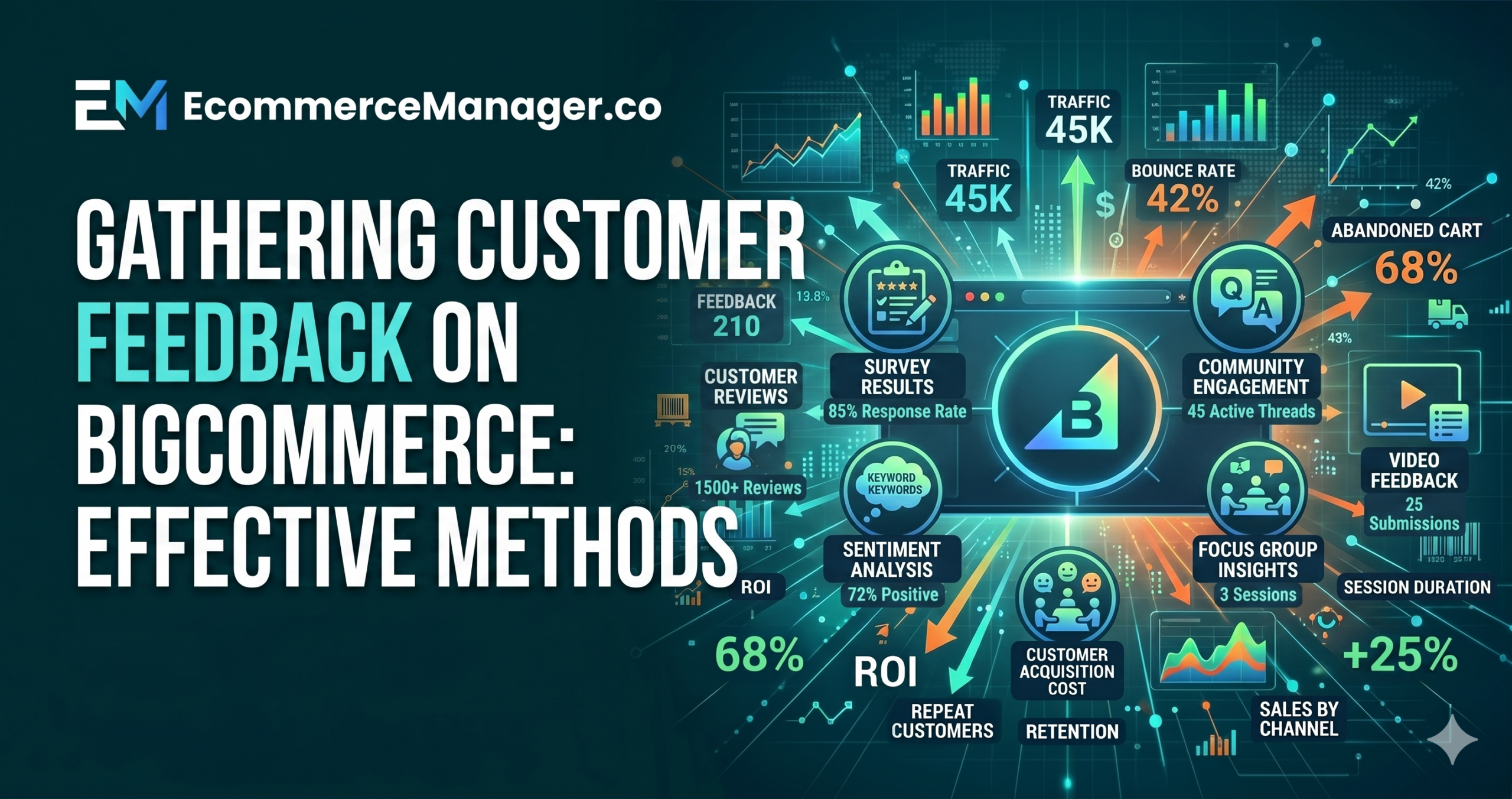
Customer feedback transforms BigCommerce stores from guesswork into data-driven operations. This guide compiles practical methods tested by ecommerce experts who have used direct customer input to improve everything from product specs to checkout flows. Each technique focuses on collecting actionable insights that lead to measurable improvements in conversion rates and customer satisfaction.
- Ask Two Questions to Clarify Choices
- Log Consult Calls to Shape New Products
- Leverage WhatsApp Surveys to Fix Logistics
- Apply Verified Evidence to Refine Pro Specs
- Harness Guarantee Claims to Elevate Livestock Quality
- Request Visual Testimonials and Showcase Social Proof
- Trigger Targeted Post-Arrival Size Checks
- Run Cause Polls to Direct Assortment Roadmap
- Revamp Ring Guide with Simple Form
- Parse Ratings to Expand and Boost Compatibility
- Mine Special Instructions to Upgrade Delivery Reliability
- Send Casual Follow-Ups to Restructure Navigation
- Pose One Honest Query at Checkout
- Capture Instant Feedback to Streamline Preview Tool
Ask Two Questions to Clarify Choices
One effective method we use is a post-purchase survey embedded in our BigCommerce order confirmation flow and follow-up email, with a mix of one quantitative question (what nearly stopped you from buying) and one open-ended prompt (what result are you hoping for, in your own words). We keep it short so completion stays high, and our team tags responses by theme (e.g., confusion about product differences, subscription hesitation, shipping expectations, or education gaps).
That feedback has directly shaped improvements: when we repeatedly saw customers say they weren’t sure which product was right for their situation, we clarified on-page decision support and tightened our FAQs and comparison language. Based on our internal testing, those changes reduced pre-purchase questions and improved conversion on key product pages, while also lowering return-related frustration because expectations were clearer upfront.

Log Consult Calls to Shape New Products
As owner-operator of EveryBody eBikes on BigCommerce, our customer-first model relies on tracking every interaction–from online inquiries to test rides–in a central system linked to store orders.
One effective method is logging detailed notes from phone consultations prompted by our site’s contact form, where “wobbly riders” share fears and goals.
Feedback from riders with dwarfism revealed standard bikes didn’t fit; we designed the Lightning eBike from scratch, now exported to the US and Canada, expanding our range and revenue.
This tracking also spotlighted demand for semi-recumbent trikes like the Trident, boosting repeat services and helping us serve thousands across Australia.

Leverage WhatsApp Surveys to Fix Logistics
My primary source of feedback on our BigCommerce-based e-commerce business comes from automated post-purchase surveys via WhatsApp (we have a 90% mobile penetration rate according to the 2025 INEI statistics).
I send out a short three-question link via message to customers 7 days after their delivery to Lima. I’ll ask them to rate their delivery experience, whether or not their product was as described, and if they would recommend us, for zero cost with Twilio API.
I did this first with the first hundred order shipments and received a 42% response rate as compared to a 12% response rate for email. This survey also revealed that there were problems in shipping to the Andes, which I was able to resolve by setting up regional distribution hubs, which increased my repeat customer rate by 28% and sales by $15,000 per month.
Prior to this experiment, I was missing significant numbers of leads because I was emailing them and not receiving a response. However, after working with WhatsApp, my NPS score increased by 35%, so I encourage you to try it in order to receive real-time feedback!

Apply Verified Evidence to Refine Pro Specs
I’ve scaled Stout Tent from a $6,000 investment into a multi-million dollar global brand by obsessing over the technical performance of canvas in rugged environments.
We use the CusRev independent review service on our BigCommerce store to capture verified-owner feedback, which helps us identify “manufacturing weaknesses” like specific seam-stretch or threading issues.
This feedback directly led to the development of our “Glamping Business Blueprint” course and technical maintenance guides to address common customer hurdles regarding ROI and tent longevity.
By analyzing these trends in variance, we’ve refined our Pro-edition manufacturing specs and now provide the same professional-grade patch kits to retail customers that we use for our large-scale wholesale deployments.

Harness Guarantee Claims to Elevate Livestock Quality
As the owner of SaltwaterFish.com, I’ve scaled our business into the second-largest online marine life retailer by treating livestock survival data as our most vital feedback loop. We focus on “Quality Scores” to maintain industry-leading health standards across thousands of monthly shipments.
We use a specialized Guarantee Request Form integrated into our customer account portal that requires specific photo documentation for all 8-day guarantee claims. This granular feedback provides visual proof of how species are responding to our shipping protocols, moving beyond basic reviews to hard biological data.
By mapping this feedback, we improved our livestock quality scores by more than 20% and identified a need for a value-driven segment, leading to the launch of Reefs4Less.com. This data-driven approach allowed us to optimize our supply chain and maximize EBITDA while maintaining our commitment to sustainable sourcing.

Request Visual Testimonials and Showcase Social Proof
With 18+ years optimizing e-commerce like BBQGuys and now leading SiteTuners’ teams for BigCommerce clients, one effective method is post-purchase emails requesting reviews with photos/videos.
We personalize by name, optimize for mobile with a single “Write Review” button, and incentivize with 5% off next purchase—PowerReviews data shows 80% of reviews come this way. Feedback exposed “trust blindness” from hidden reviews, so we made them prominent on product pages with visual content; products gained 69% conversion lift per ProductReviews stats. This directly improved our clients’ trust signals, mirroring Overland’s 14% revenue gain by better answering visitor questions via optimized social proof.

Trigger Targeted Post-Arrival Size Checks
I always first analyze the “silent friction” in post-purchase feedback and never overhaul a site’s conversion funnel. It’s quite a known fact that most marketers consider feedback as a generic survey, but I consider it a reactive CRO roadmap to identify exactly where the UX fails the customer’s intent.
By reflecting the unique language of the customer, data-centric CTOs, or some confused founder, you can bridge the gap between what you think you’re selling and what they are actually shopping for. This showcases where users are struggling—the onboarding flow or a specific feature lag. Let’s take an example from ecommerce:
Once, on BigCommerce, I’ve moved forward with automated triggers using Okendo to ask “Did the size match your expectations?” seven days post-delivery. If that answer is too short, we instantly update the product page using a size-up disclaimer.
By shifting from generic “How did we do?” emails to specific, one-click NPS queries, our response rate increased from 4% to 26%. This granular data allowed us to decrease rates by 22% and enhance AOV by 15% in the last quarter simply by fixing the sizing charts that customers highlighted.

Run Cause Polls to Direct Assortment Roadmap
As the owner of One Love Apparel and a growth strategist with two decades of experience, I’ve found that the most actionable feedback comes from “Mission-Alignment Polls” integrated directly into our storefront. Instead of standard service surveys, we ask our community which specific causes—like mental health advocacy or veterans’ support—they want our rotating donations to fund next.
This feedback helped us realize that our audience was deeply invested in “Self-Care” as a lifestyle, not just a buzzword. In response, we pivoted our product development to launch a dedicated collection of extra-soft, heavyweight tees designed specifically for comfort and “grounding” during high-stress days.
By aligning our inventory with these specific customer values, we saw a significant lift in repeat purchase rates and organic social shares. This method transforms the feedback loop from a transaction check-up into a relationship-building tool that ensures our brand evolves alongside the community’s priorities.

Revamp Ring Guide with Simple Form
We added a feedback form at Wedding Rings UK and learned so much. One customer said our ring sizing guide was confusing, so we completely rewrote it with photos of rings on actual hands. That one change cut down our sizing problems and customers were definitely happier. My advice is to keep the form simple though. People won’t respond if you ask for too much.

Parse Ratings to Expand and Boost Compatibility
With over 20 years in motocross graphics and running Rival Ink’s BigCommerce store, our top method for customer feedback is the integrated review system on product and main review pages.
92% of reviews are 5-stars, highlighting perfect fit (“fit like it came from the factory”), unmatched quality, and easy installs—driving repeat buys like one rider’s third kit.
This data helped us refine designs, partner with Thrill Seekers for seat covers matching our kits, and expand into e-bikes plus adventure bikes based on rider requests via our feedback form.
One color mismatch review prompted tighter proofing emails, boosting satisfaction and turning skeptics into loyal fans.

Mine Special Instructions to Upgrade Delivery Reliability
I run Flowers N Baskets in Palm Harbor and lead our wedding/event design, so I obsess over the “special instructions” field at checkout (gate codes, delivery windows, “don’t leave outside,” venue contact, etc.). That free-text box is where customers tell the truth–what they were worried about and what would make delivery feel safe and personal.
We started tagging those notes weekly (weather/heat concern, gated community access, hospital/venue rules, timing requests). When “please don’t leave outside” kept showing up, we changed our delivery workflow: we proactively call/text on arrivals that look risky, and we tightened our internal rule to avoid drop-offs in bad Florida heat unless we confirm handoff.
It also pushed a simple but measurable policy change: we set a clear same-day cutoff (1:00 PM ET, and Saturday 2:00 PM for Sunday deliveries) because timing confusion was a repeat theme in notes. That reduced last-minute back-and-forth and improved on-time handoffs, which matters when arrangements are custom-designed and freshness is the product.

Send Casual Follow-Ups to Restructure Navigation
At Japantastic, I just send customers a quick email after their Japanese products arrive. People mentioned our bento box section was confusing, so we reorganized it and added filters based on what they said. Now we get way fewer support questions about those items. I’ve found that keeping my follow-up emails casual makes people more willing to give honest feedback.

Pose One Honest Query at Checkout
35+ years in digital marketing and hundreds of client storefronts later, the most underrated feedback method I’ve seen work consistently is adding 1–2 strategic fields directly into your checkout or contact form. Not a follow-up email, not a pop-up—right there, in the moment.
We tested this on our own site at ForeFront Web by adding a “Budget Range” field to our inquiry form. It felt risky, but quality submissions went up because people who filled it out were already self-qualifying. The noise dropped, the signal got louder.
The real business improvement came from reading patterns in those responses over 90 days. We noticed a cluster of users describing the same confusion about service scope—so we built out a “Markets We Serve” page that addressed it head-on. That one page change reduced pre-sale back-and-forth significantly.
The lesson: your form fields aren’t just data collection, they’re a diagnostic tool. One honest question placed at the right moment in the buying journey tells you more than a 10-question survey sent three days later ever will.

Capture Instant Feedback to Streamline Preview Tool
We stuck a feedback form on our order confirmation page. One person said our diploma preview tool was confusing, so we fixed it. Now customers say personalizing their documents is easy. Getting feedback right when something happens gives us honest, useful details. It’s become our favorite way to figure out what needs to improve.

Related Articles
- 18 Customer Retention Strategies for BigCommerce and the Results They Produced
- Essential BigCommerce Features for Business Success: Insights from the Pros
- BigCommerce Product Page Optimization: Top Tips & Results