Consumer-to-Business (C2B) in 2026: The DTC Operator's Field Guide
C2B flips the arrow: your customers create the content, drive the sales, set the price, and even supply the inventory. Here's the data on creators, UGC, affiliates, and recommerce — and what a sharp operator does with it in 2026.
Updated June 11, 2026
Read14 min
Sources14 cited
Stats30+ data points
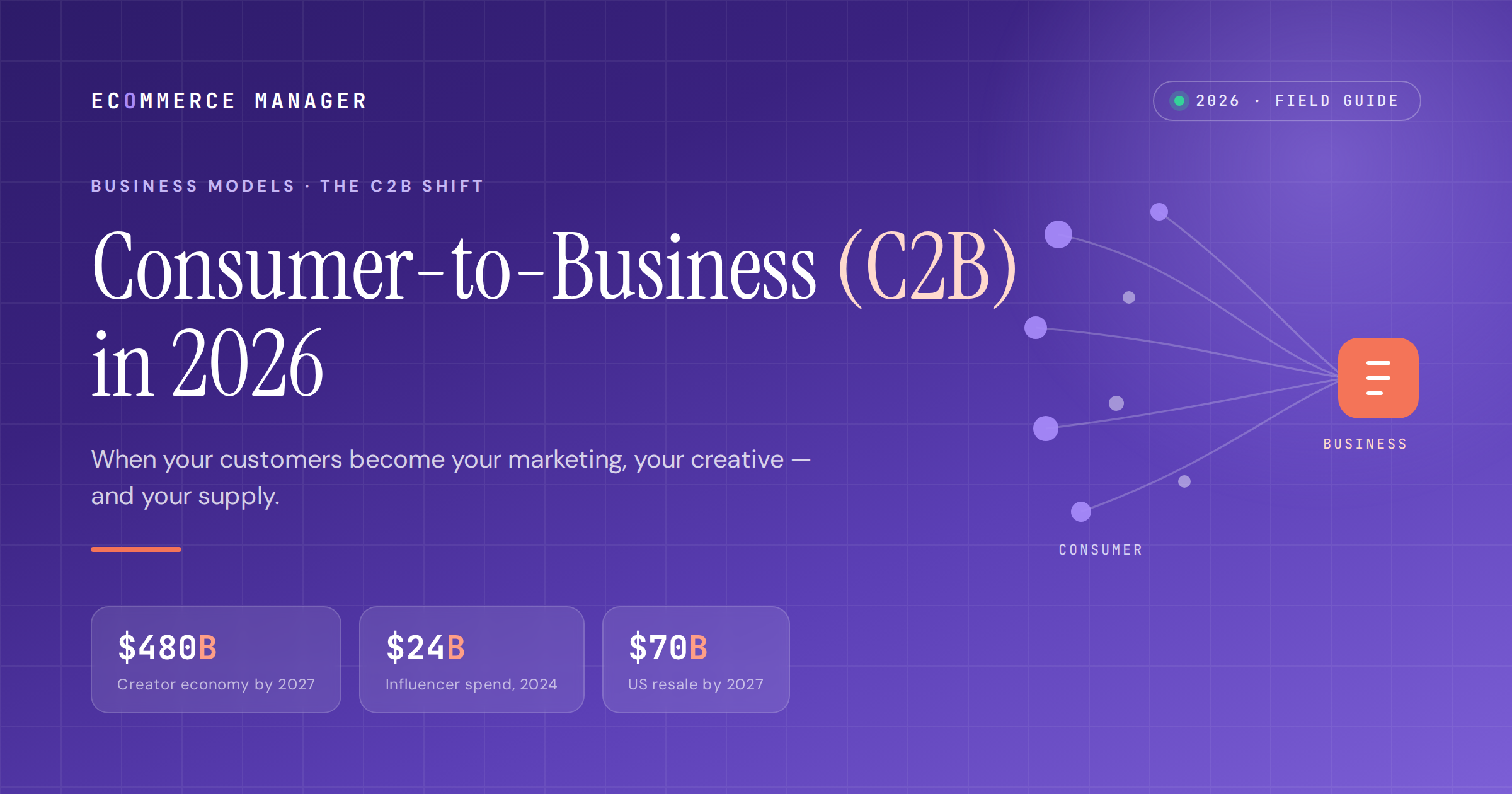
$480B
Projected creator-economy size by 2027 (Goldman Sachs)
$24B
Global influencer-marketing spend, 2024 (Influencer Marketing Hub)
$70B
Projected US resale market by 2027 (ThredUp / GlobalData)
Consumer-to-Business (C2B) inverts the usual arrow. Instead of a business selling to a consumer (B2C), the consumer creates the value — content, audience, referrals, even physical inventory — and the business pays for it. In 2026 that's not a fringe model. It's woven through every DTC growth stack: the UGC in your paid social, the creators in your affiliate program, the reviews on your product pages, the trade-in credit in your retention flow.
The money is real. The creator economy alone is heading toward $480B by 2027 (Goldman Sachs), influencer spend cleared roughly $24B in 2024 (Influencer Marketing Hub), and consumers now supply inventory through a US resale market projected near $70B by 2027 (ThredUp). None of that shows up on a line item called "C2B" — which is exactly why it's undermanaged.
This guide breaks C2B into its five working flavors, the data behind each, and a short playbook for what a sharp operator does with it before year-end.
DEFINITION
What C2B actually means in 2026
You already run C2B; you probably just don't call it that. It shows up in five distinct flavors, and most DTC brands are active in at least two.
→
User-generated content (UGC). Customers create photos, video, and reviews that you repurpose as conversion assets and paid ad creative.
→
Creators & influencers. Individuals build an audience and sell access, content, and endorsement to brands — the largest C2B channel by spend.
→
Affiliates & referrals. Consumers and publishers drive tracked sales in exchange for commission, billed on performance.
→
Consumer-set pricing. "Name your price" and make-an-offer mechanics where the shopper proposes terms and the business decides.
→
Consumer-as-supplier. Trade-in and resale programs where customers sell used product back, feeding recommerce inventory.
MARKET SIZE
The money: how big C2B really is
Pull the threads together and C2B is a multi-hundred-billion-dollar layer sitting underneath modern DTC. Here's where the dollars actually are.
01
Goldman Sachs pegs the creator economy near $250B in 2023 and projects it to roughly double to $480B by 2027. That's the engine behind most modern C2B — people building audiences brands then pay to reach.
02
Global influencer-marketing spend hit roughly $24B in 2024, up from about $21B the year prior, per Influencer Marketing Hub's annual benchmark report.
03
Brands earn an estimated $5–$6.50 in media value for every $1 spent on influencer marketing (Influencer Marketing Hub) — a return profile that has pulled budget away from pure paid social. Worth pressure-testing against your own LTV:CAC.
04
US affiliate-marketing spend has pushed past $8B and keeps compounding at double digits annually (Statista) — making affiliates one of the oldest and most durable C2B channels.
05
The US secondhand market is projected to reach about $70B by 2027, growing several times faster than overall retail (ThredUp / GlobalData) — proof that consumers are now suppliers, not just buyers.
USER-GENERATED CONTENT
Your customers are your creative team now
The cheapest, highest-trust content in your funnel isn't made by your agency. It's made by people who already bought from you.
01
Around 80% of shoppers say user-generated content significantly influences what they buy (Nosto/Stackla consumer surveys). Peer content outranks brand copy at the moment of decision.
02
Consumers rate UGC as far more authentic than brand-produced content — some studies put it at roughly 2.4x more authentic (Stackla). Authenticity is the currency C2B runs on.
03
UGC-style creative routinely beats polished brand ads on click-through and cost-per-acquisition in paid social, which is why DTC teams now brief creators for ad units, not just organic posts.
04
Customer photos and reviews on product pages lift conversion for most catalogs (Bazaarvoice network data). Reviews are the lowest-effort form of C2B every store already runs — and the easiest conversion metric to move this quarter.
Need creative that converts, not just looks good?
UGC, lifecycle, and CRO partners who treat customer content as a performance channel are vetted in the ECM directory.
The center of gravity is shifting from a few mega-deals to many small, always-on partnerships — and from flat fees to performance.
01
An estimated 50 million-plus people worldwide now identify as creators, with a few hundred thousand earning at a professional level (SignalFire / Linktree estimates).
02
Micro- and nano-influencers (under ~100K followers) consistently post higher engagement rates than mega-creators, at a fraction of the cost — the reason 2026 budgets favor partnership volume over single big-name deals.
03
Whitelisting and creator-licensed ads let brands run paid traffic through a creator's own handle, blending C2B authenticity with paid reach. Expect this to be table stakes for DTC social on Shopify and beyond.
04
Creator-led affiliate and commission deals are replacing flat sponsorship fees, tying spend to performance and quietly merging the creator and affiliate channels into one.
AFFILIATE
Affiliate and performance partnerships
If you need to prove C2B ROI to a skeptical CFO, start here. Affiliate is the most measurable flavor — billed on attributed sales.
01
Affiliate marketing drives an estimated 15–20% of digital orders for many retailers in mature markets (Awin / industry network data) — a channel running almost entirely on consumer and publisher referrals.
02
Affiliate is billed on last-click or attributed sales, which makes it the easiest place to start when you're building a measurement case for C2B.
03
Content and creator affiliates behave very differently from coupon affiliates — the former tend to drive incremental new customers, while coupon sites often capture demand you already had. Knowing the difference protects your margin.
Can you prove the incremental value of each channel?
Before you scale C2B spend, get the unit economics right. The ECM KPI Library has the formulas operators actually use.
Consumer-as-supplier: resale, trade-in, and reverse pricing
The fastest-growing edge of C2B isn't content — it's inventory. Customers are becoming a sourcing channel and a retention loop at the same time.
01
The global secondhand apparel market is on track for roughly $350B by 2028 (ThredUp / GlobalData), with the US slice near $70B by 2027 — consumers supplying inventory at scale.
02
Brand-operated resale and trade-in programs are expanding fast — Patagonia's Worn Wear and a wave of apparel and electronics trade-in schemes turn customers into both a supply source and a reason to come back.
03
"Make an offer" and reverse-auction mechanics, where the shopper names a price and the business decides whether to accept, remain a niche but durable C2B pattern — most visible in marketplaces and clearance.
04
Recommerce doubles as a retention play: trade-in credit pulls customers back, and resale extends product lifetime value well past the first sale.
PLAYBOOK
The 2026 C2B operator playbook
Six moves, roughly in order of effort-to-payoff. Most teams can start the first two this month.
→
Start with reviews and UGC rights. The cheapest win is collecting customer photos and video and securing usage rights to run them as ad creative.
→
Build a creator roster, not a campaign. Recruit 10–30 micro-creators on commission instead of one big sponsorship, and treat it as an always-on channel.
→
Move sponsorships to performance. Shift flat fees toward affiliate and commission structures so spend tracks revenue, not impressions.
→
Measure incrementality, not last click. Separate content and creator affiliates (new demand) from coupon affiliates (existing demand) before you scale a dollar. Your attribution model matters here.
→
Pilot a trade-in or resale loop if you sell durable goods. It's a sourcing channel and a retention hook in one — and a differentiator on your platform roadmap.
→
Pick partners who specialize. UGC, creator, and affiliate management are distinct skill sets — vet them in the directory rather than stretching your in-house team.
Key Takeaways
What a smart operator does with this
C2B isn't one tactic — it's five overlapping ones (UGC, creators, affiliates, consumer-set pricing, and consumer-as-supplier), and most DTC brands already run at least two without naming it.
The dollars are concentrated in the creator, influencer, and affiliate cluster, but the fastest-growing edge is recommerce, where customers become suppliers and trade-in becomes retention.
The winning move in 2026 is consolidation and measurement: turn ad-hoc creator deals and UGC into always-on, performance-based channels, and measure incrementality instead of last click. Start with the cheapest win — reviews and UGC rights — then build out from there.
FAQ
Frequently asked questions
What is Consumer-to-Business (C2B)?
C2B is a model where individuals create value that businesses pay for: content, audience reach, referrals, feedback, or even physical inventory. Influencer marketing, user-generated content, affiliate marketing, reverse auctions, and consumer resale supply are all forms of C2B.
How is C2B different from B2C?
B2C flows from business to consumer — a store sells you a product. C2B reverses the arrow: the consumer supplies something of value, such as a post, a tracked sale, a price offer, or a used product, and the business pays or compensates them for it.
Is influencer marketing a form of C2B?
Yes. Creators are consumers who build an audience and sell access, content, and endorsement to brands. It is the largest and most visible C2B channel, with global influencer spend around $24B in 2024 according to Influencer Marketing Hub.
What are examples of C2B in ecommerce?
Customer reviews and photos on product pages, UGC repurposed as paid ad creative, affiliate and creator commission programs, name-your-price or make-an-offer pricing, and trade-in or resale programs that buy used product back from customers.
Why does C2B matter for DTC brands in 2026?
Because customer-created content and referrals now outperform a lot of brand-produced marketing on trust and cost, and because recommerce turns customers into a low-cost supply and retention channel. A growing share of efficient DTC growth is hiding inside C2B.
NEW ISSUE EVERY TUESDAY
The playbook top eComm operators actually read
One weekly brief. Five stories that matter. Zero fluff. Written for managers at $5M–$50M DTC brands who want to sound sharper than everyone else in the meeting.
Unsubscribe anytime. No spam. 12,000+ operators already subscribed.
Join 12,000+ ecommerce managers reading the ECM newsletter every Tuesday — or browse the directory to find vetted UGC, creator, affiliate, and retention partners.