

Last Updated on September 15, 2026
Ecommerce Agency Pricing in 2026: The Operator's Guide
Real retainer benchmarks by service, the percentage-of-spend slide, the hidden line items that inflate invoices, and the agency-side economics most operators never see. Written for the person approving the budget.
On this page
Two agencies quote the same number for completely different products
Ecommerce agency pricing varies 5–10x for what looks like the same work: a boutique quotes $1,500/month for SEO while an enterprise firm quotes $15,000 for similar scope. The spread rarely reflects quality. It reflects overhead, geography, client-size expectations, and most of all seniority. Hourly value runs from roughly $80 for junior freelance work to ten times that for a senior strategist, so two agencies quoting the same monthly fee can represent completely different resource allocations. That single fact explains most pricing confusion, and it's the lens for everything below.
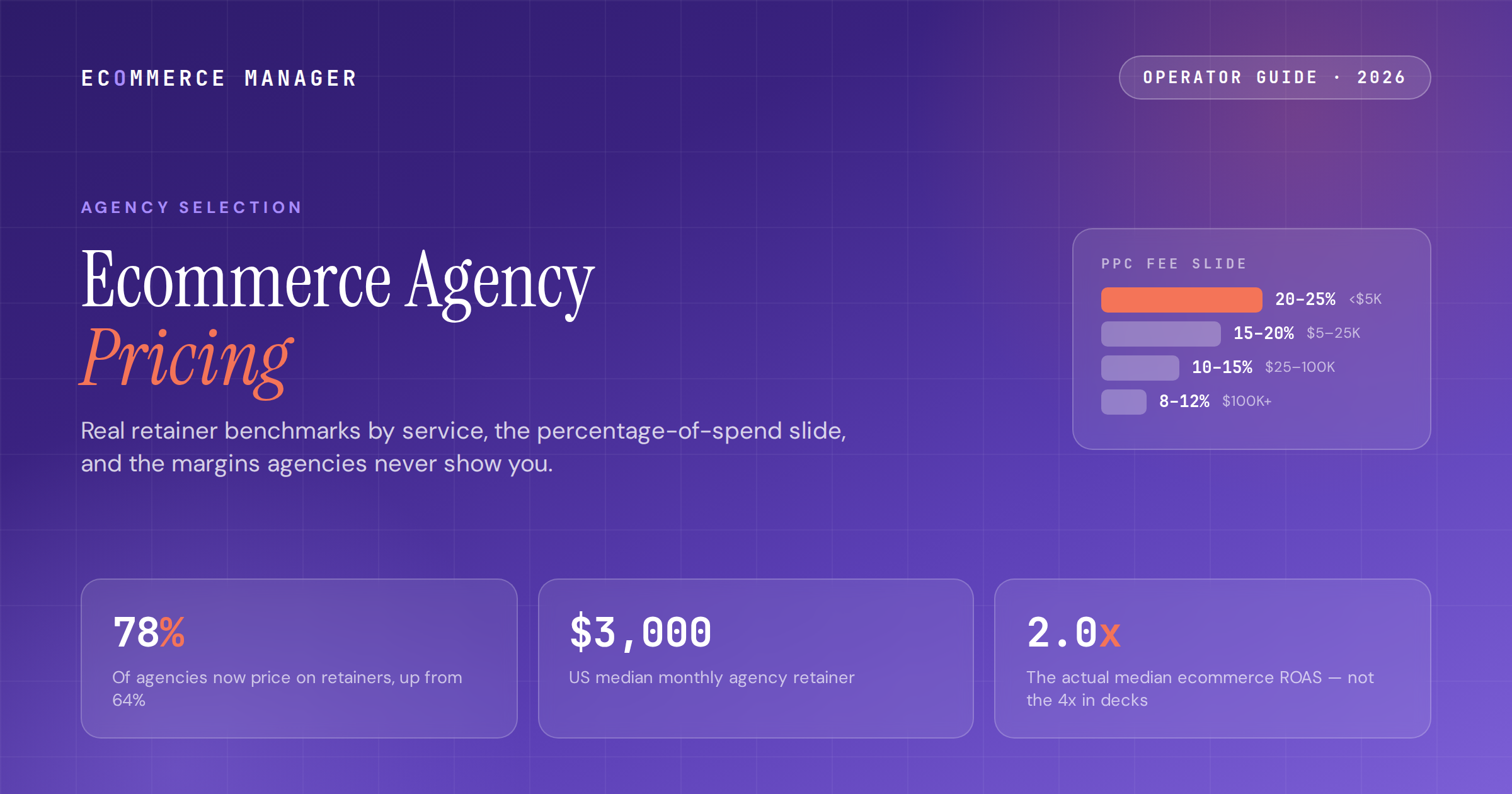
The structural shift worth knowing first: 78% of digital agencies now use retainer-based pricing as their primary model, up from 64% in 2023. The project quote is becoming the exception, and the retainer changes what you're evaluating: not a deliverable but a monthly resource allocation you'll renew or cancel based on results.
This guide gives you the 2026 benchmarks by service and by pricing model, the sliding scales that govern percentage-of-spend fees, the hidden line items that quietly inflate invoices by 20–50%, and something most pricing guides skip entirely: the agency's own margin economics, because knowing which services they profit on is genuine negotiating power.
The five pricing models, and what each one optimizes for
Every quote you receive is one of five structures. Each one shifts risk between you and the agency in a different direction, and picking the structure matters as much as negotiating the number.
-
01Monthly retainers — now the default at 78% of agencies. The US median sits around $3,000/month across all agency types; ecommerce specialists run meaningfully higher. Retainers buy consistency and priority access, and the agency's own data explains their enthusiasm: retainer agencies churn at roughly 18% a year versus 42% for project-based shops. Their retention strategy is your pricing model.
-
02Percentage of ad spend — the PPC standard, on a slide. The prevailing band is 10–20% of managed spend, and it slides with volume: 20–25% under $5K/month, 15–20% at $5K–$25K, 10–15% at $25K–$100K, and 8–12% above $100K. Setup and onboarding typically add $1,000–$5,000 once. If your spend has grown and your percentage hasn't moved, that's a renegotiation you're owed.
-
03Flat project fees — right for defined, bounded work. SEO audits run $1,000–$5,000; replatforms and redesigns spike to $50K–$250K+ at mid-market scale. The risk sits with whoever scoped it worse, which is why vague project scope is the classic path to a $40K quote invoicing $70K.
-
04Hourly — transparent and increasingly rare as a primary model. SEO specialists run $100–$150/hour; a 2025 Promethean Research survey found 32% of agencies charging $200–$249/hour overall. Hourly works for advisory and overflow work; for ongoing programs it punishes efficiency, which is why agencies moved away from it.
-
05Performance and revenue share — 3–10% of attributed sales, sometimes layered on a reduced base. Attractive on paper, and the attribution question is where it breaks: whoever controls the attribution model controls the invoice. Only enter one with attribution rules you understand and audit rights you'd actually use.
-
06The model to refuse: anything anchored to a guaranteed ROAS. The median ecommerce ROAS is around 2.0x, not the 4x that decks promise — an agency competing on a ROAS guarantee is either selecting easy accounts or planning to redefine attribution. Benchmarks for your own funnel live in the ECM KPI library; hold every promise against them.
2026 benchmarks by service
The ranges below come from cross-referenced 2025–2026 pricing surveys (Clutch, UpCity, Whatagraph, Promethean, AgencyAnalytics and published agency rate cards). The meaningful range is narrower than the theoretical one — quotes far outside it need an explanation.
By single service
-
→SEO: $1,500–$10,000/month is where legitimate work happens. The theoretical range runs $500–$25,000+, but sub-$1,000 'quick fix' SEO reliably costs more later in cleanup. Most agencies cluster at $1,500–$7,500.
-
→PPC management: the percentage slide above, or flat fees of $500–$5,000+/month for budgets under $10K in spend. Above that, percentage models dominate; check which side of the crossover your spend sits on before accepting either structure.
-
→Email and retention: $500–$15,000/month. The widest legitimate range on the sheet, because scope runs from campaign sends to full lifecycle architecture with segmentation and flows. Price it against list size and revenue share of email, not against the hours.
-
→Content marketing: $3,000–$25,000+/month. Social: $1,000–$25,000. Both scale with production volume; both are where junior-heavy teams hide most easily. The seniority question matters more here than anywhere.
By engagement size
-
→Single-service ecommerce retainers: $5,000–$25,000/month. Full-stack (paid, creative, retention): $20,000–$75,000/month depending on ad spend volume and scope. Mid-market brands at $20M+ typically invest $10K–$50K+/month in multi-discipline retainers.
-
→The deliverables ladder is the pricing sanity check. At $10K–$15K+/month you should receive full-stack management across paid, email, and creative, CRO and landing page work, executive reporting and forecasting, and quarterly business reviews — an outsourced growth department. If your invoice is in that band and your deliverables aren't, you're overpaying at the current agency, not underpaying for a better one.
-
→Match the retainer against the in-house alternative at every tier. A $12K/month full-service retainer competes with a senior growth hire; what the agency adds is cross-brand pattern recognition no single hire has, and what it costs is depth on your brand specifically. Model both against your revenue in the ECM platform calculator before renewing.
Compare real agencies against these benchmarks.
The ECM directory lists ecommerce agencies with published minimum budgets, hourly-rate ranges, and verified client reviews scored on results, communication, and value — filterable by service, platform, and budget.
The agency's margins, and why they're your leverage
Most pricing guides stop at what you pay. Knowing what the agency keeps — and on which services — changes how you negotiate and what you should expect them to push.
-
01The margin ladder, from agency-side analysis: email/SMS retention runs 60–70% delivery margins, CRO about 62%, creative and UGC around 60%, paid media roughly 50%. Paid media is the service everyone leads with and the one that pays agencies worst, which explains both why it's competitively priced and why upsells always point toward retention and creative.
-
02Expect the retention upsell, and evaluate it on merits. The agency's margin interest and your interest genuinely align here more often than not — email is a channel you own, and cart abandonment averaging around 70% (Baymard) means retention and CRO work compounds everything paid media buys. High-margin for them can still be high-ROI for you; just price it against the benchmarks above, not the pitch.
-
03Creative is where 2026 performance actually lives. Analyses of Meta attribute 50–70% of campaign performance variance to creative rather than bid or audience changes. An agency proposing a creative/UGC retainer is reading the platform correctly; an agency selling pure 'media buying' at premium rates is selling a commodity.
-
04The churn numbers explain the contract terms. At 18% annual churn on retainers versus 42% on projects, agencies will trade meaningful concessions (rate locks, added scope, senior time) for longer commitments. If you're confident after a pilot quarter, an annual term is real negotiating currency; spend it deliberately.
-
05Use structured, comparable data when you shortlist. Verified client reviews that rate results, communication, and value separately do what a logo wall can't. The ECM agency directory structures reviews exactly this way, and the vetting framework in the ECM agency selection guide covers the discovery-call questions that pair with these numbers.
Reading a quote: seniority, scope, and the hidden lines
Two identical monthly fees can buy completely different teams. These are the checks that reveal which one you're being sold.
-
01Ask for the resource allocation, not the rate card: who works on the account weekly, at what seniority, for roughly how many hours. A $6K retainer staffed by a senior strategist at 15 hours is a different product from the same retainer staffed by two juniors at 40, and the fee tells you nothing about which you're getting.
-
02Inventory the hidden line items before signing. The recurring offenders: tool and software pass-throughs ($500–$2,000+/month for SEO, analytics, and design stacks), reporting dashboard fees ($200–$1,000+/month), revision limits with $150–$500 per extra round, rush fees adding 20–50%, and platform management fees of 5–20% of spend stacked on top of the stated retainer. Every one is negotiable before signature and awkward after.
-
03Demand outcome metrics in the scope, not activity metrics. Revenue, ROAS against the real 2.0x median, conversion rate, and LTV. Not campaigns launched, hours logged, or reports delivered. An agency that resists outcome-based reporting is telling you what its reporting would show.
-
04Take the pilot structure when stakes are high: a bounded 90-day engagement with defined success metrics before any annual term. It costs slightly more per month and buys you the only data that matters: how this team performs on your account. Baseline your numbers first so the 90-day review is arithmetic, not argument.
-
05Cheap is the most expensive option in two specific places. Sub-$1,000 SEO that requires cleanup, and bottom-rate development on anything touching a replatform (scoped properly in the ECM migration checklist) — where the failure mode is lost organic traffic on the scale documented in the ECM replatforming SEO guide. In both cases the second engagement pays for the first one's savings, with interest.
Want the shortlist matched to your budget?
Answer five questions about your platform, services needed, and monthly budget range, and the Find My Agency matcher returns agencies that actually fit — with match scores.
Matching the model to your revenue stage
The right pricing structure changes as you scale. The map, by stage.
-
01Under $1M revenue: project fees and hourly specialists, not retainers. Bounded work — an audit, a build, a channel setup — from freelancers and small shops. A $3K+/month retainer at this stage consumes margin the channels haven't earned yet; buy defined outcomes instead.
-
02$1M–$10M: the single-service retainer stage. One or two specialist retainers ($5K–$25K combined) on the channels that drive your model — SEO and CRO specialists being the two most common pairings, with PPC on the percentage slide and a hard look at where your spend sits on it. This is also where the pilot-quarter structure earns its premium — you're choosing a partner for the growth phase, and the 90-day data beats any pitch.
-
03$10M+: full-stack retainers or in-house-plus-agency. The $20K–$75K full-stack band competes directly with building an internal team; the working split at scale is in-house for the daily channels, agency for architecture, creative production, and surge capacity. Revisit annually — the answer changes as headcount economics do.
-
04At every stage, the same closing discipline: outcome metrics in the contract, hidden lines surfaced, seniority allocation named, and the review calendar set before kickoff. ECM tracks how agency pricing and the service mix keep shifting in weekly Insights; the benchmarks in this guide have a shelf life, and the discipline doesn't.
What a smart operator does with this
Evaluate the structure before the number. Retainers are the market default at 78% of agencies and fit ongoing channel work; percentage-of-spend belongs on PPC with your fee checked against the volume slide; projects fit bounded scope; and anything anchored to a guaranteed ROAS gets declined on arrival, because the actual median is 2.0x. The model allocates risk before the first dollar moves.
Buy seniority, not fees. The 5–10x pricing spread is mostly a seniority spread, so the question that cuts through every quote is who works the account weekly and at what level. Pair it with the hidden-line inventory — tool pass-throughs, dashboard fees, revision limits, rush surcharges, stacked platform fees — and the outcome-metrics requirement, and most bad quotes disqualify themselves.
Negotiate with their economics in view. Agencies keep 60–70% on retention, ~62% on CRO, ~60% on creative, and ~50% on paid media — expect the upsells to follow the margins, evaluate them on your ROI anyway (they often clear), and trade the thing they value most — contract length — for the things you value: rate locks, senior time, and scope. Then hold the whole engagement to a 90-day review against your own baseline.
Frequently asked questions
How much does an ecommerce marketing agency cost in 2026?
Single-service ecommerce retainers run $5,000–$25,000 per month, and full-stack engagements covering paid media, creative, and retention run $20,000–$75,000 depending on ad spend and scope. Mid-market brands at $20M+ typically invest $10,000–$50,000+ monthly in multi-discipline retainers, with major projects like replatforms running $50,000–$250,000+. By individual service: SEO's legitimate range is $1,500–$10,000/month, email and retention $500–$15,000, content $3,000–$25,000+, and PPC management 10–20% of ad spend. The US median monthly retainer across all agency types sits around $3,000.
What percentage of ad spend do agencies charge for PPC management?
The industry standard is 10–20% of managed ad spend, sliding with volume: 20–25% under $5,000/month in spend, 15–20% at $5,000–$25,000, 10–15% at $25,000–$100,000, and 8–12% above $100,000. Setup and onboarding typically add a one-time $1,000–$5,000. Flat monthly fees of $500–$5,000+ are common alternatives for budgets under $10,000 in monthly spend. If your spend has grown substantially and your percentage hasn't moved down the slide, you are due a renegotiation. Watch for platform management fees of 5–20% stacked on top of a stated retainer.
Which agency pricing model is best: retainer, project, or performance?
Match the model to the work. Retainers — now the primary model at 78% of agencies — fit ongoing channel management and buy consistency and priority; note that retainer agencies churn at 18% annually versus 42% for project shops, so contract length is real negotiating currency. Project fees fit bounded, well-scoped work like audits ($1,000–$5,000) and builds. Performance and revenue-share models (3–10% of attributed sales) only work with attribution rules you understand and audit rights you'd use. Decline anything anchored to a guaranteed ROAS: the median ecommerce ROAS is roughly 2.0x, not the 4x in pitch decks.
What hidden costs do marketing agencies add to retainers?
The recurring line items that inflate invoices beyond the quoted retainer: tool and software pass-throughs of $500–$2,000+ per month for SEO, analytics, and design subscriptions; reporting dashboard fees of $200–$1,000+ monthly; revision limits with $150–$500 charged per additional round; rush fees adding 20–50% for faster turnaround; and platform management fees of 5–20% of ad spend stacked on top of the management retainer. Every one is negotiable before signing and awkward afterward — inventory them in the contract stage and specify revision limits and inclusions in writing.
How do I know if an agency quote is fair?
Three checks. First, hold it against the benchmarks: SEO $1,500–$10,000/month, PPC 10–20% of spend on the volume slide, single-service ecommerce retainers $5,000–$25,000, full-stack $20,000–$75,000 — quotes far outside these ranges need an explanation. Second, ask for the resource allocation: who works your account weekly and at what seniority, since the 5–10x pricing spread is mostly a seniority spread and two identical fees can buy completely different teams. Third, require outcome metrics (revenue, ROAS, conversion, LTV) in the scope rather than activity metrics, and structure a 90-day pilot with a measured baseline before any annual commitment.
The playbook top eComm operators actually read
One weekly brief. Five stories that matter. Zero fluff. Written for managers at $5M–$50M DTC brands who want to sound sharper than everyone else in the meeting.
References
- 01 eCommerce Agency Cost (2026) — limelightmarketing.com
- 02 Marketing Agency Pricing Benchmarks 2026: Real Numbers — thezulumethod.com
- 03 Digital Marketing Pricing 2026: What Agencies Charge — digitalapplied.com
- 04 Ecommerce Marketing Cost 2026: Real Numbers by Channel — theinterconnections.com
- 05 Marketing Agency Cost 2026: Real Pricing by Service — darkroomagency.com
- 06 Ecommerce Marketing Agency: Pricing, ROAS & Margins (2026) — gigradar.io
- 07 How Much Do Marketing Agencies Charge in 2026? — ba3digitalmarketing.com
- 08 6 Proven Digital Marketing Agency Pricing Models in 2026 — taskip.net
- 09 Digital Marketing Agency Pricing Guide 2026 — influenceflow.io
- 10 Shopify Plus Development Cost: What You Should Actually Pay (2026 Guide) — shopexperts.com
- 11 Top 26 US Shopify Agencies Ranked by Tier for 2026 — sherocommerce.com
- 12 Shopify Plus Partners in 2026: Tiers, What They Do, and How to Choose — askphill.com
Make your agency decision data-backed
Join 12,000+ ecommerce managers reading the ECM newsletter every Wednesday — or browse the directory to find vetted Shopify, migration, and CRO specialists.