

Last Updated on June 20, 2026
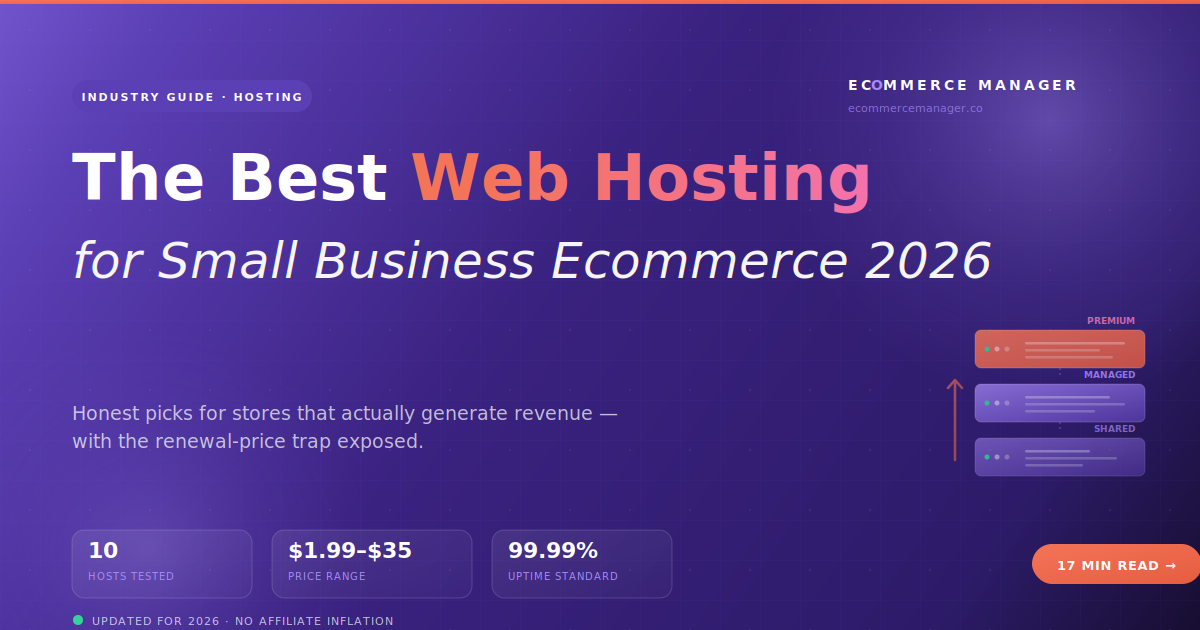
The Best Web Hosting for Small Business Ecommerce in 2026
An honest field guide to hosting that survives a real store — without the affiliate spam, the $1.99 trick pricing, or the “unlimited” claims that fall apart at 200 concurrent visitors.
Table of Contents
Overview
There are roughly 8,000 articles online claiming to rank “the best web hosting for small business.” Almost all of them are sorted by affiliate payout. The host that pays the highest commission wins, regardless of whether it’ll keep your store online during a Cyber Monday rush. This is not that article. The hosts below earned their spots because real ecommerce operators run real stores on them — and the stores don’t fall over.
Every second of page load delay on a product page drops conversion rates by 4–7%, depending on whose data you trust. Cheap shared hosting at $1.99/month sells you the page load time of a 2018 site. The same store on a properly resourced managed host loads in under a second. On a $200K/year store, that performance gap represents roughly $16,000 of revenue lost to save $30/month.
Why Hosting Matters More for Ecom Than Anything Else You’ll Host
A brochure website that goes down for an hour costs you nothing measurable. An ecommerce store that goes down for an hour during a campaign costs you exactly what you were on track to do that hour — and then some, because every visitor who hit your site and got an error becomes a customer with a bad first impression. Hosting is the most under-discussed line item in small-business ecommerce, and it’s the one that decides whether your other investments (paid ads, SEO, email) actually convert when they land.
The Renewal-Price Trap (Read This Before You Sign Anything)
Here’s the trick that almost every budget host uses, and almost no shopper sees coming. The $2.99/month price you see on the homepage is locked for the first billing cycle only — typically 12 months, sometimes 36 if you prepay. After that, the renewal price kicks in. And it’s not a 20% bump. It’s a 3–6x bump.
Hostinger’s $1.99/month plan renews at $11.99. Bluehost’s $2.95 plan renews at $11.99. SiteGround’s $3.99 plan renews at $17.99. These aren’t predatory exceptions — they’re the standard. The cheap intro pricing is the bait. The renewal is the actual price you’ll pay forever.
When evaluating any host, calculate the 3-year total cost at renewal pricing, not promo pricing. A “$2.99/month” host that renews at $14.99 actually costs $683 over three years. A “$25/month” managed host costs $900 over the same period — and you get vastly more reliability, better support, and a site that doesn’t collapse during a Black Friday sale.
The Hosting Ladder: Where You Actually Belong
Ecommerce hosting is a ladder, not a buffet. Where you should be depends entirely on what your store does — not what you wish it did.
Shared Hosting
Under $50K annual revenue. You’re testing a concept, launching, or running a side hustle. A reliable shared host (SiteGround, Hostinger, A2) is fine. You’ll outgrow it.
Managed WP / Cloud
$50K – $500K revenue. The site is now an income source. You need managed WooCommerce or managed cloud (Cloudways, Nexcess, Kinsta). Worth every dollar over shared.
Premium Managed
$500K – $5M revenue. Traffic spikes are predictable, downtime is unacceptable. WP Engine, premium Kinsta tiers, or dedicated cloud infrastructure.
The single biggest mistake small businesses make: staying on shared hosting two years longer than they should. The second biggest: jumping to enterprise managed hosting two years before they need it. The hosts below cover all three rungs — pick the one that matches the rung you’re on, not the rung you wish you were on.
Quick Comparison: 11 Hosts for Small Business Ecommerce
Side-by-side. Starting price is the promo rate — real cost in the renewal column is what you’ll actually pay long-term.
| Host | Tier | Best For | Promo Price | Renewal |
|---|---|---|---|---|
SG SiteGround |
Reliable shared | Revenue-generating sites | $3.99/mo | $17.99/mo |
HG Hostinger |
Budget shared | Startups, multi-site | $1.99/mo | $11.99/mo |
BH Bluehost |
WP-friendly shared | WordPress beginners | $2.95/mo | $11.99/mo |
CW Cloudways |
Managed cloud | Mid-stage growth ($100K+) | $11/mo | $11/mo (no hike) |
MZ Mad-ez Domains |
Full-service | All-in-one operators | $1.99/mo | Varies |
NX Nexcess |
Managed WooCommerce | WooCommerce specialists | $15.83/mo | $31.66/mo |
KN Kinsta |
Premium managed WP | Serious revenue sites | $35/mo | $35/mo (no hike) |
WE WP Engine |
Premium managed WP | Agency-managed stores | $25/mo | $25/mo (no hike) |
A2 A2 Hosting |
Performance shared | Speed-focused budgets | $2.99/mo | $12.99/mo |
HT HostGator |
Budget shared | Brochure + light store | $2.75/mo | $10.95/mo |
DH DreamHost |
Independent shared | No-upsell value | $2.59/mo | $8.99/mo |
Which platform fits your store?
Compare Shopify, WooCommerce, BigCommerce, and more with our interactive platform calculator.
SiteGround
If your store directly generates revenue and unreliable hosting would count as a real business risk, SiteGround is the answer. Their Google Cloud infrastructure, dynamic caching, and genuinely responsive support team mean fewer 3am emergencies about the site being down. The trade-off is the renewal price — $17.99/month after the first year is on the high end of “shared” hosting, but you're effectively paying for the operational reliability of a managed host wrapped in a shared-host package. For an ecommerce store doing real numbers, that math works.
Hostinger
Hostinger built its business on the bet that low prices and real performance don't have to be mutually exclusive. They mostly pulled it off. The infrastructure is LiteSpeed-based — the same enterprise web server used by SiteGround and Kinsta — so the speed is genuinely good. The Premium plan hosts up to 100 websites at $2.99/month, which is unmatched at that price point. If you're an agency or you own a portfolio of small brands, the math is hard to argue with. The catch: support is hit-or-miss, and the renewal pricing still bites at $11.99/month. For early-stage stores, “good enough hosting at one-third the price” is a defensible choice.
Bluehost
Bluehost is the host WordPress.org officially recommends, which sounds like a big deal until you realize that recommendation is largely commercial and has been in place for over a decade. That said, Bluehost is still a perfectly reasonable starting point for a WordPress store. The setup is genuinely beginner-proof — one-click WordPress and WooCommerce installation, phone support that actually picks up, and an admin dashboard that doesn't require Googling every other button. The downsides: performance lags behind SiteGround at the same price point, and the support quality has slipped in the last two years. If you're new to WordPress and just need something that works, it works. If you've outgrown beginner tools, look elsewhere.
Cloudways
Cloudways is what every store should graduate to when shared hosting starts buckling. It's a management layer that sits on top of five enterprise cloud providers — DigitalOcean, Vultr, Linode/Akamai, AWS, and Google Cloud — so you pick your underlying infrastructure and Cloudways handles the server admin. Entry pricing is $11/month on DigitalOcean, and unlike shared hosts, there's no renewal markup. The pay-as-you-go model means a $14/month server can host multiple sites with sub-150ms response times. The catch: it's less hand-holding than Kinsta or WP Engine. If your eyes glaze at the words “server choice” and “block storage,” Cloudways will feel like overkill. If you're comfortable with infrastructure decisions, the cost savings versus premium managed hosts are real.
Mad-ez Domains
Mad-ez Domains positions itself as a full-service digital provider — domain registration, cPanel and Plesk hosting, VPS, dedicated servers, and an integrated online store builder under one roof. The product range spans from shared hosting to fully managed VPS, so there's room to scale without switching providers. They also bundle an online marketing toolkit that covers website building, SEO, and email — useful for small business operators who'd rather consolidate vendors than juggle five dashboards. The Phoenix-based company backs everything with 24/7 support and a website builder for quick launches. The trade-off: less name recognition than SiteGround or Kinsta, and the hosting runs on a reseller infrastructure, so peak-load performance under heavy ecommerce traffic is worth testing against your specific requirements before committing.
Nexcess (Liquid Web)
Nexcess (owned by Liquid Web) is one of the few hosts that actually treats WooCommerce as a first-class platform rather than a “we also support that” footnote. Their Managed WooCommerce plans come pre-configured with WooCommerce, premium plugins worth $1,500+, object caching, image optimization, and a development-to-production workflow that's miles ahead of generic managed hosts. The “Sales Performance Monitor” flags performance issues that correlate with conversion drops, not just generic uptime alerts. The downside: the entry price is $15.83/month promo, $31.66 renewal, so it's not a budget play. For a serious WooCommerce store, that's a fair number.
Kinsta
Kinsta is what you graduate to when you stop caring about saving $20/month and start caring about whether the host's dashboard makes you want to throw your laptop. It runs on Google Cloud Platform's premium-tier network with Cloudflare Enterprise included, which would cost hundreds extra at most other providers. Support is famously good — Kinsta's team knows WordPress debugging at a depth that Cloudways' infrastructure-focused team can't match. The pricing is the conversation: $35/month for the entry plan, which limits you by site count and visits. WooCommerce stores benefit from Kinsta's fully managed approach because the hosting layer rarely interferes with the application layer. If your store is your business, Kinsta is the answer.
WP Engine
WP Engine starts at $25/month and is built around an agency workflow — phone support, Git push-to-deploy, white-label client portals, and a developer experience that's miles ahead of beginner-focused hosts. For a small business that's working with an agency or has a developer in-house, WP Engine often makes more sense than Kinsta because of the tooling. For a non-technical founder running their own store, Kinsta's dashboard is friendlier. The performance is competitive with Kinsta's, but the choice between them often comes down to who else is touching your site. If it's just you, Kinsta. If it's you plus a dev or agency, WP Engine.
A2 Hosting
A2 Hosting's pitch is “shared hosting but actually fast,” and the Turbo plans deliver. The infrastructure uses LiteSpeed servers, NVMe storage, and a custom caching layer that gets shared hosting closer to managed-host territory than competitors at the same price. The downside: support quality is inconsistent and the dashboard feels dated. If you're price-sensitive but performance-obsessed, A2 is worth a look — though it's been overshadowed by Hostinger in the last two years on the budget end. Best fit for slightly more technical founders who'll trade UX for speed.
HostGator
HostGator is the host you grew up with if you launched a website before 2018. It's still functional, still affordable, still bundled with the same EIG corporate parent as Bluehost. Performance is unremarkable but not bad, support is reasonable but slow, and the renewal pricing at $10.95/month is one of the gentler markups on this list. Where HostGator works: small brand sites with a light store attached, where you're processing a couple dozen orders a month and don't need WooCommerce's full firepower. Where it doesn't work: anywhere your traffic spikes meaningfully.
DreamHost
DreamHost has been independently owned since 1997, which makes it one of the few major hosts not owned by a conglomerate. That independence shows up in the sales experience — fewer upsells, gentler renewal pricing ($8.99/month after promo is among the friendliest on this list), and a generally less aggressive feel. The performance is mid-tier, the dashboard is reasonable, and they're officially WordPress.org recommended along with Bluehost. The trade-off: support quality is solid but not standout, and they don't have the cult following of SiteGround or the value reputation of Hostinger. DreamHost is the host you pick when you've been burned by an aggressive renewal hike and want someone less adversarial.
RSH Web Services — Hosting, Domains & Design Since 1997
RSH Web Services has been a fixture in web hosting since 1997, offering a full suite of services that spans cPanel hosting, WordPress hosting, domain registration, SSL certificates, website design, and SEO marketing. Their hosting starts at $2.99/month and comes with a 45-day money-back guarantee, free domain names with hosting accounts, and an AI website builder through cPanel integration.
What separates RSH Web from the bigger players is the breadth of hands-on services: they’ll design your site, handle WordPress setup, run an 18-point SEO tune-up, and manage ongoing maintenance — all from the same team. For small business operators who want a single partner handling everything from domain to deployment, that consolidation is worth considering.
Web Hosting Domains & Designing ServicesA Word on Shopify (The “No Hosting Needed” Option)
Every list like this should mention Shopify, because for a meaningful slice of small business ecommerce, the right answer is to skip the hosting question entirely. Shopify includes hosting in the platform fee — no separate server, no renewal markup, no debate about LiteSpeed vs Apache. You pay $39/month for Basic, $105/month for Shopify Plan, $399/month for Advanced, and Shopify handles every infrastructure problem for you.
When does that math win versus self-hosting WooCommerce? When you’d rather pay a flat monthly fee and never think about it. When your store is your business and you don’t want to be on the hook for security patches. When you’re not technical and you’d rather spend your time on marketing than on hosting decisions.
When does WooCommerce on managed hosting win? When you need design flexibility Shopify can’t deliver. When you have product types or pricing models Shopify doesn’t natively support. When you want to own your tech stack and not pay platform fees on every transaction.
The Hosting Choice Is Reversible — Until It Isn’t
Migrating between hosts is annoying but doable in the first six months. By month 18, you’ve added integrations, custom code, image libraries, and SEO equity that all has to come with you. Pick something you can grow into for 2–3 years. Cheap shared hosting that you’ll outgrow in 12 months ends up costing you twice — once in the migration time and once in lost SEO during the transition.
How to Actually Choose
Skip the affiliate articles. Answer these four questions and the host picks itself:
1. What’s your annual revenue stage?
Under $50K/year
Hostinger or SiteGround shared
$50K – $500K/year
Cloudways or Nexcess
$500K – $5M/year
Kinsta or WP Engine
$5M+/year
Enterprise managed cloud or Shopify Plus
2. How technical are you (honestly)?
If “what’s a DNS record?” makes you sweat: Bluehost, SiteGround, or Kinsta — they handle everything. If you’re comfortable picking a server size and clicking through Cloudways’ dashboard, you’ll save real money there. If you can SSH into a server, you have more options than this list covers.
3. Do you have an agency or dev helping?
If yes, WP Engine’s agency tooling earns its price. If no, the agency-focused features are mostly wasted and Kinsta is friendlier.
4. What’s the actual 3-year total cost of ownership?
Calculate it. Promo price × 12 + renewal price × 24, plus migration time if you outgrow it. A “$2.99/month” host that you’ll abandon in 18 months is rarely cheaper than $35/month Kinsta you’ll keep for five years.
- “Unlimited” anything. Unlimited storage, unlimited bandwidth, unlimited sites — all marketing language. There’s a real limit somewhere, written in the terms of service. Read it.
- Renewal price not on the marketing page. If you have to dig three clicks to find what you’ll actually pay in year two, that’s intentional.
- “99.9% uptime guarantee.” That’s 8 hours and 45 minutes of downtime per year. For ecommerce, demand 99.99% (52 minutes/year) or better.
- Aggressive 36-month prepay pressure. Good hosts let you pay month-to-month. Bad ones lock you in because they can’t keep you with quality.
- No money-back guarantee, or one under 30 days. Industry standard is 30–90 days. Anything less is a tell.
Need an agency to help migrate?
Browse vetted ecommerce agencies in our directory — filtered by specialty, budget, and platform expertise.
The Honest Bottom Line
Ecommerce hosting is the most boring infrastructure decision you’ll make and one of the most consequential. The right host doesn’t make you money, but the wrong one absolutely costs it — in lost conversion, lost sales during outages, and lost time on support tickets.
Match your host to your stage. Don’t pay enterprise rates for a $10K/year store, and don’t run a $300K/year store on $1.99/month shared hosting. The middle of this list — Cloudways and Nexcess — is where most small business ecommerce should live for the second and third years of operation. SiteGround is the safest starting point if you’re not sure. Kinsta is what you graduate to. And Shopify is always worth considering as the “no hosting” alternative.
Frequently Asked Questions
What is the best web hosting for a small ecommerce business?
It depends on your revenue stage. For stores under $50K/year, SiteGround or Hostinger offer the best balance of reliability and price. Between $50K and $500K, Cloudways or Nexcess deliver managed cloud performance without enterprise pricing. Above $500K, Kinsta or WP Engine provide the infrastructure and support to match the stakes.
How much does ecommerce hosting actually cost per month?
Promo pricing ranges from $1.99 to $35/month, but renewal pricing is what matters long-term. Shared hosts like Hostinger renew at $11.99/month and SiteGround at $17.99. Managed hosts like Cloudways ($11/month) and Kinsta ($35/month) have no renewal markup. Calculate the 3-year total cost at renewal rates to compare accurately.
Is shared hosting good enough for an online store?
For stores under $50K in annual revenue or in a testing phase, yes. Reliable shared hosting from SiteGround or Hostinger handles light to moderate traffic adequately. Once revenue exceeds $50K or traffic spikes become regular, managed cloud hosting delivers measurably better performance and conversion rates.
Should I use Shopify instead of self-hosted WooCommerce?
Shopify eliminates hosting decisions entirely by including infrastructure in the platform fee, starting at $39/month. It wins when you want zero maintenance overhead and value simplicity. WooCommerce on managed hosting wins when you need design flexibility, custom pricing models, or full stack ownership without per-transaction fees.
What is the difference between shared and managed hosting?
Shared hosting places your site on a server with hundreds of other sites, sharing CPU, RAM, and bandwidth. Managed hosting dedicates resources, handles server administration, security updates, caching, and backups. The performance gap is significant: shared hosts typically deliver 2-3 second load times while managed hosts achieve sub-second performance, directly impacting conversion rates.
The operator’s edge, delivered weekly
Join ecommerce managers at $5M–$50M DTC brands getting data-forward insights, platform analysis, and growth strategies every Wednesday.
Still not sure which host fits?
eCommerce Manager helps operators at $5M–$50M DTC brands pick the right hosting stack for their stage — without affiliate bias.