

Last Updated on June 7, 2026
Global fulfillment is not a logistics problem, it is a customer experience problem. After an 11-day customs hold in Riyadh nearly cost us a high-value GCC customer in 2024, we rebuilt our entire process around four steps that prevent the avoidable failures most DTC brands keep repeating. Cost per order varies by 3x between regions, and your refund-or-reship rule is the single biggest trust signal you can give an international buyer.
The Riyadh Order That Changed How We Ship
It was a Tuesday in March 2024 when a customer service ticket landed in our inbox from Riyadh. A buyer had ordered four pairs of premium boxer briefs. Standard order, standard packaging, standard delivery promise of seven business days. The order had been sitting at Saudi customs for eleven days.
The customer was polite at first. By day fourteen, when the package finally cleared, he was furious. He had ordered the items for a trip he was about to take. The delay made the purchase useless. He requested a refund and said he would not order again.
I pulled the commercial invoice and saw the problem immediately. Our fulfillment partner had shipped the package without the correct HS code on the customs declaration. The default code on the carrier’s system was a generic textile code that flagged the shipment for manual inspection. Eleven days of inspection. Eleven days of a customer losing trust.
That single incident cost us roughly $340 in refund and replacement product. The reputational cost was higher. The lesson was the most expensive part: we had been treating global fulfillment as a back-office operation when it was actually the most visible part of our customer experience for international buyers.
The Problem With Generic Global Fulfillment Advice
Most articles about international fulfillment for DTC brands are written by logistics software companies trying to sell you their platform. The advice is always the same. Find a global 3PL. Use a multi-carrier shipping API. Offer DDP shipping. Localize your checkout. That advice is technically correct and operationally useless.
The reason is that it treats fulfillment as a single problem to solve once, when in reality it is a series of region-specific problems that each have their own failure modes. A shipping process that works for France will fail in the UAE because customs documentation requirements differ. A 3PL handling US fulfillment beautifully will quote absurd rates for Dubai because they sub-contract to a freight forwarder you have never heard of. Generic advice focuses on tools rather than process. A great shipping API will not save you if your product data does not include accurate HS codes.
What Global Fulfillment Actually Is
Fulfillment is the moment your customer finds out whether your brand can be trusted. Everything before fulfillment is a promise. The product photography, the website copy, the price, the order confirmation email all promise something specific.
Fulfillment is when those promises either hold or fall apart. For international customers, fulfillment happens in conditions you do not fully control. A customs officer in Jeddah is making decisions about your package. A delivery driver in Brooklyn is leaving your box in front of an apartment door. Your brand is being represented by people who have never heard of it. The premium DTC brands that win internationally do not treat fulfillment as a cost center. They treat it as a touchpoint to design.
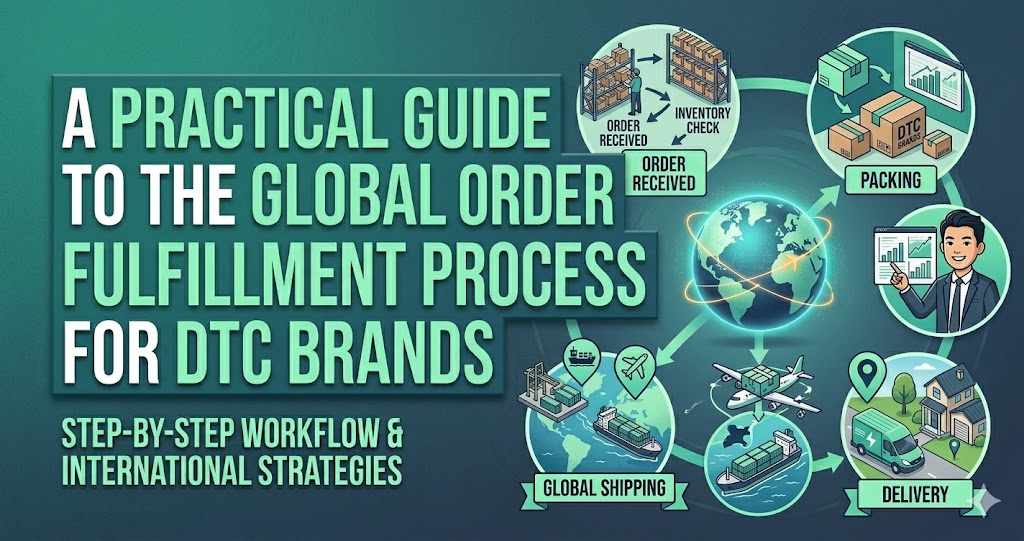
The Four-Step Process We Built After Riyadh
After the customs incident, our team spent six weeks rebuilding the international fulfillment workflow. We tested it for two months across France, the GCC, and the US before considering it stable.
Step 1: SKU mapping with HS codes at the product master level.
Every SKU in our system now has an assigned HS code stored at the product master record, not at the shipping label level. This sounds obvious. It is not standard practice. Most DTC brands store HS codes at the shipping integration layer, which means a missing code defaults to a generic value at shipment time. We worked with a customs broker in Marseille for two weeks to map every SKU to the correct 6-digit HS code. Underwear ships under HS code 6107.11 for cotton knit men’s briefs and 6107.12 for synthetic blends. Getting that right at the SKU level eliminates the most common cause of customs delays.
Step 2: Regional 3PL allocation based on order destination.
We use three different 3PLs depending on where the order is going. A 3PL near Lyon handles all EU orders. A 3PL in Dubai’s Jebel Ali Free Zone handles all GCC orders. A 3PL in New Jersey handles all US orders. Orders are routed automatically at checkout based on shipping address. This adds inventory complexity because we forecast demand by region and stock each warehouse correctly. The benefit is that no order crosses an international border twice. A US customer’s package ships from New Jersey directly, which cuts our average delivery time to US customers by four days.
Step 3: Customs documentation pre-staging for all non-domestic orders.
Every order shipping outside its origin country gets a customs document package generated automatically at the moment the order is placed, not when it ships. The package includes the commercial invoice with itemized HS codes, the certificate of origin where required, and the value declaration in the destination country’s preferred currency. Pre-staging gives our operations team a chance to review documents before the package leaves the warehouse. We catch roughly 8 to 12 errors per month at this step that would have caused customs delays if they had reached the carrier.
Step 4: The 5-day refund-or-reship rule.
If a customer’s package is delayed more than five days beyond the promised delivery date, we proactively reach out and offer two options: a full refund processed immediately, or a free reshipment with expedited shipping. The customer chooses. We do not negotiate or ask them to wait. This rule sounds expensive. It is not. The cost of one refund is dwarfed by the cost of one angry public review. The rule triggers on roughly 2.3% of international orders. Customers who experience a delay handled well order again at higher rates than customers who never had a problem.
Why More DTC Brands Are Going Multi-Region in 2026
The shift toward multi-region fulfillment is not happening because brands are getting more ambitious. It is happening because customer expectations changed and never reverted.
Shopify’s commerce trends data shows that more than half of online shoppers will abandon a purchase if shipping takes more than five days, and the threshold drops below three days for repeat customers. McKinsey’s research on cross-border ecommerce reinforces the point, with delivery speed and customs friction emerging as the top two drivers of international cart abandonment. That math does not work with a single warehouse model unless you are willing to spend heavily on express shipping. Regional fulfillment is the structural answer.
The other driver is customs unpredictability. Brexit is still creating shipment friction between the UK and EU more than five years after implementation. GCC countries have tightened their customs documentation requirements over the last two years. Going multi-region is also a marketing decision. When a customer in Abu Dhabi sees a delivery promise of four business days from a Dubai warehouse instead of fourteen days from France, the conversion rate on that customer changes significantly. Same product, same price, different fulfillment infrastructure.
The State of eCommerce in 2026
IMGPLACEHOLDER2
How to Evaluate a 3PL or Freight Forwarder
Most 3PL evaluations get bogged down in pricing comparisons. Here is what we look for now after evaluating more than a dozen partners across three regions:
- Customs broker relationships in the destination country. Ask the 3PL who their customs broker is and how long they have worked together. A five-year relationship gets shipments through faster than a 3PL shopping for the cheapest broker every quarter.
- Visibility into the actual carrier handoff. You want a partner that can tell you which carrier picked up the package, when, and from which dock. The hand-off is where things break and you need visibility there.
- Returns processing capability in-region. International returns are a nightmare if every return ships back across borders. A 3PL that accepts returns locally and either restocks or disposes of them in-region saves significant cost and customs exposure.
- Real-time inventory API with sub-hour latency. Some 3PLs still operate on overnight batch updates. That breaks if you have any meaningful order volume. You need API access with inventory updates within the hour.
- SLAs with real financial penalties. A 3PL that promises 99% on-time pick rates without any financial penalty for missing the target is selling you a marketing line. Insist on SLAs with real dollar consequences.
The Complete 2025 E-commerce Manager Career Guide: From Entry-Level to Executive
EU vs GCC vs US: The Specifics That Matter
The three regions we ship to most heavily each have their own quirks.
For the EU, the main challenge is intra-EU VAT compliance. The IOSS (Import One-Stop Shop) system simplifies VAT collection for orders under €150, but you need to register and collect VAT at checkout in the customer’s local rate. Get this wrong and your customer either pays VAT twice or your shipment gets held at the border. Our average EU shipping cost sits around $34 per order (€31). France domestic comes in much lower at around $11.
For the GCC, the issue is documentation density. Saudi Arabia, the UAE, and Qatar each have slightly different requirements for commercial invoices, certificates of origin, and product compliance documentation. We standardized on the most demanding country’s requirements across all GCC shipments. Our cost per order from our Dubai warehouse runs about $19 (AED 70) because we already have inventory in-region. Shipping to GCC from France would cost more than double.
For the US, the challenge is the size of the country. We use regional carriers in addition to national ones for last-mile speed in major metro areas. Our average US shipping cost runs around $8.50 domestic when we use a US 3PL versus over $28 when we shipped from France.
Marketing Calendar: A Complete Guide
When to Switch From a Single Warehouse to Regional
The transition from single-warehouse to multi-region is one of the bigger operational decisions a DTC brand makes. We made the switch when international orders crossed roughly 22% of total order volume and customer service tickets related to international shipping crossed 15% of total tickets.
The financial trigger is roughly when your blended international shipping cost exceeds $25 per order and your average international delivery time exceeds 9 days. Both numbers are unsustainable if you want repeat customers. The fixed cost of a small in-region 3PL setup runs about $1,200 to $2,500 per month in storage and account fees, plus per-order pick and pack fees in the $3.50 to $5.50 range. If you do at least 200 orders per month from that warehouse, the math works.
The State of eCommerce in 2025!
What I Tell Other DTC Operators Now
When founders ask me about international fulfillment, the question I send back is what your operation looks like the day a customer in another country has a problem.
If your answer involves the customer waiting on hold or paying for return shipping that costs more than the original purchase, you have designed for domestic customers and added international shipping as an afterthought. The brands that win internationally build the refund-or-reship rule into the operating system. They map every SKU to a customs code at the product master level. They allocate 3PLs by region. They pre-stage documentation rather than relying on the carrier’s defaults. Fulfillment is your most visible international touchpoint. Treat it that way.