

Last Updated on October 6, 2026
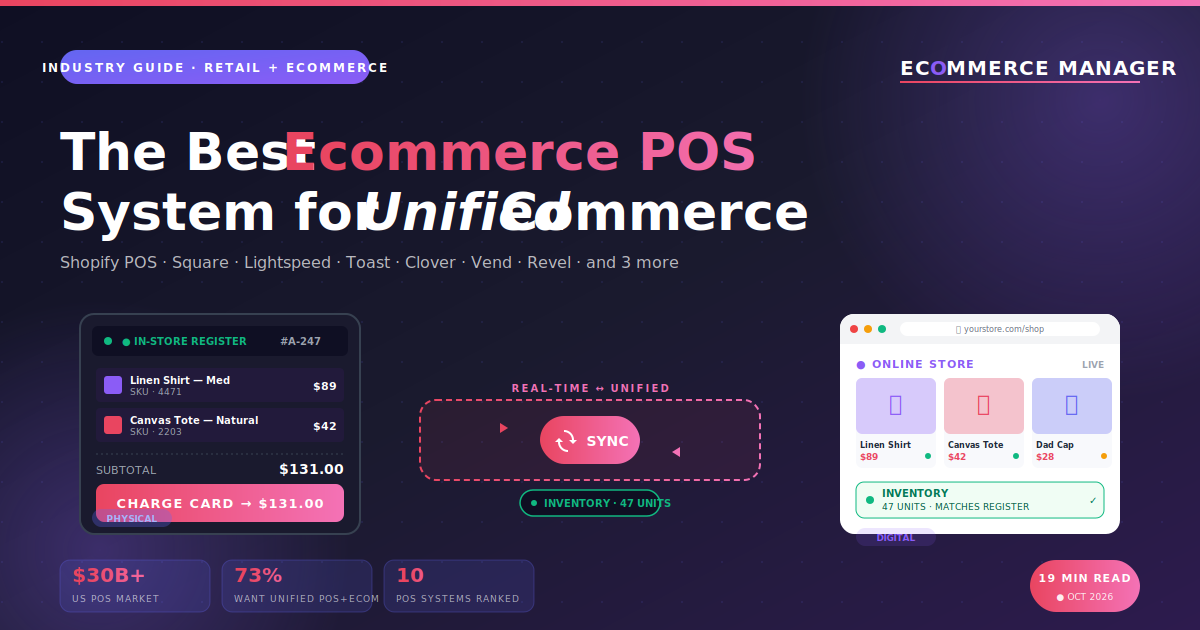
The Best Ecommerce POS System for 2026
If your physical store and your online store don't talk to each other, you're not running one business — you're running two, and losing money on both. This guide ranks POS systems by how well they actually unify retail and ecommerce, not just how pretty their checkout screens look.
Here's the operator truth nobody writes about honestly: most "best POS system" articles rank the same tools on checkout UX, hardware polish, and payment rates — then quietly skip the one question that actually matters for anyone running both a physical store and an online shop. Does the inventory in your register match the inventory on your website? Does a sale in-store drop the SKU count online in real time? Does a customer who bought something at your pop-up last month show up as a known customer on your Shopify site? These three questions decide whether your POS is a cash drawer with Wi-Fi or an actual unified commerce system. This guide ranks 10 POS systems by that standard — real ecommerce integration — because for anyone selling online and in-person, that's the only ranking that matters.
Why "Ecommerce POS" Is Its Own Category
A traditional POS system was a cash register with a receipt printer. A modern POS system is supposed to be the operational nerve center of a hybrid retail-online business — but most of them aren't, because they weren't designed for merchants selling in two places at once. If you only sell in-person, almost any POS will do. If you only sell online, you don't need a POS at all. The specific pain shows up when you try to do both, and your POS and your ecommerce platform act like strangers who happen to share customers.
The symptoms are familiar to any hybrid operator. You sell the last unit of something in your shop and get an angry email three hours later because someone bought the same unit online. Your "customer database" is actually two customer databases that have never met. Your end-of-month reporting takes four hours because you're reconciling two systems that should have been one. Your loyalty program only works in the store because the website doesn't know about it. Every one of these problems is a POS-ecommerce integration failure, not a POS feature gap — and no amount of pretty checkout screens will fix it.
The POS systems that solve this problem are the ones built with ecommerce integration as a first principle, not as an afterthought feature bolted on in year four. That's the lens this guide uses to rank them.
The Four Types of Ecommerce POS (Which Are You?)
Not every merchant needs the same POS. Match your business type to the right category before you compare specific products:
Ecommerce-First Retail
You run an online store with a physical location (DTC brand with a flagship, boutique with a pop-up schedule). Your ecommerce is the primary channel; retail is secondary. You want a POS that extends your ecom, not the other way around. Shopify POS, Square POS.
Retail-First Hybrid
Physical store is your primary business, online is secondary (clothing boutique, bike shop, bookstore). You need deep retail features (loyalty, deep inventory, staff scheduling) and want online as an extension. Lightspeed Retail, Vend.
Restaurant + Online Ordering
Food business where "ecommerce" means online ordering, delivery, catering, gift cards. Different world — POS is tightly coupled to kitchen display, menus, and tabs. Toast POS, TouchBistro.
Multi-Location / Enterprise Retail
5+ stores, warehouse, multiple sales channels. You need centralized inventory, multi-location reporting, and franchise-grade controls. Revel Systems, Lightspeed Retail X, Clover for enterprise.
The Four Criteria That Decide the Winner
1. Ecommerce integration depth
Native (POS and ecommerce are the same product): Shopify POS + Shopify, Square POS + Square Online. Inventory, orders, and customers sync automatically in real time. Zero integration work. This is the gold standard.
Plugin (POS has an official connector to major ecom platforms): Lightspeed to Shopify or BigCommerce, Clover to BigCommerce. Usually works, occasionally breaks, requires setup. Manual (CSV exports, Zapier, or custom integration): any serious operator should treat this as a dealbreaker. If you have to manually sync inventory, you'll stop doing it by month three.
2. Hardware ecosystem and cost
Every POS vendor sells hardware (card readers, receipt printers, cash drawers, barcode scanners, kitchen printers, and increasingly, full iPad-based setups). Hardware is a one-time cost that ranges from $0 (Square gives you a free magstripe reader) to $3,000+ for a full retail or restaurant setup. Vendors lock you into their hardware ecosystem — Shopify POS hardware doesn't work with Square, Clover hardware is Clover-only. Get the hardware math right before signing.
3. Payment processing rates
In-person card rates range from 2.4% to 3.5% + fixed fee per transaction, depending on vendor, card type, and volume. On a store doing $300K/year, a 0.2% difference in rates is $600/year — the difference between vendors is real money. Vendors that force you onto their payment processor (Shopify, Square, Clover) often have better integration but less competitive rates than vendors that let you pick a processor (Lightspeed, Revel).
4. Offline capability
What happens when your internet dies mid-Saturday-rush? Serious retail POS systems have offline modes that queue transactions and sync when the connection returns. Weaker systems stop working entirely until the Wi-Fi is back. If you're running real retail volume, this is non-negotiable.
Complete Comparison: 10 Ecommerce POS Systems
Ranked by ecommerce integration quality and real-world fit for hybrid retail-online operators. "Ecom Integration" scores native (built-in to the ecom platform), plugin (official connector exists), or manual (you're on your own). "Starting Price" is monthly software; hardware is separate (see the hardware reality section below).
| POS System | Best For | Ecom Integration | Starting Price | In-Person Rate |
|---|---|---|---|---|
SP Shopify POS |
Ecom-First | NATIVE | Free (with Shopify) | 2.4-2.7% + $0.10 |
SQ Square POS |
Ecom-First | NATIVE | Free | 2.6% + $0.10 |
LS Lightspeed Retail |
Retail-First | PLUGIN | $89/mo | 2.6% + $0.10 |
CL Clover POS |
Retail-First | PLUGIN | $14.95-$84.95/mo | 2.3-3.5% |
TS Toast POS |
Restaurant | NATIVE | $0-$165/mo | 2.49% + $0.15 |
VD Vend (Lightspeed X) |
Multi-Location | PLUGIN | $119/mo | 2.6% + $0.10 |
RV Revel Systems |
Multi-Location | PLUGIN | $99/mo+ | Negotiated |
TB TouchBistro |
Restaurant | PLUGIN | $69/mo+ | Negotiated |
EP ePOSNow |
Retail-First | PLUGIN | $49/mo | 2.6% + $0.10 |
LV Loyverse POS |
Budget / Starter | MANUAL | Free | Varies (BYO processor) |
Green "NATIVE" means the POS and the ecommerce platform are the same product from the same vendor — inventory and orders sync automatically and instantly. Orange "PLUGIN" means an official connector exists and usually works but requires setup and occasionally breaks during platform updates. Red "MANUAL" means you're exporting CSVs or stitching things together with Zapier — a dealbreaker for any serious hybrid operation. Only two systems in this list achieve native integration with major ecom platforms: Shopify POS (with Shopify) and Square POS (with Square Online). That alone is why they rank #1 and #2.
1. Shopify POS — The Native Ecommerce POS Winner
Shopify POS
Shopify POS is the obvious answer if your business is Shopify-first and you're adding physical retail. The integration isn't "pretty good" — it's actually one system with two interfaces. Sell a product in-store on the iPad POS app and your website inventory drops instantly. Online order comes in; it shows up in the same orders screen your register staff uses. Customer buys something in your pop-up; they're added to the same Shopify customer database that powers your email marketing and online loyalty. For hybrid operators where ecommerce is the center of the business, nothing else comes close on integration quality.
Shopify POS Lite is free with any Shopify subscription and handles basic in-person selling. Shopify POS Pro ($89/mo per location) unlocks multi-location inventory transfers, staff permissions, custom receipts, exchanges, and smart grid customization — the features actual retail staff need. In-person card rates are 2.4-2.7% depending on your Shopify tier, which is competitive but not best-in-class. Hardware is Shopify-only (card reader starts at $49, full retail setup $400-$1,200).
2. Square POS — The Universal SMB POS With Real Ecommerce
Square POS
Square POS is the SMB POS leader for reasons that have aged well. The core app is genuinely free (not free-for-a-trial-free, actually free), the free Square Online store integrates natively with the POS inventory, and the first magstripe reader is free in the mail. For retail-first businesses (coffee shops, boutiques, salons, food trucks) adding online as a secondary channel, Square is almost always the pragmatic right answer. Four million+ active merchants can't all be wrong, and most of them aren't.
The trade-off: Square is optimized for simplicity, not for depth. If you need advanced retail features — complex pricing rules, deep loyalty, sophisticated inventory logic — you'll outgrow Square faster than you'd like. The paid Square for Retail tier ($60/mo) adds some retail depth but still falls short of Lightspeed's capabilities. For businesses doing under $500K/year across both channels: Square is often perfect. For businesses planning serious retail scale: look at Lightspeed or Vend.
3. Lightspeed Retail — The Retail-First Hybrid Pick
Lightspeed Retail
Lightspeed Retail is the serious retail POS for merchants who need actual retail-grade features — complex matrix inventory (size × color × style), purchase order management, supplier integrations, serial number tracking, work orders, and multi-location transfers that actually work. The ecommerce integration goes through Lightspeed eCom (previously Ecwid, which Lightspeed owns), making it a Lightspeed-native stack. If you're running a bike shop, boutique, pet store, jewelry store, or any specialty retail with real inventory depth — Lightspeed is often the honest right answer over Shopify POS or Square.
The trade-off: more expensive ($89/mo starter, climbs with location count and features), steeper learning curve, and the ecommerce side (Lightspeed eCom) is weaker than Shopify or BigCommerce. For retail-first operators where the POS features matter more than the ecom features, this is the pick. For ecom-first operators adding a physical location, Shopify POS wins.
4. Clover POS — The Hardware-Forward Fiserv-Backed Option
Clover POS
Clover is the POS most Americans see at local coffee shops and restaurants — recognizable touchscreen hardware, backed by Fiserv (the massive payment processor). The hardware ecosystem is genuinely strong (full countertop systems, handheld devices, kitchen displays), and the app marketplace gives you flexibility on specific features. For brick-and-mortar businesses that want polished hardware and don't need deep retail-chain features, Clover is a legitimate option.
The honest caveats: Clover is often sold through merchant service resellers whose primary interest is locking you into high payment processing rates (3%+ is common when sold this way). If you go direct to Clover and negotiate, rates come down to 2.3-2.7%. Ecommerce integration exists via BigCommerce, Woocommerce, and other partners but is plugin-based, not native — treat it as "it works, with caveats." Always get competing POS bids before signing a Clover contract through a reseller.
5. Toast POS — The Restaurant Industry Standard
Toast POS
Toast is the dominant restaurant POS for a reason — purpose-built for food service with native online ordering, delivery integrations (DoorDash, Uber Eats, Grubhub), kitchen display systems, menu management, tab handling, and tip pooling. The "ecommerce" angle for restaurants means online ordering, gift cards, catering orders, and loyalty — all of which Toast handles natively. If you run any food business adding or scaling online ordering, Toast is almost certainly in your final two.
The trade-off: Toast is restaurant-only — don't buy it for retail. Pricing can climb aggressively once you add modules (loyalty, email marketing, payroll, inventory). Hardware is proprietary. And the sales process is high-touch, enterprise-style — expect multiple calls before pricing, and negotiate everything.
6. Vend (Lightspeed Retail X) — Multi-Location Retail at Scale
Vend (Lightspeed Retail X)
Vend (now officially Lightspeed Retail X after the acquisition) is purpose-built for multi-location retail chains — 3+ stores where centralized inventory, cross-store reporting, and franchise-grade staff controls matter. The Shopify integration is one of the better plugin-based integrations in the category, making Vend a legitimate choice for Shopify-powered chains that need deeper POS features than Shopify POS Pro provides. European and APAC retail chains have adopted Vend heavily.
The trade-off: Lightspeed's product consolidation (Retail, Retail X, Vend, eCom) is genuinely confusing for new buyers, and sales reps don't always clarify which product solves your specific problem. Get a demo of the exact product variant you're being quoted and verify the ecommerce integration against your platform specifically.
7. Revel Systems — Enterprise iPad POS
Revel Systems
Revel Systems is the serious enterprise iPad POS — designed for multi-location chains, franchise operations, and businesses with sophisticated requirements (quick-service restaurant chains, specialty retail franchises, museum gift shops). Deep inventory management, advanced reporting, kitchen display integration, and robust multi-location controls. Belly Rubs Dog Spa, Smoothie King, Little Caesars, and Cinnabon all run on Revel in various deployments.
The real talk: Revel requires a 3-year contract (!) at minimum, has an aggressive sales process, and starting pricing is often doubled or tripled once you add required modules. Read the contract carefully, get competing bids, and negotiate everything — including the contract length. Not suitable for small operators who want flexibility; genuinely strong for enterprise operators who want depth.
8. TouchBistro — Restaurant-Specific iPad POS
TouchBistro
TouchBistro is the independent restaurant alternative to Toast — iPad-based, restaurant-specific, with menu management, tableside ordering, kitchen display, and tab handling. Preferred by many independent restaurateurs over Toast for its simpler setup, lower starting cost, and less aggressive sales process. Online ordering is a separate module ($50/mo on top) rather than native, which is a step down from Toast's integration but still works well.
Best fit: single-location independent restaurants, small restaurant groups (2-5 locations), bars, cafés. Not suitable for retail. For restaurants that want restaurant-first software without Toast's enterprise sales motion: TouchBistro is a legitimate alternative worth comparing side-by-side.
9. ePOSNow — The Budget Cross-Vertical Option
ePOSNow
ePOSNow sits in the budget tier of the serious POS category — $49/month for either retail or hospitality variants, with legitimate feature depth at that price point. UK-strong with growing US presence. Integrates with Shopify, BigCommerce, WooCommerce, and other major ecommerce platforms. Not as polished as Lightspeed or Toast, but genuinely functional at roughly half the cost. Good fit for cost-conscious SMBs who need more depth than Square but don't want to pay Lightspeed prices.
The trade-off: smaller US ecosystem, fewer third-party integrations, less mature than competitors in some verticals. If budget is the primary constraint and you need real POS features: ePOSNow is a legitimate consideration.
10. Loyverse POS — The Free Starter That's Actually Free
Loyverse POS
Loyverse is a legitimately free POS designed for small operators — core POS, inventory, and basic analytics at no cost. Advanced features (employee management, kitchen display, advanced inventory) run $5-25/month per module. BYO payment processor model means you can choose your own card rates rather than being locked into the POS vendor's rates. Best fit: pop-ups, market vendors, first-time operators testing whether their business works before investing in paid POS.
The honest limitation: no native ecommerce integration. Loyverse doesn't connect automatically to Shopify, Square Online, or BigCommerce — you're on CSV exports and manual reconciliation if you need unified inventory. For in-person-only or very light online operations, this is fine. For serious hybrid retail-online operations, treat the manual integration as a dealbreaker and look at Square, Shopify POS, or Lightspeed instead.
The Hardware Cost Reality Every Buyer Underestimates
Software pricing is the first number vendors advertise. Hardware is the first number they'd rather not discuss. Here's what you'll actually spend on hardware for different POS setups:
Phone + free card reader (Square)
iPad + stand + card reader + receipt printer
Terminal + scanner + cash drawer + printer per station
Multi-register retail or multi-terminal restaurants multiply by number of stations. A 3-station restaurant setup from Toast or Lightspeed often lands at $5K-$10K in hardware before you even pay for software. Clover full systems can hit $1,500 per terminal. Shopify POS hardware is on the lower end ($400-$1,200 for a full setup) because the system is designed around iPads customers often already own.
What vendors won't tell you: used and refurbished hardware is widely available and perfectly functional for most SMB operators. Buying a one-year-old Clover Station on eBay for $400 instead of $1,500 new is a legitimate choice. New hardware mostly gets you better warranty terms, not better performance.
The POS Reseller Trap
Clover, Lightspeed, and several other POS vendors sell both direct and through merchant service resellers. The same POS can cost dramatically different amounts depending on which channel you buy through — reseller pricing often includes 50-100% markup on payment processing rates (3-4% instead of 2.3-2.7%) in exchange for "free" or discounted hardware. Over three years, that markup costs you $5K-$30K on moderate volume. Always get a direct quote from the POS vendor and a competing quote from an independent payment processor before signing with a reseller. If a POS "deal" seems too good — the trap is usually in the processing rate.
Red Flags When Shopping for Ecommerce POS
- "Ecommerce integration" means Zapier. If the only integration path to your ecom platform is through Zapier or manual CSV exports, that's a dealbreaker. You'll stop syncing by month three and your inventory will drift.
- Multi-year contracts required for standard pricing. Revel requires this. Others pretend they don't but include 20-40% price jumps on month-to-month tiers. Negotiate or walk.
- Payment processing locked at vendor's rate. Vendors that force you onto their payment processor (Shopify, Square, Clover) are often fine, but verify the rate is competitive. Vendors that force you onto a bank partner at 3%+ are extracting money.
- Hardware ecosystem locked. Clover-only hardware with Clover means you can't switch POS without replacing physical hardware. Factor replacement cost into your 3-year TCO.
- Sales rep won't commit prices in writing. Enterprise POS vendors (Revel, Toast at higher tiers) will quote verbally and avoid email. Get everything in writing or you'll be surprised at year two renewal.
- No offline mode. If the POS stops processing transactions when the internet dies, that's a dealbreaker for any retail operation of real volume.
How to Actually Choose Your Ecommerce POS
1. What's your primary channel?
🛒 Ecommerce-first (DTC with retail)
Shopify POS (if on Shopify) · Square POS (if on Square Online)
🏪 Retail-first (store with ecom)
Square POS (SMB) · Lightspeed Retail (depth)
🍽️ Restaurant with online ordering
Toast POS · TouchBistro
🏢 Multi-location (3+ stores)
Lightspeed Retail X · Revel Systems
2. What's your realistic 3-year volume?
Under $200K/year combined: Square POS almost certainly correct — don't overthink it. $200K-$1M/year: Shopify POS (if ecom-first) or Lightspeed Retail (if retail-first). $1M-$5M/year across multiple locations: Lightspeed Retail X or Vend. $5M+/year or franchise operations: Revel Systems or Toast enterprise tier.
3. What's your biggest operational pain today?
Inventory reconciliation across online and physical: you need native integration — Shopify POS or Square POS. Complex retail features (matrix inventory, suppliers): Lightspeed. Restaurant online ordering: Toast. Multi-location reporting: Vend or Revel. Match the tool to the pain, not to the vendor's demo.
4. What's your real 3-year TCO?
Add it up honestly: monthly software × 36 months, plus hardware investment, plus payment processing fees on 3-year projected volume, plus any required modules. A "cheap" Clover setup through a reseller at 3.5% processing on $500K/year volume is $52,500 in processing fees over 3 years — compared to Shopify POS at 2.6% on the same volume ($39,000). The $13,500 difference dwarfs any software subscription savings.
The Honest Bottom Line
For most hybrid retail-online operators, the ranking is actually simpler than most POS articles pretend. If you're on Shopify, use Shopify POS — the native integration is worth it, full stop. If you're a smaller retail business on Square Online, use Square POS — same logic, free, same-day setup. If you need serious retail-grade features (matrix inventory, deep merchandising, multi-location transfers that actually work), Lightspeed Retail is the honest pick. If you run a restaurant with online ordering, Toast POS dominates for a reason, with TouchBistro as the independent alternative. Clover for Fiserv-ecosystem brick-and-mortar; Vend and Revel for multi-location enterprise retail; ePOSNow for budget-conscious SMBs; Loyverse for free testing.
The wrong move is picking POS based on checkout screen UX or the salesperson's smile. The right move is matching POS to your actual ecommerce platform, your realistic volume, and your operational pain — then negotiating the hardware and processing rate aggressively. Do that, and your POS becomes the operational nerve center that lets your retail and online channels actually work as one business.
Running a POS Evaluation?
The eCommerce Manager helps retail-online operators pressure-test POS shortlists against real-world integration quality — no reseller commissions, no vendor incentives.
Get an Unbiased POS Review →