

Last Updated on September 22, 2026
In-House vs Agency Marketing in 2026: The Operator's Guide
The fully-loaded cost math founders miss by 40–60%, real team budgets built from BLS wage data, the accountability gap that breaks hybrid setups, and a decision framework by revenue stage. Written for the person who signs both kinds of contract.
On this page
The comparison most brands run is the wrong one
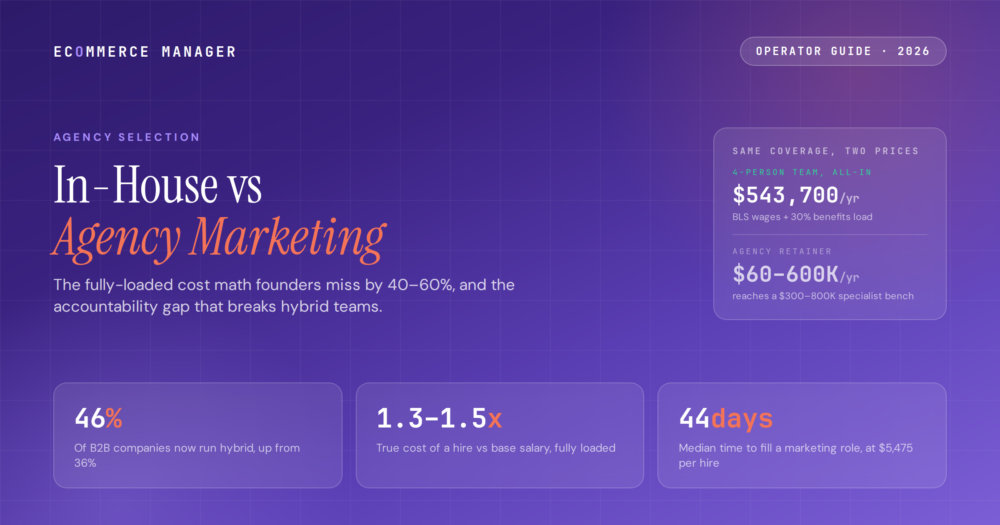
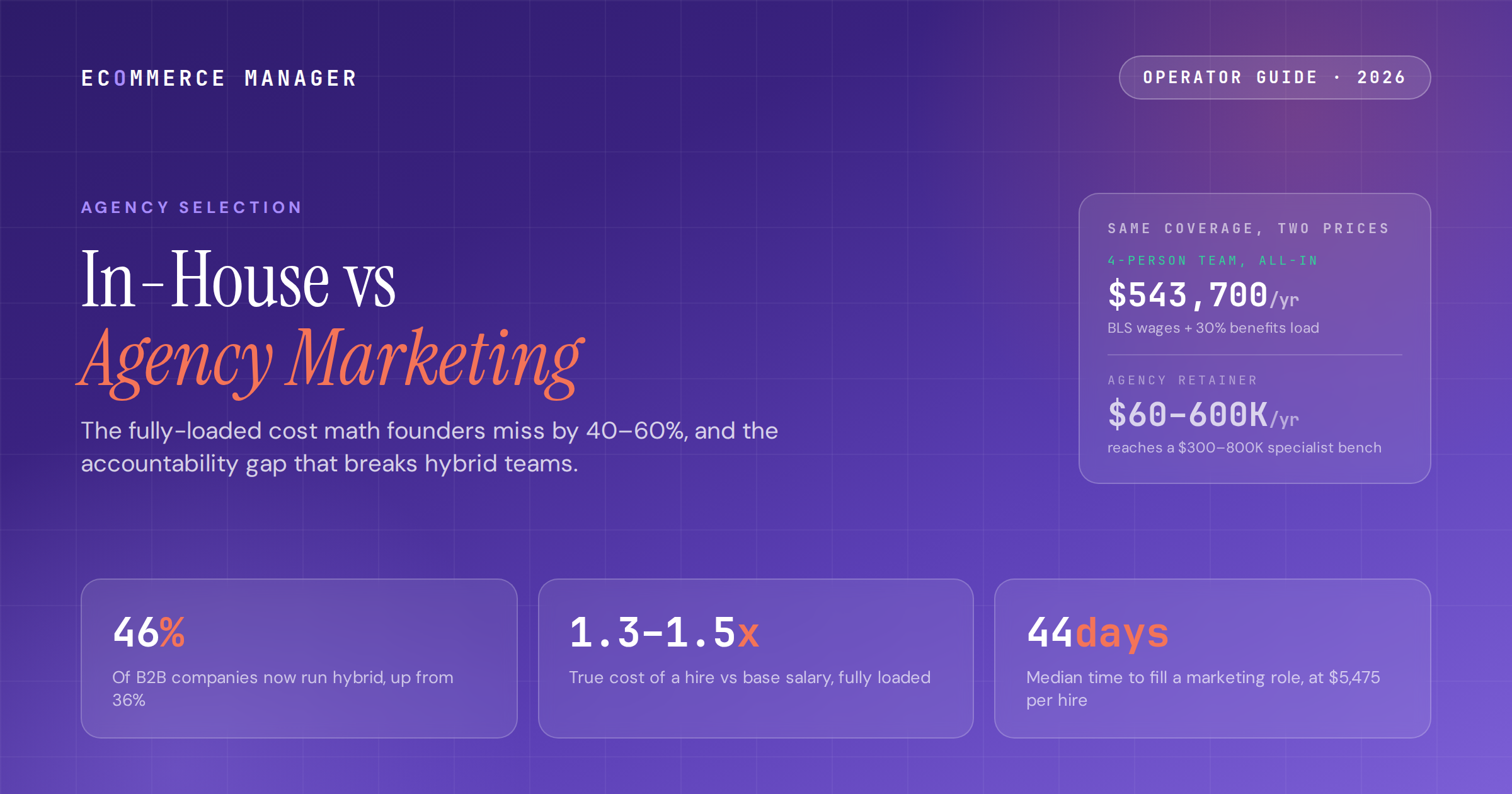
The standard comparison, agency retainer versus employee salary, produces a wrong answer every time, because salary is only 60–70% of what an employee costs. The U.S. Bureau of Labor Statistics puts wages at 70.1% of total private-industry compensation, with benefits making up the other 29.9%, and that's before software, equipment, recruiting, management time, and ramp enter the budget. The working multiplier is 1.3–1.5x base: a $100K marketer costs $130K–$150K a year all-in. Founders who price out base salaries and stop there underestimate the true cost of an in-house team by 40–60%.
The right comparison is fully-loaded team cost versus agency retainer for equivalent coverage, and this guide builds both sides with real numbers: BLS median wages, published recruiting costs, current retainer benchmarks. It also covers the model most brands actually end up running (46% of B2B companies now use a hybrid, up from 36% in 2025) and the accountability gap that makes hybrids fail more often than either pure model.
One framing to carry through everything below, from a decision framework that circulated widely this year: fast, frequent, repetitive work goes in-house; strategic, exploratory, perspective-driven work goes to an agency. Every section is that sentence with numbers attached.
What an in-house team actually costs
Built from BLS wage data and published hiring benchmarks, not from a pitch deck on either side. The numbers get large quickly, and the hidden lines are where the 40–60% underestimate lives.
-
01Start with the multiplier: 1.3–1.5x base salary, fully loaded. BLS pegs benefits at 29.9% of total compensation, so a $70K salary points to roughly $100K in total pay before tools, equipment, and training. An $80K designer costs $110K–$120K all-in. Every in-house number below is a total figure; every comparison you run should be too.
-
02A realistic four-person team runs about $543,700 a year all-in. Using BLS median wages (marketing manager $161,030, market research analyst $76,950, writer $72,270, PR specialist $69,780) the base is $380,030, and loading benefits at the BLS 30.1% structure produces $543,700. That excludes recruiting, computers, software, office space, and leadership time.
-
03A five-person DTC marketing team's first year lands at $550K–$700K once you add $30K–$60K in software subscriptions (attribution, creative tools, email platform, SEO stack — worth its own tech stack audit before you commit) and one-time recruiting costs of $20K–$40K per hire at agency recruiter rates. A lean starter team of one manager plus a couple of specialists runs $120K–$300K depending on seniority.
-
04Hiring itself has a price and a clock: roughly $5,475 per hire and a median 44 days to fill the role, with recruiter fees at 15–25% of first-year salary when you use one. Then comes the part nobody budgets: a 6–12 month ramp before a new marketer performs at full capacity, paid at full cost the whole way.
-
05What the money buys is real: brand immersion, immediate availability, and approval speed. An internal team lives in your Slack, knows the founder's taste, and ships same-day changes without a change order. For fast, frequent, repetitive work (lifecycle emails, promo calendars, site merchandising) nothing external matches it. The question is never whether in-house is good; it's whether the volume of that work justifies the loaded cost at your stage.
-
06The turnover tax compounds all of it. Every departure restarts the $5,475-and-44-days clock plus the ramp, and single-person teams concentrate that risk completely: one resignation is a 100% capability loss. Benchmark your team's output against the core KPI set the same way you'd benchmark an agency's — internal teams get measured less often, which flatters them.
What agencies cost, and what the retainer replaces
The agency side of the ledger is more transparent — published retainers, no ramp, no recruiting — but it has its own fine print. Full pricing detail lives in the ECM agency pricing guide; here's the comparison view.
-
01Agencies run $5,000–$50,000+ per month ($60K–$600K a year) depending on scope: single-service ecommerce retainers at $5K–$25K, full-stack engagements at $20K–$75K. The value mechanism: a mid-tier retainer buys access to a specialist bench that would cost $300K–$800K+ to replicate in-house. The full benchmark sheet is in the ECM agency pricing guide.
-
02The speed advantage is structural, not marketing. An agency starts next Monday with a working stack; the in-house alternative starts after 44 days of hiring plus 6–12 months of ramp. For a growth-stage brand, the agency's cross-client pattern recognition is the other asset no single hire carries — they've seen your problem at ten other brands this quarter.
-
03For variable-demand work, the loaded in-house cost often matches or exceeds agency bill rates once advertising, HR time, training, and turnover are counted. A lean in-house team runs $180K–$300K a year against $50K–$150K for an agency or fractional model covering the same channels — the crossover only arrives when the workload is constant enough to keep employees fully utilized.
-
04The threshold rule from both sides of the market: under roughly $20M in revenue, an agency is usually the more cost-effective structure for multi-channel coverage. Above it, and especially past $10M with continuous daily channel work, in-house economics improve steadily, which is why the answer changes as you scale and why the decision deserves an annual revisit rather than a permanent answer.
-
05What the retainer doesn't buy: depth on your brand specifically, and undivided attention. You share your account team with other clients, brand voice takes longer to land, and approval loops run through someone else's calendar. The vetting discipline in the ECM agency selection guide (named team, seniority allocation, outcome metrics) is how you keep those costs visible and priced.
Pricing the agency side of the ledger?
The ECM directory lists ecommerce marketing agencies with published minimum budgets, rate ranges, and verified client reviews scored on results, communication, and value.
What each model actually wins on
Strip the sales copy from both sides and the trade is consistent. Score your own work mix against it.
In-house wins on
-
→Fast, frequent, repetitive execution. Lifecycle sends, promotions, merchandising, community, and anything shipping daily. The approval loop is a desk away, and volume work at constant load is exactly where full utilization beats bill rates.
-
→Brand context and institutional memory. An internal team compounds knowledge of your customer, catalog, and voice — the asset agencies rebuild from scratch at every onboarding and lose at every account-team change.
-
→Accountability without ambiguity. One team owns the number. When performance dips, the diagnosis starts immediately instead of with a whose-domain-is-this negotiation.
Agencies win on
-
→Strategic, exploratory, and specialist work. New channel launches, creative testing programs, technical SEO, migrations, CRO: work that needs deep expertise in bursts rather than a permanent salary. One retainer reaches a bench no single hire replicates.
-
→Speed to competence and cross-brand pattern recognition. Next-Monday starts versus 44-days-plus-ramp, and the compounding advantage of seeing what works across dozens of accounts in your category right now.
-
→Cost flexibility. Retainers scale down, pause, or end with notice; payroll doesn't. For channels you haven't proven yet, that reversibility is worth a premium on its own.
The model most brands run, and the gap that breaks it
46% of B2B companies now run hybrid (internal lead, agency execution), up from 36% in 2025. The growth is earned; so is the failure mode nobody puts in the case study.
-
01The standard hybrid shape: a senior internal lead owns strategy and brand, agencies own specialist execution. Most companies between $1M and $25M land here, and the logic is sound: you buy brand context where it compounds and specialist depth where it doesn't. A common split: internal manager for voice and lifecycle, agency for paid channels and the tech stack.
-
02The accountability gap is the model's biggest documented risk. When performance is good, everyone shares credit; when it's bad, the internal team and the agency each point at the other's domain. That finger-pointing dynamic is most damaging to decision speed, the primary variable in performance marketing, and it's the failure mode practitioners on both sides name first.
-
03The fix is structural, not interpersonal: one owner for every number. Before kickoff, write down who owns strategy, who owns each channel's result, what data flows where, and who makes the call when in-house and agency disagree. Hybrid setups without that document generate coordination overhead that quietly eats the cost savings the model promised.
-
04Coordination is a real line item — budget management time for it. An internal lead managing two agencies is doing a genuine job: briefing, QA, reconciling attribution, running the weekly. Brands that assign hybrid oversight as a side duty to a full-time IC get side-duty results from both halves.
-
05Run the hybrid on the same measurement discipline as anything else: shared baseline, outcome metrics per owner, and a quarterly review where the split itself is on the table. The right internal/external boundary moves as channels get proven — ECM tracks how operators keep redrawing it in weekly Insights.
Building the hybrid? Pick the agency half well.
Answer five questions about your platform, channels, and budget, and the Find My Agency matcher returns agencies that fit your actual requirements — with match scores.
The framework, by revenue stage
Stage, capacity, specialization, and accountability are the four factors that decide this. Here's how they resolve at each stage for a DTC brand.
-
01Under $1M: agency or fractional, full stop. You need expertise without permanent commitment while you find repeatable demand, and a $130K+ loaded hire is margin you don't have. Buy bounded outcomes: a channel setup, a defined retainer, a project. The 'marketing unicorn' single hire is the classic trap at this stage — one person mastering paid, SEO, email, and creative doesn't exist at a price you can pay.
-
02$1M–$5M: first internal hire plus agency execution: the entry hybrid. Hire the generalist lead who owns brand, lifecycle, and coordination ($110K–$160K all-in), and keep specialist channels on retainers you can scale or cut as channels prove out. Write the accountability document the same week.
-
03$5M–$20M: expand internal where work is constant, keep agencies where it's spiky. Bring lifecycle, retention, and creative coordination in-house as their volume becomes daily; leave technical SEO, migrations, and creative production external — SEO and CRO retainers being the two most commonly kept. This is the 46%-hybrid heartland, and the annual question is utilization: any function with full-time constant workload is a candidate to internalize.
-
04$20M+: in-house core, agency edges. Above the ~$20M threshold the cost math flips for daily channels, and the working split becomes an internal team for the core engine with agencies reserved for architecture, surge capacity, and specialist bursts. The four-person team's $543,700 all-in cost now buys utilization that beats retainer economics.
-
05At every stage, the same two disciplines: compare total cost against retainer cost (never salary against retainer), and give every number one owner. When the answer is an agency for any part of the mix, the ECM directory filters by service, budget, and verified reviews, and the Find My Agency matcher builds the shortlist from your actual requirements.
What a smart operator does with this
Run the comparison with loaded numbers or don't run it at all. Salary is 60–70% of what an employee costs; the working multiplier is 1.3–1.5x base, a four-person team is $543,700 a year before recruiting and ramp, and every hire carries a 44-day clock and a 6–12 month ramp paid at full price. Against that, a retainer reaching a $300K–$800K specialist bench for $5K–$50K a month is not expensive; it's a different product.
Sort the work before sorting the vendors: fast, frequent, repetitive work belongs in-house as soon as its volume supports full utilization; strategic, exploratory, specialist work belongs external for as long as it arrives in bursts. Under roughly $20M in revenue the math favors agencies for multi-channel coverage; above it, internalize the daily engine and keep agencies at the edges.
If you run the hybrid (and at 46% adoption, you probably will) treat the accountability gap as the design problem it is. One owner per number, the strategy/execution boundary in writing before kickoff, real management time budgeted for coordination, and a quarterly review where the split itself can move. Hybrids fail on ambiguity, not on either team's competence.
Frequently asked questions
Is it cheaper to hire an in-house marketing team or an agency?
For most brands under roughly $20 million in revenue, an agency is more cost-effective for multi-channel coverage. The comparison must use fully-loaded employee costs — 1.3–1.5x base salary once BLS-documented benefits (29.9% of compensation), payroll taxes, software, and management time are included. A four-person in-house team runs about $543,700 a year all-in, and a five-person DTC team's first year lands at $550,000–$700,000 with software and recruiting. Agencies run $5,000–$50,000+ monthly and provide access to specialist coverage that would cost $300,000–$800,000+ to replicate in-house. Above $20M with constant daily channel work, in-house economics steadily improve.
What does an in-house marketer actually cost in 2026?
About 1.3–1.5x base salary, fully loaded. The Bureau of Labor Statistics puts wages at 70.1% of total compensation and benefits at 29.9%, so a $100,000 salary becomes $130,000–$150,000 once benefits, payroll taxes, equipment, tools, training, and management time are included. Add hiring costs of roughly $5,475 per hire with a median 44 days to fill the role, recruiter fees of 15–25% of first-year salary when used, and a 6–12 month ramp period before full productivity — all paid at full cost.
What is a hybrid marketing model and does it work?
A hybrid pairs a senior internal lead who owns strategy, brand, and coordination with agencies handling specialist execution — typically internal ownership of voice and lifecycle with external paid media, SEO, or creative production. It's now the most common structure: 46% of B2B companies run hybrid, up from 36% in 2025, and most companies between $1M and $25M land there. It works when accountability is designed in: one owner per metric, the strategy/execution boundary documented before kickoff, and real management time budgeted for coordination. Its documented failure mode is the accountability gap — when performance drops, each side points at the other's domain, and decision speed collapses.
When should a DTC brand bring marketing in-house?
Function by function, when the work becomes fast, frequent, and repetitive enough to keep a full-time hire fully utilized. The typical sequence: first internal hire (a generalist lead) around $1M–$5M in revenue while agencies run specialist channels; lifecycle, retention, and creative coordination internalized through $5M–$20M as their volume becomes daily; and the core daily engine in-house above roughly $20M, where team costs of $543,700 for four people buy utilization that beats retainer economics. Strategic, exploratory, and burst work (migrations, technical SEO, creative testing, new channel launches) stays external at every stage.
What are the hidden costs of building an in-house marketing team?
The lines founders miss when they price only salaries, the source of a documented 40–60% underestimate: benefits and employer taxes (29.9% of total compensation per BLS), software subscriptions of $30,000–$60,000 a year for a real team (attribution, creative, email, SEO tools), recruiting at $5,475 per hire plus 15–25% recruiter fees, a median 44-day vacancy per role, a 6–12 month ramp paid at full cost, management and training time, and the turnover tax: every departure restarts the hiring clock and the ramp. Single-hire teams concentrate the risk: one resignation is a 100% capability loss.
The playbook top eComm operators actually read
One weekly brief. Five stories that matter. Zero fluff. Written for managers at $5M–$50M DTC brands who want to sound sharper than everyone else in the meeting.
References
- 01 In-House vs Agency Marketing: The 2026 Decision Guide for DTC Brands — jetfuel.agency
- 02 Digital Marketing Agency vs In House: True Cost Comparison 2026 — hoopinteractive.com
- 03 In-House Marketing vs Agency: 2026 Decision Guide — amworldgroup.com
- 04 In-House Marketing vs Agencies: What to Hire, When, and Why — 321webmarketing.com
- 05 Employer Costs for Employee Compensation — March 2026 — bls.gov
- 06 Choosing Between an Agency and an In-House Hire in 2026 — gtm8020.com
- 07 Hiring a Marketing Agency vs. In-House Team: The 2026 ROI Comparison — brandlume.com
- 08 Marketing Agency vs In-House Team — ellingtondigital.com
- 09 Agency vs In-House Marketing Team: Decision Guide — teyluandpartners.com
- 10 Ecommerce Marketing Cost 2026: Real Numbers by Channel — theinterconnections.com
- 11 Marketing Agency Pricing Benchmarks 2026: Real Numbers — thezulumethod.com
Make your team decision data-backed
Join 12,000+ ecommerce managers reading the ECM newsletter every Wednesday — or browse the directory to find vetted marketing, migration, and CRO specialists.