

Last Updated on September 1, 2026
The Best Ecommerce Solutions for 2026 — The Complete Stack
Most "best ecommerce solutions" articles rank platforms and stop there. That's one layer. A working ecommerce operation needs about ten — here's the stack serious operators actually build, category by category.
"Best ecommerce solutions" is a phrase that gets misused constantly. Almost every article ranking under it just ranks ecommerce platforms — Shopify, BigCommerce, WooCommerce, and so on — as if the platform were the entire solution. It isn't. It's one layer of about ten. A store that only uses its platform and calls that "the solution" ships broken checkouts, loses returning customers, can't figure out which ads are working, and pays a fortune for support tickets that a $30/month tool would have prevented. This guide covers the actual stack — the ten categories of tools that make up a real ecommerce operation, the best-in-class pick in each, and how to phase the build so you're not paying for scale-tier software when you're doing $30K/year.
Why "Platform" and "Solution" Aren't the Same Word
Here's the confusion that costs operators real money. Search "best ecommerce solutions" and every article shows you Shopify, BigCommerce, WooCommerce, and the rest of the platform lineup. Fine — a platform is a solution. But it's the storefront layer only. A real ecommerce operation runs on a stack of about ten distinct categories of software, each solving a different problem the platform doesn't touch. Skip any of them and you leave money on the table or create work that eventually gets outsourced to a $75/hour freelancer instead of a $30/month tool.
The categories most operators underinvest in early: email and SMS marketing (typically the single highest-ROI channel), analytics that actually attribute revenue to source, reviews (which affect conversion rate by 20-30%), and customer support tooling (which decides whether a returning customer becomes a repeat or a chargeback). Every one of these has best-in-class solutions with clear winners. This article walks through all ten, with the honest recommendation in each category — not affiliate-ordered, not "it depends" — plus how to phase the build so you're not overbuying at the wrong stage.
The Four Pillars of an Ecom Solutions Stack
Before naming tools, understand the shape. Every serious ecom stack maps to four functional pillars. Missing a pillar means you're solving the wrong problem with the wrong tool — the store equivalent of trying to use a hammer for surgery. Get all four covered at whatever tier fits your revenue, and you have a real operation.
Store Foundation
The layer customers actually see and transact on. Platform + payments + hosting + core UX. Get this wrong and nothing else matters — nobody can buy from you.
Customer Acquisition
How new buyers find you. SEO, paid ads, content, and the analytics to know what's working. The bill you pay to acquire strangers.
Customer Experience
Everything from clicked-to-cart onward. Reviews, checkout, support, shipping. The difference between one purchase and a repeat customer.
Retention & Analytics
What makes a first-time buyer buy again. Email, SMS, loyalty programs, and the analytics that tell you which cohort is worth pursuing.
The Complete Ecommerce Solutions Stack (Comparison)
Ten categories, one top pick per category, and the strongest alternative. Starting prices reflect entry tiers. Realistic all-in cost for a growing store (roughly $50K-$500K/year in revenue) is at the bottom of the article.
| Category | Pillar | Top Pick 2026 | Best Alternative | Starting Price |
|---|---|---|---|---|
PL Ecommerce Platform |
Foundation | Shopify | BigCommerce | $39/mo |
PA Payment Processing |
Foundation | Stripe | Shopify Payments | 2.9% + $0.30 |
EM Email & SMS Marketing |
Retention | Klaviyo | Postscript (SMS-only) | Free / $60/mo |
AN Ecom Analytics |
Acquisition | Triple Whale | Polar Analytics | From $129/mo |
RV Product Reviews |
Experience | Yotpo | Judge.me (budget) | Free / $19/mo |
CS Customer Support |
Experience | Gorgias | Re:amaze | From $10/mo |
SH Shipping & Fulfillment |
Experience | ShipStation | ShipBob (3PL) | From $9.99/mo |
SE SEO & Content |
Acquisition | Ahrefs | Semrush | From $129/mo |
AD Ad Management |
Acquisition | Meta Ads Manager | Northbeam (attribution) | Free (Meta) |
LO Loyalty & Retention |
Retention | Smile.io | LoyaltyLion | Free / $49/mo |
Every category has a different winner at different revenue stages. Klaviyo is the right answer at $100K/year and still right at $10M/year. Triple Whale is overkill under $500K/year — use Shopify Analytics + GA4 first. Yotpo is right at scale but Judge.me is fine (and free) at launch. The "Build Your Stack in Phases" section further down maps tools to revenue stages so you're not overbuying.
1. Ecommerce Platform — Shopify
Ecommerce Platform
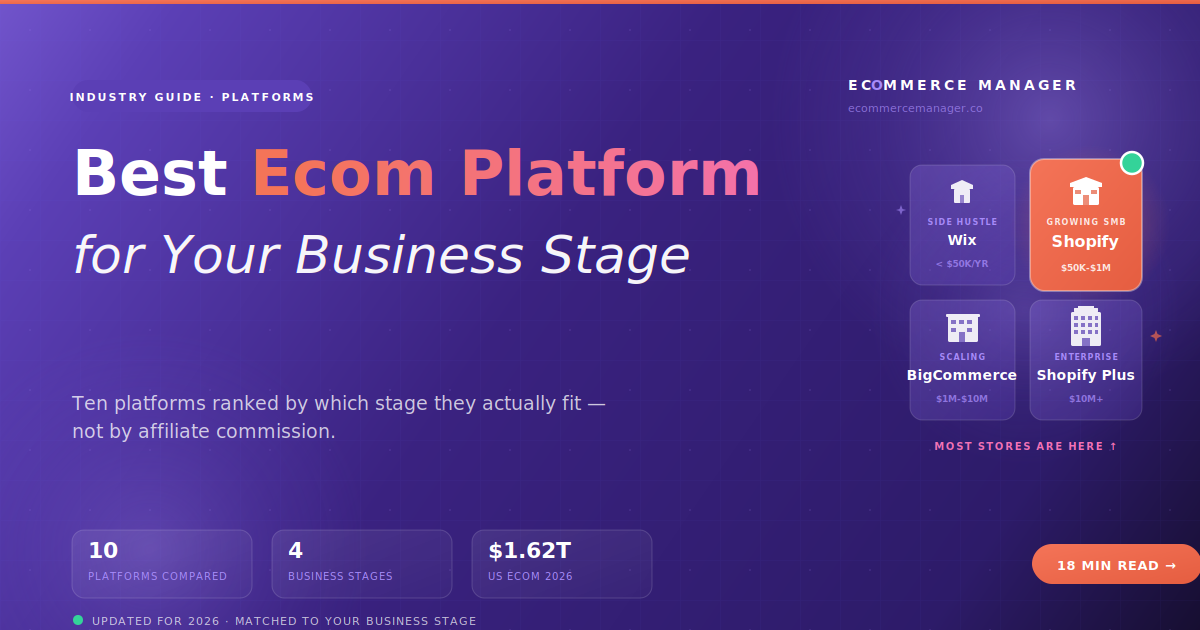
The platform is the layer everyone thinks of first because it's the layer customers see. Shopify is the pragmatic default for most stores under $10M in revenue — well-designed admin, best-in-class app ecosystem (17,000+ apps), scales from Basic to Plus, and hard to migrate off of once you're on it. BigCommerce wins for high-volume stores that want zero platform transaction fees. WooCommerce wins for WordPress-first operations. Wix and Squarespace fit smaller stores where design flexibility matters more than commerce depth.
For most operators reading this article, Shopify at $39-105/month is the right answer. Migrate to Plus around $3M/year when the transaction fee math and custom checkout capability start earning back their cost. For the deeper platform selection logic by business stage, see the complete platform guide.
2. Payment Processing — Stripe (or Shopify Payments)
Payment Processing
Payments is the category where 90% of merchants pay too much because they don't do the math. Standard US card-present rate is 2.9% + $0.30 per transaction. Stripe is the underlying processor for most SaaS platforms and pretty much every payment aggregator you've heard of. Shopify Payments (powered by Stripe under the hood) is the default on Shopify — using it also waives Shopify's 0.5-2% platform transaction fee, which is why Shopify pushes it hard. PayPal Express as a secondary option converts well but at higher fees.
The optimization: for Shopify stores, use Shopify Payments as primary and add PayPal Express + Shop Pay for conversion. For non-Shopify stores, Stripe directly. For high-volume stores ($1M+/month), negotiate interchange-plus pricing with Stripe or Adyen — this can drop effective rates by 0.3-0.5%, which is real money at scale.
3. Email & SMS Marketing — Klaviyo
Email & SMS Marketing
For most ecom brands, email is the single highest-ROI marketing channel. Not "one of the highest" — the highest. Serious operators generate 20-40% of total revenue from email alone. Klaviyo is the category standard for good reason: purpose-built for ecom (unlike Mailchimp which is built for newsletters), tight Shopify integration, sophisticated segmentation, and flows that handle everything from abandoned cart to post-purchase to VIP tiers. Free up to 250 contacts, then scales roughly with list size.
For SMS specifically, Postscript is the dedicated leader (Shopify-native, cleaner segmentation than Klaviyo's SMS). Attentive is the enterprise alternative. Most stores under $5M can run everything through Klaviyo's combined email + SMS. Above that, splitting SMS to Postscript is often worth it for the deeper feature set.
4. Ecommerce Analytics — Triple Whale (or GA4 + Shopify Analytics)
Ecommerce Analytics
Post-iOS 14 attribution is broken by default on every platform. Meta reports higher conversions than actually happened. GA4 undercounts because of cookie loss. Shopify shows you what happened, not what caused it. The fix is a dedicated ecom analytics tool that combines platform data with server-side attribution to give you honest numbers. Triple Whale is the category leader — pulls in Shopify, Meta, Google, TikTok, and Klaviyo data, then attributes revenue back to source using post-purchase surveys plus server-side tracking. From $129/month.
For stores under $500K/year, Shopify Analytics + GA4 (both free) are usually enough. Triple Whale earns its cost once you're spending real ad budget and need to know whether your Meta campaigns are actually profitable. Polar Analytics is the strong alternative at a similar price point. See the complete analytics tools breakdown for the full comparison.
5. Product Reviews — Yotpo (or Judge.me for Budget)
Product Reviews
Reviews are one of the highest-ROI additions to any store. Adding a review system typically lifts conversion rate 20-30%, adds structured data that helps SEO (stars in Google results), and gives customers the exact social proof that overcomes purchase anxiety. Yotpo is the category standard — deep Shopify integration, automated review request emails, photo/video reviews, and syndication to Google Shopping. From $19/month, scales with review volume.
For budget-conscious operators, Judge.me offers most of Yotpo's core functionality for free (with a paid $15/month tier). It's genuinely competitive for early-stage stores. Okendo is the mid-market alternative that's grown fast. But for most operators past $50K/year in revenue, Yotpo's automation and integrations are worth the upgrade.
6. Customer Support — Gorgias
Customer Support
Customer support is where most operators massively underinvest until they have a crisis. Gorgias is the category leader specifically built for ecommerce — pulls order data, customer history, and past interactions into every conversation. Answering "where's my order?" takes 10 seconds instead of 5 minutes because the order info is right in the ticket. Auto-tags similar tickets, macros for common issues, and integration with Shopify, Klaviyo, and everything else you use. From $10/month for the starter tier.
For solo operators, Gorgias's starter tier plus a personal email inbox works well. As volume grows past 100 tickets/month, upgrade tiers. Re:amaze is the strong alternative at similar pricing. Zendesk is more powerful but overkill for most ecom operations — better for enterprise B2B.
7. Shipping & Fulfillment — ShipStation
Shipping & Fulfillment
Shopify prints labels natively, and for stores under about 30 orders/day, that's enough. Above that volume, ShipStation is the industry standard for self-shipped stores — pulls orders from every channel (Shopify, Amazon, eBay, Etsy), gets you discounted carrier rates (USPS Commercial Plus, UPS, FedEx), batches label printing, and routes orders to the fastest carrier automatically. From $9.99/month for up to 50 shipments.
For stores past ~100 orders/day, consider a 3PL (third-party logistics provider) instead of self-shipping. ShipBob and Shipmonk are the DTC-focused leaders. You send inventory to their warehouses, they pick/pack/ship every order for you. Costs more per unit but eliminates the ops overhead entirely. Break-even point is usually around 50-100 orders/day depending on product size.
8. SEO & Content — Ahrefs
SEO & Content
SEO tooling has consolidated to essentially two serious options: Ahrefs and Semrush. Both do keyword research, competitor analysis, backlink tracking, and technical site audits. Ahrefs has the better backlink index (largest in the industry) and cleaner interface. Semrush has better content tooling and paid-search research if you also run Google Ads. Either works — pick one and commit. From $129/month for entry tiers, more realistic at $199-449/month for the plans most operators actually use.
For serious ecom operators, one of these tools plus a content calendar is the difference between organic traffic that grows quarter over quarter and organic traffic that plateaus. For agencies specifically, see the SEO companies for ecommerce guide.
9. Ad Management — Meta Ads Manager + Northbeam
Ad Management
Ad platforms themselves are free to use — Meta Ads Manager, Google Ads, TikTok Ads Manager. What you pay for is the media. What most operators underestimate is the tooling around ad management: attribution (Northbeam, Triple Whale), creative testing (Motion, Foreplay), and reporting (Supermetrics into a Google Sheet or Looker). For any store spending more than $10K/month on ads, one of the attribution tools is genuinely worth it — otherwise you're optimizing based on Meta's inflated numbers.
Motion is emerging as the leader for creative testing and iteration workflows for DTC brands. Northbeam is the enterprise-grade attribution platform (from $1,000/month, worth it above $50K/month ad spend). Below that spend level, Triple Whale's attribution is generally enough.
10. Loyalty & Retention — Smile.io
Loyalty & Retention
A repeat customer is 3-5x more profitable than a first-time buyer because you've already paid the acquisition cost. Loyalty programs are how you engineer that repeat behavior. Smile.io is the standard for ecom loyalty — points, referrals, VIP tiers, all with clean Shopify integration. Free up to 200 monthly orders, $49/month for growth features. Best combined with Klaviyo (email triggers on point milestones) for maximum impact.
LoyaltyLion is the enterprise alternative with deeper customization. Yotpo Loyalty is worth considering if you're already deep in Yotpo for reviews. For subscription businesses, loyalty is less critical (subs handle the repeat behavior) — spend the budget elsewhere.
The Underinvestment Trap Most Operators Fall Into
Nearly every store owner over-invests in the platform and under-invests in email, analytics, and reviews. This is backwards. Your platform difference between Shopify Basic and BigCommerce Standard costs you almost nothing in outcome. Not having Klaviyo, not having attribution, and not having reviews on product pages costs you 20-50% of the revenue you could be earning. Reallocate.
Build Your Stack in Phases (Don't Buy Everything at Once)
The mistake most operators make is buying the growth-tier stack when they should still be on the launch stack. Here's what to run at each stage of revenue:
- Platform: Shopify Basic ($39)
- Payments: Shopify Payments (free)
- Email: Klaviyo Free (250 contacts)
- Analytics: Shopify + GA4 (free)
- Reviews: Judge.me Free
- Support: Gmail + Gorgias Starter
- Shipping: Shopify Shipping
- Loyalty: Smile Free tier
- Platform: Shopify ($105/mo)
- Email: Klaviyo paid ($60-150)
- Analytics: Triple Whale ($129)
- Reviews: Yotpo ($19-79)
- Support: Gorgias Basic ($60)
- Shipping: ShipStation ($30)
- SEO: Ahrefs Lite ($129)
- Loyalty: Smile.io ($49)
- Platform: Shopify Advanced or Plus
- Email + SMS: Klaviyo + Postscript
- Analytics: Triple Whale + Northbeam
- Reviews: Yotpo full ($299+)
- Support: Gorgias Advanced
- Fulfillment: 3PL (ShipBob)
- SEO: Ahrefs Advanced + Motion
- Loyalty: LoyaltyLion or Yotpo Loyalty
Common Stack Mistakes (And What They Actually Cost You)
- Delaying email setup "until we have more traffic." Email compounds — every subscriber you don't capture today is revenue you can never earn later. Set up Klaviyo on day one, even with 10 subscribers.
- Running paid ads without attribution. Meta's reported ROAS is 2-4x higher than actual on most accounts. Without Triple Whale, Polar, or Northbeam, you're scaling what feels like your winners — which are often not your winners.
- Buying enterprise tools too early. A $1,000/month Northbeam subscription for a store doing $30K/month in revenue is expensive theater. Match your stack to your stage.
- Skipping reviews because "we'll add them later." Reviews add 20-30% to conversion rate. That means every day without them costs you 20-30% of your revenue. Judge.me is free — install it today.
- Using Gmail for customer support past 50 tickets/week. Support tickets in Gmail get lost, duplicated, and mis-routed. Move to Gorgias the day you feel the pain.
- Assuming Shopify Analytics tells you what caused a sale. It tells you what happened, not what drove it. Without a dedicated attribution layer, your channel decisions are guesswork.
How to Actually Pick Your Stack
Skip the "which is best" listicles for each category. Answer these questions honestly and the stack picks itself:
1. What's your current annual revenue?
Under $50K → Launch stack. $50K-$1M → Growth stack. $1M+ → Scale stack. Don't buy above your stage; you'll bleed cash on features you can't use yet. Don't buy below your stage; you'll cap your growth and pay for it in migration costs later.
2. Which pillar are you weakest in?
Every operator has one obvious gap. If you don't know your ROAS by channel: fix analytics first. If your abandoned cart flow doesn't exist: fix email first. If customers wait days for support responses: fix support first. Fix the weakest link, then reassess.
3. What's your team capacity?
Solo operator: pick tools with good defaults and minimal setup (Shopify + Klaviyo + Judge.me). Team of 2-5: you can absorb more complexity (add Triple Whale, Gorgias, Yotpo). Team of 10+: enterprise tooling starts earning its keep.
4. What's the switching cost if you migrate later?
Some tools are low-cost migrations (reviews platforms, support tools). Some are painful (platform, email marketing with historical data). Optimize the painful ones for long-term fit, not the low-cost ones.
The Honest Bottom Line
"Best ecommerce solutions" isn't one tool — it's about ten. The platform is important but not more important than email, analytics, or reviews. The stack that generates outsized results is one where every pillar is covered at the tier your revenue supports. Not everything at the enterprise tier. Not everything at the free tier. Match the tool to the stage, spend the freed budget on ads and inventory, and let the compound effects do their work.
If you already run a Shopify store without Klaviyo, without reviews on your product pages, and without attribution beyond what Meta's dashboard tells you — that's where your stack is leaking revenue. Fix those first. Everything else is optimization on top.
Need Help Building Your Stack?
The eCommerce Manager helps operators audit their tooling stack against real revenue leakage — what's missing, what's overbuilt, and what's earning its cost.
Get a Stack Audit →