

Last Updated on July 31, 2026
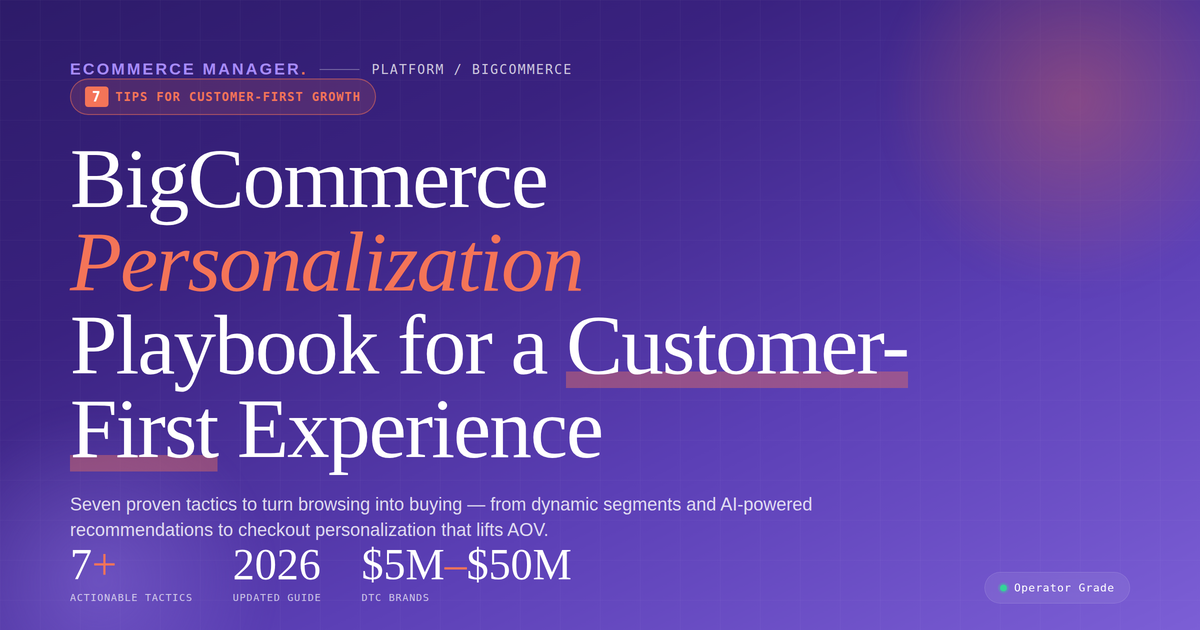
BigCommerce Personalization: 7 Tips for a Customer-First Experience
Online shoppers expect experiences tailored to their needs, not generic storefronts that treat everyone the same. Personalization has become essential for BigCommerce merchants who want to increase conversions and build lasting customer relationships. This guide shares seven proven strategies from e-commerce experts to help businesses create customer-first experiences that drive measurable results.
- Match Experience to Entry Intent
- Anchor Choice to the Key Attribute
- Segment Content by Subscription Status
- Trigger Behavior-Based Emails and On-Site Actions
- Tailor Support via Live Customer Context
- Build Unique Features through AI Assistance
- Show Real Examples and Embed Proof Approval
Match Experience to Entry Intent
A simple win is to personalise by entry intent, not by broad audience labels. On one BigCommerce store in home fitness, product page banners and collection sorting changed based on the visitor’s landing page and on-site behaviour. People coming from “apartment gym” searches saw compact gear, clutter-related FAQs, and delivery info first, while people browsing strength gear saw bundles, weight range guides, and financing sooner. That change increased add-to-cart rate by about 18% over six weeks.
The reason it works is that most stores personalise too late, after a customer has already done the work of filtering. The better move is to cut choice and answer the next question early: size, use case, shipping, fit, or price. I’ve used BigCommerce customer groups and custom fields for some of this, but the bigger gains usually came from pairing them with behaviour-based rules through a tool like Nosto or a light setup via Google Tag Manager and BigCommerce stencil logic.
A good example was a skincare store where returning visitors who had viewed sensitive-skin products were shown a calmer homepage version with fragrance-free ranges, proof points, and fewer promo tiles. Average pages per session went up from 3.1 to 4.0, and repeat purchase rate improved by roughly 9% over the next two months.

Anchor Choice to the Key Attribute
My one tip is to personalise on the single fact that decides the whole purchase, and ignore the rest. For a lot of stores, that instinct goes straight to browsing history and clever recommendation widgets, but for a considered product the most powerful personalisation is answering the question the customer would otherwise have to work out for themselves. In our case, selling EV charging cables, that question is always the same: which of these will fit my car?
The way we implemented it was to let a visitor pick their vehicle once, then reshape the storefront around that choice. Tell us it is a particular model, and the site stops showing cables that will not connect to it and leads with the ones that do, at the lengths that suit a normal driveway. It is not exotic technology; it is a stored preference driving what gets surfaced, but it turns a confusing wall of connector types into a short list a nervous buyer can trust. The personalisation is doing the job a good shop assistant would do, narrowing the choice to what is right for you.
The effect was most visible in returns rather than just conversion. Once people were being shown only cables compatible with the car they had told us about, wrong-product returns on those paths fell by around 25%, because the mismatch that caused them was designed out. The example I would give any store is to find the one attribute that makes or breaks the fit, capture it early, and personalise the catalogue around it. That beats guessing at someone from their clicks.

Segment Content by Subscription Status
Before optimizing anything else on BigCommerce, segment your homepage and product recommendation blocks by subscription status. At Happy V, a first-time visitor and an existing subscriber used to see the same “try our probiotic” hero — wasted real estate for a customer already on autoship. We split the audience into first-time, one-time buyer, and active subscriber, then swapped the block logic: subscribers see complementary SKUs matched to purchase history (a digestive enzyme next to their vaginal probiotic), not what’s already in their fridge.
Two compliance notes shaped this: recommendations stay on-label — we don’t let a personalization engine generate health claims — and bundling copy mirrors language our scientific advisory board already cleared. We validated with a pre/post read against the prior static hero. AOV lifted once subscribers stopped being re-sold their own regimen.

Trigger Behavior-Based Emails and On-Site Actions
As the Founder and CEO of Zen Agency, with over 22 years of experience scaling e-commerce brands, my number one tip for personalizing a BigCommerce store is to move beyond basic name tags and implement dynamic, behavior-based email and on-site triggers. True personalization means delivering hyper-relevant content based on exactly how a user interacts with your catalog, turning anonymous browsing into tailored solutions.
For example, we leverage advanced behavioral segmentation to trigger “Browse Abandonment” sequences. If a customer views a highly specific product category multiple times without adding anything to their cart, we automatically trigger an educational guide tailored to that exact product line to help them make an informed decision.
We also use purchase history to automate highly personalized milestone triggers, such as automated replenishment reminders exactly 30 days after a consumable purchase and exclusive, VIP-only loyalty perks for the top 5% of customers. This strategy moves the customer experience from a generic, transactional relationship into highly relevant, automated brand advocacy that can boost lifetime value by up to 30%.

Tailor Support via Live Customer Context
While I don’t run a BigCommerce storefront directly, my team at AGO builds the AI customer operations systems that plug into ecommerce platforms for growing brands. From what I see on the backend, the most overlooked area for personalization isn’t in product recommendations—it is in customer support. Usually, brands heavily personalize the front-end shopping experience, but the moment a customer submits a support ticket, they get dropped into a generic, one-size-fits-all queue.
My tip is to connect your support AI or ticketing system directly to your store’s customer data layer, so every reply is tailored to their specific buying history.
In our deployments, we set up AI agents to query a store’s backend the second a support ticket arrives. For example, if a shopper emails about a fit issue with a jacket, the system doesn’t just send a standard return policy link. It pulls their purchase history. If the data shows they typically buy a medium but ordered a large this time, the AI drafts a response that actively acknowledges that specific context—noting that the new item might run differently than their usual fit—and immediately offers a friction-free exchange for their standard size. Bringing that level of tailored data into the post-purchase phase usually turns a frustrating return process into a moment where the customer feels genuinely remembered.

Build Unique Features through AI Assistance
Don’t stop with the basics available to you on the platform. Go above and beyond to develop custom experiences particular to your product and customer. No matter what platform you are on, AI-assisted coding is a great tool that even non-developers can use to make highly customized experiences. It could be adding information, cross linking different products, or something even more original. These features can help sell individual products, and make your website a more engaging place to stay.

Show Real Examples and Embed Proof Approval
Since almost everything we sell is custom, personalization for us starts before checkout, not after. On product pages, we make sure customers can see real examples close to what they are ordering, whether that is a similar pin design, patch style, or metal finish, so they are not guessing what their own order will look like. That alone cuts down on a lot of back and forth after purchase.
One specific change that helped was adding clearer proofing communication right into the order flow instead of treating it as a separate email later. Customers get a proof to review and approve before production starts, and framing that as part of the buying experience, not an extra step, has made people feel more involved in their own order instead of just waiting on us.

Related Articles
- Building Brand Loyalty on BigCommerce: 8 Proven Strategies from Top Sellers
- Effective Shipping Strategies for Your BigCommerce Store
- 8 Ways to Personalize Your WooCommerce Shopping Experience