


Last Updated on July 15, 2026
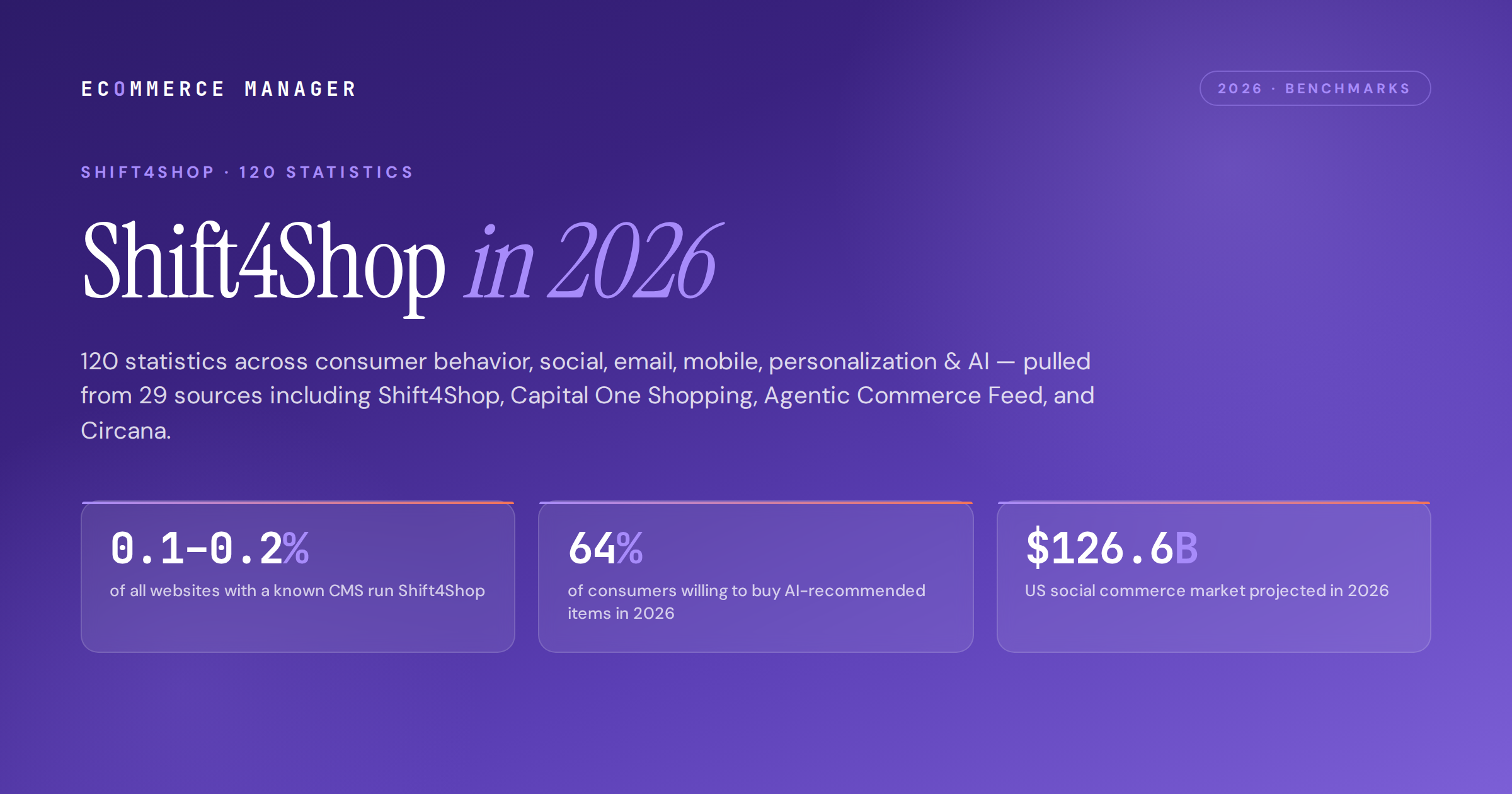
Shift4Shop in 2026: 120 statistics on consumer behavior, social, email, mobile, personalization, and AI
The 120 numbers B2C operators evaluating or running Shift4Shop need on hand — pulled from Shift4Shop's own data, Capital One Shopping, Agentic Commerce Feed, Escalent, Circana, and 24 other sources.
On this page
The state of Shift4Shop in 2026
Shift4Shop occupies a strange niche in 2026: a legitimate ecommerce platform with enterprise-grade features that most of the industry has quietly forgotten. W3Techs data pegs its market share at 0.1–0.2% of known CMS sites — a rounding error next to Shopify and WooCommerce — but its zero-subscription pricing for US merchants who adopt Shift4 Payments makes the total cost of ownership math genuinely different from every other platform in the mid-market.
The 120 statistics below are drawn from 29 sources: Shift4Shop's own product pages and blog, Capital One Shopping's 2025 consumer behavior research, industry analysts (Escalent, Circana, Akeneo, Salsify, Netguru, DHL, Contentsquare), and specialist coverage from Agentic Commerce Feed on Shift4Shop's AI readiness specifically. They're organized into six sections: consumer behavior, social commerce, email marketing, mobile UX, personalization, and AI in B2C.
This is not a Shift4Shop product review. It's the benchmark set every Shift4Shop operator — or every operator weighing the platform against Shopify, BigCommerce, or WooCommerce — should have on hand for planning 2026 budgets, targets, and platform decisions.
Shift4Shop + consumer behavior
Shift4Shop sits in an unusual spot in 2026: a niche CMS by market share but a serious contender on cost, thanks to its transaction-driven pricing tied to Shift4 Payments. The behavior data below explains why the platform's SMB positioning fits the current consumer moment — price-sensitive, research-heavy, and low on brand loyalty.
-
01W3Techs estimates Shift4Shop/3dcart is used by about 0.1–0.2% of all websites with a known CMS, placing it as a niche but capable ecommerce platform.
-
02Shift4Shop positions itself as "best ecommerce software of 2026" for SMBs, with hands-on assistance and extensive resources for merchants building or migrating stores.
-
03For US businesses using Shift4 Payments, full access to Shift4Shop's core platform is effectively free, making transaction-driven pricing a major draw.
-
04Reviews highlight Shift4Shop's strategy for 2026 as capturing SMBs with enterprise-grade features plus direct-to-payment infrastructure, lowering total cost of ownership while accelerating go-to-market.
-
05OfferSafari and other independents describe it as a top free ecommerce platform option for serious operators willing to adopt Shift4's payments stack.
-
06Shift4Shop's ecommerce statistics page notes that over 80% of shoppers conduct online research before big purchases, underscoring the importance of rich product content and reviews.
-
07The same resource cites that average online shopping cart abandonment rate is high, illustrating how common incomplete purchases are and why abandonment recovery tools matter.
-
08Capital One Shopping's 2025 report finds 86% of US consumers read online reviews before purchases, and 66% use search engines to research companies or products.
-
0994% of consumers say good customer service inspires brand loyalty, and 82% make recommendations based on good service, making service a central differentiator for Shift4Shop merchants.
-
1075% of consumers tried different brands and new ways to shop within three months, and among those trying new brands, 73% intend to keep exploring — indicating low long-term brand lock-in.
-
11American consumers spend 87.9% of after-tax income on goods and services, with average per-person consumer spending projected at $32,732 in 2025.
-
1272% of consumers express concern about increasing everyday costs, intensifying demand for deals, clear value, and transparent pricing.
-
13Over five years, online searches for sustainable products increased 71%, showing growing interest in ethical and eco-friendly offerings.
-
1473% of consumers compare prices across three or more retailers before buying, increasing competitive pressure on Shift4Shop merchants to differentiate.
-
1577% often view return policies before buying, making clear policies on Shift4Shop product and checkout pages essential.
-
1657% research intended purchases extensively, which shifts emphasis from pure discounting to comprehensive content and transparency.
-
17288.5 million Americans shop online retail, and 254 million shop via smartphones, reinforcing a massive online consumer base for Shift4Shop users.
-
18For most consumers, the primary reasons for shopping online are home delivery (58%) and convenience (51%), making logistics and UX central to perceived value.
-
19Circana and other 2026 analyses highlight consumers' desire for value-driven, transparent, and seamless experiences, pushing Shift4Shop stores to optimize journeys rather than just discount.
-
20Shift4Shop's own statistics emphasize that it's more expensive to acquire new customers via paid ads than to retain existing ones, underscoring the importance of retention tactics.
Weighing Shift4Shop against Shopify, BigCommerce, or WooCommerce?
Model the 3-year total cost — including payments lock-in, app tax, and migration overhead — for your revenue tier in under two minutes.
Email marketing & lifecycle
Shift4Shop bundles newsletter tools, autoresponders, and an Abandoned Cart Saver into the base platform — meaning much of what other platforms treat as third-party add-ons is native here. For SMBs, that's an unusually complete lifecycle stack out of the box.
-
01Shift4Shop's marketing page highlights "online retail marketing tools like discounts, coupons, group deals, daily deals, and more" plus analytical tools for customer behaviour.
-
02The same page promotes built-in email marketing that reliably increases sales and draws existing customers back with customized offers.
-
03Shift4Shop includes newsletter tools so merchants can send targeted email campaigns directly from the platform.
-
04Email tools extend beyond newsletters: merchants can set up drip campaigns via Autoresponders, sending a series of post-purchase emails automatically.
-
05The Abandoned Cart Saver encourages customers via email to return and complete their transactions, directly addressing cart abandonment.
-
06Shift4Shop's ecommerce statistics note that for every dollar spent acquiring customers, only $1 is spent converting them, highlighting the need for lifecycle email and conversion optimization.
-
07They also stress it's more expensive to acquire new customers via paid ads than to retain existing ones, reinforcing email retention's importance.
-
08Industry-wide, email marketing is cited as one of the best and most important methods for ecommerce marketing, key to growing an audience of recurring customers.
-
09BayEngage/TargetBay provides dedicated email marketing and automation for Shift4Shop, enabling campaign creation, sending, and analysis while staying on-brand.
-
10TargetBay's campaigns offer unique ways to grow and communicate with audiences, integrating with Shift4Shop stores.
-
11Email remains a high-ROI channel: marketing statistics generally place email near the top for return on investment vs other digital channels.
-
12Forge Apollo's 2026 stats report average campaign open rates near 38% and automated flow open rates near 49%, with automated flows driving higher CTR.
-
13Automated email flows (welcome, post-purchase, win-back) typically see CTR around 4.7%, far above bulk campaigns' 1.3%.
-
14Capital One Shopping notes that good customer service and positive experiences drive recommendations, which can be reinforced via email.
-
1580% of consumers prioritise cost savings over convenience, but 50% are willing to spend more to save time — giving email offers and convenience messaging strong relevance.
-
16AI-powered email tools can increase open rates by significant margins, with some studies citing up to 41% improvements in certain industries.
-
17AI and automation are expected to handle a large share of repetitive campaign tasks, freeing marketers to focus on strategy and creative.
-
18As cookies decline, email becomes a privacy-resistant, first-party data channel crucial for Shift4Shop merchants.
-
19Shift4Shop's integrated email and abandoned cart flows help merchants convert more of their hard-won traffic into revenue without extra tools.
-
20Overall, Shift4Shop positions email marketing as a core built-in capability — newsletters, drip campaigns, and cart recovery — underpinning B2C lifecycle growth.
Mobile commerce & UX
254 million Americans now shop on smartphones — more than any other channel. Shift4Shop's stock themes ship responsive by default, but the platform's 2026 mobile competitiveness depends less on whether the theme adapts and more on whether the merchant tunes it for one-thumb use.
-
01Capital One reports 254 million Americans shop online via smartphones, making mobile the dominant shopping device.
-
0276% of Americans have bought a product on their smartphone, compared to 69% on desktops/laptops.
-
0340% of consumers shop online because it's cheaper than in-store, while 36% value 24-hour availability, and 34% seek a wider product range — all benefits delivered on mobile.
-
0430% shop online because it's easier to compare products, which mobile shoppers often do quickly via multiple tabs or apps.
-
05Shift4Shop's mobile ecommerce page claims its stores "perform flawlessly on mobile devices without sacrificing functionality on desktop" thanks to responsive design.
-
06Responsive design means the site adapts to any device, ensuring consistent UX for phones, tablets, and desktops.
-
07Shift4Shop emphasises that merchants don't need separate mobile sites: one responsive store serves all device types.
-
08In 3dcart/Shift4Shop reviews, mobile responsiveness and performance are cited as core strengths compared with some older competitors.
-
09Consumer behaviour data show smartphones are the most popular device for online shopping, making mobile optimisation non-negotiable.
-
10Most shoppers value clear layout and design: Shift4Shop's statistics note that many people leave websites if they find the layout unattractive.
-
11Attractive, easy-to-navigate layouts significantly reduce bounce and abandonment, especially on mobile where patience is limited.
-
12Contentsquare's 2026 benchmark shows cross-device behaviour is normal: users jump between mobile and desktop, so consistent experiences matter.
-
13AI-driven UX tools increasingly analyse session paths and cross-device behaviour, helping merchants improve mobile experience over time.
-
14As social commerce and livestream shopping are mobile-native, many visits to Shift4Shop stores will start on mobile from social links.
-
15AI-powered search and discovery will increasingly surface mobile pages, making structured content and clean UX essential to conversions.
-
16Mobile advertising shares are high in digital ad spending, and Shift4Shop's Facebook Pixel integration helps merchants tap into mobile-heavy social audiences.
-
17Capital One data show that 50% of social media users under 50 have made purchases on social, often via mobile, demonstrating mobile-social synergy.
-
18Friction in delivery, returns, and payments is more noticeable on mobile, so clear policies and easy payment flows are critical.
-
19Shift4Shop themes and checkout must align with modern mobile expectations — speed, clarity, minimal typing — or merchants risk losing conversions.
-
20Overall, Shift4Shop's responsive designs plus mobile-centric consumer behaviour mean mobile commerce is the default context for many stores.
Need help getting Shift4Shop AI-ready?
Browse vetted SEO, structured data, and AI-personalization agencies that specialize in mid-market DTC brands running Shift4Shop, Shopify, and BigCommerce.
Personalization in B2C for Shift4Shop
Shift4Shop's personalization capability out of the box is thinner than Shopify or BigCommerce — but the platform's structured data flexibility means AI-driven personalization from Google, agentic commerce agents, and third-party recommendation engines can be layered on cleanly, provided merchants do the schema work.
-
01Shift4Shop's marketing tools include customised offers via email and discount features, enabling basic personalization such as targeted deals for returning customers.
-
02The platform supports customer segmentation via email tools and analytics, helping merchants tailor campaigns to behaviour and history.
-
03Agentic Commerce Feed notes that Shift4Shop's structured data output varies by theme and version, with some themes including microdata or JSON-LD and others including minimal or none.
-
04To improve AI-powered personalization and visibility, merchants are advised to add JSON-LD Product schema to templates using Shift4Shop's variables (name, price, brand, identifiers, description).
-
05Merchants should fill in all product fields (manufacturer, UPC, weight, attributes) to give AI and search more context for personalization and ranking.
-
06Detailed product descriptions — materials, dimensions, use cases, specs, care instructions — provide more content for AI agents to personalise recommendations.
-
07Enabling and collecting product reviews adds user-generated content and social proof, which can feed into structured data and AI layers when supported.
-
08Akeneo's 2026 trends note that AI-powered product search and discovery will shape ecommerce, meaning personalization depends heavily on rich product data.
-
09Akeneo reports 49% of Americans say AI recommendations already influence what they buy, and 64% are willing to purchase AI-recommended items, showing strong acceptance.
-
10Intelligence Node notes over 80% of American shoppers expect personalized shopping experiences, with many willing to pay more for sustainable goods.
-
11Netguru finds 64% of consumers express interest in tailored experiences, but only 41% feel benefits justify privacy trade-offs — highlighting the need for respectful personalization.
-
12Salsify's data show 37% of shoppers buy more often when they receive personalized product recommendations, a strong incentive for Shift4Shop merchants to deploy recommendation engines.
-
1325% of shoppers are willing to purchase AI-recommended products when given a personalised explanation, indicating messaging and transparency matter.
-
14Circana's hyper-personalization trend emphasises using pooled data from loyalty, panels, and transactions to tailor experiences — a concept Shift4Shop merchants can replicate on a smaller scale.
-
15Many consumers prioritise values alignment and community: personalization that surfaces local, sustainable, or artisanal items can justify higher prices.
-
16Agentic Commerce guidance advises using Google Shopping integration with Shift4Shop to create structured feeds that AI systems and shopping surfaces can access.
-
17Merchants should also optimize SEO settings (titles, meta descriptions, clean URLs) for every product, since these elements influence how AI agents categorize items.
-
18Adding an llms.txt file, correctly configured robots.txt, and canonical URLs ensures AI agents and search crawlers index the right product pages for personalization.
-
19Netguru notes AI-driven recommendations can raise conversion by up to 70%, making investments in structured data and personalization potentially high-ROI.
-
20Overall, personalization on Shift4Shop in 2026 is a mix of platform tools (discounts, email, reviews) and external AI/search readiness, grounded in rich, well-structured product data.
AI in B2C & the Shift4Shop ecosystem
The most consequential AI question for Shift4Shop merchants in 2026 isn't which AI to use — it's whether their store is structurally readable by AI at all. Agentic commerce is coming fast, and Shift4Shop's variable schema support means the burden of readiness falls squarely on the merchant.
-
01Agentic Commerce Feed focuses on AI readiness for Shift4Shop, noting that structured data varies by theme and recommending explicit JSON-LD implementation to improve AI visibility.
-
02It advises merchants to monitor AI visibility — checking whether products appear in AI shopping surfaces and then testing structured data and content for gaps.
-
03The guidance warns that if AI agent visibility is critical, merchants should evaluate whether Shift4Shop's limitations align with their strategy or whether migration to more AI-ready platforms is warranted.
-
04Akeneo's 2026 landscape names AI-powered search and discovery and agentic commerce as top trends, where AI agents proactively transact on behalf of users.
-
05SEMrush (via Akeneo) predicts AI-powered search will overtake traditional search by 2028, making AI a primary gateway to ecommerce sites.
-
06Akeneo reports 64% of people are willing to purchase items recommended by generative AI, a strong endorsement for AI-driven merchandising.
-
07Capital One notes social commerce at 17.1% of global ecommerce, much of it mediated by AI recommendation engines inside social platforms.
-
08Salsify's 2026 research shows 64% of shoppers use AI tools to discover or research new products, even though 33% do not — signalling mixed but significant adoption.
-
09Escalent and Circana emphasise AI-driven hyper-segmentation and journey design as necessary to deliver relevant, personalised experiences at scale.
-
10Digital marketing stats show 63% of marketers currently use generative AI, and 83% of sales teams using AI see revenue growth vs 66% not using AI.
-
11AI marketing revenue is expected to reach $107 billion by 2028, underscoring the centrality of AI in modern marketing stacks.
-
12AI is considered highly effective for data-heavy tasks like analysing customer behaviour and predicting churn, supporting smarter campaigns and merchandising.
-
13DHL's 2026 ecommerce report notes AI is going mainstream for younger shoppers and larger businesses, while misinterpretation and trust issues remain big concerns.
-
14Consumers worry about privacy and accuracy: Netguru warns that AI personalization must be balanced with transparency to avoid creepiness.
-
15Circana suggests brands must combine AI-driven personalization with values-based differentiation, not rely solely on algorithms.
-
16Agentic commerce guidance for Shift4Shop emphasises optimising product data, SEO, robots.txt, and canonical URLs so AI agents can index and understand stores correctly.
-
17Google Shopping feeds from Shift4Shop provide structured data that AI systems can access and use in shopping surfaces, boosting discoverability.
-
18Peer-to-peer payments and social shopping, often mediated by AI, are increasingly part of the retail landscape, affecting how Shift4Shop customers pay and shop.
-
19As AI shopping surfaces evolve, Shift4Shop merchants who implement full schema, complete attributes, and rich descriptions are more likely to benefit from AI recommendations.
-
20Overall, AI in 2026 acts as the invisible infrastructure behind search, recommendations, and optimization — and Shift4Shop merchants succeed by making their stores structurally ready for AI agents while keeping human-centric brand values front and center.
What matters most for Shift4Shop operators in 2026
Shift4Shop's economics are the story in 2026. Effectively free platform access for US merchants using Shift4 Payments makes it the lowest-cost credible ecommerce stack for SMBs — but the payments lock-in is the real price, and it needs to be modeled against long-term processing volume before signing.
The platform's lifecycle stack is unusually complete out of the box: newsletters, autoresponders, and an Abandoned Cart Saver are native. Automated email flows industry-wide see ~49% open rates and ~4.7% CTR — those benchmarks are achievable on Shift4Shop without the app-tax stack other platforms require.
AI readiness is Shift4Shop's biggest structural risk. Structured data output varies by theme, and 64% of consumers are already willing to buy AI-recommended items. Merchants who don't hand-configure JSON-LD product schema, complete attribute fields, and Google Shopping feeds will get progressively less visible as AI-mediated commerce accelerates through 2028.
Social commerce is where the growth is, and Shift4Shop's native Facebook Shop plus one-click Pixel install genuinely reduces the setup burden. With 50% of Gen Z and 51% of Millennials already buying on social, that native integration is worth more than the specs suggest — especially for brands that would otherwise pay app fees for equivalent Shopify functionality.
Frequently asked questions
Is Shift4Shop really free to use in 2026?
For US businesses that agree to use Shift4 Payments as their payment processor, yes — full access to Shift4Shop's core platform is effectively free, with revenue generated through payment processing fees rather than SaaS subscription pricing. Merchants outside the US or those unwilling to switch payment processors pay a traditional monthly subscription. The trade-off is real: you're locking in a payments vendor to save on platform cost.
How does Shift4Shop compare to Shopify for SMBs?
Shift4Shop offers a wider feature set at a lower base cost (or free with Shift4 Payments), including built-in newsletters, autoresponders, and an Abandoned Cart Saver that would be paid apps on Shopify. Shopify's advantages are ecosystem depth — thousands of vetted apps, a much larger developer talent pool, and stronger third-party integrations. For sub-$5M brands willing to trade ecosystem breadth for lower cost and payments consolidation, Shift4Shop is a serious contender. Above that, most brands hit Shopify's advantages faster.
What are Shift4Shop's key AI capabilities?
Shift4Shop itself does not ship with proprietary AI merchandising tools comparable to Shopify Magic or BigCommerce's AI features. Its AI story is external: making the store structurally ready for AI shopping agents through JSON-LD product schema, complete product attribute fields, Google Shopping feeds, and clean SEO configuration. Merchants who invest in structured data and content depth are the ones who benefit as agentic commerce and AI-powered search grow through 2026 and 2028.
Does Shift4Shop handle mobile commerce well?
Shift4Shop themes ship responsive by default and, per platform documentation, adapt to any device without requiring separate mobile sites. Reviews consistently cite mobile responsiveness as a platform strength. The practical caveat: as with any platform, mobile UX quality depends heavily on merchant configuration — theme choice, image optimization, checkout tuning, and thumb-friendly CTA sizing. Responsive by default is not the same as mobile-optimized in practice.
Should I stay on Shift4Shop or migrate to another platform?
The decision hinges on three factors: (1) whether you're comfortable with Shift4 Payments as your long-term processor, (2) whether your growth trajectory will need advanced app ecosystem depth or headless architecture, and (3) whether AI agent visibility is critical to your acquisition strategy. Brands under $2M in revenue with straightforward product catalogs are often well-served staying put. Brands over $5M that need custom checkout, complex merchandising, or heavy third-party integrations typically outgrow Shift4Shop and migrate to Shopify, BigCommerce, or WooCommerce.
The playbook top eComm operators actually read
One weekly brief. Five stories that matter. Zero fluff. Written for managers at $5M–$50M DTC brands who want to sound sharper than everyone else in the meeting.
References
- 01 W3Techs — 3dcart/Shift4Shop CMS Usage — w3techs.com
- 02 Shift4Shop — Official Site — shift4shop.com
- 03 Linktly — Shift4Shop Review — linktly.com
- 04 OfferSafari — Shift4Shop Ecommerce Review — offersafari.com
- 05 Ecommerce Paradise — Shift4Shop 2026 Review — ecommerceparadise.com
- 06 Shift4Shop — Ecommerce Market Statistics — shift4shop.com
- 07 Capital One Shopping — Consumer Behavior Statistics — capitaloneshopping.com
- 08 Circana — Consumer Marketing Trends 2026 — circana.com
- 09 Shift4Shop — Ecommerce Marketing — shift4shop.com
- 10 SellersCommerce — Social Commerce Statistics — sellerscommerce.com
- 11 Escalent — Top Consumer Trends 2026 — escalent.co
- 12 Netguru — Consumer Behavior Trends — netguru.com
- 13 TargetBay — BayEngage for Shift4Shop — targetbay.com
- 14 Forge Apollo — Digital Marketing Statistics 2026 — forgeapollo.com
- 15 Shift4Shop — YouTube Review — youtube.com
- 16 Salesforce — Marketing Statistics 2026 — salesforce.com
- 17 Shift4Shop Blog — Email Marketing — blog.shift4shop.com
- 18 HubSpot — Marketing Statistics — hubspot.com
- 19 Adobe — AI Marketing Trends — adobe.com
- 20 DHL — 2026 Ecommerce Trends Report — dhl.com
- 21 Shift4Shop — Mobile Ecommerce — shift4shop.com
- 22 Stuart Kerrs — Shift4Shop Reviews — stuartkerrs.com
- 23 Contentsquare — 2026 Digital Experience Benchmark — contentsquare.com
- 24 Square AI — Product Page — squareup.com
- 25 Agentic Commerce Feed — Shift4Shop AI Readiness — agenticcommercefeed.com
- 26 Akeneo — 2026 Ecommerce Trends — akeneo.com
- 27 Intelligence Node — Top Consumer Behavior Trends 2026 — linkedin.com
- 28 Salsify — How Consumer Buying Behavior Is Changing in 2026 — salsify.com
- 29 BuiltWith — Shift4Shop Trends — trends.builtwith.com
Make every platform decision data-backed
Join 12,000+ ecommerce managers reading the ECM newsletter every Wednesday — or browse the directory to find vetted CRO, retention, and AI-readiness partners for your Shift4Shop stack.
Social media & social commerce
Shift4Shop ships with native Facebook Shop export and Pixel installation baked in — which matters because 50% of Gen Z and 51% of Millennials now buy directly on social. The platform's social integrations are a meaningful cost saver against Shopify's app-tax model.