

Last Updated on July 3, 2026
Shopify Alternatives in 2026: A Cost-First Guide for DTC Operators
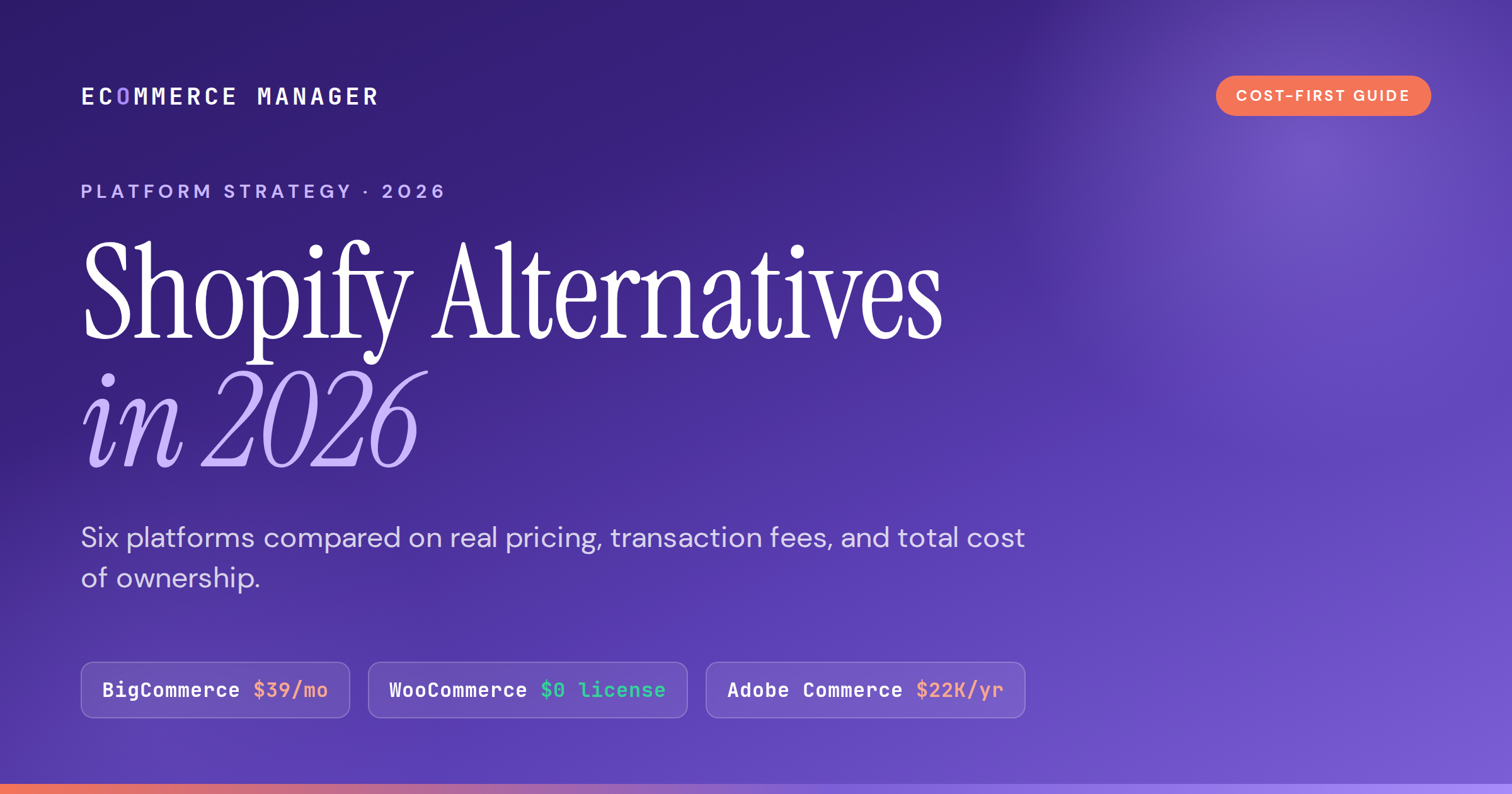
Six credible alternatives, benchmarked on the numbers that decide a replatform: subscription price, the fees hiding underneath it, and what each one actually costs to run at your revenue.
On this page
The only useful way to compare
Shopify still runs roughly 26.9% of every identifiable online store in 2026, and closer to 30% in the US. It is the default for a reason. But defaults get expensive, and the question that lands in most operators' inboxes is not "is Shopify good." It is narrower: is one specific fee, feature ceiling, or ownership constraint worth leaving for?
That is the only useful frame for this decision. You are not comparing brochures. You are comparing a line item on your P&L against the switching cost of moving it. This guide benchmarks six credible alternative platforms on the numbers that actually move a replatform decision: subscription price, the transaction and payment fees sitting underneath it, and what each one costs to run at $5M to $50M in revenue.
Every price below is current as of July 2026, including BigCommerce's June 1 plan rename and its new payment fee, which changed the math for a lot of stores overnight.
Why operators actually leave Shopify
Nobody replatforms because a competitor's homepage looked nicer. The moves I see are triggered by a specific, quantifiable cost. Four show up again and again.
-
01The third-party gateway surcharge. Shopify charges an extra 0.2% to 2% on every order if you use a payment processor other than Shopify Payments. On Basic that top rate is 2%. At $50K a month, that is $1,000 leaving the building monthly, more than the plan itself. If a contract locks you to an outside processor, this is a real, recurring tax rather than an annoyance.
-
02The Plus jump. Shopify Plus now starts around $2,300/month, roughly six times the Advanced plan. Brands crossing into the $5M+ band hit that wall and start pricing what the same money buys elsewhere. Sometimes Plus is worth every dollar. Sometimes it funds features you will never switch on.
-
03The checkout and B2B ceiling. Deep checkout customization and native B2B (unlimited catalogs, partial payments, deposits) still live on Plus. If your model needs wholesale pricing tiers or a custom checkout and you are on Advanced, you are choosing between a $2,300 upgrade and a platform that includes it lower down.
-
04App-stack creep. Mid-market Shopify brands routinely spend $350 to $1,400/month on apps to cover gaps that other platforms include natively. Add that to the subscription and the "cheap" plan is not cheap. A tech stack audit usually finds two or three apps you are paying for that a different platform bundles.
Notice the pattern: every trigger is a number. If you cannot name the number that is pushing you off Shopify, you probably are not ready to replatform yet.
The 2026 Shopify alternatives, side by side
Here is the field, priced as of July 2026. The Shopify row is the baseline you are comparing against, highlighted at the top. Every figure is US pricing; annual billing lowers most SaaS plans by 10–25%.
| Platform | Store entry price | Top self-serve tier | Platform / extra fees | Best fit |
|---|---|---|---|---|
| Shopify (baseline) | Basic $39/mo | Advanced $399/mo; Plus $2,300+/mo | 0% with Shopify Payments; +0.2–2% on third-party gateways | All-in-one DTC, fastest launch, deepest app ecosystem |
| BigCommerce | Core $39/mo | Scale $399/mo; Performance $1,499+/mo | No platform fee; new Open Payment Provider Fee 0.6–2% on non-embedded gateways | Closest SaaS swap; strong native B2B/B2C, no app tax for core features |
| WooCommerce | Free license; hosting from ~$25/mo | Self-managed; TCO $1.8K–$10K+/yr | None beyond your gateway (~2.9%+30¢) | WordPress teams that want to own the stack and customize freely |
| Adobe Commerce | Open Source: free | Adobe Commerce ~$22K/yr; Cloud ~$40K/yr | License scales with GMV; gateway on top | Enterprise B2B, complex catalogs, multi-store, custom pricing logic |
| Wix | Core $29/mo | Business Elite $159/mo | No Wix fee; gateway ~2.9%+30¢ | Small stores, service businesses, fast design without dev help |
| Squarespace | Core $23/mo | Advanced $99/mo | 3% on Core; 0% on Plus/Advanced | Design-first brands, small catalogs, content-heavy storefronts |
| Headless (commercetools / Medusa) | Medusa: free; commercetools $100K+/yr | Negotiated enterprise | Varies by build; infra + dev-heavy | API-first teams needing a fully custom, composable stack |
Sources: platform pricing pages and 2026 cost breakdowns (BigCommerce, Shopify, Wix, Squarespace, Adobe, StoreLeads). BigCommerce plans reflect the June 1, 2026 rename (Standard→Core, Plus→Growth, Pro→Scale, Enterprise→Performance). WooCommerce and Adobe Commerce TCO figures are ranges, not sticker prices; your real cost depends on hosting, extensions, and development.
Model the real number before you switch
A sticker price is not a total cost. Run your revenue, order volume, and gateway split through the platform calculator to see three-year TCO side by side.
BigCommerce: the like-for-like alternative
If you want to leave Shopify without leaving hosted SaaS, this is the one to price first. Same three-tier logic, similar entry price, and more included in the base plans.
Pricing tracks Shopify almost dollar for dollar after the June 1, 2026 rename: Core at $39/mo, Growth at $105/mo, Scale at $399/mo, and Performance from $1,499/mo billed annually. The historical selling point was zero platform transaction fees, and the base plans still include features (reviews, faceted search, multi-channel) that Shopify gates behind apps or higher tiers.
Two things changed in 2026, and you need both in your model. First, BigCommerce added an Open Payment Provider Fee: 2.0% on Core, 1.0% on Growth, 0.6% on Scale, charged on GMV from orders that do not run through an embedded provider. Performance pays 0%. Second, the GMV thresholds that auto-upgrade you between tiers were cut, so the same revenue now lands you a tier higher than it used to. Core caps at $30K GMV, Growth at $100K.
Net read: BigCommerce is still the strongest structural alternative for a mid-market DTC brand, especially on B2B and multi-storefront. Just price the payment fee and the tighter thresholds honestly. The full breakdown lives in our BigCommerce platform review.
WooCommerce: control, if you have the team
WooCommerce still powers around a third of all online stores globally and owns roughly 85% of the WordPress commerce plugin market. The license is $0. That is also the most misread number in this entire guide.
The real cost is your stack. A production store realistically runs $1,800 to $3,000 a year at the low end once you add managed hosting, a premium theme, essential extensions, and payment processing. Complex builds pass $10,000, and a full custom enterprise build can clear $50,000 in year one. Hosting alone spans $25/mo shared plans that break at scale up to $700/mo managed tiers.
WooCommerce takes nothing on top of your gateway, so your only per-order cost is the processor's standard rate. That is the win. The catch is that you are now the IT department: updates, security patches, performance tuning, and uptime are yours. Plenty of $10M+ brands run on it happily, but they staff for it.
Choose WooCommerce when you have genuine WordPress or PHP capacity in-house or on retainer, and when the customization you need is something a hosted platform simply will not allow. Choose against it if you want hands-off operations. Details in the WooCommerce review, and if you are cost-sensitive and open-source-friendly, OpenCart is worth a look as a lighter self-hosted option.
Adobe Commerce: power with a price to match
This is the enterprise end of the field. Adobe Commerce (the platform formerly sold as Magento Enterprise) is the share leader for B2B above $50M GMV, and it is priced accordingly.
Magento Open Source carries a free license but a real TCO of $30K to $60K in year one and $8K to $15K annually after, driven by specialized developers and heavy hosting. Adobe Commerce, the licensed version, starts around $22,000/year on-premise and $40,000/year for the Cloud edition, scaling with your GMV. A full custom Adobe Commerce build routinely runs $100K to $500K+ in the first year once implementation is included.
The store count tells its own story: Magento is down from a 2021 peak of about 162,000 live stores to roughly 112,000 in Q1 2026. Smaller merchants have left for simpler platforms, and the remaining base skews toward mid-market and enterprise stores with the GMV to justify the spend.
For most $5M to $50M DTC brands, Adobe Commerce is overkill. It earns its keep when you have genuinely complex requirements: multi-tier B2B pricing, deep ERP integration, multi-store architecture, or catalog logic that hosted SaaS cannot express. See the Adobe Commerce review before you even take the sales call.
Replatforming? Get a partner who has done it before
Migrations lose revenue in the redirect and SEO work, not the storefront. Browse vetted agencies that specialize in platform moves and post-migration recovery.
Wix and Squarespace: where they fit, where they cap out
Both are cheaper than everything above and both are aimed below the mid-market. For a $5M+ DTC brand they are rarely the destination, but they matter when you are running a secondary storefront, a content site with a shop, or a lean brand that has not outgrown them yet.
Wix
Wix restructured to four plans in 2026. Ecommerce starts at the Core plan, $29/mo, and tops out at Business Elite, $159/mo. Wix charges no transaction fee of its own on top of your gateway, so your per-order cost is just the processor rate (~2.9% + 30¢). The Light plan at $17/mo has no ecommerce at all, so ignore the headline entry price if you are selling.
Squarespace
Squarespace's design quality is the draw. The pricing trap is the 3% transaction fee on the Core commerce tier ($23/mo). On $100K in annual sales that is $3,000 in fees on top of your processor, purely for being on the cheaper plan. The Plus ($39/mo) and Advanced ($99/mo) tiers drop that fee to zero and add abandoned cart recovery and subscriptions. If you sell more than about $100/month, Plus pays for itself instantly.
Both platforms cap out on catalog depth, B2B, and advanced merchandising well before a scaling DTC brand's needs. Treat them as a starting point or a satellite site, not a Shopify Plus replacement.
Headless and composable: the expensive escape hatch
If your reason for leaving Shopify is architectural rather than financial, headless is the other direction to look. You decouple the storefront from the commerce backend and assemble your own stack.
The two reference points at either end: Medusa, an open-source Node.js commerce engine with a $0 license and full API-first control, and commercetools, whose enterprise pricing typically starts at $100,000+/year. Both assume you have serious engineering. Medusa hands you the freedom and the maintenance bill; commercetools hands you an enterprise platform and an enterprise invoice.
Headless is the right call for a narrow band of teams: brands with real developer capacity, unusual front-end requirements, or a multi-channel setup that a monolithic platform genuinely constrains. For everyone else it is a way to spend six figures solving a problem you did not have. Shopify's own Hydrogen and BigCommerce's open checkout give you most of the headless upside without leaving a supported platform.
How to actually decide
Skip the feature matrices. Three questions settle almost every replatform decision, in order.
-
01What is the number pushing you off Shopify? Name it in dollars. A 2% gateway surcharge, a $2,300 Plus jump, $900/month in redundant apps. If you cannot quantify it, the honest move is to fix your app stack and payment setup on Shopify first. Most "we need to replatform" conversations end here.
-
02Does your team have engineering capacity? Yes points you toward WooCommerce or headless, where control offsets maintenance. No points you toward BigCommerce, the one alternative that keeps operations hands-off. This single answer eliminates half the field before you compare a single feature. A tech stack audit makes the honest answer obvious.
-
03What is the three-year total cost, including migration? Compare TCO, not monthly price, and put the switching cost in the model. Watch your CLV and LTV:CAC through the transition, because a migration that dents conversion for a quarter can erase years of platform savings. Price the redirect and SEO work explicitly.
Work those three in order and the answer usually names itself. The platform is downstream of the constraint, not the other way around.
What a smart operator does with this
BigCommerce is the default alternative, but price the new fee. It is the closest structural swap for a mid-market DTC brand, with strong native B2B and no app tax on core features. The 2026 Open Payment Provider Fee and tighter GMV thresholds mean the "no transaction fees" pitch now comes with an asterisk. Model it.
"Free" platforms are not free. WooCommerce and Magento Open Source carry a $0 license and a real annual cost of anywhere from $1,800 to $50,000+, depending entirely on your team and complexity. Free means you own the bill, not that there isn't one.
Match the platform to the constraint, not the trend. Adobe Commerce for enterprise B2B, WooCommerce for control with a WordPress team, Wix and Squarespace for lean or satellite stores, headless only when the problem is genuinely architectural. There is no best platform, only the best fit for the specific number pushing you to move.
The migration is where the money hides. Every replatform quietly bleeds revenue through broken redirects and lost rankings. Budget for SEO stabilization as a first-class line item, and consider a CRO or migration specialist to protect conversion through the switch.
Frequently asked questions
What is the best Shopify alternative in 2026?
There is no single winner. BigCommerce is the closest like-for-like SaaS swap and charges no forced app tax for core features. WooCommerce wins if you have WordPress capacity and want to own your stack. Adobe Commerce is the pick for enterprise B2B with complex catalogs and pricing logic. The right answer depends on the specific Shopify constraint you are trying to escape, not on a generic ranking.
Is there a free alternative to Shopify?
WooCommerce and Magento Open Source both carry a $0 license. That is where the free part ends. A production WooCommerce store realistically runs $1,800 to $3,000 a year at the low end once you add hosting, a theme, essential extensions, and payment processing, and $10,000 or more for complex builds. Magento Open Source lands higher because it needs specialized developers and heavier hosting.
Which Shopify alternative has the lowest transaction fees?
BigCommerce and Wix add no platform fee on top of your payment gateway when you use a supported provider. WooCommerce takes nothing beyond your gateway rate. Squarespace charges 3% on its Core commerce tier but drops that to 0% on Plus and Advanced. Shopify itself is 0% only when you use Shopify Payments; a third-party gateway adds 0.2% to 2% depending on plan.
Should I leave Shopify just to avoid the third-party gateway fee?
Run the math before you decide. On Shopify Basic, the third-party surcharge is 2%. At $50,000 in monthly revenue that is $1,000 a month, more than the plan costs. But switching to Shopify Payments takes that fee to zero. The surcharge is only a real trigger to replatform if you are contractually locked to an external processor that Shopify penalizes.
How much does it cost to migrate off Shopify?
It varies with catalog size, data cleanliness, and how much design you rebuild. A DIY move to another SaaS platform can cost mostly your own time. An agency-led replatform to WooCommerce or Adobe Commerce commonly runs into five figures once you account for data migration, URL redirects, theme rebuild, and SEO stabilization. Budget for the redirect and SEO work specifically, because that is where replatforms quietly lose revenue.
The playbook top eComm operators actually read
One weekly brief. Five stories that matter. Zero fluff. Written for managers at $5M–$50M DTC brands who want to sound sharper than everyone else in the meeting.
References
- 01BigCommerce Pricing and Plan Information — bigcommerce.com
- 02BigCommerce 2026 Pricing & Plan Updates — bigcommerce.com
- 03Shopify Pricing — shopify.com
- 04Shopify Pricing 2026: Plans, Fees & Real Cost Breakdown — commerce-ui.com
- 05Wix Pricing 2026: All Plans Compared — craftybase.com
- 06Squarespace Pricing 2026 — costbench.com
- 07WooCommerce Pricing in 2026: Full Cost Breakdown — swell.is
- 08Magento / Adobe Commerce License Cost 2026 — mgt-commerce.com
- 09Enterprise Ecommerce Platform Market Share 2026 — elogic.co
- 10E-Commerce Platform Market Share 2026 — dataresearchtools.com
Make the platform call with data, not vibes
Join 12,000+ ecommerce managers reading the ECM newsletter every Wednesday — or browse the directory to find vetted migration, CRO, and platform partners.