


Last Updated on July 3, 2026
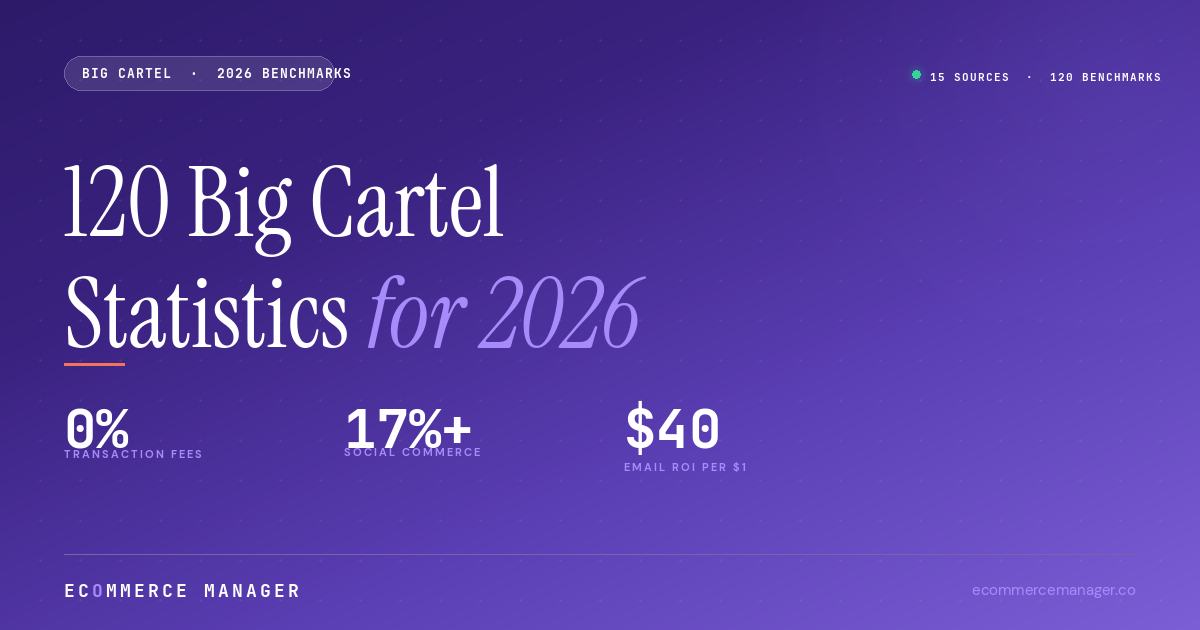
120 Big Cartel Statistics for 2026
Big Cartel is the drop-based indie platform for artists, makers, and cost-conscious creators — 0.1–0.2% market share and none of the enterprise ambitions of Shopify or Adobe Commerce. 120 numbers from 15 sources on how creator-driven commerce actually works in 2026.
On this page
Why Big Cartel deserves an honest editorial look — even if you'll never use it
Let's be direct about what Big Cartel is: a niche ecommerce platform used by roughly 0.1–0.2% of websites with a known CMS, purpose-built for artists, makers, and independent creators running drop-based inventory. It's not competing with Shopify Plus, BigCommerce, or Adobe Commerce. It's not in the evaluation set for a $5M–$50M DTC brand. The source data we're working with even acknowledges that Big Cartel doesn't publish deep platform-specific stats the way larger platforms do.
So why write 120 stats about it? Because Big Cartel matters as context. A meaningful share of successful DTC brands started on Big Cartel before migrating to Shopify or beyond. Understanding creator commerce — drops, scarcity, community-led selling, the economics of zero-fee starter platforms — is part of understanding the broader ecosystem. And the 2026 trends here (social commerce, AI recommendations, personalization backlash, wellness and values-driven purchasing) apply universally.
Three numbers worth taking away: Big Cartel's zero transaction fees are the entire pitch (Shopify Plus users pay real percentages here), email is the single most stable retention channel for indie brands ($36–$40 ROI per $1, even more critical when algorithmic reach is volatile), and AI is genuinely absent from the platform itself — indie sellers get AI value through external tools, not native features.
1. The Big Cartel ecosystem — niche by design, not by accident
0.1–0.2% market share, zero transaction fees, and a positioning statement that reads "independent sellers do more with less." Big Cartel is a purpose-built creator platform, not a Shopify competitor. The consumer trends still matter — trust, community, and value-seeking behavior play differently at this scale.
-
01W3Techs estimates Big Cartel is used by about 0.1–0.2% of all websites with a known CMS, making it a niche but focused ecommerce platform for independent creators.
-
02Big Cartel has built its reputation on zero transaction fees and transparent pricing, which strongly appeals to cost-conscious small sellers.
-
03Its positioning is "independent sellers do more with less" — aimed at artists, makers, and small brands who want simplicity over complex enterprise stacks.
-
04Big Cartel recommends limited inventory and drops, reflecting a consumer appetite for scarcity, exclusivity, and collectible products in creator-driven niches.
-
05Circana's 2026 consumer trends show lower-income households prioritizing essentials and value-focused channels, while higher-income consumers maintain discretionary spending and seek premium experiences.
-
06Consumers are scrutinizing brand values and demanding transparency and genuine community engagement, which independent, face-forward Big Cartel brands can uniquely provide.
-
07Community engagement is rising; shoppers increasingly value supporting local and independent businesses plus social and sustainability initiatives.
-
08Wellness remains a dominant trend; consumers look for health-oriented products in categories beyond food, opening niches for Big Cartel (e.g., wellness accessories, prints, planners).
-
09Hyper-personalization is expected to grow, but some consumers find it "creepy"; it is generally well-received when clearly aligned with their needs and consent.
-
10Private label and value brands are gaining share as financial pressure rises, forcing small brands to differentiate beyond price through story, quality, and community.
-
11Netguru finds 57% of consumers actively seek deals (up 23% from last year), with over a third trading down in some categories to splurge in others they care about.
-
12Salsify/Netguru research shows 64% of consumers express genuine interest in tailored experiences, yet only 41% feel benefits justify privacy trade-offs.
-
13Social commerce searches have surged 65% in five years, showing a structural shift to discovery and buying directly in social environments where many Big Cartel brands operate.
-
14Over 90% of US and Chinese consumers report shopping at online-only retailers in the previous month, reinforcing comfort with pure-play online shops (including micro-brands).
-
15OUTFRONT's trends show trust is non-negotiable: 80% of Americans say they trust the brands they use, and 95% say trust is critical to purchase decisions, favouring transparent, small brands.
-
16Consumers increasingly trust entities with a local presence or a visible face more than large institutions, aligning well with artist-run Big Cartel shops.
-
17Travel, fitness, and wellness are key trade-up categories; shoppers cut back elsewhere to splurge on experiences and well-being, which opens lifestyle product niches for independent sellers.
-
18Social commerce is reshaping paths to purchase; by 2026, over 17% of online sales will occur through social platforms, merging entertainment and shopping.
-
19In the US, social commerce sales are expected to reach nearly $70–100 billion by 2026, indicating enormous potential for social-native small brands.
-
20DHL's 2026 ecommerce trends report notes AI is going mainstream for younger shoppers, emerging markets, and larger businesses, but misinterpretation and trust are top concerns — small creators must communicate AI usage transparently.
Building email flows for a drops-based indie brand?
Since Big Cartel has no native email, Mailchimp does the heavy lifting for most indie stores — welcome flows, drop announcements, win-back. For creators graduating to Klaviyo or dedicated lifecycle tools, the directory lists vetted partners with experience in scarcity-driven and drops-based email programs.
3. Email — external by design, essential in practice
Big Cartel has no native email or abandoned cart. Mailchimp is the recommended integration. $36–$40 email ROI still applies — actually more so, because algorithm-dependent social reach makes owned email lists the most stable retention channel for indie brands.
-
01Big Cartel has no native email marketing or abandoned cart recovery, so merchants must integrate with third-party tools like Mailchimp or others.
-
02The help centre explicitly lists Mailchimp as the recommended integration for newsletters and automated emails.
-
03Fera's ratings/reviews integration can trigger review request emails, helping generate social proof and repeat engagement.
-
04Big Cartel recommends using Google Analytics acquisition and engagement reports to understand which traffic sources — email included — drive results.
-
05Industry benchmarks show email marketing often yields $36–$40 ROI per $1 spent, making it an essential off-platform channel even for simple Big Cartel setups.
-
06As social commerce and AI search grow, owning email lists and first-party data becomes critical for independent brands to maintain relationships beyond algorithms.
-
07Netguru notes AI-driven recommendations can increase conversion rates by 70%, which extends to email product blocks and personalised suggestions.
-
08Yet only 41% of consumers believe personalization benefits justify privacy costs, making transparency in email data usage important.
-
09Circana highlights the importance of pooled data from shopper panels, loyalty programs, and transaction history to understand 2026 consumers; email + ecommerce data is the core of this for small brands.
-
10Economic pressure drives strategic spending: 57% of consumers actively seek deals, so email campaigns with offers and bundles can drive response.
-
11Subscription spending is surging; the subscription market could reach $1.5 trillion by 2025, and many consumers underestimate their monthly spend — email is key for managing churn and upsell.
-
12Big Cartel's "market your shop" resources frame email as part of a broader mix — SEO, social, limited releases, and reviews — rather than a standalone solution.
-
13Google Analytics engagement reports help identify content that excites visitors, informing what to feature in email newsletters.
-
14User attributes data (age, gender, interests) guides email segmentation at a basic level when combined with ESP data.
-
15Tech reports show device and browser usage, helping ensure email and landing pages render well for the majority of subscribers.
-
16With Big Cartel lacking built-in automation, external ESPs like Mailchimp handle welcome, win-back, and product-drop flows, which are especially powerful for limited-release stores.
-
17AI-powered email tools (subject-line generation, predictive send-time, product recommendations) are increasingly accessible to small brands, aligning with broader AI marketing trends.
-
18DHL's report notes AI is going mainstream but misinterpretation and trust issues trouble shoppers and businesses, so email content must explain AI use clearly.
-
19For independent artists, email often becomes the highest-ROI retention channel, because social reach can be volatile and algorithm-dependent.
-
20Overall, the Big Cartel stack assumes email is external but essential: integrate an ESP early to build owned relationships and support repeat sales.
4. Mobile commerce — themes are responsive, everything else is DIY
Big Cartel themes handle basic responsiveness, but Google Analytics + operator judgment do everything else. Image-heavy artist sites face performance trade-offs that larger platforms abstract away. Social-first drops mean most first visits arrive from mobile.
-
01Big Cartel's Google Analytics guide emphasises analyzing device type and browser via Tech reports, to optimize performance and UX for different devices.
-
02Tech reports help sellers see whether most customers visit on mobile or desktop, enabling mobile-first design decisions for themes and product layouts.
-
03Engagement data (page views, events, sessions) shows which elements and pages users interact with most, useful for improving mobile navigation and CTAs.
-
04Consumers increasingly shop on mobile; global data show a majority of ecommerce sessions now come from mobile devices, with social and visual categories leading.
-
05Social commerce, largely mobile-native, is expected to account for over 17% of online sales by 2026, meaning many first visits to Big Cartel stores originate from mobile social links.
-
06Voice and visual search are gaining traction, with AI-powered search predicted to overtake traditional search as the preferred choice by 2028.
-
07Akeneo notes 49% of Americans say AI recommendations already influence what they buy, and 64% are willing to purchase items recommended by generative AI, often discovered on mobile.
-
08DHL's trends emphasise friction points like delivery, returns, cross-border logistics, and payments, all of which feel more acute on mobile when UX is poor.
-
09Circana points out that economic pressure pushes shoppers toward value channels; mobile experiences that make price and value clear win more attention.
-
10Netguru highlights that social commerce and livestream shopping are blurring entertainment and purchase, driving mobile-native shopping flows.
-
11Big Cartel themes are generally responsive, but deeper UX tuning (image sizes, button placement, copy length) is critical for mobile conversion.
-
12Tech reports let merchants see slow or problematic browsers/devices, prompting testing and optimisation on those combinations.
-
13Limited-release drops and scarcity messages are often consumed on mobile; short, clean product pages with clear inventory signals are key.
-
14With many Big Cartel users being artists, image-heavy sites must balance visual richness with performance to avoid slow mobile load times.
-
15AI-powered search and visual discovery trends mean structured product data and clear imagery become more important for mobile search engines and assistants.
-
16Cross-border commerce is a growth area; DHL notes increasing emphasis on delivery, returns, and payments for international shoppers, many of whom browse via mobile.
-
17Device and engagement insights can inform mobile-specific landing pages for social campaigns, tailored to high-performing layouts.
-
18Tech data also helps merchants decide whether to prioritise PWAs or app-like experiences if mobile usage is overwhelmingly high.
-
19Consumers expect fast sites and easy checkout; friction on mobile is more likely to cause instant abandonment for small brands without strong loyalty.
-
20Overall, Big Cartel relies on Google Analytics + responsive themes for mobile strategy; merchants that act on device data and performance insights gain an edge.
Ready to graduate off Big Cartel?
Most indie brands hit an operational or growth ceiling around $500K–$1M annual revenue when Big Cartel's simplicity becomes limitation. The Platform Calculator runs Shopify, BigCommerce, WooCommerce, and others against your real numbers — including honest TCO comparison with Big Cartel's zero-fee baseline.
5. Personalization — scarcity and community, not algorithms
Big Cartel offers a basic Related Products integration and not much else on-platform. That's less limitation than positioning — indie brands often personalize better through community depth, drops for superfans, and creator storytelling than through AI recommendation widgets.
-
01Intelligence Node notes personalization is no longer optional; over 80% of American shoppers expect personalized shopping experiences.
-
02About 66% of US consumers are willing to pay more for sustainable goods, meaning personalised merchandising that surfaces sustainable items can justify higher prices.
-
03AI-powered decision intelligence helps determine what to show, when, and to whom, turning personalization into measurable impact — something even small brands can access via external tools.
-
04Netguru reports AI-driven recommendations can increase conversion rates by 70%, but only 41% of consumers feel benefits justify privacy costs, requiring careful, consent-based personalization.
-
0564% of consumers express genuine interest in tailored experiences, especially when tied to value (deals, relevance, convenience).
-
06Circana's hyper-personalization insight: tailored retail experiences and personalized products are expected to grow, but must resonate rather than feel intrusive.
-
07Community-driven brands that personalise around values and community initiatives may have an advantage over purely algorithmic personalization.
-
08Big Cartel offers a Related Products integration to "boost sales with automated product recommendations," giving basic on-site personalization without custom code.
-
09Fera ratings and reviews allow highlighting top-rated and most-loved items, a simple form of personalization using social proof.
-
10Google Analytics user attributes (demographics, interests) can inform manual personalization — e.g., curating collections or landing pages for dominant segments.
-
11Tech and engagement data suggest which products and layouts perform best for different devices, guiding device-specific personalization.
-
12Many independent sellers use simple segmentation in external ESPs (e.g., fans of specific product lines) to send more relevant email campaigns.
-
13Subscription and membership models, with personalised perks, are highlighted as a major growth area in consumer spending patterns.
-
14Hyper-personalization backfires when it is too aggressive or poorly explained, leading to creepiness and distrust — especially for smaller brands.
-
15AI-powered search, recommendations, and visual discovery rely on clean product data and consistent tagging, which Big Cartel sellers must uphold to benefit from external AI channels.
-
16Circana underscores that brands must differentiate themselves to justify higher price points amidst private-label growth; personalization around story, quality, and values is a key tactic.
-
17Well-designed drops (limited runs, exclusive variants) create personalized scarcity experiences for superfans, a core strategy for artist-driven Big Cartel shops.
-
18The rise of social commerce means personalization increasingly happens inside social algorithms, but store UX and inventory still need to match those personalised entry points.
-
19Many small sellers use basic tools like Mailchimp tags, manual segmenting, and curated product grids to deliver "good enough" personalization without heavy AI stacks.
-
20In 2026, personalization for Big Cartel brands is as much about values, community, and scarcity as about algorithms — combining simple tech with human-centric brand building.
6. AI in B2C — relevant context, not a platform feature
Big Cartel provides no native AI. That's the honest baseline. AI still matters for indie creators — external tools for copy, design, and ad targeting have real value — but AI complexity happens off-platform. Product data hygiene and clear imagery matter more than ever as AI search grows.
-
01Akeneo reports 49% of Americans say AI recommendations already influence what they buy, and 64% are willing to purchase AI-recommended items, showing widespread AI influence on commerce.
-
02SEMrush predicts AI-powered search will overtake traditional search as the preferred choice by 2028, drastically shifting discovery paths.
-
03Intelligence Node notes social commerce is reshaping shopping, with US social commerce sales expected to reach nearly $70 billion by 2026, often mediated by AI recommendation systems.
-
04Over 17% of online sales are expected to occur through social platforms by mid-2020s, where AI curates feeds and offers.
-
05DHL's 2026 report states AI is going mainstream for younger shoppers, emerging markets, and larger businesses, but misinterpretation and trust top AI concerns.
-
06Netguru highlights that AI personalization requires privacy balance; while conversion can jump 70%, many users worry about data use.
-
07Circana's hyper-personalization trend suggests brands will pool data from diverse sources (loyalty, panels, transactions) to deliver better AI-driven personalization.
-
08Consumer behaviour is shifting toward faster, more tailored digital experiences, with AI underpinning search, recommendations, and support.
-
09AI-powered product search and discovery are listed as Trend #1 shaping the 2026 ecommerce landscape in Akeneo's analysis.
-
10Akeneo notes that 64% of people are willing to purchase items recommended by generative AI, suggesting AI-driven merchandising will drive significant sales.
-
11AI-powered social recommendation systems, search, and chatbots are central to how consumers stumble upon small brands, including Big Cartel stores.
-
12DHL identifies growth opportunities in AI-enhanced delivery, returns, payments, and risk management, which will increasingly shape shopper expectations even for niche brands.
-
13Consumers' trust concerns mean brands must clearly communicate how AI is used, especially around recommendations and data handling.
-
14Netguru shows subscription economy growth and underestimation of spending; AI can help small brands identify churn risk and upsell opportunities in membership models.
-
15Circana points out brands should differentiate based on values and community, not just AI-driven personalization, to avoid feeling generic or machine-driven.
-
16Big Cartel does not currently provide native AI engines, but its ecosystem can benefit from external AI tools for copy, design, ad targeting, and recommendations, like ChatGPT, AI SEO, or visual search.
-
17CheckThat.ai positions Big Cartel as a simple, transparent platform, meaning AI complexity is usually off-platform (ads, email, search), not inside the cart itself.
-
18Creator-driven brands can use AI to generate product copy, social posts, and campaign ideas, but their differentiation still comes from unique art and voice.
-
19As AI-powered search grows, structured product data, clear imagery, and strong brand storytelling become crucial for being surfaced and trusted.
-
20Overall, AI in 2026 is the invisible infrastructure behind discovery, recommendations, and optimisation; for Big Cartel brands, winning means blending AI-assisted marketing with genuine, human-centric brand building.
What a smart operator does with these 120 numbers
Respect the model without over-selling it. Big Cartel is a legitimate starter platform for creators making under $500K annually — zero transaction fees, low overhead, minimal complexity. Above that threshold, most brands hit real limits and start planning a migration. The platform's honesty about its niche is a feature, not a bug.
Own the email list from day one. Because Big Cartel has no native email or abandoned cart, indie sellers who defer setting up Mailchimp or similar leave the highest-ROI retention channel entirely unused. $36–$40 per $1 email ROI compounds harder when social reach is algorithm-dependent and drops are inherently spiky.
Lean into scarcity and drops as personalization strategy. Big Cartel's "personalization" playbook isn't AI recommendation carousels — it's timed drops, superfan access, community storytelling. That's actually competitive with algorithmic personalization at this scale, and it's the actual reason indie brands succeed on the platform.
Watch the migration triggers. Three signals consistently push brands off Big Cartel: hitting inventory or SKU limits on higher tiers, needing serious wholesale or B2B functionality, and reaching a point where the built-in analytics and marketing tools become bottlenecks. Most creators migrate to Shopify (occasionally BigCommerce) around $500K–$1M annual revenue.
Use AI externally, not natively. Big Cartel provides no native AI. That's fine. External tools for copy generation, ad targeting, product photography enhancement, and social content are widely accessible and deliver real value. What matters is clean product data and imagery — the same fundamentals that help AI search find and cite indie brands.
Frequently asked questions
Is Big Cartel a serious ecommerce platform?
It's serious about its niche — independent creators, artists, and makers running drops-based inventory who value simplicity and zero transaction fees over enterprise features. Big Cartel powers roughly 0.1–0.2% of websites with a known CMS, which is small compared to Shopify or WooCommerce but reflects deliberate positioning rather than failure to scale. It's not competing with enterprise platforms and doesn't try to. For an artist selling prints, a musician selling merch, or a maker running small runs, Big Cartel is fit-for-purpose. For a growing DTC brand with wholesale, subscription, or B2B ambitions, it's a starter platform to migrate off.
How does Big Cartel compare to Shopify?
They serve different customers. Shopify is a full-stack ecommerce platform built to scale from starter to enterprise. Big Cartel is intentionally lean — a small handful of paid tiers, no transaction fees, minimal features beyond what an indie creator needs. The comparison usually breaks down to: Shopify wins on ecosystem depth, app availability, scalability, and B2B/wholesale functionality. Big Cartel wins on cost predictability (zero transaction fees is a genuine advantage), simplicity, and clarity of purpose for creator brands. Most brands that start on Big Cartel and grow beyond $500K–$1M annual revenue eventually migrate to Shopify.
What are Big Cartel's actual capabilities in 2026?
The realistic feature set: responsive themes, product listings, checkout with major payment methods, custom domains, basic SEO controls, Facebook Catalog integration, Google Analytics support, and a small ecosystem of integrations including Mailchimp for email and Fera for reviews. There's a Related Products integration for basic on-site recommendations. Notably absent: native email marketing, native abandoned cart recovery, native AI features, subscription commerce, advanced wholesale or B2B, and sophisticated personalization. Most marketing sophistication happens off-platform through external tools.
Does Big Cartel work for building an email marketing program?
Yes, but everything happens off-platform. Big Cartel has no native email marketing or abandoned cart recovery, so indie sellers integrate with Mailchimp (the officially recommended integration) or a similar ESP. The good news: this actually works fine for creator-scale operations. Industry benchmarks show email marketing delivering $36–$40 ROI per $1 spent, and for indie brands, email is often the most stable retention channel precisely because algorithmic social reach is volatile. Setting up welcome flows, drop announcements, and post-purchase sequences in Mailchimp is straightforward.
When does a Big Cartel brand need to migrate?
Three triggers consistently push brands off Big Cartel. First, hitting product limits on the plan tiers (higher-volume sellers eventually need more SKUs than Big Cartel supports). Second, needing wholesale, subscription, or B2B functionality that isn't natively supported. Third, reaching a scale where limited built-in analytics, marketing automation, and integrations become growth bottlenecks. For most indie brands, this cluster of pressures shows up somewhere between $500K and $1M annual revenue. The typical migration is to Shopify (most common), occasionally to BigCommerce if wholesale is the primary driver.
The playbook top eComm operators actually read
One weekly brief. Five stories that matter. Zero fluff. Written for managers at $5M–$50M DTC brands who want to sound sharper than everyone else in the meeting.
References
- 01 Big Cartel CMS Usage Statistics — W3Techs — w3techs.com
- 02 Big Cartel Pricing & Platform Overview — CheckThat.ai — checkthat.ai
- 03 Big Cartel Marketing Tools — bigcartel.com
- 04 Big Cartel Marketing Help Centre — bigcartel.com
- 05 2026 Consumer Marketing Trends — Circana — circana.com
- 06 Consumer Behavior Trends — Netguru — netguru.com
- 07 2026 Consumer Trends Report — OUTFRONT — outfront.com
- 08 Top 2026 Consumer Behavior Trends — Intelligence Node — linkedin.com
- 09 DHL 2026 Ecommerce Trends Report — dhl.com
- 10 Basic Google Analytics Reports for Big Cartel — bigcartel.com
- 11 Watch — youtube.com — youtube.com
- 12 Watch — youtube.com — youtube.com
- 13 Big Cartel vs Shopify — Printify — printify.com
- 14 2026 Ecommerce Trends — Akeneo — akeneo.com
- 15 Watch — youtube.com — youtube.com
Make every platform decision data-backed
Join 12,000+ ecommerce managers reading the ECM newsletter every Tuesday — or browse the directory to find vetted CRO, email, retention, and AI partners for growing indie and DTC brands.

2. Social media — the primary acquisition engine for indie creators
Facebook Catalog integration, Instagram-first content, drops-based scarcity messaging. Big Cartel's marketing playbook is essentially: build audience on social, drive attention to timed drops, sell out fast. Livestream shopping and creator-led commerce fit the model naturally.