

Last Updated on July 3, 2026
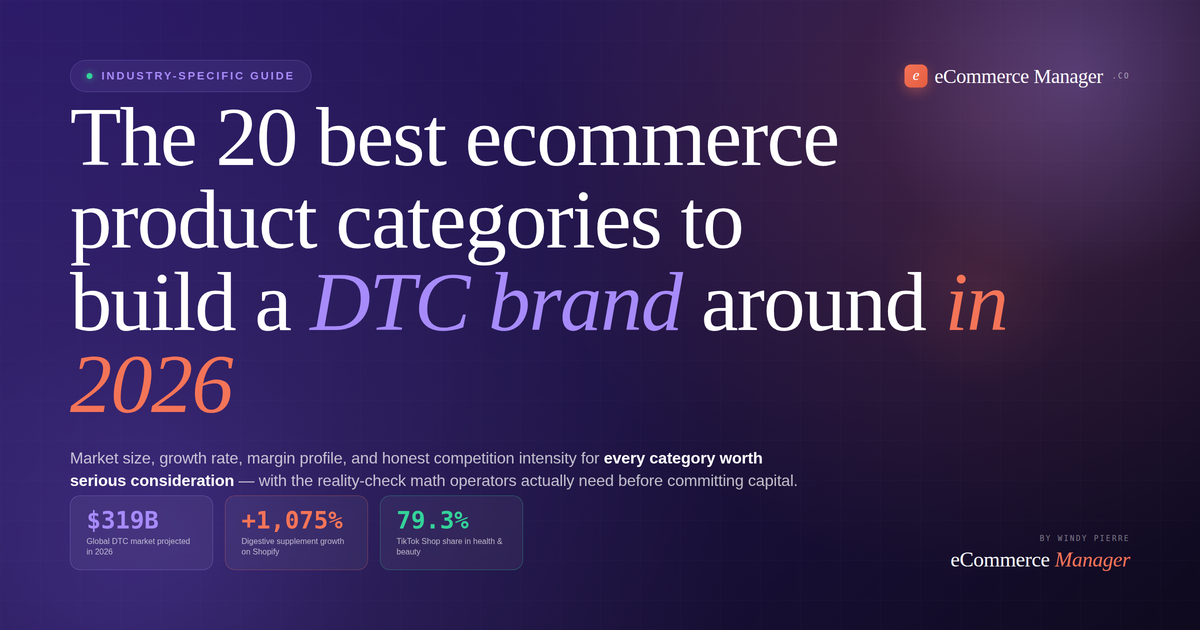
The 20 best ecommerce product categories to build a DTC brand around in 2026 — and the honest math behind each one
"Which category should I build in" is the wrong question. The right one is: which category has enough demand, defensible margin, and reasonable competition intensity to justify what you'll spend to get in? Here's a data-forward breakdown of 20 categories worth serious consideration in 2026, with market size, growth rate, margin profile, competition, and what it actually takes to win.
Why the category choice matters most
Every operator I know who's raised money for a DTC brand has spent more time on the pitch deck than on the market they were pitching. That's backwards.
Here's what actually determines whether a DTC brand works. Not the founder story. Not the packaging. Not even the paid social strategy — though everyone in the pitch room wants to talk about that. What determines whether the brand works is whether the category itself supports the unit economics. A brand can be well-run in a bad category and lose money for a decade. A brand can be moderately-run in the right category and be profitable inside 18 months. That gap is what this guide is about.
The numbers behind category selection in 2026 are sharper than they used to be. Average CAC has climbed 222% over the past eight years and now sits between $45 and $70 depending on channel mix — but it varies wildly by vertical. Pet products cost roughly $23 per customer to acquire. Beauty is around $42. Food runs about $51. Supplements are the toughest at $89 per customer. Meanwhile, average retention across DTC is only 28.2%, which means the difference between a category with 40% repeat rate and one with 20% is the difference between profit and slow bleed.
The 20 categories below are the ones where the math is defensible in 2026 — real market size, real growth, defensible margin, and a business model that supports repeat purchase. Each card includes market size, growth rate (CAGR), margin profile, and a "competition" grade (Easy / Medium / Hard) reflecting how crowded the category is right now for a new entrant. Nothing here is a get-rich-quick play. But if you're deciding what to build, this is the honest math.
The full comparison table
All 20 categories, with market size, CAGR, margin range, and competition intensity. Sortable by section — full write-ups follow below.
| Category | Segment | US market / CAGR | Competition |
|---|---|---|---|
| Vitamins & supplements | Health | $68.7B / 8.5% | Hard |
| Functional beverages | Health | $53.9B / 4.7% | Medium |
| Sports nutrition & protein | Health | $45B+ / 8.0% | Hard |
| Sleep & recovery | Health | $12B / 9.2% | Medium |
| Skincare & treatments | Beauty | $38B / 8.5% | Hard |
| Clean & men's grooming | Beauty | $25B / 8.4% | Medium |
| Hair care & scalp health | Beauty | $18B / 6.8% | Medium |
| Color cosmetics | Beauty | $20B / 9.2% | Hard |
| Pet food & treats | Pet | $60B / 6.8% | Hard |
| Pet supplements & wellness | Pet | $5B / 8.1% | Easy-Med |
| Premium coffee & tea | Home | $28B / 7.5% | Medium |
| Candles & home fragrance | Home | $8B / 5.5% | Medium |
| Home fitness & recovery | Home | $15B / 8.7% | Medium |
| Snacks & better-for-you food | Home | $45B / 6.2% | Hard |
| Eco-friendly household | Home | $12B / 10.4% | Easy-Med |
| Activewear & athleisure | Fashion | $70B / 6.5% | Hard |
| Demi-fine jewelry | Fashion | $15B / 8.2% | Medium |
| Kids & baby DTC | Fashion | $32B / 7.1% | Medium |
| Sustainable apparel | Fashion | $8B / 9.1% | Easy-Med |
| Sexual wellness | Specialty | $40B / 12.5% | Easy-Med |
Health, wellness & supplements
The category with the highest ceilings and the highest CACs — $89 per customer on average, meaningfully sharper than beauty ($42) or pet ($23). What makes it work anyway is the repeat rate: consumables with genuine 30-day usage cycles create some of the strongest subscription unit economics in DTC. The four sub-categories below have very different competition dynamics.
01Vitamins & supplements
The largest and most competitive wellness category. US dietary supplements hit $68.74 billion in 2025 and are compounding at 8.5% annually. The demand is real — digestive supplements alone saw a 1,075% year-over-year sales lift on Shopify — but the CAC is brutal at $89 per customer, the highest of any DTC vertical. Winning means picking a defensible niche (gut health, women's hormonal, cognitive, or a specific ingredient story like functional mushrooms) rather than chasing "multivitamin" as a category.
The unit economics work because supplements are consumable — a customer buying a 30-day supply becomes a subscriber who pays back CAC in 3-5 months at typical margins. But regulatory scrutiny is intensifying, testing and compliance costs are non-trivial, and TikTok Shop virality is now a double-edged sword: a viral product can 10x demand overnight and also invite regulatory attention overnight.
If you're launching a supplement brand in 2026 without either (a) a legitimate clinical differentiator or (b) a distinctive founder/audience story that lowers CAC dramatically, the $89 CAC will eat you alive. Pick a niche narrow enough that organic community can carry acquisition, not one where you're bidding against Athletic Greens on paid.
02Functional beverages
Functional beverages — energy drinks, prebiotic sodas, adaptogenic drinks, protein waters — is where the DTC playbook is being written in real time. The US market is $53.9 billion in 2026 and the online channel is compounding at 11.4% CAGR, well above the category average. The Poppi/Olipop prebiotic soda wars, Bloom Nutrition's rise, and the Celsius acquisition of Alani Nutrition for $1.65B all landed in the last 18 months.
What makes the category unusually accessible: consumers are actively looking for alternatives to Coke and Red Bull, and social proof translates faster than in supplements because trial is cheap and pleasure is immediate. What makes it hard: distribution and unit economics are painful — liquid is heavy, shipping is expensive, and shelf-life management means holding inventory. Brands that win typically start DTC subscription and expand into retail once the concept validates.
Functional beverage unit economics only work with either subscription bundles (12-24 pack minimums) or eventual retail distribution. Shipping single cans to individual consumers doesn't scale — model your pricing around case-quantity minimums from day one.
03Sports nutrition & protein
Protein powder, pre-workout, creatine, electrolytes. The category that built Gymshark, Ghost, and a hundred other brands, and one where the incumbents (Optimum Nutrition, BSN, MyProtein) are entrenched but not innovating fast. New entrants win by pairing a specific athletic audience (CrossFit, Hyrox, longevity, functional fitness) with clean formulation stories — the "no artificial colors, third-party tested, informed sport certified" positioning has real traction with the informed buyer.
The unit economics are strong once you crack subscription. Protein powder is a genuine 30-45 day consumable at typical use, and repeat rates in the 40-55% range are achievable. But CAC hovers around $70-90 depending on paid mix, and Amazon is a brutal competitor — many buyers price-check on Amazon before committing to DTC subscription.
Sports nutrition rewards audience specificity over product differentiation. A brand built for one specific training modality (Hyrox racers, older lifters, women in strength) can charge a premium and hold subscription. A "for athletes" brand is competing with everyone and winning on price — which never ends well in this category.
04Sleep & recovery
Sleep is the wellness sub-category with the fastest structural growth and one of the friendliest CAC profiles. The pain is universal, the willingness to pay is high (people will spend $80 on a mattress topper cover, $200 on a weighted blanket, $40/month on a sleep supplement), and the category is meaningfully less crowded than supplements or beauty. Products range from magnesium glycinate supplements to cooling sheets to wearable devices — the operator question is which sub-segment you can own.
Where the math works best: consumable sleep products (supplements, teas, sprays) with genuine 30-day usage cycles hit strong subscription retention. Durable products (weighted blankets, silk pillowcases) require harder repeat-purchase engineering — usually via accessory categories or gifting. Both models work; they just look nothing alike operationally.
If your brand story is "sleep better," you'll get lost. If your story is "sleep better *specifically* for hot sleepers / anxious sleepers / new parents / shift workers," the messaging targeting is sharp enough to make paid social actually work at reasonable CAC.
Building a supplement or beverage brand? Compliance, formulation, and 3PL matter as much as the product.
Browse our directory of vetted DTC agencies — filterable by vertical, platform, and budget.
Beauty & personal care
The category where brand and packaging matter as much as the product itself. US beauty and personal care hit $109.6B in 2025 and is compounding at 7.7% through 2033, with online growing meaningfully faster at 9.3%. CAC averages $42 — much friendlier than supplements — but competition is intense. The four sub-categories below have distinct dynamics.
05Skincare & treatments
The single largest sub-category in beauty at 32.5% share, and the one where DTC brands have most consistently built billion-dollar exits — The Ordinary, Drunk Elephant, Youth to the People, Glossier. US skincare e-commerce is expanding at 8.5% CAGR to hit $38 billion in 2026. Viral ingredient stories drive category expansion — snail mucin serum, beef tallow moisturizer (+2,600% Google search growth), rice water toners — but the winning brands are built on formulation IP and dermatologist credibility, not just a TikTok moment.
The margin profile is strong (50-70%) because the ingredients are cheap relative to perceived value. The competition is brutal because every influencer with a following now has a skincare line. Winning is easier at the extremes: either the science-forward tier (clinical claims, patents, third-party clinical trials) or the ingredient-storytelling tier (single-hero-ingredient brands built for one specific concern).
The middle of the skincare market is dead. If you can't credibly claim "clinical-grade" or "distinctive ingredient story," you're building a house brand competing on Amazon price. Pick a defensible edge before you formulate — not after.
06Clean & men's grooming
Beauty and personal care for men is compounding at 8.4% CAGR through 2033, faster than the category overall, driven by a cultural normalization that's real and durable. The category is genuinely under-served relative to demand — most incumbents (Old Spice, Axe) still target teenagers, and DTC brands that actually treat men as sophisticated buyers (Harry's, Beardbrand, Fulton & Roark, Manscaped) have found meaningful whitespace.
Clean beauty as a positioning cuts across genders. US demand for clean, non-toxic personal care compounds around 10% annually, and the small share of the total beauty market means there's still room for new entrants in specific formulations — deodorant without aluminum, sunscreen without oxybenzone, shampoo without sulfates. The trick is that "clean" alone doesn't sell anymore; the brand story has to carry it.
Men's grooming works best when you build for a specific ritual (beard care, shaving, morning skincare) rather than a full product line. Beardbrand didn't win by selling all men's grooming; it won by owning "the beard" completely. Own one ritual, expand adjacently.
07Hair care & scalp health
Hair care is the sub-category where the "scalp health" reframe has created the most whitespace in years. Consumers who grew up thinking of hair as a styling problem now think of it as a skincare problem — which means dermatologist-adjacent branding, active ingredients, and scalp-first messaging all work in ways they wouldn't have a decade ago. Function of Beauty proved personalization works; Vegamour proved a specific-concern brand (thinning) can scale.
The commercial reality: hair care is a category where subscription retention holds up well (shampoo and conditioner are 45-60 day consumables) and hero-product brands (a signature serum, a signature scalp treatment) can build repeat purchase around that anchor. The category is less crowded than skincare specifically because the DTC hair opportunity was slower to be recognized.
The best hair care brands are built around a specific hair problem, not a hair type. "Hair loss," "damaged from color-treating," "curly hair moisture" are targetable concerns. "For women's hair" is not — and it's why generic DTC hair brands struggle to hold CAC.
08Color cosmetics
Color cosmetics — lipstick, blush, eyeshadow, foundation — grow faster than skincare (9.2% CAGR) but the competition is fierce. Rare Beauty, Fenty, Hourglass, Charlotte Tilbury, and a hundred celebrity brands crowd the space, and TikTok Shop is now a full sales engine where a viral lip stain can sell one unit every 5 seconds at its peak (that literally happened with Wonderskin, 300K+ units sold in 2024).
The reality is that color cosmetics reward brand and marketing skill more than product IP. The ingredients are relatively commoditized; the differentiation lives in shade range, packaging design, influencer strategy, and virality mechanics. For a founder who's genuinely great at brand and community — not just competent — the ceilings are enormous. For anyone else, this is not the category to prove yourself in.
Color cosmetics is a founder-dependent category. If your founder isn't personally magnetic enough to build a community from scratch, and you're not willing to hire (and equity-compensate) a co-founder who is, don't launch here. It's the one beauty category where the founder has to be part of the product.
Pet products & wellness
The category with the friendliest CAC in DTC — roughly $23 per customer, less than a third of what supplements cost — and one of the highest emotional-loyalty profiles. Global pet care e-commerce grew online sales over 30% in 2026, with 9x the growth rate of brick-and-mortar. 95 million US households own pets, and pet spending has proven remarkably recession-resistant across cycles.
09Pet food & treats
Pet food and treats is the largest sub-category in pet at roughly $60B in the US, and the toughest to break into as a new entrant. Nestle Purina, Mars Petcare, and Hill's dominate distribution and marketing spend. But the humanization trend — 65%+ of pet owners in developed markets willing to pay premium for functional pet products — has cracked open specific niches: fresh pet food (The Farmer's Dog, Ollie), single-protein/limited-ingredient (Open Farm), and functional treats.
Where DTC works: subscription fresh food has genuine unit economics — high AOV, high retention (70%+ in year one), premium price points ($60-$120/month per pet). The Farmer's Dog reportedly hit nine-figure revenue on this model. Where DTC struggles: dry kibble competing on shelf-parity pricing. Amazon and Chewy own that game.
Fresh pet food is the fastest-growing DTC pet segment because it can't be replicated by mass retail — the cold chain and subscription mechanics create a moat that dry food doesn't have. If you're launching in pet, "fresh, subscription, one specific breed size or life stage" is a better wedge than "premium pet food."
10Pet supplements & wellness
Pet supplements is one of the most underserved-relative-to-demand categories in DTC. The US market is roughly $5 billion (some estimates run to $5B when you include topicals, dental chews, and adjacent wellness) growing at 8.1% CAGR, and pet supplement purchases on Shopify grew 89% in a single year. The ingredient stories from human wellness are cleanly translating to pets: probiotics, collagen, adaptogens, functional mushrooms (dog supplement purchasers are 1.6x more likely to have positive associations with mushroom ingredients).
The CAC is friendlier than human supplements — closer to $30-$50 per customer versus $89 — because pet owners self-identify as an audience on social. Soft chews remain the dominant format. Repeat rates are strong (60%+ at 90 days for well-executed brands). Emerging opportunities cluster in calming, joint health for senior pets, cognitive support, and cat-specific supplements (still underserved versus dogs).
Pet supplements is the rare category where "human wellness trend, translated to pets" is a genuinely durable playbook. The ingredient stories are already validated in humans; the pet market is 3-5 years behind and eager. Pick a trending human ingredient (mushrooms, collagen, adaptogens), formulate for dogs or cats, and you're competing in a category with soft edges.
Home, food & lifestyle
The broadest section here because it spans wildly different economics. Candles carry 55-80% margins with tiny AOVs; home fitness equipment carries 35-45% margins with high AOVs; specialty coffee sits in between with strong subscription mechanics. The five categories below are the ones with the cleanest paths from launch to profitable DTC.
11Premium coffee & tea
Premium coffee and specialty tea sit in one of the sharpest DTC subscription sweet spots. Instant coffee sales alone grew 1,339% on Shopify. The subscription math is clean: a coffee drinker consumes a bag every 2-4 weeks, replenishment is a genuine need not a marketing invention, and switching costs (finding a roast you love) are real. Trade Coffee, Blue Bottle, Atlas Coffee Club, and dozens of regional roasters have proven the model.
Where it gets sharp: coffee-drinker communities are passionate and social — Instagram, Reddit, and specialty forums drive organic acquisition at scale. Where it gets hard: shipping economics on a $16 bag are painful (freight can eat 15-20% of order value), and roast-to-ship freshness expectations mean you need roasting close to fulfillment. Tea has friendlier logistics but a smaller and slower-growing audience.
Coffee subscription only works if you own the roasting (or partner tightly with one roaster). Reselling other people's coffee at a subscription markup doesn't survive contact with dedicated coffee drinkers — they can taste the difference between fresh-roasted and 3-weeks-old, and they'll churn immediately.
12Candles & home fragrance
Candles is the sleeper category on this list. The gross margin range (55-80%) is one of the highest in physical DTC. The category is genuinely accessible — you can start with home production for under $2K and validate a brand before scaling. And it's gift-driven, which means Q4 seasonality creates enormous concentrated revenue windows for well-timed launches.
The tradeoff: repeat purchase rates are lower than consumables (people don't burn candles fast enough to sustain a monthly subscription), and shipping is painful — candles are heavy and fragile, meaning packaging and freight can eat 20-30% of order value. The brands that scale (Homesick, Boy Smells, Anecdote) win on scent complexity, brand storytelling, and gift-market dominance rather than subscription mechanics.
Candle brand economics are gift-first. Model your business around Q4 accounting for 40-55% of annual revenue, corporate/wholesale as a meaningful secondary channel, and repeat purchase driven by scent library expansion (customer buys one, comes back for a different scent). Not subscription. Not monthly cadence.
13Home fitness & recovery
Home fitness equipment — smart mirrors, connected bikes, massage guns, weighted vests, resistance bands — has settled into a durable post-Peloton reality. The market didn't disappear when gyms reopened; it fragmented into recovery devices (Theragun, Hyperice), portable equipment (weighted vests grew 900%+ on Shopify in one year), and premium accessories. AOV is high ($200-$3,000+), which supports strong per-transaction unit economics even at higher CAC.
The challenge: high AOV means longer consideration cycles, which means paid-social CAC alone rarely closes the sale. Winning brands invest in content, community, and creator partnerships (a real athlete or trainer using the product) to build the trust that closes high-ticket purchases. Repeat purchase relies on accessory ecosystems (a bike buyer becomes a shoes/mat/apparel buyer over 24 months).
Home fitness needs a real practitioner or athlete behind it. "Trainer-designed" that's actually a marketing claim gets caught immediately by the community and never converts. Real practitioner endorsements (or founder credibility) close 2-3x better than generic influencer campaigns in this category.
14Snacks & better-for-you food
Better-for-you snacks (protein bars, keto-friendly cookies, low-sugar candy, jerky, high-protein pasta) is enormous — $45B+ in the US — and RXBar, Magic Spoon, Perfect Snacks, Legendary Foods, and Chomps have all built meaningful brands here. The category rewards distinctive product differentiation (Magic Spoon's low-sugar cereal, Chomps' clean-ingredient jerky) far more than clever branding alone.
The DTC hard part is unit economics. Snacks are typically $3-$8 per unit, which means AOV runs $30-$60 even with bundles — barely enough to cover CAC ($51 average for food) plus fulfillment plus product. The successful brands almost universally start DTC to validate, then move aggressively into retail (Whole Foods, Sprouts, Target, mass grocery) where the unit economics finally work. Pure-DTC snack brands are rare and usually not profitable at scale.
Better-for-you snacks is a "start DTC, scale via retail" category — not a DTC-forever business. Model your investor pitch around DTC as the validation and community-building channel with retail as the path to profitability. Retail buyers in this space now expect DTC traction as proof of demand.
15Eco-friendly household
Eco-friendly household — refillable cleaners, plastic-free personal care, biodegradable everything — is one of the fastest-growing US categories at 10.4% CAGR, and one of the friendliest to new entrants. Blueland proved the refill-tablets model. Grove Collaborative built a distribution platform around it. The category has real, structural tailwinds: Gen Z and Millennial buyers actively seek out sustainable brands, and the household spend is enormous.
What makes it defensible: eco-conscious buyers have strong retention if the product actually works. What makes it hard: "eco" as a positioning is now table stakes, not differentiation. The winners pair sustainability with either (a) a novel format (tablets vs. liquid, refills vs. new bottles) or (b) genuinely great fragrance/design that competes on aesthetics alongside eco credentials.
"Sustainable cleaning" is not a business — it's a category descriptor. The brands winning are winning on format innovation (tablets that dissolve, powders you rehydrate) or on beautiful design that makes eco products people actually want on their countertop. Pick one edge and lean hard.
Fashion, accessories & specialty
The category with the widest range of outcomes. Activewear has produced Gymshark and Alo Yoga; sustainable apparel has produced smaller but resilient brands like Everlane and Girlfriend Collective; sexual wellness has quietly become one of the fastest-growing DTC verticals with the friendliest CAC. Five sub-categories worth serious consideration.
16Activewear & athleisure
Activewear is a $70B US category and the DTC playbook has produced Gymshark, Alo Yoga, Vuori, Bandier, and dozens of successful mid-size brands. The category rewards a defined tribe (a training modality, a body type, an aesthetic) more than technical innovation — Vuori proved men's athleisure could compete with Lululemon by owning a specific casual-fitness aesthetic; Set Active owns a specific young-women's community.
The hard truth: the category is expensive to enter (samples, fit testing, inventory across multiple sizes) and Lululemon has effectively become the reference brand every competitor is measured against. Winning means either a genuinely different silhouette/fabric (Ten Thousand, Rhone), an underserved audience (plus-size, older women, a specific sport), or a founder with real community pull. Repeat purchase relies on continuous drops and product line expansion.
Activewear is not a category to enter without at least $500K in launch capital. Between sampling, fit testing, initial inventory across sizes and SKUs, and paid social budget to acquire customers who don't know you yet, the burn is steeper than any consumable category. Fund accordingly or don't enter.
17Demi-fine jewelry
Demi-fine jewelry — real materials (14K solid gold, sterling silver, real diamonds) at accessible price points ($50-$500) — is the fastest-growing segment in jewelry and where Mejuri, Missoma, Astrid & Miyu, and Aurate all live. The 8.2% CAGR undersells the DTC growth specifically, which is closer to 15% in the online-first tier. AOV is high enough for strong per-transaction economics; product-line expansion drives repeat purchase (a first-time necklace buyer comes back for earrings, then rings).
The reason DTC works so well here: traditional jewelry retail has 4-8x markups, so DTC brands can offer real gold at half the price of Tiffany while maintaining 55-70% margins. Astrid & Miyu's 5x repeat purchase lift on ear-stacking mechanics is one of the sharper models in the category — piercing services become an in-person acquisition channel that also builds emotional loyalty.
Demi-fine jewelry only works if the materials are real. Gold-plated pieces at demi-fine prices get called out immediately by the community, kill trust, and never scale. Commit to solid gold and sterling silver from launch — the higher COGS is offset by higher retention and word-of-mouth.
18Kids & baby DTC
Kids and baby is a $32B US market with some of the most emotionally-invested customers in DTC — new parents will pay premium for anything perceived as safer, healthier, or more thoughtfully designed. The Honest Company built a public company on this. Millie Moon, Coterie, Kyte Baby, and Frida Baby have all found meaningful whitespace in specific product categories (diapers, sleep sacks, feeding, safety).
The category has one structural challenge: kids grow out of things. A 6-month subscription customer for baby clothing has a hard cap on lifetime value. Winning brands solve this by expanding product lines with the child (Kyte's baby-to-kids-to-adult expansion) or by owning specific parent moments (feeding, sleep, safety) rather than a single product. Repeat purchase mechanics require careful product roadmap design.
Parent communities are among the most powerful referral engines in DTC — but they're also among the least tolerant of BS. If your product isn't genuinely better than the incumbent, parents will figure it out and share their conclusions publicly. This is a category to enter with a real product edge, not just better marketing.
19Sustainable apparel
Sustainable apparel — organic cotton, recycled materials, ethical manufacturing — has produced Everlane, Girlfriend Collective, Pact, Boyish, and Reformation. The category compounds at 9.1% CAGR, above general apparel, driven by younger buyers who genuinely factor sustainability into purchase decisions. The margin profile is slightly tighter than mainstream apparel because materials cost more, but pricing power is real for brands that credibly deliver.
The genuine challenge is that "sustainable" alone is now table stakes rather than differentiation — every brand claims it, and shoppers have gotten cynical. Winning brands pair sustainability with something else: a specific aesthetic (Reformation), a specific fabric innovation (Girlfriend Collective's recycled bottles into leggings), or a specific price point (Pact's mass-accessible tier).
Younger buyers can spot greenwashing at 50 paces. If you can't produce third-party sustainability certifications (B-Corp, GOTS, Fair Trade), don't launch here — the community will call it out, and you'll spend years explaining away instead of building.
20Sexual wellness
The category quietly compounding faster than almost anything else on this list. Sexual wellness — lubricants, condoms, toys, hormone/libido supplements, menopause care — is a $40B global market growing at 12.5% CAGR. Maude, Dame Products, Winx Health (formerly Stix), Bonafide, and Beducated have all built durable brands in a category historically underserved by mainstream retail.
What makes it work: massive underlying demand, high margins, strong subscription mechanics on consumables (lube, condoms, hormone supplements), and paid-social channels that will actually accept the ads with the right positioning. Sexual wellness has DTC-friendly economics almost across the board. What makes it hard: creative approval on Meta and TikTok requires careful positioning ("wellness" and "self-care" framing works; explicit framing gets rejected), and Amazon is not a viable channel for most SKUs.
Sexual wellness lives or dies on the "wellness" frame — brands positioned as medical, functional, or self-care get creative approvals and reach; brands positioned as sexy or explicit get shadow-banned. Understand the platform playbook before you brand, not after.
Ready to model your category unit economics before you commit capital?
Run our Platform Calculator to sketch a first-pass P&L for your category, AOV, and CAC assumptions.
5 filters to apply before picking a category
Every category on this list can produce a great business or a great disaster depending on how you enter it. Before committing capital, run your idea through these five filters. If it doesn't clear all five, the category isn't wrong — your entry angle probably is.
Repeat-purchase logic
Does the category have a natural replenishment cycle? Consumables win DTC economics; durables need product-line expansion or accessory ecosystems to survive.
Defensible CAC
Can you acquire a customer for meaningfully less than the category average? If your CAC = category average, you're competing on scale you don't have. Niche your way to a lower CAC.
Real product edge
Is there a formulation, format, material, or design edge that shoppers can feel? "Better brand" is not a product edge. Community, over time, always catches up to real differentiation and lets weaker positioning die.
Founder-audience fit
Does your founder or founding team genuinely understand this customer? Categories with sharp community expectations (color cosmetics, beauty, activewear) collapse under fake authenticity. Pick a category you actually live in.
Capital efficiency
Can you realistically launch on the capital you have? Apparel and electronics need $150K+ to reach first profitability. Candles and print-on-demand can start under $10K. Match the category to the capital, not the ambition.
The single biggest mistake first-time DTC founders make: falling in love with the product before validating the unit economics. A brand can be beautifully built and still lose money forever because the category doesn't support the math. Spend a week modeling your CAC / AOV / repeat rate / gross margin before you sample your first product. If the model doesn't work at industry-average assumptions, no amount of marketing skill will fix it.
What's actually shifting in 2026
Four trends genuinely worth tracking as you evaluate categories. First, TikTok Shop has moved from experimental channel to full sales engine — it hit $15.82B in US sales in 2025, up 108% year over year, and health/beauty/wellness dominate at 79.3% of TikTok Shop volume. If you're building in those categories, TikTok Shop strategy isn't optional in 2026; it's the primary awareness-to-purchase channel for a large slice of your addressable audience.
Second, subscription mechanics are getting stronger, not weaker. The subscription box market is projected to grow at 18.1% CAGR through 2034 to $183.6B. Replenishment models (coffee, supplements, personal care) show 7-10% monthly churn — access models (memberships) can hit 5-8%. If your category supports subscription, you're building on structurally stronger unit economics than one-time-purchase competitors. If it doesn't, you're building on structurally harder unit economics — that's fine, but engineer the retention mechanics deliberately.
Third, CAC keeps climbing. It's up 222% over eight years and the trend line doesn't bend. Categories where CAC is currently friendly (pet at $23, beauty at $42) are the safer places to launch in 2026; categories where CAC is punishing (supplements at $89) require a real audience or clinical differentiator to work. Build the brand where the acquisition math is winnable, not just where the market is largest.
Fourth, retail-DTC hybrid is now the default winning model. Pure DTC forever is rare and usually unprofitable at scale in food, snacks, and mass beauty. Pure retail is losing share to digitally-native brands. The brands scaling to nine and ten figures almost universally use DTC to validate and build community, then move aggressively into retail (Whole Foods, Target, Sephora) to reach profitability. Plan for both channels from day one, even if you launch DTC-only.
If you're evaluating categories right now, the sharpest single question is: where does the acquisition math work in my favor before I've built anything? Pet supplements at $30-$50 CAC is a fundamentally different starting posture than color cosmetics at $60+ CAC in a crowded field. Pick the category where you're playing offense, not the one where you're spending your way in.
FAQ
The highest-margin ecommerce categories in 2026 are candles and home fragrance (55-80% gross margin), digital products (85-95% margin with zero fulfillment cost), skincare treatments (50-70% margin), and premium pet supplements (55-70% margin). Category profitability depends less on the product itself and more on your brand positioning, subscription mechanics, and repeat-purchase economics — a $30 supplement with a 40% repeat rate is more profitable than a $150 one-time apparel purchase in almost every model.
The fastest-growing US ecommerce categories in 2026 include pet care e-commerce (online pet sales growing 9x faster than in-store), functional beverages (7-10% CAGR globally, with online channels growing at 11.4%), digestive supplements (+1,075% Shopify sales growth), and beef tallow moisturizer (+2,600% in Google searches). Health, beauty, and wellness combined make up roughly 79% of TikTok Shop sales, which grew 108% year over year in 2025.
It varies dramatically by category. Print-on-demand and digital products can launch for under $500. Skincare, supplements, and food/beverage brands typically need $25,000-$75,000 for initial inventory, formulation, packaging, and compliance testing. Electronics, home appliances, and heavy goods often require $100,000+ before first sale. Add roughly 2-3x your inventory cost for CAC, working capital, and reserve — a $50K inventory launch realistically needs $150K-$200K in total funding to reach profitability.
TikTok Shop is heavily weighted toward health, beauty, and wellness — those three categories account for approximately 79.3% of all TikTok Shop sales. Beyond those, apparel (particularly hoodies, puffer jackets, and activewear), functional beverages, pet supplements, and viral skincare (snail mucin, beef tallow) have shown the strongest performance. TikTok Shop hit $15.82 billion in US sales in 2025, up 108% year over year, and now represents 18.2% of all US social commerce.
Subscription models create structural advantages — the subscription box market is projected to grow at 18.1% CAGR through 2034 — but they require product categories with genuine replenishment or curation logic. Consumables (coffee, supplements, pet food, personal care) fit the replenishment model well with 7-10% monthly churn. Curation models (beauty boxes, apparel) show higher churn (10-15%). One-time purchase businesses can still work at scale in fashion, home goods, and electronics, but they demand aggressive repeat-purchase mechanics like loyalty programs to compete with subscription unit economics.

Deciding what category to build in?
Run our Platform Calculator to model unit economics, or browse vetted DTC agencies specializing in your target category.