Shopify in 2026 isn't just a store builder — it's commerce infrastructure. Here's what changed this year, what each plan gets you, the KPIs to watch, and how it stacks up against the alternatives.
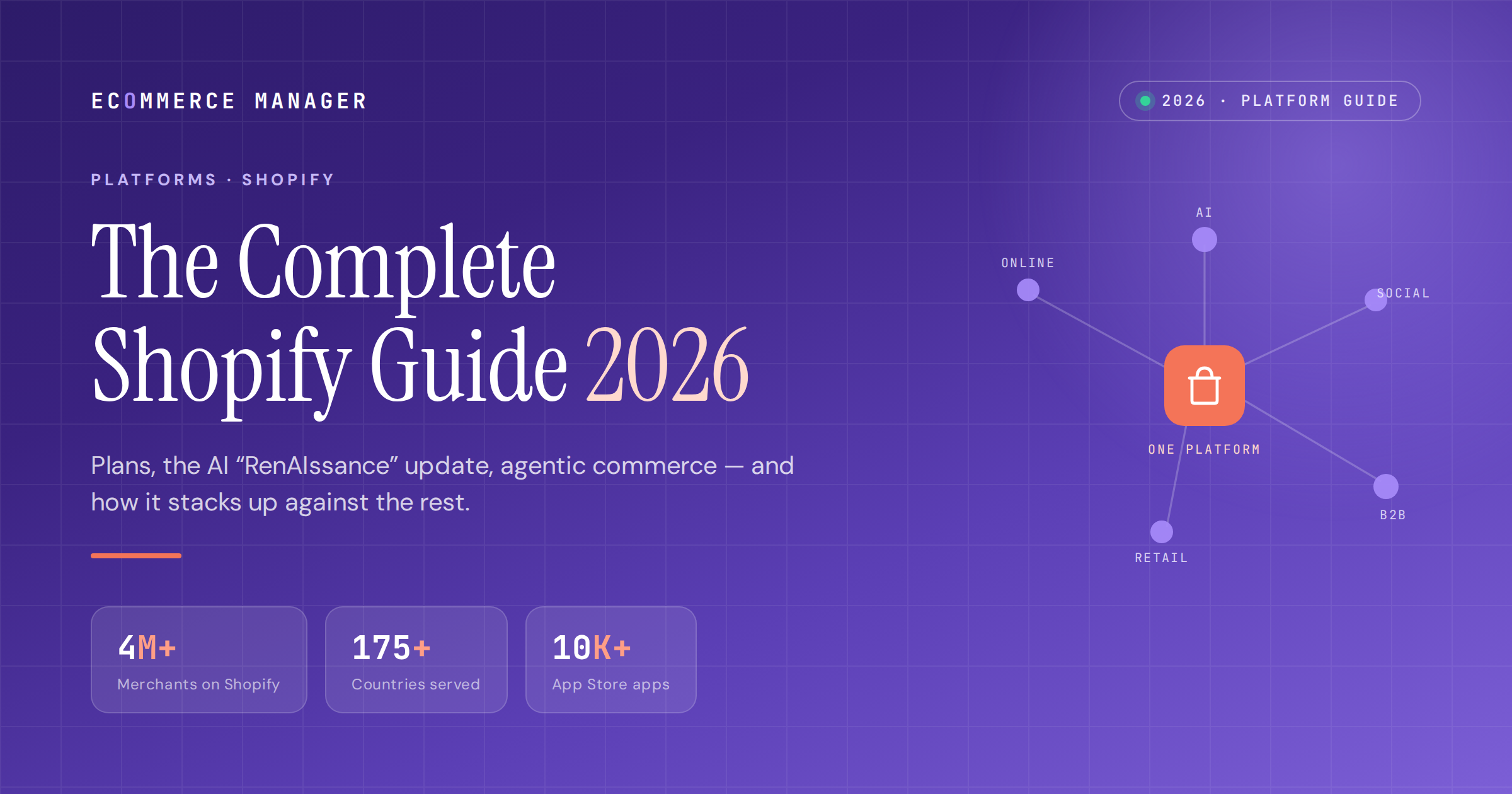
Shopify started as a store builder. In 2026 it operates as a commerce operating system: one platform running online stores, retail POS, mobile, marketplaces, social channels, B2B portals, and international storefronts — across more than 175 countries.
The competitive frame has changed too. Shopify is no longer just fighting other store platforms; it's positioning to be the infrastructure layer for retail, social commerce, AI commerce, B2B, subscriptions, and omnichannel. The product roadmap this year reflects that ambition.
This guide covers the numbers, the 2026 AI update, what each plan actually gets you, where Shopify is strongest, the mistakes that quietly cost revenue, the KPIs worth tracking, and how it compares to the alternatives. For most operators the question isn't whether Shopify is capable enough — it's whether you're using what's already in front of you.
BY THE NUMBERS
Shopify by the numbers in 2026
The scale is the moat. The ecosystem and transaction volume below are why most app makers, agencies, and integrations build for Shopify first.
01
4M+ merchants now run on Shopify across 175+ countries, spanning first-time sellers to billion-dollar brands.
02
The Shopify App Store holds 10,000+ apps — the deepest integration ecosystem in commerce, and the main reason switching costs stay high. Audit yours before you add more with a tech-stack review.
03
Shopify processes hundreds of billions in GMV and billions of checkout transactions annually, which is why its checkout is tuned harder than almost any other on the market.
04
Thousands of enterprise brands run on Shopify Plus, backed by thousands of ecosystem partners worldwide.
PLATFORM UPDATE
The 2026 AI update: “RenAIssance”
Per Shopify’s Winter 2026 “RenAIssance” Edition, the company shipped 150+ new features, with AI threaded through everyday operations — store management, merchandising, content, reporting, and conversational commerce.
Sidekick gets serious
→
Build custom reports and analyze performance through natural language, no SQL or report builder required.
→
Generate store content and code snippets, recommend optimizations, and surface issues before they cost conversions.
→
Generate custom apps and implement design changes via AI — a real drop in the technical barrier for lean teams. Pair it with an AI-focused partner if you're scaling it across the store.
Agentic commerce arrives
→
Agentic Storefronts make products discoverable and purchasable through AI assistants, not just traditional web pages.
→
Customers can ask an assistant for recommendations, compare conversationally, and buy without visiting a site — commerce starting to move beyond the search box.
→
The operator takeaway: structured data, feeds, and product content now feed machines as well as shoppers. Clean catalog data is becoming a ranking factor for AI surfaces too.
PLANS & PRICING
Shopify plans explained
Four tiers, climbing on reporting, staff accounts, shipping logic, and automation. Shopify reprices and renames tiers periodically, so confirm current rates and model total cost (apps + fees included) before committing.
Plan
Best for
What you get
Basic
New businesses, small brands, side projects
Online storefront, payment processing, product and order management
Grow (formerly Shopify)
Growing brands, higher volume, small teams
Better reporting, more staff accounts, enhanced operational features
Advanced
Established, multi-channel brands
Advanced reporting, more sophisticated shipping rules, greater flexibility
Plus
Enterprise retailers, large DTC, international
Highest limits, advanced automation, B2B, and dedicated enterprise tooling
STRENGTHS
Why Shopify still wins
Four advantages keep Shopify the default recommendation for most brands under $100M in revenue.
01
Ease of use. Most merchants can build products, configure shipping, and launch a storefront without engineering help.
02
Ecosystem depth. Thousands of apps cover email, SMS, reviews, loyalty, subscriptions, inventory, analytics, and support — Shopify’s strongest competitive moat.
03
Best-in-class checkout. Shopify Checkout remains one of the highest-converting flows in commerce, and small conversion gains compound directly into revenue. It’s the first place a CRO partner should look.
04
Omnichannel by default. Retail POS, online, social, marketplaces, and international selling run from one back office.
Is Shopify actually the right call for your stack?
Run the numbers against WooCommerce, BigCommerce, and Adobe Commerce before you commit — platform choice is a five-year decision.
Beyond the storefront, four capability areas decide how far Shopify scales with you — plus the app shortlist most operators end up running.
Social commerce
→
Native integrations with TikTok Shop, Meta Commerce, YouTube Shopping, and Pinterest push products where attention already lives.
→
TikTok Shop is the one to watch — US GMV is forecast to top $20B in 2026, making it a primary channel rather than an experiment.
Payments
→
Shopify Payments simplifies setup, speeds implementation, and unifies reporting.
→
PayPal, Stripe, and BNPL options run alongside it for coverage and conversion.
B2B & wholesale
→
Company accounts, custom pricing, net payment terms, wholesale catalogs, and dedicated B2B storefronts let you run DTC and wholesale from one platform.
Going international
→
Shopify Markets handles multi-currency, local pricing, international domains, localization, and tax — cutting the complexity of cross-border expansion.
Subscriptions: Recharge. Loyalty: LoyaltyLion — both core to retention.
PITFALLS
Common Shopify mistakes
None of these are platform limitations. They’re operator habits that quietly leak revenue.
01
Installing too many apps. Every app adds cost, complexity, and conflict risk, and drags performance. Prune with a regular tech-stack audit.
02
Ignoring site speed. Speed moves conversion, SEO, and experience together — it’s rarely a single fix and usually a CRO discipline.
03
Weak product pages. Design gets attention while photography, descriptions, reviews, FAQs, and trust signals get neglected. Those are the elements that actually convert.
04
Overlooking email. Email is among the highest-ROI channels; skipping owned audiences leaves brands dependent on paid. Fix it through the email agencies who do this full-time.
METRICS
KPIs every Shopify manager tracks
Six numbers tell you whether the store is healthy. Definitions and benchmarks live in the ECM KPI Library.
01
Conversion rate — the share of visitors who purchase.
02
Average order value (AOV) — revenue per order.
03
Customer lifetime value (LTV) — total projected revenue per customer.
04
Repeat purchase rate — the cleanest read on retention and loyalty.
05
Customer acquisition cost (CAC) — what it costs to win a customer; watch it against LTV.
06
Checkout completion rate — how many shoppers finish after starting checkout.
Need a Shopify partner who's actually shipped this?
From checkout CRO to retention and AI workflows, the ECM directory lists vetted specialists — not generalists guessing at your stack.
For most businesses under $100M in annual revenue, Shopify stays the default on the balance of simplicity and scale. The alternatives win in specific lanes — see the full platforms hub for head-to-heads.
Shopify’s 2026 story is AI and infrastructure, not store building. Sidekick, Agentic Storefronts, and 150+ new features point at a platform meant to run your operations and your machine-readable commerce, not just host a catalog.
The capability question is settled. The execution gap is what’s left: most teams already pay for tools they barely use. Prune the app stack, fix checkout and speed, and build an owned email audience before chasing the next feature.
The brands that win on Shopify this year pair strong operations with retention, AI-assisted workflows, and disciplined execution. Start by pressure-testing the platform fit and your stack, then bring in specialists where the in-house team is stretched.
FAQ
Frequently asked questions
How much does Shopify cost in 2026?
Shopify offers four main tiers — Basic, Grow (formerly the Shopify plan), Advanced, and Plus — climbing on reporting, staff accounts, shipping logic, and automation. Shopify reprices periodically, so confirm current rates and factor in apps and transaction fees when modeling total cost.
Is Shopify good for beginners?
Yes. Shopify remains one of the easiest platforms to launch. Most merchants can create products, configure shipping, and go live without technical expertise, which is a large part of why it powers millions of stores.
What is Shopify Sidekick?
Sidekick is Shopify’s AI assistant. In 2026 it can build custom reports, generate store content and code snippets, recommend optimizations, analyze performance, and even generate apps and implement design changes through AI, lowering the technical barrier for small teams.
Is Shopify better than WooCommerce?
It depends on priorities. Shopify wins on ease of use, hosted reliability, checkout conversion, and ecosystem depth. WooCommerce wins on flexibility and ownership for WordPress-native teams. For most DTC brands under $100M, Shopify is the default; WooCommerce suits those who want full control of the stack.
What is agentic commerce on Shopify?
Agentic commerce is buying through AI assistants instead of traditional web pages. Shopify’s Agentic Storefronts make products discoverable and purchasable inside conversational interfaces, so customers can get recommendations, compare options, and check out without visiting a site.
NEW ISSUE EVERY TUESDAY
The playbook top eComm operators actually read
One weekly brief. Five stories that matter. Zero fluff. Written for managers at $5M–$50M DTC brands who want to sound sharper than everyone else in the meeting.
Unsubscribe anytime. No spam. 12,000+ operators already subscribed.
Join 12,000+ ecommerce managers reading the ECM newsletter every Tuesday — or browse the directory to find vetted Shopify, CRO, retention, and AI partners.