


Last Updated on June 8, 2026
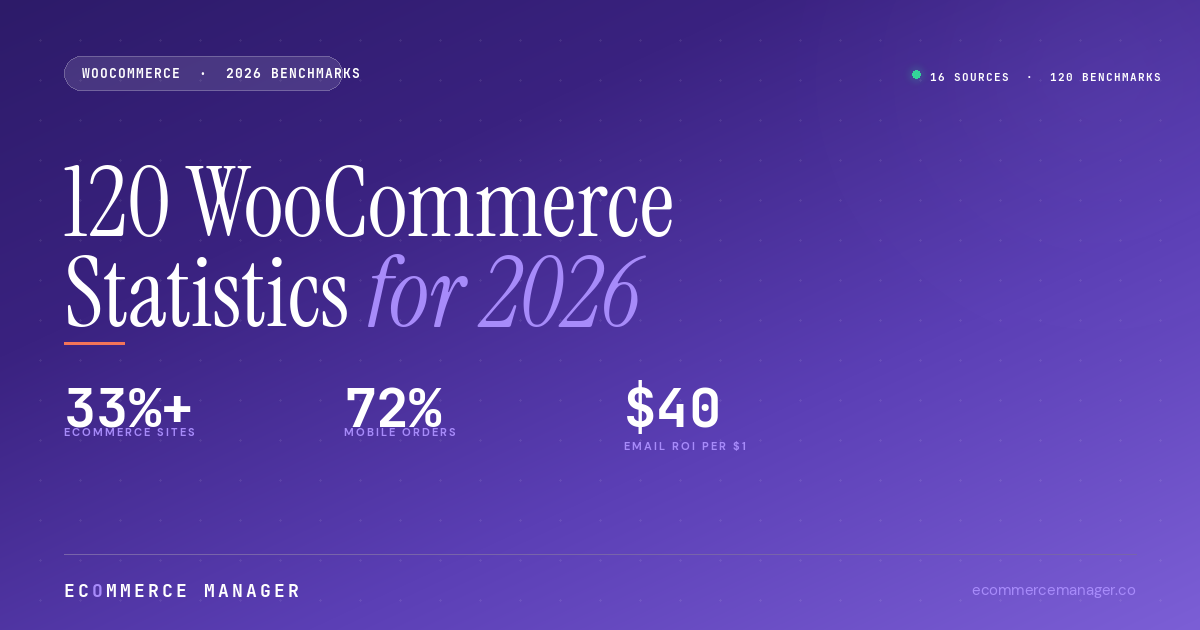
120 WooCommerce Statistics for 2026
WooCommerce powers a third of all ecommerce sites worldwide. 120 numbers from 16 sources — including Metorik's 65-million-order dataset — on what's actually working for WooCommerce brands in 2026.
On this page
Why these numbers matter for any platform-evaluation conversation
WooCommerce sits in the platform evaluation set alongside Shopify, BigCommerce, and Adobe Commerce — and it usually wins on flexibility, total cost of ownership at lower-mid GMV bands, and tight integration with WordPress content. The trade-off is plugin sprawl, hosting responsibility, and a more developer-heavy ops profile.
This guide pulls 120 statistics from 16 sources across six areas: consumer behavior, social, email, mobile, personalization, and AI. The most unique data here comes from Metorik's 65-million-order WooCommerce dataset — the platform-specific benchmarks (72% mobile orders, $105 AOV, 18% weekend dip) that don't show up in generic ecommerce reports.
Three numbers worth walking into a planning meeting with: WooCommerce powers a third of all ecommerce sites globally, 72% of orders are mobile but desktop AOV is 2.3x higher (the highest-ROI quarter project for most operators), and email still returns $40 per $1 — the leverage channel for retention and LTV.
1. Consumer behavior — who actually shops on WooCommerce stores
WooCommerce now runs roughly a third of all ecommerce sites and processes nearly a quarter of online orders worldwide. The Metorik benchmark dataset gives WooCommerce-specific behavior numbers nobody else has at this scale.
-
01WooCommerce powers 4.17–4.34 million live stores globally as of 2026, confirming it as one of the largest ecommerce ecosystems.
-
02Estimates show WooCommerce powers around 33–39% of all ecommerce sites worldwide, depending on measurement method.
-
03WooCommerce Checkout is estimated to process about 23% of all online orders worldwide, giving it huge influence on consumer checkout behavior.
-
04Annual WooCommerce sales/GMV are estimated at $30–35 billion, with roughly 55% of revenue from the US, UK, and India.
-
05At least 12,600+ WooCommerce stores earn over $100,000 per year, proving there is meaningful scale beyond hobby stores.
-
06WooCommerce has surpassed 344 million downloads and supports 200+ countries and multiple currencies, reflecting global consumer reach.
-
07Roughly 60% of WooCommerce users are small-business owners, so most consumers are buying from lean, founder-led brands.
-
08The US hosts about 422,000 WooCommerce stores (9.4% of installs), the UK ~171,000 (3.7%), and India ~135,000 (2.6%), anchoring consumer adoption in these markets.
-
09Across 65 million orders and $6.6B in revenue, the average WooCommerce order value (AOV) is $105, but it drops 18% on weekends.
-
1072% of WooCommerce orders are now placed on mobile, showing how heavily customers rely on phones to shop WooCommerce stores.
-
11Desktop orders have an AOV roughly 2.3x higher than mobile, revealing a value gap despite mobile order volume dominance.
-
1274% of WooCommerce orders include free shipping, up from 65% in 2023, indicating that shoppers now expect free shipping as standard.
-
13The WooCommerce Commerce Insights report finds 33% of consumers rank free shipping as their number-one purchase driver, above speed or brand.
-
14WooCommerce refund rates dropped from 2.4% in 2023 to 1.4% in 2025, indicating better product fit, expectations, or operations.
-
15Customers located 1,000–5,000 km away spend roughly 2x more than local buyers, suggesting cross-border customers often place larger orders.
-
16WooCommerce stores grew 5.3% quarter-over-quarter in Q1 2026, even though they were down 11% year-over-year, suggesting saturation but continued net growth.
-
17WooCommerce stores run an average of 58 plugins, a figure that has remained stable since 2023, showing a mature plugin ecosystem.
-
18Around 45% of WooCommerce stores use email marketing integrations, making email a mainstream channel but leaving room for adoption.
-
19Over 70% of WooCommerce users utilize a cart-recovery plugin, signaling high awareness of abandonment issues and the value of recovery flows.
-
20WooCommerce supports 65+ payment gateways, letting merchants mirror local consumer payment preferences from cards to wallets and BNPL.
Hit 20–30% revenue from email yet?
For mature WooCommerce email programs, 20–30% of revenue from email is the benchmark — most stores sit below 15%. The directory lists vetted FunnelKit, Klaviyo, and lifecycle email partners who've shipped that work on WooCommerce stacks.
3. Email marketing — the highest-ROI lever in the WooCommerce stack
$40 ROI per $1. 20–30% of revenue from email for mature programs. These aren't aspirational numbers — they're table stakes. Most WooCommerce stores still sit below 15%, which is where the operator opportunity is.
-
01FunnelKit cites that over 64% of businesses already use email marketing to connect with customers, underlining email's ubiquity in ecommerce.
-
02Monetate data shows email marketing drives about 4.24% of ecommerce conversions, outperforming search and social media on conversion rate.
-
03VentureHarbour notes email marketing generates about $40 in revenue for every $1 spent, nearly double the ~$22.24 per $1 from some other digital channels.
-
04For WooCommerce stores, 20–30% of total revenue should come from email in a mature program (automations + campaigns); below 15% indicates big upside.
-
05A "healthy" WooCommerce email program aims for 2–5% monthly list growth (net) to keep the channel scaling.
-
06For WooCommerce specifically, 5–15% cart recovery rate is described as good; under 3% signals issues in timing, copy, or targeting.
-
07Email open rates of 15–20% are average for ecommerce; anything above 25% is good, while below 12% suggests deliverability or subject-line problems.
-
08A WooCommerce store's unsubscribe rate should stay below 0.3% per campaign; higher than this means poor expectations, content mismatch, or over-sending.
-
09Metorik's 65-million-order dataset shows returning customers spend significantly more than first-time buyers, confirming the value of email-driven retention.
-
10Pet supplies stores on WooCommerce see a 42% uplift in spend from returning customers, showing email's potential in repeat-purchase niches.
-
11Commerce Insights reports that 60% of consumers unsubscribe because they get too many messages, reminding WooCommerce brands to manage frequency carefully.
-
12Key metrics WooCommerce stores are advised to track: revenue per email, cart recovery rate, repeat purchase rate, list growth, and revenue share from email.
-
13The goal for many WooCommerce merchants is 20–30% of revenue from email, with 10–15% a reasonable initial benchmark when starting out.
-
14Email automation (welcome, browse abandonment, cart abandonment, post-purchase) is especially valuable where WooCommerce AOV is around $105.
-
15WooCommerce email guides recommend post-purchase sequences as the main lever for increasing repeat purchase rate and LTV.
-
16Email is the main channel for order confirmations, shipping updates, and transactional messaging, which typically get near-100% open rates and can include cross-sells.
-
17Many WooCommerce stores integrate AI to generate subject lines, product blocks, and segment content, speeding up email production.
-
18WooCommerce merchants are advised to use exit-intent popups and checkout opt-ins to improve that 2–5% monthly list growth target.
-
19With 70%+ of orders on mobile, WooCommerce email must be mobile-first (short copy, clear CTAs, big tap targets).
-
20Email marketing remains the highest-ROI channel for many WooCommerce brands, functioning as the backbone of retention and LTV growth.
4. Mobile commerce — the 72/2.3x gap that defines WooCommerce in 2026
72% of orders come from mobile but desktop AOV is 2.3x higher. That single ratio is the highest-ROI project most WooCommerce operators could ship — and headless plus checkout customization is where it's solved.
-
01Metorik's 2026 report: 72% of WooCommerce orders are now placed on mobile devices, showing mobile's dominance in purchasing, not just browsing.
-
02Despite mobile volume, desktop AOV is 2.3x higher than mobile, indicating WooCommerce merchants still have work to do in mobile upsell and bundling.
-
03The average WooCommerce order value of $105 is a blended figure; optimizing mobile UX can help nudge mobile orders closer to desktop AOV.
-
04WooCommerce design guides for 2026 stress speed, mobile-first layouts, and conversion-driven UX as non-negotiables.
-
05"Fast isn't enough; your store must be instant" — high-performing WooCommerce stores focus on minimizing server-side requests and optimizing databases.
-
06Performance-first architecture is positioned as a key differentiator; even minor delays on mobile can result in significant revenue loss.
-
07WooCommerce trend guides highlight advanced checkout customization as a 2026 priority — checkouts adapt to user device and location automatically.
-
08The "one-size-fits-all" checkout is considered "dead"; adaptive checkouts outperform generic flows on both mobile and desktop.
-
09WooCommerce themes now default to mobile-first design principles, given the majority of orders and traffic coming from smartphones.
-
10AI-driven UX optimization, like real-time personalization and predictive product blocks, is increasingly deployed on mobile PDPs and homepages.
-
11Voice search is "steadily becoming normal" in WooCommerce shopping; customers use smart speakers and assistants to find and reorder products.
-
12WooCommerce stores are advised to optimize for voice queries in titles and descriptions as voice search grows.
-
13Visual recognition — customers uploading images to find similar products — is highlighted as a growing discovery method that impacts WooCommerce product presentation.
-
14AR features are "now expected" in categories like fashion, furniture, and cosmetics, improving buyer confidence and reducing returns.
-
15WooCommerce merchants offering free shipping (74% of orders) and clear shipping expectations on mobile enjoy higher conversion.
-
16Mobile-optimized forms and address fields are critical to reducing friction; abandoned checkout often happens at the form-fill stage on small screens.
-
17Many WooCommerce sites move to headless or hybrid setups to achieve app-like performance on mobile web.
-
18Push notifications through PWA or apps add an extra retention layer for WooCommerce brands, especially in mobile-first markets.
-
19Online shoppers increasingly demand transparent, ethical, and sustainable logistics, including shipping options explained clearly on mobile.
-
20WooCommerce's flexibility allows merchants to plug in localized payment gateways and mobile wallets, boosting conversion in specific regions.
Comparing WooCommerce against Shopify, BigCommerce, or Adobe Commerce?
The Platform Calculator runs all four against your actual GMV, AOV, traffic mix, and hosting profile. Real 3-year TCO including hosting, plugin licensing, dev costs, and the gotchas the demo never mentions.
5. Personalization — AI moves from optional to standard on WooCommerce
WooCommerce trend content frames AI-powered personalization as table stakes for 2026, not differentiator. The leverage shows up in returning-customer spend (42% lift in pet supplies) and predictive flows that outperform basic "recommended for you" widgets.
-
01WooCommerce trend reports say AI-powered personalization is now standard, not a bonus, driving hyper-personalized recommendations, dynamic pricing, and personalized email.
-
02AI is described as the "digital store manager" for successful WooCommerce shops — analyzing browsing behavior, predicting purchases, and optimizing product descriptions.
-
03Personalization in 2026 is predictive, not reactive: models analyze real-time browsing speed, cursor movement, and history to predict what customers need next.
-
04Commerce Insights highlights that 33% of consumers prioritize free shipping and many expect tailored offers — personalization must incorporate key value drivers like shipping and price.
-
05Returning customers spend significantly more than first-time buyers; in pet supplies, returning customers spend 42% more, showing the ROI of personalized retention.
-
06WooCommerce trend content stresses personalization that goes beyond "recommended for you blocks" into personalized bundles, offers, and content experiences.
-
07AI-enabled stores can serve instant product recommendations and best deals, deepening relationships and retaining clients more effectively.
-
08AI solutions are framed as a useful tool for retaining WooCommerce clients by surfacing the right products and offers at the right times.
-
09NotificationX notes that AI-powered product recommendation systems enhance engagement, satisfaction, and repeat purchases on WooCommerce.
-
10WooCommerce 2026 guides emphasize AI-driven segmentation — grouping users by behavior, value, and lifecycle stage for tailored messaging.
-
11Many WooCommerce merchants use personalization in email automations, dynamically inserting products based on browsing and purchase history.
-
12AI-driven dynamic pricing is used to adjust prices by demand, inventory, and user segment, improving revenue and sell-through.
-
13Personalized checkout experiences tailor payment options, shipping defaults, and upsells based on customer history and location.
-
14AR try-on and 3D previews are used as personalization tools, letting shoppers see how products fit their specific context (home, body, etc.).
-
15Hyper-automation connects personalization across product pages, checkout, email, and support, creating continuous experiences.
-
16WooCommerce-specific design advice calls for contextual recommendations — e.g., accessories and add-ons shown at cart and checkout.
-
17Merchants are encouraged to personalize post-purchase flows (replenishment, cross-sell, review requests) to boost repeat purchase rate.
-
18Eco-conscious consumers demand transparency; personalizing sustainability messaging (e.g., eco collections, carbon-light options) helps align with values.
-
19Agentic AI support can personalize support experiences by recalling past orders and preferences, improving satisfaction.
-
20WooCommerce trend content consistently frames AI-powered predictive personalization as a top 2026 growth lever for both small and large stores.
6. AI in the WooCommerce ecosystem — where it actually moves a metric
Recommendations, dynamic pricing, inventory forecasting, agentic chat, and content generation are all running in production WooCommerce stores. The 2026 question isn't whether to adopt — it's which surface to apply it to first.
-
01WooCommerce trend reports say AI is now "powering every major function" in modern online stores — recommendations, pricing, email, content, inventory, and support.
-
02AI-powered systems handle smart recommendations and dynamic pricing, adjusting what shoppers see in real time based on probability of purchase.
-
03AI-driven chatbots in WooCommerce have moved beyond FAQ links; agentic AI can now track packages and process returns directly in chat, reducing support load.
-
04AI enables inventory forecasting and smart reordering, helping WooCommerce merchants avoid stockouts and overstock.
-
05AI tools generate product descriptions and content at scale, freeing teams to focus on strategy and creative direction.
-
06AI ecommerce tools are described as "the store manager behind successful WooCommerce shops," quietly optimizing experiences and performance.
-
07WooCommerce guides stress that AI is already running product recommendations, automated emails, dynamic pricing, and support, not a future add-on.
-
08Voice search features in WooCommerce have the potential to significantly enhance consumer satisfaction, letting users search without typing.
-
09AI-powered product discovery with visual recognition helps shoppers find items by uploading images, especially in fashion and decor.
-
10WooCommerce-specific AI content notes that AI-driven experiences retain customers by showing best deals and items instantly, enhancing loyalty.
-
11AI solutions are positioned as essential for personalized communications across email and onsite messaging, not just basic automation.
-
12WooCommerce in 2026 increasingly uses Salesforce and other AI-enabled CRMs to synchronize customer data and drive smarter marketing.
-
13AI helps WooCommerce stores optimize performance by analyzing bottlenecks in funnels and adjusting layouts or flows accordingly.
-
14Leading WooCommerce agencies call AI-powered predictive personalization the number-one trend for 2026.
-
15Headless WooCommerce architectures are adopted to make AI-driven front ends faster and more flexible, particularly for larger merchants.
-
16As AI chat improves, a higher share of pre-purchase questions are handled by bots, smoothing the path to checkout.
-
17AI also helps segment customers by CLV, discount sensitivity, and product affinity, guiding promotions and inventory decisions.
-
18Commerce Insights and trend blogs highlight that AI is no longer a "nice to have" but a must-have for competitive WooCommerce stores.
-
19AI-powered performance analytics are used to test layouts, offers, and content variations at scale, something previously out of reach for small stores.
-
20Overall, AI + WooCommerce in 2026 means predictive, automated, and personalized commerce, where human teams set direction and AI handles execution and optimization.
What a smart WooCommerce operator does with these 120 numbers
Close the mobile AOV gap before chasing more traffic. 72% of orders are mobile, but desktop AOV is 2.3x higher. Bundling, sticky cart upsells, adaptive checkout, and mobile-first PDPs typically claw most of that gap back. It's the single highest-ROI project most WooCommerce operators could ship next quarter.
Get email to 20–30% of revenue. The math here is brutal: $40 per $1 ROI, and most stores sit below 15% revenue contribution. Welcome, browse abandonment, cart abandonment, post-purchase, and replenishment flows are the four that compound. A 5–15% cart recovery rate is the benchmark — below 3% means timing, copy, or targeting is broken.
Audit your plugin stack at least annually. The average WooCommerce store runs 58 plugins. Most of them never get reviewed, and three or four are usually doing 80% of the work the others were supposed to do. Page speed, security, and conflict bugs all trace back here.
Treat headless as a 2026 conversation, not a 2027 one. The biggest WooCommerce stores are increasingly running headless to hit app-like mobile speed and connect to AI-driven personalization. It's an infrastructure investment, but the mobile conversion gap is what makes the math work.
Apply AI to specific commerce surfaces, not "content." The 2026 WooCommerce AI stack runs across recommendations, dynamic pricing, inventory forecasting, agentic chat, and segmentation. Each one moves a measurable revenue or cost metric. Generic "AI for marketing" rarely does.
Frequently asked questions
How dominant is WooCommerce in 2026?
Very. WooCommerce powers between 4.17 and 4.34 million live stores globally and runs roughly 33–39% of all ecommerce sites worldwide depending on measurement method. WooCommerce Checkout processes about 23% of all online orders globally. The US hosts about 422,000 WooCommerce stores (9.4% of installs), with the UK and India as the other major adoption markets.
What's the average order value on WooCommerce?
Metorik's 65-million-order dataset shows the blended average WooCommerce order value is $105, but it drops about 18% on weekends. The more important number for operators: desktop AOV is roughly 2.3x higher than mobile, and 72% of orders are placed on mobile. That gap — high mobile volume, lower mobile AOV — is the central optimization opportunity for most WooCommerce stores in 2026.
Is WooCommerce a good choice in 2026 versus Shopify?
It depends on the operator profile. WooCommerce typically wins on flexibility, tight WordPress content integration, and lower direct platform costs at smaller GMV bands. Shopify wins on out-of-the-box simplicity, faster app ecosystem, and lower operational overhead. For $5M–$50M DTC brands, the deciding factors are usually content-and-commerce hybrid needs (WooCommerce wins), internal dev capacity (WooCommerce requires more), and B2B requirements (more nuanced — both have options). The Platform Calculator runs the TCO comparison directly.
What's a good email marketing benchmark for WooCommerce stores?
For a mature program, 20–30% of total revenue should come from email — automations plus campaigns combined. Below 15% indicates significant upside on the table. Healthy benchmarks: 2–5% monthly net list growth, 15–20% open rates (above 25% is good), 5–15% cart recovery rate (below 3% signals problems), and unsubscribe rate below 0.3% per campaign. Email ROI sits around $40 per $1 spent, well ahead of most paid channels.
Why do so many WooCommerce stores run 58 plugins?
WooCommerce is intentionally lean — core functionality is supplemented by plugins for everything from payments and shipping to email integrations and cart recovery. The 58-plugin average has been stable since 2023, reflecting a mature ecosystem rather than bloat per se. The risk isn't the plugin count itself; it's lack of audit. Most stores have plugins they no longer use, plugins doing overlapping work, and plugins that haven't been updated in two years. An annual stack audit usually finds 10–15 candidates to remove.
The playbook top eComm operators actually read
One weekly brief. Five stories that matter. Zero fluff. Written for managers at $5M–$50M DTC brands who want to sound sharper than everyone else in the meeting.
References
- 01 WooCommerce Statistics — Colorlib — colorlib.com
- 02 WooCommerce Statistics — PureThemes — purethemes.net
- 03 WooCommerce Reports — Store Leads — storeleads.app
- 04 WooCommerce Statistics — Wiser Review — wiserreview.com
- 05 Metorik Insights for WooCommerce — 2026 Edition — metorik.com
- 06 WooCommerce Commerce Insights Report — woocommerce.com
- 07 WooCommerce AI-Powered Product Trends — notificationx.com
- 08 Top Ecommerce Trends — WooCom Made Easy — woocomadeasy.com
- 09 WooCommerce Design — Promotedge — promotedge.com
- 10 Top Trends Shaping WordPress Ecommerce in 2026 — webiators.com
- 11 WooCommerce Trends 2026 — 79mplus — 79mplus.com
- 12 WooCommerce Email Marketing Guide — Sequenzy — sequenzy.com
- 13 WooCommerce Email Marketing — FunnelKit — funnelkit.com
- 14 WooCommerce Email Marketing — VentureHarbour — ventureharbour.com
- 15 AI Ecommerce Personalization — Netguru — netguru.com
- 16 WooCommerce 2026 Future Features — woocomadeasy.com
Make every WooCommerce decision data-backed
Join 12,000+ ecommerce managers reading the ECM newsletter every Tuesday — or browse the directory to find vetted CRO, email, retention, and AI partners with WooCommerce experience.

2. Social media — where WooCommerce merchants actually show up
Instagram and Facebook still dominate WooCommerce social adoption, but TikTok and shoppable video are taking share fast — 55% of Gen Z use TikTok for product discovery. The merchants winning are the ones treating social as a top-of-funnel and email as the conversion layer.