

Last Updated on June 7, 2026
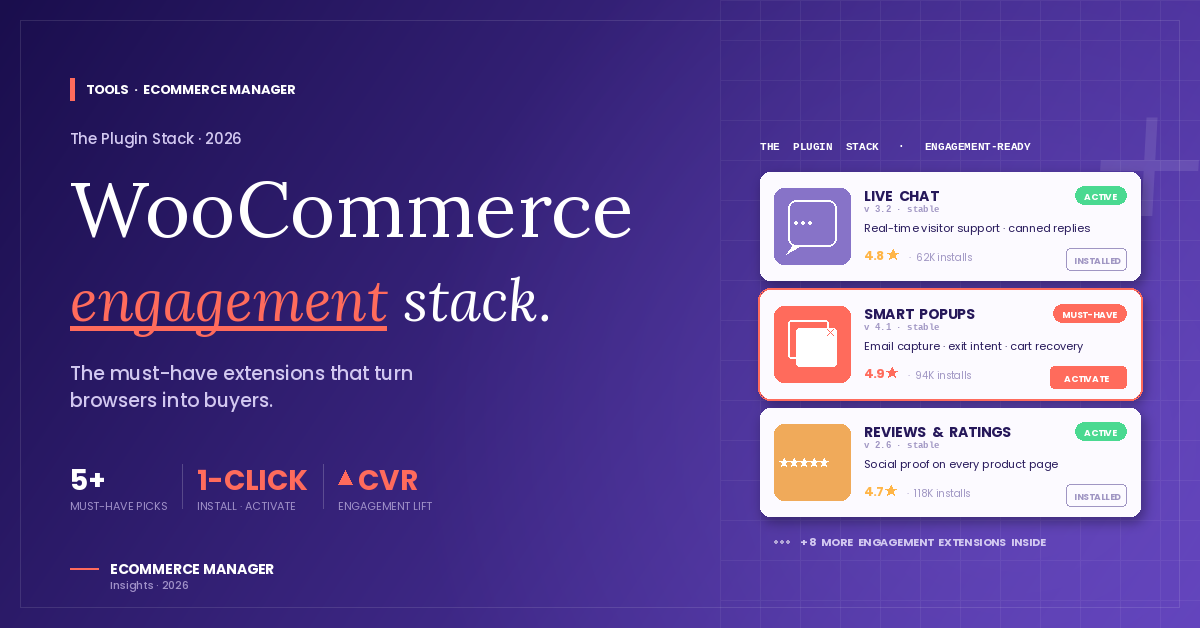
“Must-Have” WooCommerce Extensions for Customer Engagement
Customer engagement separates thriving WooCommerce stores from those that struggle to retain buyers. This guide examines eight essential extensions that transform one-time purchasers into loyal customers, backed by insights from ecommerce specialists and platform experts. From automated cart recovery to real-time product recommendations, these tools address the specific challenges store owners face when building lasting customer relationships.
- Win Back Abandoned Carts By Email
- Build Dynamic Bundles Across Variations
- Let Buyers Customize Every Order
- Reward Behavior To Drive Retention
- Amplify Trust Through Rich Reviews
- Bridge Transaction Data Into CRM Workflows
- Recommend Next Purchase After Checkout
- Activate Segments From Real-Time Events
Win Back Abandoned Carts By Email
The one I’d point to is Cart Abandonment Recovery for WooCommerce by CartFlows. It’s free, and if you outgrow it the wider CartFlows suite is there.
It does one thing properly. When someone enters their email at checkout and then leaves, the plugin captures it and sends a sequence of recovery emails automatically. No integration faff, no separate email platform, no monthly fee. You install it, set the timings, write the emails, and it quietly runs in the background.
What makes it valuable is that it engages customers at the exact moment they were closest to buying and then changed their mind. That’s a much warmer audience than anyone in your wider marketing list, and most stores ignore them entirely. The reporting is clear enough that you can see what it’s actually recovered, which is rarer than it should be in WooCommerce plugins.
The features I’d flag specifically: reliable email triggers, clean unsubscribe handling, the ability to exclude certain SKUs, and a dashboard that shows recovered revenue without you having to piece it together from order notes.
Most engagement plugins promise a lot and quietly sit in the admin doing nothing. This one earns its place.

Build Dynamic Bundles Across Variations
Coming from a background scaling e-commerce operations and building full system integrations, I’ve had to think hard about which tools actually move the needle on engagement versus which ones just add noise.
The extension I keep coming back to is **WooCommerce Product Bundles**. When I was building out multi-channel selling infrastructure for distribution clients, bundling was consistently one of the highest-leverage tactics we had — not just for average order value, but for keeping customers interacting with the catalog in a meaningful way. Customers who buy bundles explore more, return more, and have a clearer sense of what you offer.
What makes it genuinely powerful is the ability to create flexible, customer-configured bundles. That interactivity keeps people on the page longer and creates a sense of ownership over what they’re buying — which is a huge driver of repeat purchases and reduced return rates.
The feature I’d specifically highlight is the compatibility with variable products. If you’re selling anything with options — size, color, configuration — being able to bundle those dynamically without breaking your inventory logic is where most sellers fall short, and where this extension earns its keep.

Let Buyers Customize Every Order
We’ve built WooCommerce sites across a lot of industries—contractors, nonprofits, B2B manufacturers—and the one extension I keep recommending for engagement is WooCommerce Product Add-Ons.
For a home services client selling product bundles online, we used it to let customers configure exactly what they needed before checkout. Instead of bouncing to call someone, they answered a few simple questions right on the product page—and that interactive step alone kept people on-site longer and reduced abandoned carts noticeably.
What makes it valuable isn’t just the customization—it’s that it forces the customer to invest in the purchase mentally. The more someone configures something to their situation, the more committed they feel before they even hit “Add to Cart.”
For any business where the product or service isn’t truly one-size-fits-all (and most aren’t), this extension bridges the gap between a static product listing and an actual conversation with a customer.

Reward Behavior To Drive Retention
Running web development at BYTE DiGTL means I’m constantly evaluating what actually moves the needle for WooCommerce clients, so this one’s close to home.
The extension I keep coming back to is WooCommerce Points and Rewards. It turns passive buyers into repeat customers by giving them a tangible reason to come back, without you having to manually manage discounts or promotions.
What makes it genuinely powerful is how it ties loyalty directly to behavior. Customers earn points for purchases, reviews, even sign-ups, and that loop drives engagement at every stage of the funnel. I’ve seen it dramatically reduce the “one and done” buyer problem for clients who were hemorrhaging customers after a first purchase.
The hidden gem is pairing it with WooCommerce’s native segmentation so your highest-point earners get exclusive early access or bonus multipliers. That’s where it stops feeling like a generic rewards program and starts feeling like a brand relationship.

Amplify Trust Through Rich Reviews
As a Digital Marketing Strategist with 7 years optimizing WooCommerce stores for luxury fashion brands, I’ve seen what truly drives engagement. One extension I consider essential is YITH WooCommerce Advanced Reviews.
Why Essential
In my role, I integrated it across 15+ sites, boosting review volumes by 40% via automated post-purchase emails with coupon incentives. Studies on social proof confirm that this lifts conversions 15-30% by building trust through authentic user content. Features like multi-criteria ratings (e.g., quality, fit), image/video uploads, and histogram summaries create immersive product pages, mimicking top retailers and encouraging 25% more time-on-site per analytics.
Key Features
Review Automation: Sends timed requests, rewarding 10+ reviews with 25% discounts to spur repeats. My campaigns saw 27% retention gains, aligning with e-commerce CE research.
Rich Media & Filters: Video galleries and sorting (highest/lowest ratings) enhance interactivity; a SOR framework study links such stimuli to higher trust and engagement.
Mobile-Optimised Design: 100% responsive with voting. Field tests showed 18% cart recovery uplift via FOMO.
Proven Impact
Reports note 33% more user-generated content leads to 158% engagement spikes; ActiveCampaign benchmarks echo this with 39% open rates from similar nurturing. Priced affordably, it transformed my strategies, delivering data-backed loyalty without complexity. Essential for any marketing playbook.

Bridge Transaction Data Into CRM Workflows
Having spent 20 years building agencies and community platforms like FamilyFun.Vegas, I prioritize tools that transform a website from a storefront into a connected growth engine. My focus is always on the integrated ecosystem that helps service-based businesses scale through measurable data and intelligent systems.
I consider WooCommerce Zapier the most essential extension because it bridges the gap between your storefront and your CRM or automation platform. It allows for a “connected systems” approach where every transaction triggers specific, high-touch operational workflows rather than just a receipt.
The real value lies in its ability to automate lead nurturing and customer communication by feeding real-time purchase data into your broader marketing infrastructure. This ensures that even in trust-heavy industries like healthcare or professional services, the relationship-building process begins the moment a customer engages.
By syncing store activity with a central growth platform, businesses gain the pipeline visibility and operational efficiency I’ve implemented for large-scale gaming and entertainment brands. It moves the needle from simple lead generation to sustainable, long-term customer retention.

Recommend Next Purchase After Checkout
Caveat first: PerfumeM (perfumem.com) is a Shopify store, not WooCommerce. I’ve run it that way since 2017, so I can’t recommend a specific WooCommerce plugin from daily use. But the category of extension that mattered most for us crosses platforms. A post-purchase scent quiz or recommendation widget that runs after checkout, not before.
Most ecommerce stores put product recommendation engines on the homepage or product page. That’s the wrong moment. The buyer already has a hypothesis. They’re searching for confirmation. The right moment to surface a recommendation is after the purchase decision is locked in. On the order confirmation page and in the post-purchase email. That’s where the buyer is open to “what’s next.”
For WooCommerce, the closest equivalent that lots of operators have written up favorably is something in the recommendation-engine category. Booster Plus, Recommendation Engine, or YITH WooCommerce Frequently Bought Together, configured to fire on the thank-you page rather than the product page.
The metric to watch isn’t AOV uplift on the recommendation widget itself, that’s vanity. It’s 90-day repeat purchase rate from customers who interacted with the post-purchase recommendation versus those who didn’t. That’s the real test of whether the extension is doing engagement work or just decorating the order confirmation page.

Activate Segments From Real-Time Events
Klaviyo for WooCommerce, without hesitation. It is the only WooCommerce-integrated email platform that turns store events into segmentation logic deep enough to actually move the engagement needle. The extension is free; the value sits in what it unlocks downstream.
Three features make it essential.
The first is event-level data sync. Klaviyo pulls in not just orders but product views, cart additions, search queries, and account events in near real time. That gives you behavioral segments most marketers cannot build on Mailchimp or generic ESPs.
The second is the pre-built flow library. Abandoned cart, browse abandonment, post-purchase, win-back, and price-drop flows ship with templates that you can launch in an afternoon. Most stores see abandoned cart recovery jump from a typical 8 to 12 percent on Mailchimp to 12 to 18 percent on Klaviyo within the first month, mostly because the segmentation logic catches users that Mailchimp’s broader-stroke flows miss.
The third is predictive analytics on customer lifetime value and churn risk. The data was never the bottleneck for ecommerce; surfacing it was. Klaviyo surfaces it cleanly enough that even small teams can act on it.
The honest caveat: Klaviyo is expensive above 2500 contacts. Below that it is essentially free. For most stores making the engagement-to-revenue argument, the math pencils out fast.

Related Articles
- Top WooCommerce Plugins for Boosting Sales: Real Business Insights
- Favorite Opencart Extensions (and Why We Love Them) – eCommerce Manager
- November 2024 Favorite Woocommerce Plugins for Ecommerce Professionals – eCommerce Manager