

Last Updated on July 27, 2026
Shopify Plus vs Shopify in 2026: The Operator's Guide
The break-even math on the $1,901/month delta, what Shopify quietly moved down to every plan, and the five capabilities that still justify Plus. For operators building the upgrade case, or killing it.
On this page
The upgrade question got harder, not easier
Shopify Plus vs Advanced used to be a revenue question. Cross the threshold, sign the contract, move on. In 2026 the decision cuts both ways, because Shopify has spent two years moving formerly-Plus features down the ladder while widening the gap at the top. Core B2B landed on every paid plan in April 2026. Checkout branding apps now cover most visual customization on lower tiers. Meanwhile full Checkout Extensibility, expansion stores, and enterprise B2B depth stayed exclusive, and Scripts died for everyone on June 30.
Getting it wrong is expensive in both directions. Upgrade early and you pay roughly $23K a year for infrastructure you can't use yet. Stay too long on Advanced and you fund an app stack doing badly what Plus does natively, while paying triple the gateway surcharge.
This guide gives you the actual math: the 2026 price model (which changed — older articles still quote the $2,000/$800K structure), break-even calculations at three revenue levels, what's genuinely Plus-only now, and the contract points to get in writing before you sign.
The 2026 price model, and the break-even math
First the sticker prices, then the math that matters. Note that Plus pricing changed structure — plenty of comparison articles still describe the old model.
-
01The 2026 lineup: Basic $39/mo ($29 annual), Grow $105 ($79), Advanced $399 ($299), Plus from $2,500/mo on a 1-year term or $2,300 on 3-year. Plus now covers up to $1M in monthly GMV before a 0.25% variable fee kicks in, with caps negotiable above $100M annual GMV. The older $2,000 base with an $800K threshold still appears in circulating guides. It's the pre-change model, and Shopify now negotiates variable terms per contract.
-
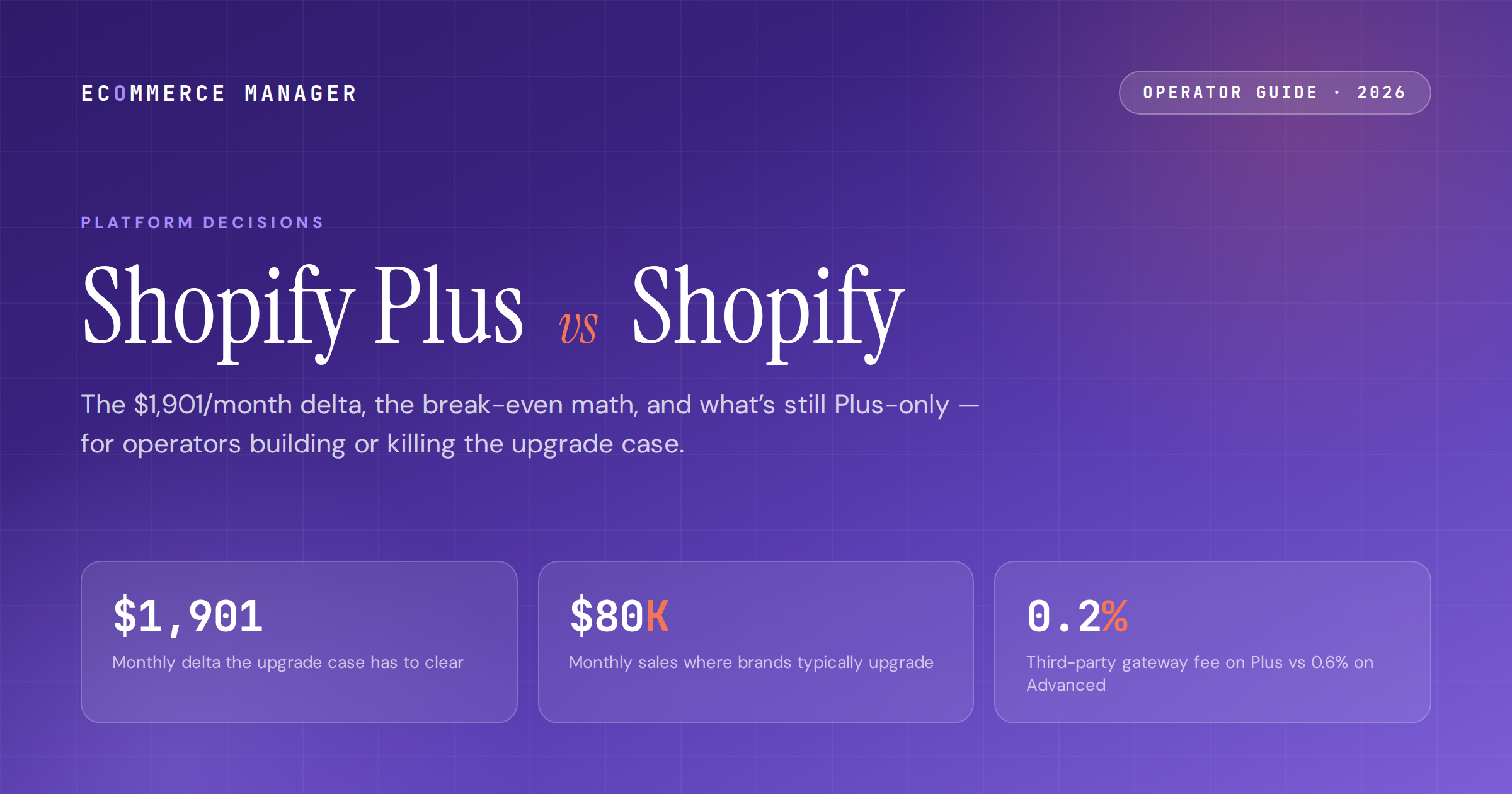
02The working delta is $1,901/mo — Plus at $2,300 (3-year) against Advanced annual at $399 monthly-equivalent pricing conventions used across agency comparisons, or roughly $23–24K per year. Every upgrade case has to clear this number with fee savings, app replacement, or conversion gains.
-
03The single most useful line: third-party gateway surcharges run 0.6% on Advanced vs 0.2% on Plus. On Shopify Payments both plans pay 0% surcharge, and Plus gets the better base rate (2.15% + 30¢, negotiable, vs 2.5% on Advanced). If you're locked into an external gateway, this delta does most of your math for you.
-
04At $1M annual revenue, Plus usually loses. Ringly's calculation: fee savings cover only about $3,500 of the ~$24K annual subscription delta. Plus at this level costs roughly 2.3% of revenue, justifiable only if a specific Plus feature is in heavy, measurable use.
-
05At $3M annual revenue on a third-party gateway, the math turns. Advanced at 0.6% costs ~$15K/year in surcharges after the base fee; Plus cuts that to ~$5K and the gap covers roughly half the delta before you count a single feature. Add $1,500+/mo of Advanced-plan apps doing B2B, automation, or checkout work and Plus's effective cost drops below what you already pay.
-
06Shopify's internal benchmark says brands typically upgrade around $80K/mo in sales (~$960K/year). Practitioner consensus puts the real ROI inflection at $1–2M annual GMV — later than the benchmark, earlier than most operators assume. A brand at $1.5M with a fast-growing wholesale channel should evaluate now; a $2M pure-DTC brand with simple checkout needs can wait. Run your own inputs through the ECM platform calculator before any agency call.
-
07A $399 first-month Plus trial now exists. Useful for pressure-testing the admin and B2B setup against your real catalog before committing to a multi-year term. Shopify doesn't charge for the plan migration itself; the theme, app, and integration work is on you.
Does the $1,901/mo delta clear for your store?
Plug your GMV, gateway, and app spend into the ECM Platform Calculator and get the Advanced-vs-Plus break-even for your actual numbers in under two minutes.
What moved down the ladder, and what stayed at the top
Shopify has quietly democratized several formerly-Plus capabilities. Knowing which ones is how you avoid paying $23K/year for features you already have.
Now on every paid plan
-
→Core B2B, since April 2, 2026: company accounts, company locations, catalogs, net payment terms, quantity rules, quick ordering, and B2B automations. If your wholesale motion is a price list and net-30 terms, you no longer need Plus for it.
-
→Most visual checkout customization. Checkout Extensibility apps deliver branding, trust badges, and field additions on lower tiers now. Agencies are explicit about this one: don't upgrade to Plus purely for checkout branding anymore.
-
→The one-page checkout and Shop Pay — the conversion engines — work identically on every plan. Shopify's 15% average checkout conversion edge over competing platforms is a platform property, not a Plus perk — how it compares to other platforms is covered across the ECM platform reviews.
Still Plus-only in 2026
-
→Full Checkout Extensibility depth: the Checkout Branding API, Shopify Functions at full capability for dynamic discount logic and tiered pricing, custom fields, buyer-type personalization, and — new in the Winter 2026 Edition — per-market checkout flows serving different countries or B2B segments from one store. Merchants report checkout running up to 50% faster than legacy Scripts implementations.
-
→Expansion stores: up to 10 storefronts under one organization (additional stores $250/mo each), with centralized admin. This is the feature that decides multi-region and multi-brand architectures.
-
→Enterprise B2B depth: unlimited catalogs, direct catalog assignment to companies, deposits, partial payments, and payment requests per fulfillment. Partial payments alone change cash flow for made-to-order and high-ticket wholesale.
-
→Launchpad for scheduling flash sales, drops, and coordinated storefront changes — it has powered over $3B in sales since 2017 and typically replaces several paid apps for brands running four or more scheduled campaigns a year.
-
→Materially higher API limits (agencies cite 5–10x depending on resource), unlimited staff accounts vs 15 on Advanced, priority support, and a 99.99% uptime commitment with throughput past 10,000 transactions per minute. This is what your ERP, PIM, and 3PL syncs feel at peak. Audit where your current stack actually throttles with a proper tech stack audit before assuming you need it.
The June 30 deadline that reshaped this comparison
2026 is the year Shopify finished rebuilding its customization layer. Two dates did the reshaping.
-
01Shopify Scripts and checkout.liquid were permanently retired on June 30, 2026. Every custom checkout behavior now runs on Shopify Functions and Checkout Extensibility. Plus stores that hadn't migrated legacy Scripts faced a forced rebuild this year; if yours still has unconverted logic, that's the first project, not the upgrade evaluation.
-
02Since August 28, 2025, even Thank You and Order Status page customizations require Checkout Extensibility. Direct HTML/CSS editing of checkout is gone on every plan. The practical effect: checkout work is now developer work (React-based UI extensions), which is worth knowing before budgeting a Plus rollout.
-
03Functions is where the real Plus advantage sits. Discount stacking, B2B-specific logic, delivery and payment customization by segment — the programmable layer runs at full capability on Plus. On standard plans you approximate this with apps, at $30–$300/mo each, with each app adding checkout latency.
-
04Automation depth compounds quietly. Merchants report saving 20+ hours weekly through Flow automation at scale — VIP tagging, high-risk order routing, restock alerts, loyalty tiers. The honest threshold from agency practice: when your ops team spends 15–20 manual hours a week on work Flow and Functions could absorb, the labor math starts covering the plan delta on its own. Measure it against your KPI baseline, not a feeling.
When Advanced is the right answer, and when Plus wins
Both mistakes cost real money. Here are the honest profiles, assembled from agency data rather than Shopify's sales page.
Stay on Advanced when
-
→You're under roughly $1M–$2M annual GMV on Shopify Payments with no multi-store requirement. The fee delta barely moves and the features you'd pay for sit idle. Reinvesting the $23K/year into marketing or a developer usually beats the upgrade.
-
→Your B2B needs fit what April 2026 put on every plan: company accounts, catalogs, net terms. Simple wholesale no longer justifies Plus.
-
→Your checkout ambitions are visual. Branding, trust signals, and field tweaks are achievable on Advanced through extensibility apps; upgrade for programmable checkout logic, not aesthetics — and if conversion is the actual goal, a CRO specialist on your current plan often beats a plan change. The ECM Shopify review covers what each plan's checkout actually permits.
Move to Plus when
-
→You clear $1M monthly GMV or you're on a third-party gateway at $3M+ annual revenue, where the 0.6%-to-0.2% surcharge drop plus app consolidation covers most of the delta before conversion gains are counted.
-
→Wholesale exceeds roughly 20% of revenue and needs unlimited catalogs, deposits, or partial payments — the B2B depth that stayed exclusive. Or you're launching regional storefronts and expansion stores replace duct-taped multi-store workarounds.
-
→You run four or more coordinated campaigns a year (Launchpad territory), your integrations hit API throttling at peak, or your Advanced-plan app bill for B2B, automation, and checkout work exceeds $1,500/mo. At that point you're paying Plus prices for an Advanced experience. A vetted Plus implementation partner can pressure-test the case before you sign.
Building the Plus business case for your board?
The ECM directory lists vetted Shopify Plus implementation partners with verified client reviews — filtered by budget, vertical, and specialty, including checkout extensibility and B2B rollout specialists.
If you upgrade: timeline, sequencing, and contract terms
The upgrade itself is not the risk. Activating everything at once, and signing without written terms, are.
-
01A standard Advanced-to-Plus migration runs 8–12 weeks with clean data. No replatforming, same store, same URLs — the time goes into checkout extensibility work, Functions conversion, B2B configuration, and QA. Budget agency support for the React-based checkout work specifically; the rest is manageable in-house.
-
02Sequence the rollout in phases. Agencies that run these weekly report that activating checkout customization, Functions, B2B, and expansion stores simultaneously creates a debugging mess where nothing can be isolated. Foundation first (checkout migration, Scripts-to-Functions), then automation, then expansion. Phased rollouts shave 3–4 weeks off launches in agency data.
-
03Get the variable-fee terms in writing: the exact GMV threshold, the percentage, the cap, and the downgrade conditions. Shopify negotiates these per contract now, and verbal commitments don't survive renewal. This is the single most repeated piece of advice from agencies who've watched the renewals.
-
04Downgrading is possible and non-destructive. Store data and products survive; you lose Plus-exclusive features (expansion stores, full extensibility, enterprise B2B, elevated API limits). Knowing the exit is clean should lower the anxiety on a borderline decision — the $399 first-month trial lowers it further.
-
05Measure the result or the upgrade never ends. Set your pre-upgrade baseline on checkout conversion, ops hours, and app spend, then compare at 90 days. ECM tracks how these platform economics shift in weekly Insights; the plan you're on should be a standing quarterly review item, not a one-time decision.
What a smart operator does with this
Run the math before the feature tour. The upgrade case has to clear $1,901 a month, and the three levers that clear it are gateway surcharge savings (0.6% down to 0.2% on third-party processing), app consolidation (the $1,500+/mo Advanced app stack doing Plus's job badly), and measurable conversion or labor gains. At $1M annual revenue the case almost never closes. At $3M on an external gateway it usually does.
Check what you already have before paying for it again. Core B2B shipped to every paid plan in April 2026, and checkout branding is achievable on Advanced through extensibility apps. The durable Plus exclusives are programmable checkout logic via Functions, expansion stores, enterprise B2B payment terms, Launchpad, and API headroom. Upgrade for the combination, not for any single feature.
If you sign, sign carefully. Get the variable-fee threshold, percentage, cap, and downgrade terms in writing; phase the rollout instead of flipping every switch; and baseline your checkout conversion and ops hours first so the 90-day review has something to compare against. The trial month exists — use it.
Frequently asked questions
How much more does Shopify Plus cost than Advanced in 2026?
Shopify Plus starts at $2,500/month on a 1-year term or $2,300/month on a 3-year term, covering up to $1 million in monthly GMV before a negotiable 0.25% variable fee applies. Advanced costs $399/month (or $299/month billed annually). The working delta is roughly $1,900 per month, or $23,000–24,000 per year, before counting fee savings: Plus pays a 0.2% third-party gateway surcharge versus 0.6% on Advanced, and gets better Shopify Payments base rates.
At what revenue should I upgrade to Shopify Plus?
Shopify's internal benchmark is around $80,000 in monthly sales (roughly $960,000/year), but practitioner consensus puts the real ROI inflection at $1–2 million in annual GMV. At $1 million annual revenue, transaction fee savings cover only about $3,500 of the $24,000 subscription delta, so Plus rarely pays. Operational triggers matter as much as revenue: heavy wholesale growth, checkout logic requirements, multi-store needs, or an Advanced-plan app bill above $1,500/month can justify upgrading earlier.
Is Shopify B2B still exclusive to Shopify Plus?
No. Since April 2, 2026, core B2B features ship on every paid Shopify plan: company accounts, company locations, catalogs, net payment terms, quantity rules, quick ordering, and B2B automations. Plus adds the enterprise layer — unlimited catalogs, direct catalog assignment to companies, deposits, partial payments, and payment requests per fulfillment. If wholesale is a price list with net-30 terms, standard plans now cover it; if it involves complex payment structures at scale, Plus still earns its fee.
Can I customize checkout without Shopify Plus?
Partially. Visual customization — branding, trust badges, additional fields — is achievable on standard plans through Checkout Extensibility apps, and direct HTML/CSS checkout editing no longer exists on any plan. Programmable checkout logic remains the Plus advantage: Shopify Functions at full capability for dynamic discounts, tiered pricing, and buyer-type personalization, plus per-market checkout flows added in the Winter 2026 Edition. Shopify Scripts was permanently retired on June 30, 2026, so all custom logic now runs on Functions.
Can I downgrade from Shopify Plus back to Advanced?
Yes, and it is non-destructive. Your store data, products, and URLs are unaffected. Downgrading removes access to Plus-exclusive capabilities: expansion stores, full Checkout Extensibility depth, enterprise B2B features like partial payments and unlimited catalogs, Launchpad, higher API limits, and unlimited staff accounts. Before signing, get downgrade conditions in writing along with the variable-fee threshold and cap, since Shopify negotiates these terms per contract.
The playbook top eComm operators actually read
One weekly brief. Five stories that matter. Zero fluff. Written for managers at $5M–$50M DTC brands who want to sound sharper than everyone else in the meeting.
References
- 01 Shopify Plus vs Advanced: 2026 Pricing, Features & When to Upgrade — charleagency.com
- 02 Shopify Pricing Plans 2026: Plus Fees & Hidden Costs — arslanemre.com
- 03 Shopify Plus Pricing 2026: Is the Upgrade Worth It? — arslanemre.com
- 04 Shopify Plus vs Advanced: Which One Makes Sense in 2026 — ringly.io
- 05 When to Upgrade to Shopify Plus: Signs, Costs & ROI (2026 Guide) — suplex.design
- 06 Shopify Plus vs Advanced: When to Upgrade — blackbeltcommerce.com
- 07 Shopify Plus 2026: Features, Pricing, B2B & Limits — elogic.co
- 08 Shopify vs Shopify Plus (2026): The Real Difference No One Talks About — dev.to
- 09 Shopify Plus in 2026: Features, Pricing, and When to Choose It — debutify.com
- 10 Shopify Plus Features: Complete Guide for B2B eCommerce (2026) — atwix.com
- 11 Shopify Plus in 2026: Enterprise Features Worth the Investment — ecosire.com
- 12 Shopify Plus Features: The Complete Guide for 2026 — wearepresta.com
- 13 Shopify Plus vs Shopify & Shopify Advanced — When to Upgrade — vervaunt.com
Make your platform decision data-backed
Join 12,000+ ecommerce managers reading the ECM newsletter every Wednesday — or browse the directory to find vetted migration, CRO, and platform specialists.