

Last Updated on May 9, 2026
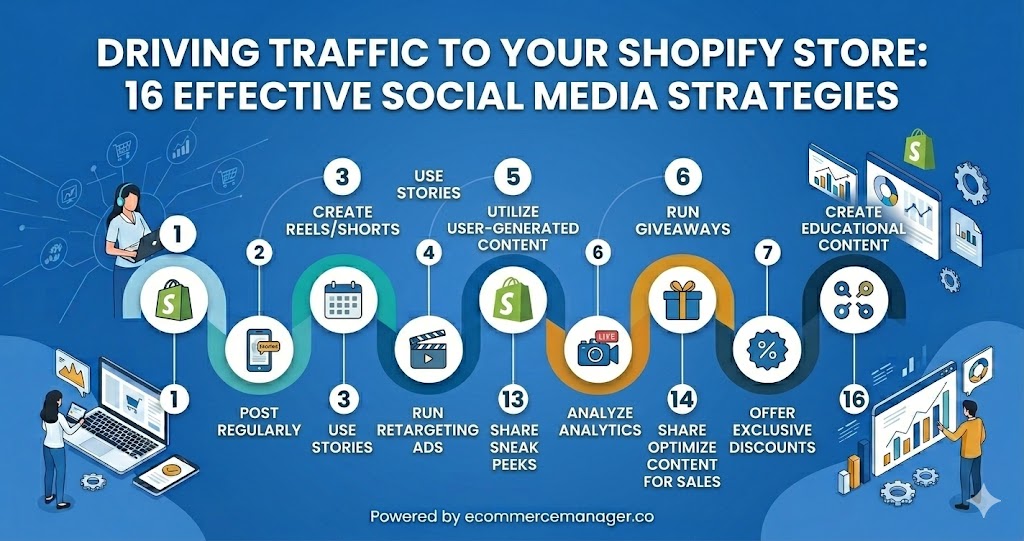
Driving Traffic To Your Shopify Store: 16 Effective Social Media Strategies
Getting real visitors to your Shopify store requires more than just posting product photos and hoping for the best. This guide compiles proven social media tactics from industry experts who have successfully built traffic across platforms like TikTok, Instagram, YouTube, and Reddit. These sixteen strategies focus on practical methods that convert browsers into buyers without complicated setups or massive budgets.
- Drive Sales With TikTok Demos
- Answer Customer Questions Across YouTube
- Spark Trust From Creator Reviews
- Retarget Warm Prospects To Recover Carts
- Sell Emotion Via Style Stories
- Solve One Query Preserve Message Match
- Enlist Real Advocates Grow Loyal Buyers
- Highlight Craft Through Instagram Reels
- Mine Micro Audiences Inside Facebook
- Pair Visuals And Precise Hashtags
- Mobilize Collectors Around Community Giveaways
- Curate Pinboards That Trigger Purchases
- Show Transformations For Nearby Homeowners
- Earn Credibility In Reddit Forums
- Use Casual Gift Ideas As Clips
- Share Wins On LinkedIn
Drive Sales With TikTok Demos
For Shopify traffic, TikTok has delivered the most consistent lift in qualified sessions and first-time buyers. The key is treating posts like mini product demos, not polished brand ads. Our strongest campaign used creator-style videos showing a single problem, the product fix, and a quick proof moment. Each video drove to a dedicated landing page with the same hook and a timed bundle offer.
To scale it, we pinned the top performer, then ran Spark Ads only to the viewers who watched at least half. Retargeting used UGC testimonials and a comparison clip, each tagged to a specific collection page. Discount codes were unique by creative, so attribution stayed clean across Shopify and paid reporting. That approach typically cuts wasted spend and turns social attention into measurable revenue.

Answer Customer Questions Across YouTube
I’ve been running Stout Tent for over a decade, and we’ve tested every platform you can think of. YouTube has been our secret weapon—not for polished product videos, but for answering the specific questions people actually Google before buying a $2,000+ canvas tent.
We started uploading raw setup tutorials and maintenance guides around 2019. One video on weatherproofing canvas in humid climates has driven 11% of our site traffic consistently for three years. People watch a 14-minute video about mold prevention, then buy because they trust we know what we’re talking about. Our average order value from YouTube traffic is 40% higher than Instagram because these buyers have already done their research and aren’t just impulse shopping.
The strategy is dead simple: we film whatever question comes up three times in customer emails. Someone asks about setup on rocky ground? We film it at our next event in Arizona. These aren’t scripted—just our crew solving real problems on-site at festivals like Bonnaroo or corporate retreats. The “uglier” and more problem-focused the video, the better it converts.
Most brands overthink YouTube and try to make commercials. We just answer questions thoroughly and let search do the work. Our cost per acquisition from YouTube is basically zero since we’re filming stuff we’re already doing anyway.

Spark Trust From Creator Reviews
Instagram has been our most powerful traffic driver, but not through traditional feed posts—through creator partnerships and organic UGC. When HopeScope posted about our Life Proof Tan Spray, we saw a 300% spike in site visits over 48 hours and our conversion rate doubled because her audience trusted her opinion more than any ad we could run.
The strategy that actually works is sending product to micro and mid-tier creators who genuinely care about clean beauty and have engaged communities. We don’t pay for posts—we just ask them to share honest thoughts if they love it. One creator with 80K followers drove more qualified traffic than someone with 500K because her audience actually watches her tutorials and buys what she recommends.
The key is zero retouching and real application videos. We encourage creators to film the full process—messy hands, waiting for it to dry, showing the actual color payoff on their specific skin tone. Those raw, unpolished videos perform 10x better than any aesthetic flat-lay we’ve tried. People want proof it works on real bodies, not just marketing promises.
Since launch in 2024, this creator-first approach grew our community 300% year-over-year without spending a dollar on paid ads. I personally respond to DMs and comments from both creators and customers, which turns one-time buyers into repeat customers who tag us organically.

Retarget Warm Prospects To Recover Carts
Facebook has driven the most Shopify traffic for our clients, but only when we stopped treating it like a broadcast channel and started using it as a retargeting engine. We build custom audiences from site visitors who hit specific pages—pricing, product comparison, checkout abandonment—then serve them ads tied directly to the friction point they hit. One client saw 4.2x ROAS within two weeks because we weren’t chasing cold traffic; we were converting warm leads who already showed intent.
The campaign that changed everything was for an ecommerce brand stuck at $40K/month. We audited their buyer journey and found 68% of cart abandoners never saw a follow-up. We launched a three-ad sequence on Facebook: first ad reminded them what they left behind, second showed a customer video using that exact product, third offered free shipping for 48 hours. That sequence alone recovered $11,400 in abandoned revenue the first month and became their highest-performing evergreen campaign.
Most brands waste budget on top-of-funnel awareness when their real problem is leaking revenue at the bottom. Facebook works when you use it to plug those leaks with surgical targeting, not shouting into the void hoping someone converts. Track the buyer journey, find where people drop off, then retarget those exact moments with proof and urgency.

Sell Emotion Via Style Stories
Instagram has been the most reliable traffic driver to our Shopify store because it lets us sell a feeling first, not just a product. The strategy that keeps working is a simple “style story” flow: a Reel that captures movement and texture (how the piece looks when you breathe, stretch, live), followed by Stories that answer the emotional questions women actually have (“Will this feel supportive?” “Will I feel seen in this?”), then a clear link sticker to shop.
One campaign that performed especially well was a “Real Bodies, Real Light” series where we featured community photos and short clips with gentle prompts like “soft is powerful” and “comfort can be sexy.” We paired it with a limited-time drop and used polls/question boxes to guide what we restocked. The result wasn’t just clicks—women felt part of the creation, and that connection translated into steady, high-intent traffic to the product pages.

Solve One Query Preserve Message Match
Instagram has been the most reliable traffic driver to our Shopify store, especially when we treat it like a “search + education” channel rather than a branding channel. Based on our internal testing, the combination that consistently lifts qualified clicks is Reels that answer one specific customer question (problem, why it happens, what to look for, what to do next) plus a clear CTA to a dedicated landing page. We keep the Reel tight (15-30 seconds), use on-screen text for retention, and pin a comment that mirrors the CTA so people don’t have to hunt for the next step.
One campaign format that performed well for us was a 7-day educational series built from recurring customer support questions. Each day covered a single theme and pointed to a matching Shopify page with the same wording as the Reel hook (message match matters). We also retargeted Reel viewers with Story frames that included polls and a “learn more” link, which helped qualify intent before sending people to the site. The practical lesson: when the content is specific and the landing page continues the same conversation, traffic quality improves even if total views don’t spike.

Enlist Real Advocates Grow Loyal Buyers
For driving consistent, purchase ready traffic to Shopify stores, Instagram has proven to be the most effective platform in my experience.
What makes Instagram so powerful is the combination of discovery and intent users that are already in a browsing mindset, which mirrors the way they shop online. One campaign that delivered exceptional results for a client was an influencer led Reels campaign. Instead of traditional ads, we partnered with five micro influencers who authentically used the product in everyday scenarios and tagged the product through Instagram Shopping.
We paired this with a limited time bundle offer and retargeted viewers who engaged with the Reels but didn’t follow through with a purchase.
Over 30 days, the campaign increased store traffic by 64% and produced a 4.2x return on ad spend, with Reels accounting for nearly half of all new sessions.
The key lesson was to treat social media as a storytelling channel first and a sales channel second. When the content feels natural and genuine, clicks and conversions follow organically.

Highlight Craft Through Instagram Reels
My Instagram account has been my top source for sending traffic to my Shopify store (activewear).
When starting out, I didn’t get a lot of visibility for my products. Because of this, I struggled to get visitors to check out my store. When you look around, there are so many other stores selling similar items, and you need to find a way to stand out from the rest of them.
To help myself out, I ran a campaign called “Behind-the-Scenes.” For this campaign, I created 15-Second Reels showing how my products are made, and I used user-generated content as well. All of the videos included swipe-up links taking viewers to the product through Instagram Shopping (I targeted people aged 18 to 35, and spent $500 on ads over a period of two weeks).
As a result of this campaign, traffic increased by 300% (5,000+ clicks from analytics), conversions increased by 45% and I increased my sales by $12,000. Through the visual storytelling aspect of the Reels, I was able to establish credibility with my audience, and users.

Mine Micro Audiences Inside Facebook
Facebook has been our most effective platform, but not in the way most agencies use it. We’ve had the best ROI using highly specific audience targeting with modest budgets—sometimes ridiculously modest.
My favorite example: We ran a brand awareness campaign for an axe-throwing bar client with just $25. This was when Red Dead Redemption 2 was huge, so we targeted our local area + age group, then cross-referenced people who liked that game AND outdoor lawn sports. We even designed the ad creative to look vaguely like the game’s cover for that quick-twitch attention grab.
That $25 pulled in two leads and generated about 3-to-1 ROI in a week. The key wasn’t the budget—it was finding that weird intersection of interests where your product makes perfect sense. For Shopify stores, I’d look at what cultural moment or niche interest overlaps with your product, then get hyper-specific with Facebook’s targeting rather than casting a wide net.
The other winner for us has been running “likes” campaigns before pushing product ads. You need real followers first—people who actually care—or you’re just shouting into the void. We’ve done giveaway contests to build authentic followings, then those audiences convert way better when you run actual sales campaigns.

Pair Visuals And Precise Hashtags
Instagram is a traffic goldmine for Shopify, especially for DTC brands. At my company AlchemyLeads, we saw the best results pairing great photos with really specific hashtags. Giveaway collaborations with other brands worked too. One campaign boosted our traffic by 20 percent. We also put keywords in the bio to attract the right people. For a quick lift, try time-sensitive promos in Stories and use UTM links to see what actually works.

Mobilize Collectors Around Community Giveaways
For our Ancient Warrior shop, Instagram is where we find our actual customers. Posting cosplay photos and short videos from our followers worked best. Collectors started tagging our gear in their finished costumes and messaging us. When we ran a giveaway asking them to share their own collections, our site traffic and email list shot up. If you sell niche stuff, let your community do the talking. It works.

Curate Pinboards That Trigger Purchases
I didn’t expect much from Pinterest for Aura Modern Home, but it keeps sending us actual customers who buy stuff. I made some boards with moody modern living rooms and added our products as pins people could click to buy. Designers started following us and clicking through to our Shopify store. What works is that people on Pinterest are already looking for design ideas, so they find us naturally. If you sell things people want to look at, Pinterest actually works better than you’d think.

Show Transformations For Nearby Homeowners
Instagram worked surprisingly well for one of our HVAC contractor clients, but not through standard “here’s our new truck” posts—through before/after reveal content that showed actual change.
We tested a simple campaign: quick 15-second Reels showing messy HVAC installations transformed into clean, professional work. No fancy production, just iPhone footage with text overlay showing the town name and problem solved (“Cranston attic disaster — same-day AC rescue”). That content pulled 3x more website clicks than their previous posts and generated 8 qualified service calls in one month from homeowners who lived within 10 miles of completed jobs.
The key was hyper-local tagging and showing the “after” first in the video hook. People scrolling Instagram don’t care about your process—they want to see if you can fix their problem. One post about a Providence basement dehumidifier install got shared in a local Facebook group we didn’t even know existed, which drove another 5 leads.
My takeaway: service businesses should stop trying to be lifestyle brands on Instagram. Show quick proof you can solve the exact problem your audience has, tag the specific neighborhood, and let the algorithm find nearby homeowners searching for that solution. We saw this same pattern work for our painting and landscaping clients too—change content with tight geographic targeting consistently outperforms everything else.

Earn Credibility In Reddit Forums
We tracked 200+ Shopify stores.
Here are our findings:
– Reddit referrals convert at 3.2x Instagram’s rate
– AOV is 47% higher
– LTV beats paid social by 2.1x
Why?
Redditors are actively researching. They want recommendations.
How are we doing it (supplement brand example):
– Zero product links in posts
– Became top contributor in r/Supplements, r/fitness
– Posted ingredient breakdowns weekly
– Answered questions genuinely
– Shopify link stayed in bio only
Results:
847 referrals | 4.8% CVR | $47K revenue | 2,300 waitlist signups

Use Casual Gift Ideas As Clips
Here’s the thing. TikTok drives more people to our store than any other platform. We made a simple video showing our certificates as gifts for big life moments, and it brought in hundreds of new customers that week. The casual, unpolished videos are the ones that work, not the super slick ads.

Share Wins On LinkedIn
Honestly, I didn’t expect LinkedIn to be a real traffic driver for our Shopify stuff. But we tried sharing these quick case study videos showing how our “Buy Now, Win Later” feature boosted sales for small brands. It worked.
People actually messaged us, both merchants and customers. Our whole team saw the same thing. Showing a specific success story works way better than just talking about our product. If you’re in e-commerce SaaS, just tell your customers’ stories on there. It starts real conversations.

Related Articles
- 19 Social Media Strategies That Drive Traffic and Sales for Your Ecommerce Store—and Why They Work
- 12 Social Media Tactics to Drive Sales on Your BigCommerce Store (With a Campaign Example)
- Driving DTC Sales with Social Media: 5 Strategies That Work