

Last Updated on June 7, 2026
7 Most Effective Strategies and Tools for Managing Shopify Inventory During Peak Seasons—and Why
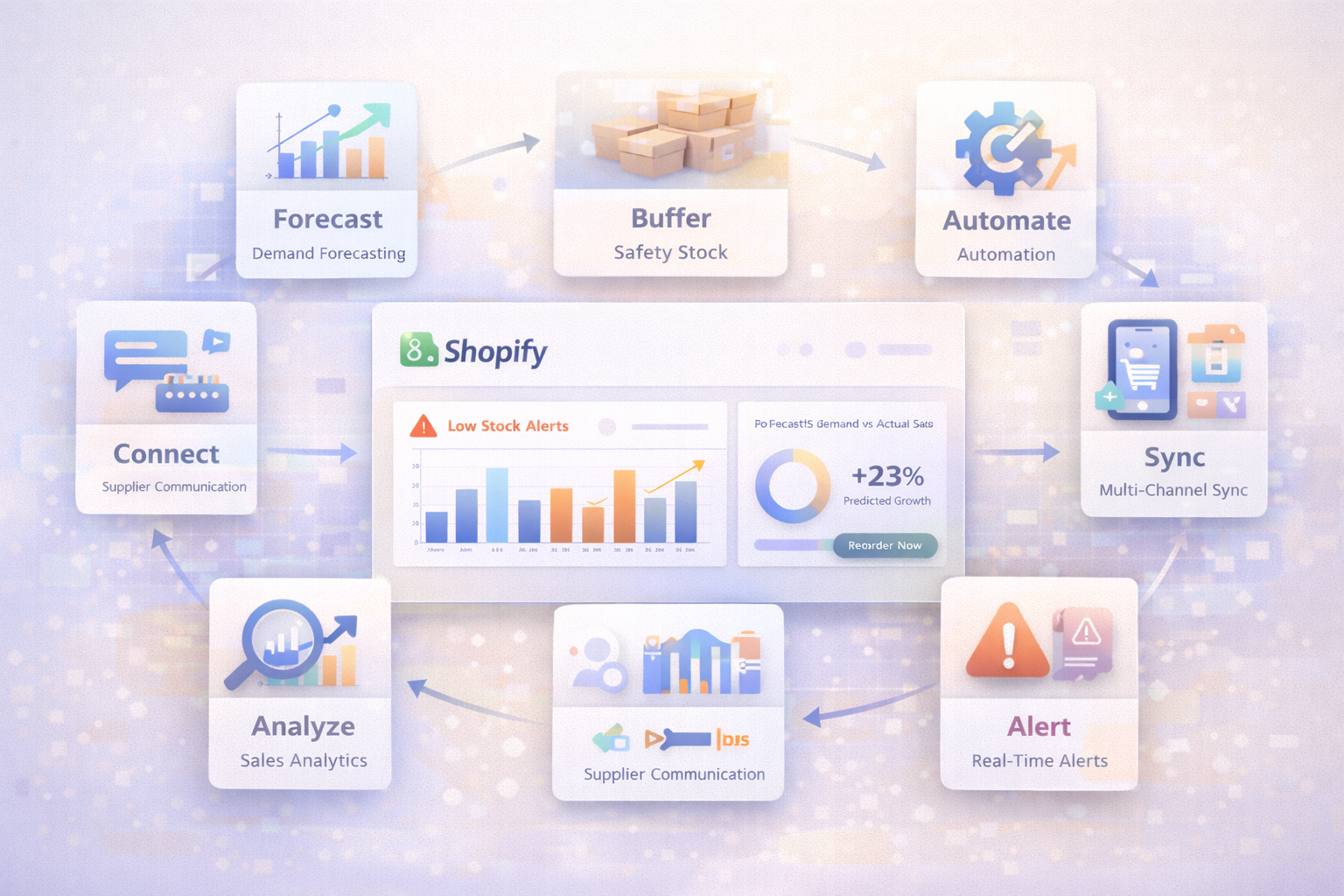
Peak season can make or break a Shopify store’s year, and running out of stock or overstocking both destroy profit margins. This guide breaks down seven practical strategies that experts use to keep inventory levels accurate when order volume spikes. Readers will learn specific tools and tactics that prevent stockouts without tying up unnecessary capital in excess inventory.
- Launch Pre-Orders To Gauge Peak Demand
- Centralize Inventory In ERP And Buffer Storefront
- Automate Forecasts Around Real Lead Times
- Dual-Source Core SKUs Via Backup Suppliers
- Set Dynamic Reorder Points By Sales Velocity
- Secure Overflow Capacity Through Secondary Carriers
- Pre-Allocate Variants Per Historical Size Ratios
Launch Pre-Orders To Gauge Peak Demand
I’ve run business development across retail, tech, and apparel for 20+ years, including scaling Muscle Up Marketing to Inc. 500’s #40 fastest-growing company. The inventory challenges I’ve seen always intensify when demand spikes, so here’s what actually moves the needle.
Pre-order campaigns are your secret weapon.
At One Love Apparel, we learned that launching pre-orders 2-3 weeks before peak seasons (back-to-school, holidays) lets you gauge real demand before committing inventory dollars. We saw 30% fewer overstock situations and almost zero stockouts on our best-selling tees by letting customer orders dictate our production runs instead of guessing.
The key is transparency—tell customers exactly when they’ll receive their order and offer a small incentive (we did 10% off pre-orders). This builds cash flow before you need it, reduces the anxiety of holding dead inventory, and creates urgency that actually converts. Most stores wait until they’re sold out to panic; we use pre-orders to never get there in the first place.
Set your pre-order window to close exactly when you need to place your supplier order. That way you’re buying based on actual commitments, not forecasts that are usually wrong.

Centralize Inventory In ERP And Buffer Storefront
The best way to mitigate peak season spikes on Shopify is to stop using Shopify as your primary inventory database.
We often see brands relying on Shopify’s native tracking to mishandle high-velocity events, leading them to fall into the “overselling trap” due to slight sync latencies.
The solve is decoupling your inventory logic from the storefront to a centralized ERP or dedicated middleware as your single source of truth.
Push real-time, “safety-stock” adjusted numbers to Shopify. If you have 100, list 90 on the storefront to account for buffer. Research by the IHL Group finds that inventory distortion — the combined cost of out-of-stocks and overstocks — costs the global retail industry $1.7 trillion each year. And in the stakes of a peak season, that value is compounded by the cost of customer acquisition; after a stockout, 70% of customers will go to a competitor. By automating this sync, you eliminate the manual lag that leads to overselling and the brand damage of post-purchase cancellations.
Peak season is a stress test on your data integrity. When the volume is high, you need to know your systems are talking to each other faster than your customers are clicking buy.

Automate Forecasts Around Real Lead Times
I’ve spent 15+ years in digital change and supply chain, and the most underused strategy I see during peak seasons is automated demand forecasting tied directly to your production or fulfillment timelines. Most Shopify stores track inventory levels but don’t connect those numbers to actual lead times from suppliers or manufacturers.
Here’s what works: Set up buffer stock calculations based on your supplier delivery routes and time windows, not just arbitrary “low stock” alerts. In one project optimizing NetSuite integrations, we reduced stockouts by 31% during Q4 by programming the system to trigger reorders when inventory hit a threshold calculated from actual delivery schedules—not guesswork. For Shopify, this means knowing your supplier delivers Thursdays at 6 AM and your product sells out by Tuesday afternoon, so you reorder the previous Friday.
The killer move is adjusting lot sizes to match actual demand patterns from last year’s peak season. Pull your Shopify sales data from the same weeks last year, identify the exact daily sell-through rates, and order in batches that match that rhythm—not your supplier’s preferred minimum order quantity. I’ve seen companies sitting on 40% excess inventory simply because they ordered what was “convenient” instead of what would actually sell during their specific peak window.
Stop managing inventory like it’s static numbers in a spreadsheet. Treat it like a supply chain with real people, real delivery trucks, and real time constraints. That’s where the money is.

Dual-Source Core SKUs Via Backup Suppliers
My top tip is to dual-source each core SKU by qualifying a backup factory so we are not exposed to a single supplier during peak demand. Ahead of the rush, we place POs with both and shift volume to the one with confirmed lead times to keep Shopify stock available through spikes.

Set Dynamic Reorder Points By Sales Velocity
My top tip for managing inventory on Shopify during peak seasons is setting automated reorder thresholds tied to real sales velocity, not static stock levels. We connect Shopify data with demand forecasting tools to adjust reorder points weekly based on trends, promotions, and seasonality. This prevents both overstock and stockouts when demand spikes. The key is to let real-time sales data drive purchasing decisions rather than manual estimates, keeping cash flow healthy and customer satisfaction high during high-volume periods.

Secure Overflow Capacity Through Secondary Carriers
I’ve spent over 30 years in supply chain and logistics, helping companies like Honda, Starbucks, and Disney optimize their shipping operations. Peak season inventory isn’t just about having stock—it’s about knowing your carrier capacity limits before they become your bottleneck.
Here’s what most Shopify sellers miss: your inventory might be ready, but if your shipping carrier hits volume caps during Black Friday, your products sit in a warehouse anyway. At AFMS, we recently helped a client audit their peak season shipping data and found they were getting hit with residential surcharges that jumped 40% during November-December. They had inventory but couldn’t afford to move it profitably.
My specific tip: run a shipping cost analysis on last year’s peak season orders by product category, then pre-negotiate overflow capacity with a second carrier NOW. We’ve seen clients save 18-25% by having backup carrier agreements in place before peak hits. One electronics retailer we worked with secured alternative routing for their top 20 SKUs in September, which saved them when their primary carrier capped pickups at their warehouse in December.
Most people optimize inventory levels but forget that shipping capacity is inventory’s silent killer during peak. Lock in your logistics before you lock in your stock levels, or you’ll have a warehouse full of products you can’t profitably deliver.

Pre-Allocate Variants Per Historical Size Ratios
I’ve run Scrubs of Evans for over 16 years, and during peak hiring seasons (late summer when hospitals onboard new staff), we learned one critical lesson: pre-allocate inventory by size ratio based on past sales data, not gut feeling.
Here’s what changed everything for us: we analyzed our Maevn and IRG sales by size over three previous peak seasons and found our assumption was completely wrong. We thought medium was our bestseller, but small actually moved 40% faster during August–September rushes. Now we adjust our Shopify stock levels two months before peak season hits, ordering 35% more smalls and 20% fewer extra-larges than our standard ratio.
The specific strategy is this: pull your Shopify sales report filtered by variant (size/color) for the same period last year, then adjust your purchase orders before your supplier’s lead time window closes. For medical uniforms, that’s 8–10 weeks out. Most people reorder the same quantities year-round and then scramble when they’re out of the size everyone actually wants.
We also set low-stock alerts in Shopify at different thresholds per size—smalls alert at 8 units remaining, XLs at 3 units. This keeps us from over-ordering slow movers while preventing stockouts on fast sellers when healthcare workers flood in needing uniforms immediately for their new jobs.

Related Articles
- Effective Inventory Management for Ecommerce: Strategies From the Experts
- Essential BigCommerce Features for Business Success: Insights from the Pros
- 11 Tips For Growing an Ecommerce Business on the Adobe Commerce Platform