

Last Updated on June 7, 2026
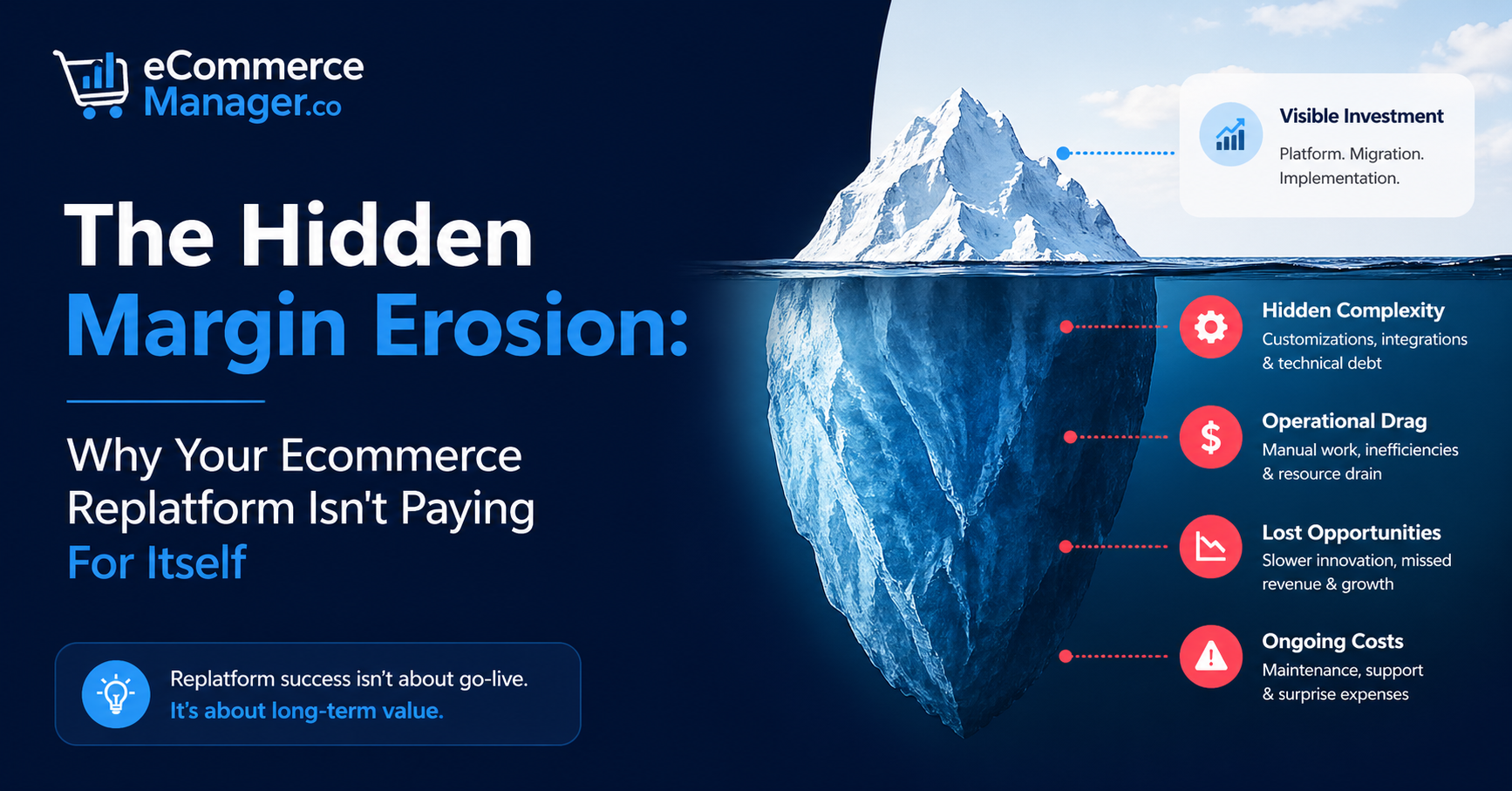
Many ecommerce businesses undertake a replatforming project with clear goals in mind. Improved customer experience, enhanced scalability, and greater operational efficiency are common drivers. These initiatives are significant investments of time and resources.
However, the anticipated return on investment (ROI) often fails to materialize. The underlying costs, both direct and indirect, can quietly erode the projected financial gains. This can leave leadership questioning the value of a substantial undertaking.
Unforeseen Integration Costs
A new platform is rarely a standalone solution. It must integrate with a complex ecosystem of existing and new third-party tools. These integrations often require custom development.
Each connection point introduces potential friction. The cost of developing, testing, and maintaining these links can be considerable. This extends beyond the initial setup phase.
API Limitations and Custom Connectors
Many off-the-shelf integrations rely on public APIs. These can have limitations in functionality or data throughput. When these fall short, custom connectors become necessary.
Building bespoke integrations demands specialized developer expertise. It also introduces a unique point of failure that requires ongoing monitoring and updates.
Data Migration Complexities
Moving historical data is a critical, often underestimated, part of replatforming. Inaccurate or incomplete data migration can cripple operations from day one.
This process involves data cleansing, transformation, and validation. Each step adds time and incurs costs, often requiring dedicated personnel or external consultancies.
Performance Bottlenecks and Optimization Deficits
A new platform is expected to perform better than the old one. Yet, performance issues can emerge unexpectedly, impacting user experience and conversion rates.
These bottlenecks can stem from various sources. Poorly optimized code, inefficient database queries, or inadequate infrastructure can all contribute.
Frontend Load Times
Slow page load times are a death knell for ecommerce. Customers expect instant access to product information and seamless navigation.
Even with a modern frontend framework, unoptimized images, excessive scripts, or inefficient rendering can lead to frustrating delays.
Backend Processing Delays
Behind the scenes, the platform handles order processing, inventory management, and customer data. Delays here affect fulfillment and customer satisfaction.
Inefficient algorithms or poorly structured databases can cause these backend processes to lag. This impacts operational throughput.
Suboptimal Marketing and SEO Alignment
A replatforming project often overlooks the intricate relationship between the technology stack and marketing effectiveness. The new system may not be inherently optimized for search visibility or campaign performance.
This can result in a loss of organic traffic and a reduced ROI on marketing spend. The benefits of a new platform are diminished if customers cannot find it.
Technical SEO Gaps
Migrating to a new platform can introduce significant technical SEO challenges. URL structures may change, canonical tags can be misconfigured, and sitemaps might not be generated correctly.
Without careful planning and execution, a replatform can lead to indexing issues and a decline in search engine rankings. Addressing these requires a deep understanding of app store optimization and website search engine visibility.
Content Migration and Tagging Errors
Product descriptions, meta tags, and other critical SEO elements need to be accurately migrated. Errors in this process can dilute the impact of content and harm search performance.
Each product page is an opportunity for organic discovery. Mismanaged content migration means these opportunities are lost.
Operational Overheads and Hidden Support Costs
The perceived efficiency of a new platform can mask escalating operational overheads. Support teams may require extensive retraining. New workflows might introduce unexpected complexities.
The initial savings projected can be offset by ongoing support and maintenance demands.
Increased Training Requirements
Staff members must learn new interfaces, processes, and troubleshooting methods. This requires significant investment in training programs.
The learning curve can lead to initial productivity dips. The cost of training, combined with lost productivity, adds to the overall expense.
Unexpected Maintenance and Bug Fixing
Even the most robust platforms require ongoing maintenance. New bugs can emerge, and vendor updates may introduce compatibility issues.
These unforeseen issues necessitate dedicated resources for troubleshooting and resolution. This can divert IT staff from strategic initiatives.
Lack of Strategic Vendor Alignment
Choosing a replatforming vendor is a critical decision. A misalignment in strategic vision or technical capability can lead to long-term issues.
The chosen platform may not evolve in ways that align with the business’s future needs. This can necessitate costly workarounds or future migrations.
Platform Scalability Miscalculations
Businesses anticipate growth. The chosen platform must be able to scale accordingly. Overlooking future traffic spikes or increased product catalogs can lead to performance degradation.
This requires foresight and a vendor partnership that can accommodate evolving demands. A platform that cannot scale effectively creates new bottlenecks.
Vendor Lock-in and Limited Flexibility
Some platforms are designed to create vendor lock-in. This limits the ability to integrate with other best-of-breed solutions or to customize extensively.
Such limitations can stifle innovation and lead to higher long-term costs as the business is forced to work within a restrictive ecosystem.
Replatforming vs. Incremental Improvement
The decision to replatform is often framed as a binary choice: replace everything or stay put. This overlooks the possibility of incremental improvements.
Targeted upgrades to existing systems or the introduction of specific new functionalities might achieve similar goals at a fraction of the cost and risk.
Modular Enhancements
Instead of a full replatform, consider modular enhancements. This could involve upgrading the checkout process, improving search functionality, or integrating a new PIM system.
These focused projects deliver tangible benefits without the disruption of a complete overhaul. They allow for continuous optimization and adaptation.
Leveraging Existing Infrastructure
Often, existing infrastructure has significant value. Identifying areas for improvement within the current system can be more cost-effective than a complete rip-and-replace.
This approach allows businesses to maintain operational continuity while still achieving key performance objectives. It’s about optimizing what works and fixing what doesn’t.
The Case for Data-Driven Decisions
Ultimately, the success or failure of a replatforming initiative hinges on rigorous data analysis and strategic foresight. Assumptions about cost savings or efficiency gains must be validated with real-world metrics.
A comprehensive understanding of integration needs, performance benchmarks, and ongoing operational expenses is crucial. Without this, the hidden margin erosion can go unnoticed.
Measuring True ROI
Calculating the true ROI of a replatform requires looking beyond initial implementation costs. It involves assessing the long-term impact on revenue, operational efficiency, and customer lifetime value.
This requires a continuous monitoring process. Key performance indicators (KPIs) must be tracked consistently to identify deviations from projected outcomes. A robust understanding of ecommerce SEO services is critical for measuring traffic and conversion impacts.
Total Cost of Ownership (TCO) Analysis
A TCO analysis provides a more accurate financial picture. It accounts for all direct and indirect costs over the lifespan of the platform.
This includes licensing, maintenance, support, customization, and the cost of associated third-party integrations. This holistic view reveals the full financial picture.
Focusing on Business Value, Not Just Technology
Technology is an enabler, not an end in itself. The focus of any significant IT project, including replatforming, must remain on delivering tangible business value.
If a new platform doesn’t demonstrably improve key business outcomes—such as increased sales, reduced operational costs, or enhanced customer satisfaction—its value is questionable. It may be that a more targeted approach to virtual recruitment definition strategy process or other operational efficiencies could yield better results without the upheaval of a full platform migration.
Strategic Alignment with Business Goals
The technology chosen must directly support overarching business objectives. A replatform that doesn’t align with growth strategies, market positioning, or customer engagement goals is unlikely to deliver its promised ROI.
This requires close collaboration between IT leadership and business stakeholders throughout the project lifecycle. The technology should serve the business strategy, not the other way around.
Agile Adaptation and Future-Proofing
The ecommerce landscape is constantly evolving. A successful platform strategy must be adaptable to future market shifts and technological advancements.
Choosing a platform that allows for agile adaptation and future-proofing is essential. This ensures that the investment remains valuable over time, rather than quickly becoming obsolete.
Conclusion
Ecommerce replatforming projects are complex undertakings. While they hold the promise of significant improvement, they also carry substantial risks of margin erosion. Unforeseen integration costs, performance bottlenecks, marketing alignment issues, and escalating operational overheads can all contribute to the failure to achieve projected ROI.
A critical evaluation of total cost of ownership, coupled with a focus on demonstrable business value rather than just technological advancement, is paramount. Often, incremental improvements and strategic enhancements to existing systems can provide a more cost-effective and less disruptive path to achieving business goals.
“The true measure of a platform’s success lies not in its complexity, but in its ability to consistently drive profitable growth and operational excellence.”
— Pratik Singh Raguwanshi, LiveHelpIndia