

Last Updated on September 29, 2026
The CRO Agency Guide for 2026: When to Hire One, What to Pay, What to Expect
The traffic thresholds that decide whether testing is even viable for your store, real retainer tiers, the real win-rate math behind the case studies, and the vetting questions that separate research-driven programs from redesigns with a dashboard.
On this page
The math has to work before the agency can
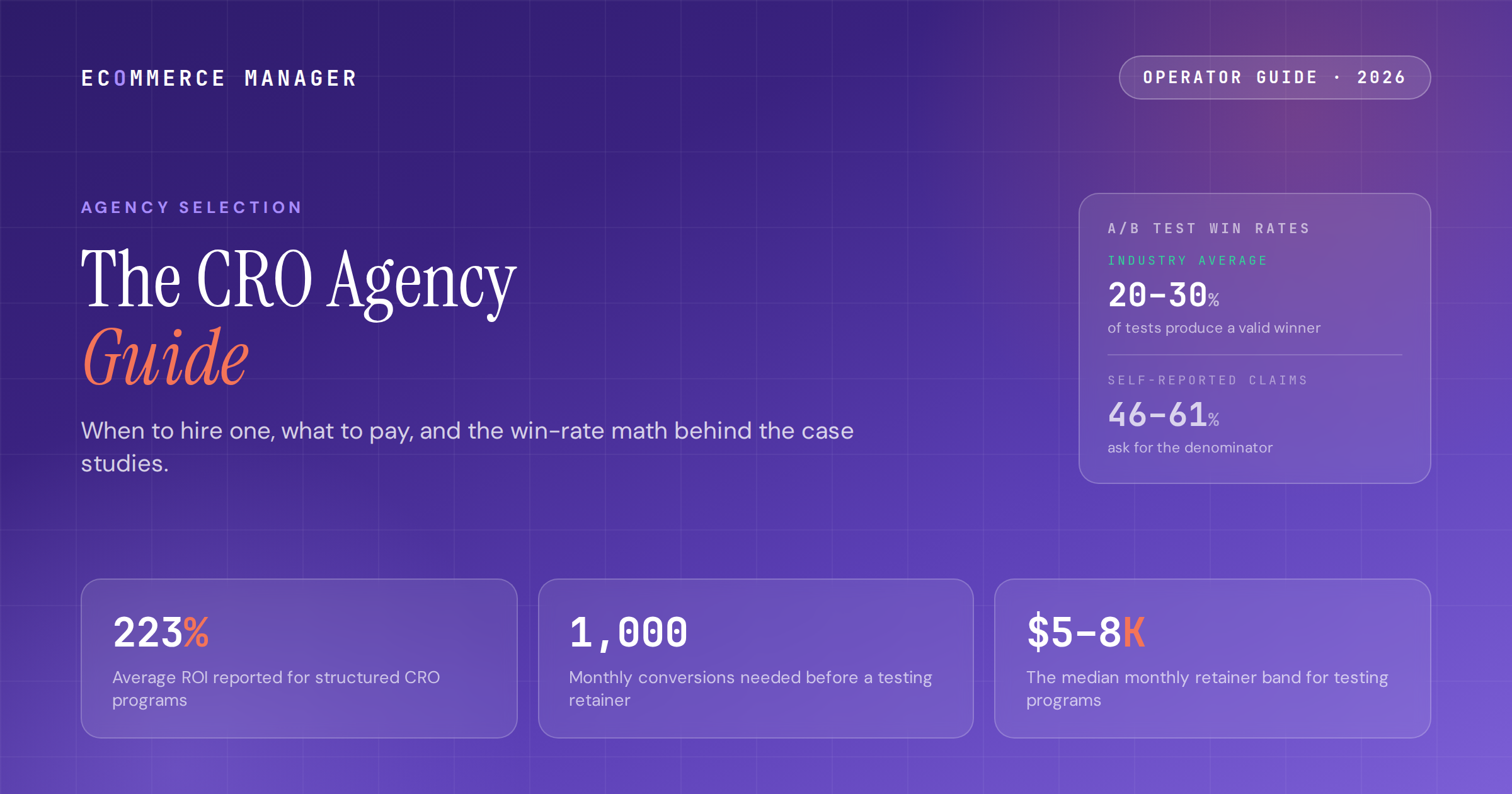
CRO has the strongest ROI story in agency services (structured programs report an average 223% return, with high performers past 1,000%) and the highest rate of engagements that should never have been signed. Both come from the same source: statistics. A/B testing needs conversion volume to reach significance, and below roughly 1,000 monthly conversions, a testing retainer physically cannot deliver what it's sold to deliver, no matter how good the agency is. The most useful thing this guide does is tell you which side of that line you're on before anyone sends a proposal.
The commercial context: with the cross-industry ecommerce conversion rate sitting at 2.5–3.0% and cart abandonment around 70% (Baymard), the upside per basis point is real, which is why CRO retainers run from $2,000 boutique engagements to $35,000+ enterprise programs, mostly on 6-month minimums. It's also why the category attracts inflated claims — self-reported test win rates of 46–61% against an industry average of 20–30% deserve the skepticism this guide applies to them.
What's below: the readiness thresholds, the full 2026 price sheet including the hidden costs (tool subscriptions, 10–40 developer hours per test), the honest results data with named cases, and the vetting framework that separates research-driven experimentation programs from redesigns with a dashboard attached.
When a CRO agency makes sense — and the threshold that decides it
CRO is the one agency category where 'are we ready' is a math question with a checkable answer. Run these five signals before any discovery call.
-
01The volume threshold: roughly 1,000 monthly conversions on the pages you want to optimize. Below it, tests take months to reach significance or never do, and the retainer burns while you wait. The right purchase under the line is research and UX work (heuristic audits, user testing, session analysis), not a testing program. Above it, a real testing cadence becomes possible — and tests-per-month is the single biggest predictor of program ROI.
-
02The traffic floor that pairs with it: 10,000+ monthly visitors to optimization-target pages, alongside spend signals like $100K+ monthly ad budgets: the point where a conversion lift pays for the program many times over because it compounds across everything you're already buying traffic for.
-
03Working measurement, before anything else. An agency inheriting broken tracking spends its first two months (and your first two invoices) on analytics repair — a pattern the ECM in-house vs agency guide flags on the internal side too. If GA4, server-side events, and revenue attribution aren't trustworthy today, buy that fix first as a bounded project; it's cheaper as a project than as a retainer's warm-up act.
-
04An internal owner at five-plus hours a week. CRO programs die of client-side neglect more than agency-side incompetence: hypotheses need business context, tests need approval, and learnings need someone to carry them into the roadmap. No owner, no program — whatever the retainer says.
-
05A clear conversion KPI tied to money. Checkout completion, add-to-cart (benchmark: 6.0–7.9%), lead quality — one number the program is accountable to, pulled from your core KPI set and baselined before kickoff. 'Improve the site' is how programs produce activity reports instead of revenue.
-
06If checkout is your leak, check the platform before hiring anyone. A meaningful share of 'CRO problems' at $5M–$50M brands are checkout-architecture problems, where the gap between a customized checkout and a platform-native one is larger than a year of testing wins. The ECM Shopify Plus vs Shopify guide covers what Checkout Extensibility now handles natively.
What CRO actually costs in 2026
Pricing clusters into clean tiers, and the tier you belong in is set by your traffic and program scope, not your ambition. The visible retainer is also not the whole bill.
The retainer tiers
-
→Entry / boutique: $2,000–$5,000/month. Newer teams and niche specialists (Shopify product-page optimization, analytics implementation). Right for first programs at modest traffic, with the vetting bar set accordingly high.
-
→Mid-tier: $5,000–$8,000/month, the median testing-program band. Established teams with solid track records; typical full-service programs start around $8,500. This is where most $5M–$50M DTC brands with real conversion volume belong.
-
→Senior / enterprise: $10,000–$35,000+/month, with average top-tier retainers near $15,000 and 6-month minimums standard across the tier. Named enterprise programs price per-test at $2,500–$12,500 including full implementation. Below the retainers: one-time audits at $1,000–$5,000 and hourly consulting at $75–$250+ for bounded questions.
-
→Performance-based models take 10–30% of incremental revenue or lift, sometimes on a reduced base. Same rule as every performance model: the attribution methodology decides the invoice, so agree on the counting before the testing.
The lines the proposal skips
-
→Testing tools and platforms: $200–$1,500/month in subscriptions, and enterprise testing platforms run $25K–$60K a year; worth asking whether the agency's stack is included, billed through, or assumed to be yours. Inventory it in a tech stack audit before signing.
-
→Implementation: 10–40 developer and QA hours per test. Whose developers? If it's yours, the retainer's real cost includes your sprint capacity, and your release calendar caps the testing pace: the detail that quietly halves the value of many mid-tier programs.
-
→Context for the fee: agency retainers across all marketing services average $3,209/month (Ahrefs, 439 providers polled). CRO sits well above that line because every test consumes design, development, and analysis hours. A specialized CRO program at $3,500–$20,000 versus a full-service bundle at $5,000–$25,000 where CRO is one slice is the real comparison to run; the ECM agency pricing guide covers the full-bundle side.
Ready to shortlist CRO specialists?
The ECM directory's CRO category lists conversion agencies with published minimum budgets, rate ranges, and verified client reviews scored on results, communication, and value.
What good programs actually deliver, and the win-rate reality
The results data is genuinely strong, which is exactly why the inflated version of it needs separating out. Both live in this section.
-
01The documented program-level outcomes: structured CRO programs report an average 223% ROI; A/B testing alone averages an 18% conversion lift after six months of structured work; and teams running high-velocity programs (15+ tests monthly) report 20–40% cumulative conversion improvement in year one. The cadence drives the compounding, which is why the readiness thresholds above matter so much.
-
02The named cases give the range: SplitBase's optimization work helped Moon Pod generate $3.3M in additional annualized revenue; documented enterprise programs include an 18% conversion uplift for eBay and a 50% improvement for 3M over one year. Individual landing-page tests post 30%+ lifts. These are real, and they came from programs, not single silver-bullet tests.
-
03Now the win-rate reality: the industry average is 20–30% of tests producing a winner. Agencies advertising 46%, 52%, or 61% win rates are quoting self-reported figures, sometimes from selective datasets — treat any number above the industry band as a marketing claim until the agency shows the denominator: how many tests, over what period, counted how. A 25% win rate with high velocity and straight analysis beats a claimed 55% you can't verify.
-
04Losing tests are a deliverable, not a failure, if the program treats them as one. A serious program documents every loser's learning and feeds it into the next hypothesis; that research asset is a large share of what the retainer buys. An agency that only reports winners is curating, and curated reporting is the first red flag in the next section.
-
05Set expectations by phase: 2–5 tests shipped in the first 90 days while research, instrumentation, and QA pipelines come online, with the pace climbing after. An agency promising ten tests in month one is skipping the research that makes tests worth running; one still 'researching' in month four is billing you for a book report.
The questions that expose weak programs
CRO is a methodology business wearing a results costume. These questions check the methodology, which is the part you're actually buying.
-
01"Walk me through a recent losing test and what you did with it." The single most revealing question in the category. Strong agencies answer with a hypothesis, a segment analysis, and the follow-up test it produced; weak ones pivot back to their wins reel. You're buying a learning system, and this is how you inspect it.
-
02"Show me case studies with before-and-after rates, traffic volumes, and test durations." A percentage lift without a base rate, sample size, and duration is decoration. '125% lift' on 40 conversions a month is noise; 8% on 20,000 is a business result. Insist on the full arithmetic, and discount anything that arrives without it.
-
03"What's your statistical standard — and when do you call a test early?" You want a straight answer about significance thresholds, minimum sample sizes, and run-time rules (full business cycles, not first-week peeks). Agencies that call tests at day five are manufacturing win rates, and the revenue those 'wins' report rarely survives the quarter.
-
04"How much research precedes your first test?" The right shape: heuristic review, analytics deep-dive, session recordings, and user research feeding a prioritized hypothesis backlog, then testing. An agency whose first-month plan is 'test your button colors' is running 2019's playbook at 2026 prices.
-
05"Who implements, who QAs, and what happens to flicker and page speed?" Client-side testing tools can degrade Core Web Vitals and leak revenue while measuring it — the same speed-to-revenue math covered in the ECM replatforming SEO guide. A current agency talks server-side or edge testing for meaningful tests, owns QA end to end, and can tell you exactly how many of your developer hours each month the program assumes.
-
06The same engagement disciplines as any agency contract apply: named senior team, no undisclosed subcontracting, you own the data, the test archive, and the learnings at exit. The full framework is in the ECM agency selection guide; CRO adds one clause worth writing in: the hypothesis backlog and results database transfer to you, in a readable format, whenever the engagement ends.
Want the shortlist matched to your store?
Answer five questions about your platform, traffic, and budget, and the Find My Agency matcher returns CRO specialists that fit your actual requirements — with match scores.
The signals that predict a wasted retainer
Assembled from the failure patterns practitioners describe, not hypotheticals. Any one is a pause; two is a pass.
-
01Guaranteed lift numbers before seeing your data. Nobody can promise a percentage without knowing your traffic, conversion volume, and baseline. Published '30% lift guarantees' are marketing structures with fine print, not statistics.
-
02A proposal with no research phase, or a testing plan for a store below the volume threshold. The second one is the quiet scandal of the category: selling significance-dependent testing to stores that can't reach significance. If your conversions are under the line and the agency didn't mention it, they either didn't check or didn't care — both disqualifying.
-
03Win-rate marketing without denominators, and reporting that only shows winners. Ask for the last twelve months of tests, all of them, with sample sizes. Refusal is an answer.
-
04Redesign-shaped proposals sold as CRO. 'We'll rebuild your PDP based on best practices' is a design project, sometimes a fine one, but it's not an experimentation program and shouldn't be priced or measured like one. The tell: no hypotheses, no control, no rollback plan.
-
05No mention of your developer hours, your release calendar, or your analytics state. These three constraints determine your real-world testing pace, the biggest ROI predictor in the category, and a proposal that ignores them was written before anyone looked at your business. ECM tracks how the CRO category keeps evolving in weekly Insights.
What a smart operator does with this
Check the math before the market. Roughly 1,000 monthly conversions and 10,000+ visitors to target pages is the line: above it, a testing program can compound (tests-per-month is the biggest ROI predictor in the category); below it, buy research, UX work, and an analytics fix as bounded projects and skip the retainer entirely. An agency that quotes you a testing program without asking for those numbers has already failed the vet.
Price the whole program, not the retainer. The tiers are real ($2K–$5K entry, $5K–$8K mid, $10K–$35K+ senior on 6-month minimums), but the full bill includes $200–$1,500/month in tools (or $25K–$60K/year platforms) and 10–40 developer hours per test, and whose developers those are determines your actual testing pace. Hold the fee against the documented outcome data: 223% average program ROI, 18% average lift from six months of structured testing, 20–40% cumulative in year one at high velocity.
Vet the methodology, not the highlight reel. The industry win rate is 20–30%; demand denominators for any claim above it, ask about the last losing test, check the statistical standards, and write the exit clause that transfers the hypothesis backlog and results database to you. The agencies that welcome those questions are the ones whose case studies you can believe.
Frequently asked questions
How much does a CRO agency cost in 2026?
Monthly retainers cluster in three tiers: entry-level and boutique teams at $2,000–$5,000, mid-tier agencies with solid track records at $5,000–$8,000 (full-service programs typically start around $8,500), and senior agencies at $10,000–$35,000+, with average top-tier retainers near $15,000 and 6-month minimums standard. One-time audits run $1,000–$5,000, hourly consulting $75–$250+, and enterprise per-test pricing runs $2,500–$12,500 including implementation. Add hidden costs: $200–$1,500/month in tool subscriptions (enterprise testing platforms run $25K–$60K/year) and 10–40 developer and QA hours per test.
When is my store ready to hire a CRO agency?
Five checkable signals: roughly 1,000+ monthly conversions on the pages you want optimized (below that, tests can't reach statistical significance — buy research and UX work instead), 10,000+ monthly visitors to those pages, trustworthy analytics and revenue attribution already in place, an internal owner who can give the program five-plus hours a week, and one clear conversion KPI tied to revenue. Spend signals like $100,000+ monthly ad budgets strengthen the case, because conversion lifts compound across all paid traffic.
What ROI should I expect from a CRO agency?
Structured CRO programs report an average ROI of 223%, with high-performing programs exceeding 1,000% return on fees. Typical trajectories: A/B testing alone averages an 18% conversion lift after six months of structured work, and teams running 15+ tests monthly report 20–40% cumulative conversion improvement in year one — test velocity is the single biggest predictor of program ROI. Documented cases include $3.3M in additional annualized revenue for Moon Pod, an 18% uplift for eBay, and a 50% improvement for 3M over one year. Expect 2–5 tests shipped in the first 90 days while research and instrumentation come online.
What is a good A/B test win rate?
The industry average is 20–30% of tests producing a statistically valid winner. Agencies advertising win rates of 46–61% are quoting self-reported figures, sometimes from selective datasets — treat any claim above the industry band as marketing until the agency shows the denominator: total tests run, over what period, with what significance standard and sample sizes. A 25% win rate with high test velocity and rigorous analysis of losing tests typically outperforms a claimed 55% that can't be verified, because losing tests feed the hypothesis backlog that produces future winners.
What should I ask a CRO agency before hiring?
Five questions that expose the methodology: Walk me through a recent losing test and what you did with the learning. Show me case studies with before-and-after rates, traffic volumes, and durations — not bare percentage lifts. What's your statistical standard for calling a test, and what are your minimum run times? How much research precedes your first test? Who implements and QAs, how do you handle flicker and page-speed impact, and how many of my developer hours does the program assume? Add the exit clause in writing: the hypothesis backlog and results database transfer to you when the engagement ends.
The playbook top eComm operators actually read
One weekly brief. Five stories that matter. Zero fluff. Written for managers at $5M–$50M DTC brands who want to sound sharper than everyone else in the meeting.
References
- 01 Best CRO Agencies 2026: A 5-Dimension Buyer's Guide — foundrycro.com
- 02 What is a CRO Agency? Cost, Tools, and When You Need One — foundrycro.com
- 03 Conversion Rate Optimization Services Pricing Guide [2026] — conversionrate.store
- 04 Conversion Rate Optimisation Agency: How to Choose — embertribe.com
- 05 Conversion Rate Optimization Services: A 2026 Guide — brandedagency.com
- 06 The 10 Best Conversion Rate Optimization Agencies, Compared by Method — webtonic.io
- 07 8 Best Conversion Rate Optimization Agencies in 2026 — beomniscient.com
- 08 Best CRO Agencies of 2026: Ecommerce, SaaS, B2B & Subscription — conversionteam.com
- 09 10 Best Conversion Rate Optimization Agencies in 2026 — marketingltb.com
- 10 Cart Abandonment Rate Statistics — baymard.com
- 11 Marketing Agency Pricing Benchmarks 2026: Real Numbers — thezulumethod.com
Make your team decision data-backed
Join 12,000+ ecommerce managers reading the ECM newsletter every Wednesday — or browse the directory to find vetted marketing, migration, and CRO specialists.