

Last Updated on September 4, 2026
10 Best Ecommerce Platforms To Sell Smarter in 2026
I have watched plenty of Australian sellers pick a platform for the wrong reason. Usually it comes down to whichever logo they saw in an ad that week. Then eighteen months later they pay an agency to move the whole store somewhere else.
So let me skip the sales copy. Below sits my read on the ten platforms worth your time in 2026, written for people selling into Australia rather than California.
One warning first. Two things shifted this year that break most of the advice sitting on page one of Google, and both cost real money.
What changed in Australian ecommerce this year
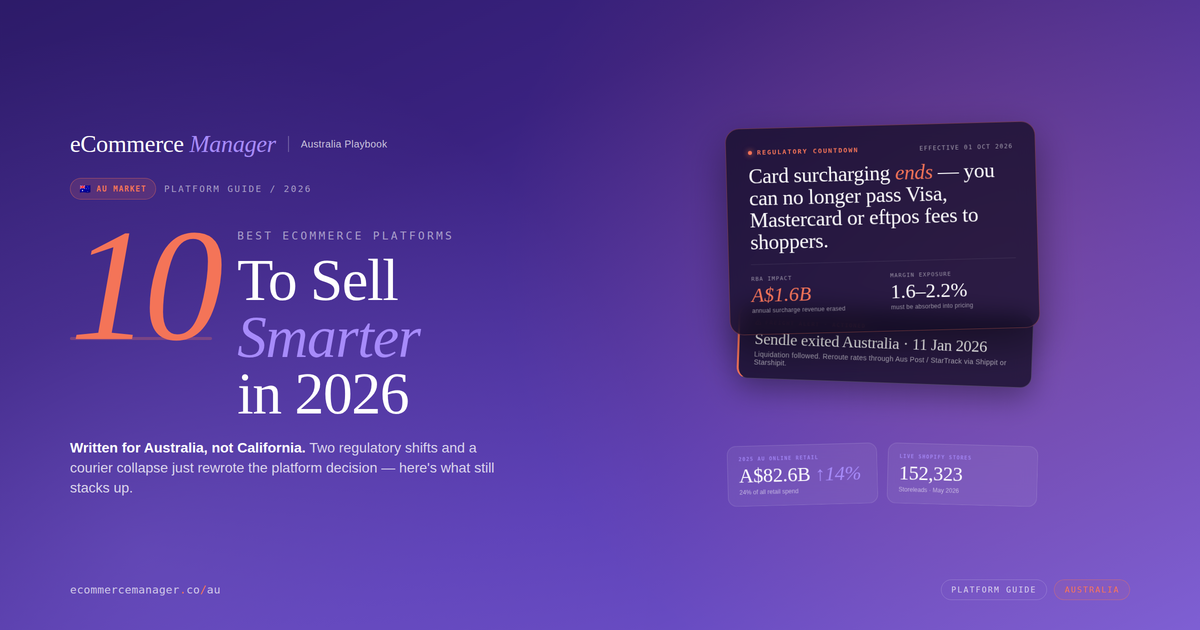
Australians spent a record $82.6 billion online during 2025, up 14 percent on the year before. Australia Post now puts online shopping at 24 percent of all retail spend. Meanwhile the ABS quietly retired its monthly online retail series in June 2025, so the benchmark everyone used to quote no longer exists.
Two changes matter far more than the headline numbers, though.
Sendle stopped shipping in Australia on 11 January 2026 and entered liquidation the following month. If your checkout still quotes Sendle rates, fix that before you read any further. Australia Post and StarTrack pick up the slack, usually through Shippit or Starshipit.
Then comes the bigger one. Card surcharging ends on 1 October 2026. After that date you cannot pass Visa, Mastercard or eftpos fees to your customer. Instead you bake them into your prices. The RBA expects the reform to strip roughly $1.6 billion a year out of surcharges, which is great for shoppers and a margin headache for you.
- Shopify
Shopify remains the answer for most sellers here, and the numbers back it up. Australia now hosts 152,323 active Shopify stores according to Storeleads data pulled in May 2026. Afterpay sits on 26.3 percent of them, the highest rate anywhere on earth.
Pricing runs A$56 a month for Basic, A$149 for Grow and A$575 for Advanced. Better yet, billing happens in Australian dollars, so no exchange rate surprises. Add your ABN and the 10 percent GST on subscription fees drops off.
Card rates fall as you climb. Basic charges 1.75 percent plus 30 cents online, Grow charges 1.6 percent, Advanced charges 1.4 percent. So the upgrade often pays for itself once volume builds.
Watch the third party gateway penalty though. Use anything other than Shopify Payments and you hand over an extra 2 percent on Basic, 1 percent on Grow and 0.6 percent on Advanced.
Magic and Sidekick come free, and the Winter ’26 release shipped over 150 updates, most of them AI. Aje, Culture Kings, The Oodie, LSKD and Peppermayo all run on Plus.
The catch is apps. Most stores I see land north of A$150 a month once the subscription, theme and plugins stack up.
- WooCommerce
WooCommerce suits sellers who want to own the whole thing. Core costs nothing. Instead you pay for hosting, a theme, plugins and someone to keep it upright.
Budget A$300 to A$1,500 for a do-it-yourself first year. A proper build from an Australian agency starts closer to A$6,000. Local developer rates run from A$40 an hour up to A$300 for a senior agency hand, with Sydney and Melbourne adding a premium.
Australia has 83,784 live WooCommerce stores, so Shopify outnumbers it roughly two to one. Still, nobody takes a cut of your sales. You only pay Stripe or PayPal.
The trade-off sits in maintenance. Nothing connects to Xero out of the box, so you add Amaka, A2X or Link My Books. When something breaks, the host blames the theme and the theme blames the plugin.
- BigCommerce
Few people know BigCommerce started in Sydney back in 2009. It still runs an Australian office and a local site.
Plans begin at US$39 a month, rising through US$105 and US$399. Because billing sits in US dollars, your real cost moves with the exchange rate. BigCommerce takes no cut of each sale, which sounds perfect until you read the fine print. An Open Payment Provider Fee of up to one percent can apply, so budget roughly US$800 a year on US$80,000 of sales.
Wholesale is where it shines. Custom catalogues, tiered pricing, multi storefront and Feedonomics all come built in. Toyota runs its branded merchandise portal here.
One signal worth knowing. Migration traffic runs heavily one way, with 2,976 Australian stores leaving for Shopify against 393 arriving.
- Square
Square earns its spot if you sell in person as well as online. The online store has a free tier, while Square for Retail starts around A$89 a month. A Reader costs A$65 including GST.
Rates are flat. You pay 1.6 percent in person and 2.2 percent online, with next day settlement and no lock in contract.
Here the surcharge ban bites hardest. From October you absorb that 1.6 percent instead of passing it on. On A$80,000 a month that means roughly A$1,280 off your margin, where a bank deal would cost far less.
Also worth flagging: merchants regularly complain about sudden account holds on large transactions.
- Wix
Wix wins on speed to launch. Ecommerce starts around A$42 a month on Core, then A$55 for Business and A$199 for Business Elite. Wix takes no transaction cut on paid plans.
The Harmony AI builder does most of the heavy lifting for a first store. So if you want to test an idea this weekend, start here.
Just understand the ceiling. Once you outgrow it, moving to another platform means rebuilding rather than migrating.
- Squarespace
Squarespace is for brands that live or die on how they look. Billed annually, Business runs about A$28 a month, Commerce about A$37 and Advanced Commerce about A$62. Anything below the Commerce tier carries a 3 percent transaction fee.
Storage is unlimited and the templates are lovely. However there is no native Australia Post integration, which is a real gap here. Once your catalogue passes a few hundred products, you will feel the walls.
- Maropost Commerce Cloud
Neto came out of Brisbane and served as the Australian answer for years. Maropost bought it in 2021 and rebranded it.
The pitch still holds up. One back end handles ecommerce, POS, inventory and fulfilment, with native connectors to eBay, Amazon, Catch and MyDeal. Better still, it links directly to Xero, MYOB and QuickBooks without a middleman. Nothing else on this list does that.
Now the catch. Merchants have documented price rises up to 260 percent, including one jump from A$358 to A$731 a month. Billing moved to US dollars, which stings for an Australian built product. Reviews through 2024 and 2025 flag Amazon sync problems and slow support.
Then in November 2025 Maropost launched a brand new Commerce Cloud built for million SKU catalogues. Nobody has published a sunset date for the old Neto code. So ask for a written roadmap before you sign anything.
- Adobe Commerce
Adobe Commerce, formerly Magento, handles complexity that breaks other platforms. Magento Open Source costs nothing to download. Everything after that costs plenty.
Adobe licences by revenue, starting near US$22,000 a year and climbing past US$80,000. Australian agencies quote A$25,000 to A$80,000 for open source builds and A$50,000 upward for enterprise work. At US$5 to US$10 million in sales, yearly cost often lands between US$150,000 and US$300,000.
Pick it if you run a huge catalogue, sell wholesale and retail together, or need ERP and PIM plumbing. Otherwise walk away.
- Salesforce Commerce Cloud
Salesforce makes sense in one situation. Your business already lives inside Salesforce.
Pricing typically works as revenue share, commonly one to two percent of sales. Einstein handles personalisation and the CRM connection is seamless. For everyone else it is an expensive way to sell t-shirts.
- Composable and headless
Composable means assembling your store from APIs instead of buying it whole. commercetools and Shopware lead here, while Shopify and BigCommerce both offer headless modes.
The payoff is total front end freedom. The price is engineers. So unless you run multiple brands or regions and employ real development capacity, stick with software you rent.
The rules you cannot design around
GST sits at 10 percent, and registration kicks in at A$75,000 turnover. Imported goods under A$1,000 attract GST at the point of sale, while anything dearer clears at the border.
The ACCC has been busy. Its 2025-26 priorities target drip pricing, fake reviews, subscription traps, greenwashing and consumer guarantees. Clorox Australia copped an $8.25 million penalty over recycled plastic claims, while Emma Sleep, Michael Hill and HelloFresh all drew action.
Buy now pay later became regulated credit on 10 June 2025. So Afterpay and Zip now need a credit licence, AFCA membership and responsible lending checks. Expect slightly more friction at checkout.
Privacy moved too. A statutory tort for serious invasions of privacy went live in June 2025, so customers can sue you directly regardless of turnover. By 10 December 2026 your privacy policy must also explain any automated decision making.
Getting found by machines, not just people
Here is where selling smarter earns its name. AI assistants now sit between shoppers and your product page.
Shopify built Agentic Storefronts to push catalogues into ChatGPT, Google AI Mode and Copilot. Two rival standards are fighting it out, with OpenAI and Stripe backing one while Shopify and Google back another.
Do not get carried away though. OpenAI pulled its Instant Checkout feature in March 2026 after only about thirty merchants went live. Discovery is the real prize right now, not in-chat purchases.
Practically, that means clean structured data on every product, shopper language in your descriptions and live pricing. Machines cite what they trust.
So which one should you pick
Sell in person as well? Square handles both without fuss. Testing an idea? Wix gets you live this weekend. Squarespace suits a small, visual catalogue.
For almost everyone else, Shopify. Move from Basic to Grow once card volume passes roughly A$20,000 a month, then to Advanced past A$80,000, because the lower rate covers the higher fee.
Choose WooCommerce when you have a developer and want control. Consider BigCommerce when wholesale matters most. Leave Adobe, Salesforce and composable to businesses with proper engineering teams.
Whatever you choose, spend the next month on your pricing rather than your platform. October is coming, and that 1.6 to 2.2 percent has to live somewhere.