


Last Updated on September 1, 2026
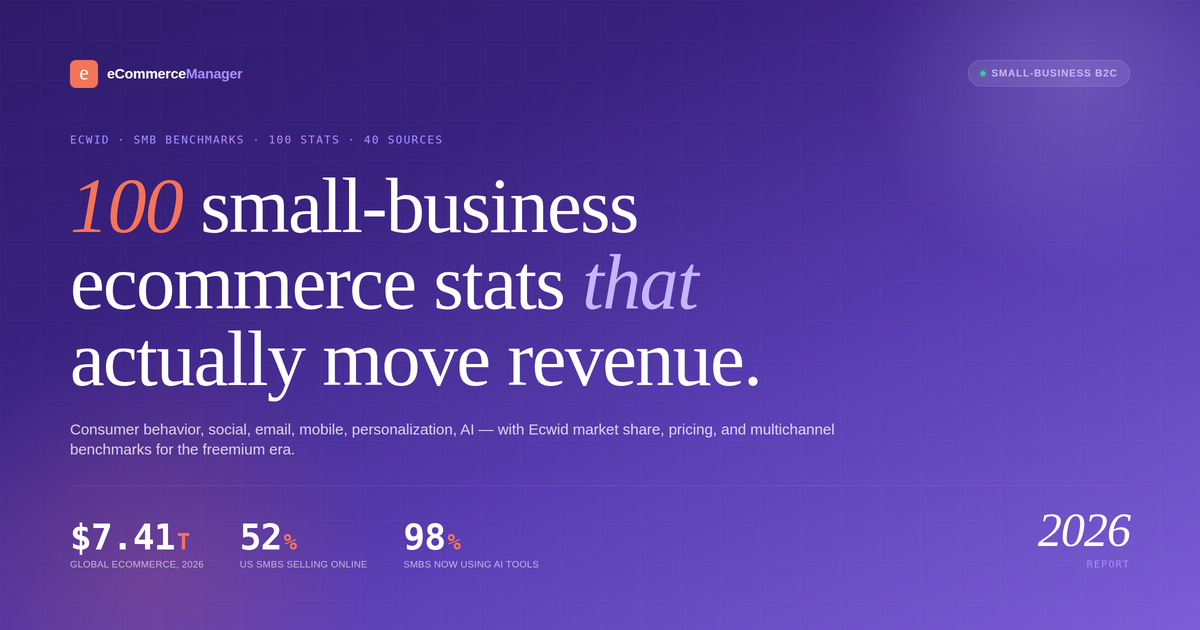
100 Ecwid & Small-Business Ecommerce Statistics for 2026: Consumer Behavior, Social, Email, Mobile, Personalization & AI
The 100 numbers small-business ecommerce operators need for 2026 — sourced from eMarketer, McKinsey, Klaviyo, Adobe, US Census, Ecwid market data, and 35+ other primary sources.
- Overview
- How small-business shoppers actually buy in 2026
- Where small merchants win discovery
- The highest-ROI channel small merchants still underuse
- SMBs live or die on mobile in 2026
- SMBs finally have the tools — most aren't using them
- Where AI is moving the needle for small merchants
- Key Takeaways
- Frequently asked questions
- References
On this page
- Overview
- How small-business shoppers actually buy in 2026
- Where small merchants win discovery
- The highest-ROI channel small merchants still underuse
- SMBs live or die on mobile in 2026
- SMBs finally have the tools — most aren't using them
- Where AI is moving the needle for small merchants
- Key Takeaways
- Frequently asked questions
- References
The state of B2C small-business ecommerce, in 100 numbers
Global ecommerce hits $7.41 trillion in 2026. 52% of US small businesses under 10 employees now sell online. 98% of US SMBs use AI-enabled tools. Ecwid alone powers roughly 128,000 to 163,000 active stores across 175+ countries. The small-merchant story in 2026 is scale times mediocrity — a huge base of stores, most of them dramatically underoptimized on the fundamentals.
This report pulls 100 sourced stats across consumer behavior, social, email, mobile, personalization, and AI — with SMB-specific benchmarks where they exist and B2C-wide data where the pattern still applies. Ecwid market and pricing data is included where it illustrates what the freemium, embedded, multichannel model looks like at scale. Skim the sections that matter, and use the platform calculator or directory to act on what stands out.
How small-business shoppers actually buy in 2026
52% of US small businesses under 10 employees now sell online, and 55% of Millennial shoppers actively prefer buying from small brands. The SMB opportunity is real — but only 30% of small merchants have anything close to a formal digital strategy. That gap is where the wins live.
-
01Global retail ecommerce reaches $7.41 trillion in 2026, growing at a 7.8% CAGR — 21.8% of all retail purchases worldwide. [7,11]
-
02There are 2.86 billion online shoppers globally in 2026, roughly 34% of the world's population. [7]
-
0352% of US small businesses under 10 employees now sell online, per US Census Bureau data. [13]
-
04The number of small business online stores worldwide reached 50+ million active sites in 2024, up 25 million from 2022. [13]
-
05Ecwid by Lightspeed powers roughly 128,000 to 163,000 active stores worldwide across 175+ countries, per third-party detection data. [1,2]
-
06Ecwid holds a 2.63% share of the ecommerce platforms market, ranking #6 globally, with 63,000+ paying customers. [2,3]
-
07Ecwid users are concentrated in the US, UK, and Germany, with .com, .org, and .de the top three domains — a distinctly SMB and mission-driven distribution. [3,4]
-
08The average small business ecommerce store generates $150,000 in annual revenue, up 12% year over year. [13]
-
0924% of small business ecommerce customers are repeat buyers, but they generate 45% of total revenue — the retention premium SMBs consistently underweight. [13]
-
1082% of consumers shop online monthly, and 34% cite convenience as their #1 reason for buying online over in-store. [11]
-
11
-
1252% of small business customers cite high shipping costs as their top purchase barrier, contributing to 20% cart abandonment specifically for SMBs. [13]
-
1355% of Millennial shoppers prefer buying from small brands, driving 40% of their online purchases. [13]
-
14Small US businesses generated $12 billion in Black Friday ecommerce sales in 2023, up 9% year over year. [13]
-
1552% of online shoppers look internationally for products, and 43% of cross-border ecommerce shoppers buy clothing and footwear. [7]
-
1628 million ecommerce stores exist globally in 2026. Almost half of small businesses report their online store as their fastest-growing sales channel. [7,14]
-
17US ecommerce hit $299.6 billion in Q3 2025 alone, with SMB share growing faster than enterprise for the third consecutive year. [7,8]
Outgrowing your starter platform?
Compare Ecwid against Shopify, Wix eCommerce, BigCommerce, and WooCommerce on features, TCO, and multichannel in the ECM platform calculator.
The highest-ROI channel small merchants still underuse
$45 return per $1 spent. 2% of sends driving 30% of revenue. For an SMB where every marketing dollar has to earn its keep, email isn't a channel — it's the channel. If your email program is contributing less than a quarter of store revenue, that's the fix.
-
01Ecommerce email marketing delivers $45 for every $1 spent in retail and consumer goods, rising to $72 for US ecommerce brands with mature programs. [17,19]
-
02Automated email flows are 2% of sends and 30% of revenue, earning 16x more per send than scheduled campaigns. [17]
-
03Global campaign open rates averaged 30.7% in 2025, up from 26.6% in 2024 — five consecutive years of increase. [17]
-
04Welcome emails hit 83.6% open rates, the highest of any automated email type in ecommerce. [20]
-
05Abandoned cart emails achieve the highest CTR of any automation at 23.33%, and convert at 3.33% on average (7.69% for top performers). [17]
-
06Segmented campaigns generate 760% more revenue than non-segmented sends, per Klaviyo's 2026 benchmark. [18]
-
07Personalized email subject lines lift open rates by 26%, and AI-generated subject lines outperform human ones by roughly the same margin. [17]
-
0859% of marketers name email their #1 revenue channel, ahead of social (14%) and paid search (12%). [21]
-
09Ecommerce brands using email marketing generate 17% more revenue than those that don't, per Klaviyo. [18]
-
1044.14% of email clicks happen within 60 minutes of send. For SMBs, send-time optimization matters more than list size. [20]
-
1164% of email opens now happen on mobile, and non-mobile-optimized emails get deleted within seconds. [21]
-
12Automated welcome emails in ecommerce have an average conversion rate of nearly 3%, the highest of any triggered flow. [20]
-
13Nearly 50% of consumers report making a direct purchase from an email in the past year, per Litmus. [19]
-
14The global email marketing market grows from $11.5 billion in 2025 to $17.9 billion by 2028 — a 15.8% CAGR. [17]
-
15Email converts at 4.0% to 5.3%, the highest of any traffic source — more than 4x paid social's 0.7% to 1.2%. [20]
-
16SMS marketing delivers an 11% CTR and 2.4% conversion rate, and roughly 40% of SMB DTC brands now run SMS alongside email. [17]
-
17A well-performing SMB email program should drive 25% to 35% of total store revenue. Anything less signals underinvestment in automation. [18]
SMBs live or die on mobile in 2026
60% of ecommerce is mobile. 79% of small-business site traffic is mobile. 73% of US consumers shop from a phone. The SMBs winning mobile aren't the ones with the best apps — most SMBs don't have apps. They're the ones with fast, thumb-friendly mobile checkout.
-
01Global mobile commerce hits $2.74 trillion in 2026, growing at 9.5% CAGR through 2034. [22,23]
-
02Mobile drives 60% of all ecommerce sales worldwide and 78% of retail website traffic. [22]
-
0373% of US consumers use smartphones for shopping, and 32% do so weekly or more often. [11,24]
-
04The average mobile ecommerce conversion rate reached 2.8% in 2026, finally matching desktop after years at 1.8%. [24]
-
05Shopping apps convert at 3.5%, roughly 75% higher than mobile web at 2%. Time in app is 18x higher than mobile web. [23]
-
06Mobile cart abandonment sits at 80% to 84%, compared to 66.4% on desktop. [24,25]
-
0788% of consumers use mobile shopping apps, and 52% use them at least weekly. [24]
-
08Average mobile order value is $112.29, versus $155 on desktop — a $43 gap SMBs can close with better mobile UX. [24]
-
09Reducing mobile page load time by 1 second lifts conversion by 5.6%, per Google's Core Web Vitals data — the fastest fix most SMBs never make. [22]
-
101.65 billion people are expected to shop via smartphone in 2026, roughly one-third of the global digital population. [35]
-
1170% of US mobile shoppers prefer dedicated ecommerce apps over mobile websites — a case for SMBs to at least offer a progressive web app. [35]
-
12Global mobile wallets are projected to process $16 trillion+ in transactions in 2026, with 5+ billion active users. [24]
-
13AR shopping experiences drive up to 94% higher conversion by letting shoppers visualize products in their own space — increasingly available to SMBs through built-in tools. [24]
-
14Mobile apps account for 54% of mobile commerce transactions, and mobile check-out via digital wallets is the single fastest-growing SMB payment surface. [23]
-
15Global mobile commerce revenue is forecast to hit $3.35 trillion by 2028. [22]
-
1670% of purchases in 2024 occurred via mobile apps versus mobile web, reflecting consumer preference for one-tap checkout. [23]
-
1759% of shoppers say being able to shop on mobile is important when deciding which brand to buy from — a direct signal for SMB mobile-first design. [14]
Mobile web at 84% cart abandonment is fixable.
Browse vetted CRO, mobile speed, and email retention partners in the ECM directory — the fastest way to unlock SMB revenue trapped in mobile friction.
SMBs finally have the tools — most aren't using them
Personalization used to be an enterprise feature. In 2026 it's a checkbox in most SMB platforms, including Ecwid. The gap between 'available' and 'used' is where mid-market DTCs pull ahead. McKinsey's 5% to 30% revenue lift is fully accessible to a small merchant now.
-
01Well-implemented personalization drives revenue increases of 10% to 30%, depending on vertical and maturity. [26]
-
0271% of consumers expect personalized interactions, and 76% get frustrated when brands don't deliver. [26]
-
03Personalized product recommendations account for 26% to 31% of ecommerce revenue for stores that implement them. [31,32]
-
04Amazon attributes 35% of total revenue to its recommendation engine — the benchmark most SMB personalization vendors reference. [32]
-
05Shoppers who click a recommendation are 4.5x more likely to add to cart and spend 5x more than average shoppers. [32]
-
0680% of consumers are more likely to purchase from brands offering personalized experiences, per Epsilon. [33]
-
0745% of ecommerce stores use some form of personalization in 2026, up from 28% in 2023 — SMB adoption is the fastest-growing segment. [35]
-
08Personalization delivers 5x to 8x ROI, with stores seeing 15% to 30% higher conversion and 10% to 20% higher AOV. [26]
-
09Fast-growing companies generate 40% more revenue from personalization than slower-growing competitors. [26]
-
10Personalized CTAs convert 202% better than generic ones across cross-industry testing. [35]
-
1189% of marketers report positive ROI from personalization, and 87% plan to increase spending in 2026. [35]
-
12Personalized email hero images lift CTR by 41%, and personalized creative on paid social lifts CTR by 22% to 40%. [35]
-
13Brands with advanced personalization grow 2x faster than brands with limited or no personalization, per BCG. [34]
-
14Real-time personalization delivers 20% higher conversion than batch processing, and 40% revenue lift at the excellence tier. [35]
-
15Personalized email flows generate up to 18x the revenue per recipient of generic campaigns, per McKinsey. [26]
-
1660% of consumers become repeat buyers after a personalized experience, and loyalty members feel 8x more satisfied when programs feel personalized. [33]
Where AI is moving the needle for small merchants
98% of US SMBs now use AI-enabled tools in some form. That's not a pilot number — that's the baseline. The frontier for SMBs isn't 'should we use AI' anymore, it's 'which two or three use cases actually move revenue.' Product descriptions, chat, and email creative are the three that consistently do.
-
0198% of US SMBs now use AI-enabled tools in some form, often built directly into everyday software. [12]
-
02Generative AI and AI agents drove $262 billion in global retail revenue during the 2025 holiday season, roughly 20% of total sales. [15]
-
03Traffic from AI sources to US retail sites grew 393% YoY in Q1 2026, and 4,700% during the 2025 holiday window. [16]
-
04AI-referred traffic converts 31% to 42% higher than non-AI traffic, and those shoppers spend 45% more time on-site. [16]
-
0589% of retailers have adopted AI, but only 7% have fully scaled it, per McKinsey's 2026 maturity data — a bigger gap for SMBs than enterprise. [26]
-
0659% of Americans use generative AI for shopping tasks, and 56% used it during the 2025 holiday season — up from 11% in 2024. [30]
-
0761% of Gen Z used AI to help with a purchase in the past year, the highest adoption rate of any demographic. [30]
-
08The global generative AI in ecommerce market hit $1.11 billion in 2026, forecast at $3.95 billion by 2035. [30]
-
09The broader AI in retail market sits at $18.64 billion in 2026, with marketing automation the top use case at 48.9% of companies. [38]
-
1069% of retailers with AI implementations report measurable revenue increases directly attributable to their AI investments. [38]
-
11AI chatbots cut cart abandonment by 20% to 30% and drive 36% more repeat purchases through post-sale engagement — a fast SMB win. [38]
-
12The global chatbot market reaches $11.80 billion in 2026, growing to $27.30 billion by 2030 at 23.3% CAGR. [30]
-
13Only 14% of consumers trust AI for autonomous purchasing, even as 73% use AI somewhere in their journey — the guardrail SMBs should design around. [36]
-
14Roughly 33% of online retailers will use advanced AI agents by 2028, up from under 1% today, potentially influencing $385 billion in US ecommerce by 2030. [37]
-
15AI implementation improves ecommerce customer retention by 10% to 15%, per Capital One Shopping — the retention lift SMBs need most. [24]
-
1675% of consumers prefer AI chatbots over human agents for straightforward questions, provided the AI stays accurate and on-brand. [38]
Six patterns small-business operators should internalize
The SMB opportunity is scale times mediocrity. 52% of small US businesses under 10 employees now sell online. 70% still lack a formal digital strategy. Every operational improvement — email automation, mobile speed, AI product descriptions — compounds against a very unoptimized baseline.
Ecwid's freemium/embedded model exists because most small merchants don't need a full-fat DTC stack. They need to plug into WordPress, Wix, or Squarespace and start selling. That's a $5/month problem, not a $2,000/month one. Pricing the platform to the merchant size matters as much as the features.
Multichannel is default now. TikTok Shop, Amazon, eBay, Facebook, Instagram, and Google Shopping all live inside Ecwid natively. The winning small merchant sells in five places and manages inventory once. Anything that forces manual sync is a growth ceiling.
Email is the single highest-ROI channel available to a small business — $45 return per $1 spent, 2% of sends driving 30% of revenue. Any SMB that isn't running welcome, abandoned cart, and post-purchase flows is leaving five-figure revenue on the table annually.
Mobile-first is table stakes. 73% of US shoppers buy from phones. Mobile cart abandonment is 84%. A one-second speed improvement lifts conversion 5.6%. For SMBs without native apps, mobile web performance is the single biggest lever.
AI adoption is now 98% among US SMBs, but almost all of that is embedded features (AI product descriptions, AI email subject lines, AI chat), not standalone tools. Pick two or three use cases that touch revenue directly. Skip the rest for now.
Frequently asked questions
What is Ecwid and who is it for?
Ecwid is a cloud-based ecommerce platform owned by Lightspeed Commerce, designed for small businesses, solopreneurs, and merchants who want to add ecommerce to an existing website (WordPress, Wix, Squarespace, or plain HTML) or run a standalone store. It has a free plan, transaction-fee-free pricing from $5/month, and built-in integrations with Facebook, Instagram, TikTok, Amazon, eBay, Walmart, and Google Shopping. Roughly 128,000 to 163,000 stores are active across 175+ countries, and Ecwid holds ~2.63% of the global ecommerce platforms market, ranking #6.
How does Ecwid compare to Shopify, Wix eCommerce, and WooCommerce?
Ecwid is best when you already have a site and want to add a store without replatforming — the embedded widget approach is unique. Wix eCommerce (~7.89% market share) bundles storefront and website builder into one product. WooCommerce dominates on absolute install base but requires WordPress hosting management. Shopify targets brands that will scale past SMB — the pricing reflects that. Third-party data shows 3,554 companies moved from Ecwid to Wix eCommerce while 2,079 moved the other way, suggesting Wix's all-in-one wins at the entry level, Ecwid wins with existing sites. Cross-reference specifics against the ECM platforms hub before switching.
What conversion rate should a small business ecommerce store target?
Global ecommerce averages 2.5% to 3%. Small business stores average 2% to 2.8%, with mobile web at 2% and desktop at 3.5%. Category matters more than platform: food and beverage converts at 5% to 6%, apparel at 2% to 3%, luxury at under 1%. Top-quartile SMB stores hit 4%+ by getting three things right — mobile page speed under 2.5 seconds, an abandoned cart email flow, and product page reviews.
What's the ROI of email marketing for a small ecommerce business?
Global ecommerce email ROI averages $45 per $1 spent for retail and consumer goods, rising to $72 per $1 for stores with mature programs. A well-run SMB email program should drive 25% to 35% of total store revenue. Automated flows (welcome, abandoned cart, post-purchase, winback) account for 2% of sends but 30%+ of revenue — that's where the leverage compounds fastest.
Is AI worth investing in for a small ecommerce business in 2026?
98% of US SMBs already use AI-enabled tools, mostly embedded in the software they already run. For a small ecommerce business, the three use cases that consistently move revenue are AI-written product descriptions and image variants (labor savings), AI chatbots for pre-purchase Q&A (20% to 30% cart abandonment reduction), and AI subject line and creative optimization for email/paid social (26%+ open rate lift). Skip standalone AI tools until those three are working.
The playbook top eComm operators actually read
One weekly brief. Five stories that matter. Zero fluff. Written for managers at $5M–$50M DTC brands who want to sound sharper than everyone else in the meeting.
References
- 01 Store Leads — State of Ecwid Report 2026 — storeleads.app
- 02 TechnologyChecker.io — Companies Using Ecwid 2026 — technologychecker.io
- 03 6sense — Ecwid Market Share & Customer Analysis — 6sense.com
- 04 WMTips — Ecwid Market Share & Usage Statistics 2026 — wmtips.com
- 05 Forbes Advisor — Ecwid Review 2026 — forbes.com
- 06 eMarketer 2026 Worldwide Retail Ecommerce Forecast — emarketer.com
- 07 Sellers Commerce — Ecommerce Statistics 2026 — sellerscommerce.com
- 08 US Census Bureau Quarterly Retail E-Commerce Sales — census.gov
- 09 Bluehost — Ecommerce Statistics 2026 — bluehost.com
- 10 Hostinger — Ecommerce Statistics 2026 — hostinger.com
- 11 Small Business Trends — Ecommerce Growth Statistics — smallbiztrends.com
- 12 Network Solutions — Small Business Website Statistics 2026 — networksolutions.com
- 13 Gitnux — Small Business Ecommerce Statistics 2026 — gitnux.org
- 14 Wifitalents — Small Business Ecommerce Statistics 2026 — wifitalents.com
- 15 Adobe Analytics — 2025 Holiday Shopping Report — adobe.com
- 16 Adobe Digital Insights — AI Referral Traffic Q1 2026 — adobe.com
- 17 Omnisend — 2026 Ecommerce Marketing Statistics Report — omnisend.com
- 18 Klaviyo 2026 Ecommerce Benchmark Report — klaviyo.com
- 19 Litmus State of Email 2026 — litmus.com
- 20 GetResponse Email Marketing Benchmarks — getresponse.com
- 21 HubSpot State of Marketing 2026 — hubspot.com
- 22 Statista — Global Retail Mobile Commerce Sales — statista.com
- 23 Fortune Business Insights — Mobile Commerce Market — fortunebusinessinsights.com
- 24 Capital One Shopping — Mobile Ecommerce Research — capitaloneshopping.com
- 25 Baymard Institute — Cart Abandonment Research — baymard.com
- 26 McKinsey — Next in Personalization — mckinsey.com
- 27 eMarketer US Social Commerce Forecast 2026 — emarketer.com
- 28 Mordor Intelligence — Social Commerce Market — mordorintelligence.com
- 29 Amra & Elma — Social Commerce Statistics 2026 — amraandelma.com
- 30 Precedence Research — Generative AI in E-commerce Market — precedenceresearch.com
- 31 Salesforce Shopping Index Q4 2025 — salesforce.com
- 32 Barilliance — Product Recommendation Statistics — barilliance.com
- 33 Epsilon — Power of Me Personalization Study — epsilon.com
- 34 BCG — Profiting from Personalization — bcg.com
- 35 Twilio Segment State of Personalization 2026 — segment.com
- 36 Riskified — AI Trust in Commerce 2026 — riskified.com
- 37 Morgan Stanley — Agentic Commerce 2030 Outlook — morganstanley.com
- 38 NVIDIA — State of AI in Retail and CPG 2026 — nvidia.com
- 39 Flowlu — 60 Ecommerce Statistics 2026 — flowlu.com
- 40 Insider Intelligence — Livestream Shopping Forecast — insiderintelligence.com
Make every SMB ecommerce decision data-backed
Join 12,000+ ecommerce managers reading the ECM newsletter every Tuesday — or browse the directory to find vetted CRO, retention, and AI partners built for small-merchant unit economics.
Where small merchants win discovery
Social is the most level playing field in commerce right now. TikTok Shop's per-follower conversion rate favors small accounts with real audience trust. Ecwid's Facebook/Instagram/TikTok/Amazon/eBay integrations were built for exactly this moment — sell everywhere, manage in one place.