

Last Updated on September 1, 2026
Headless Migration in 2026: The Operator's Guide
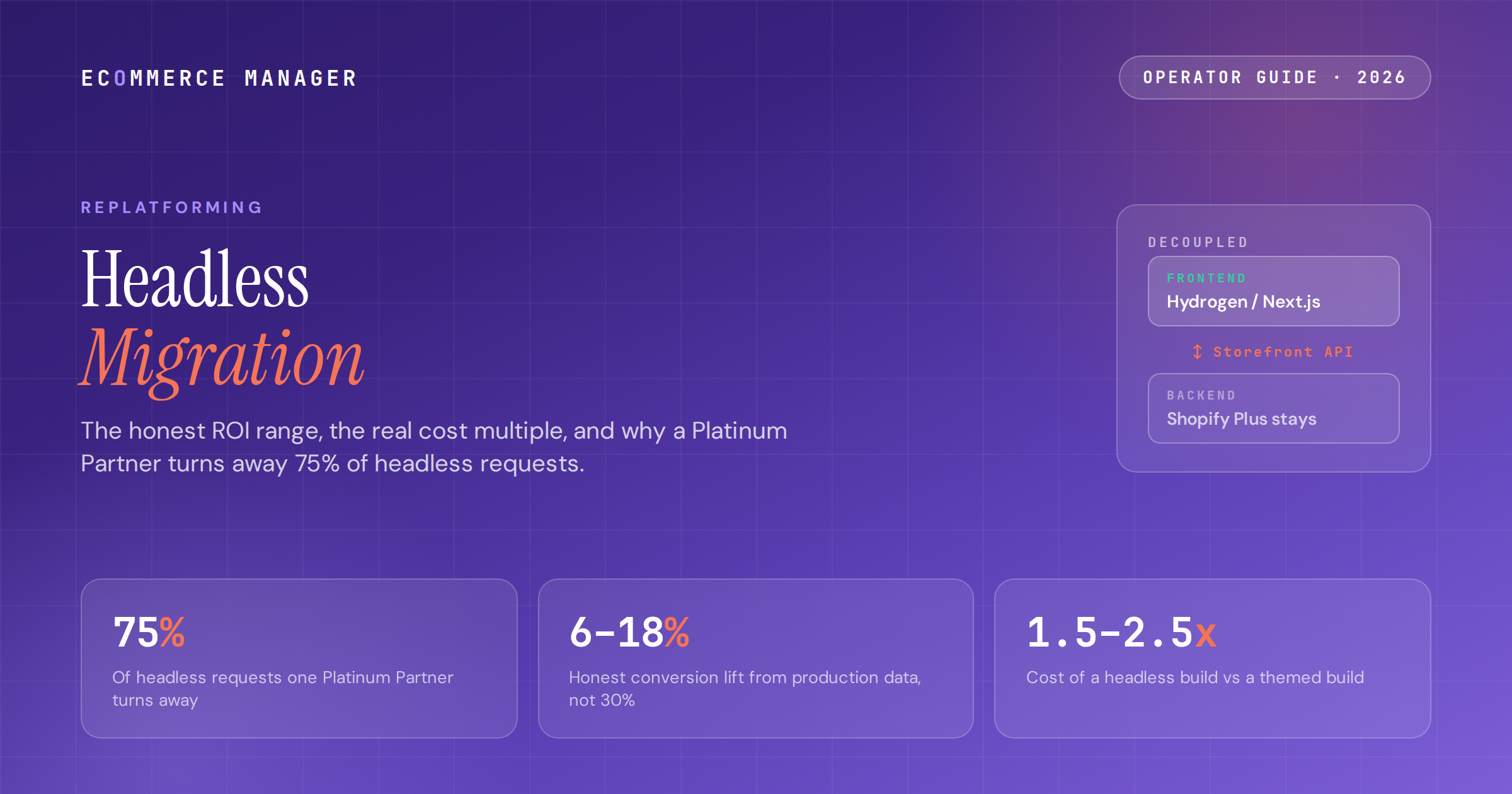
The honest ROI range, the real cost multiple, the difference between headless and composable that decides your vendor count, and the sequence that de-risks the build. Written for operators who might be better off not doing this.
On this page
The migration most operators shouldn't run — and the one some absolutely should
Headless commerce crossed the adoption line. Gartner's 2026 digital commerce survey puts 67% of enterprise retailers on some form of headless or decoupled architecture, up from 38% in 2022, and 80% of non-adopters say they intend to move within two years. The market is $2.13B this year, projected at $7.24B by 2033. Every vendor deck cites 20–30% conversion lifts.
Now the numbers vendor decks skip. When one Shopify Platinum Partner reviewed the brands arriving at its door wanting headless, it talked roughly 75% of them into native Shopify Plus instead — after 200+ migrations, its framing is that headless is a different architecture with different trade-offs, not an upgrade, and the wrong call costs six figures and months of runway for no meaningful return. When another agency reviewed actual production data from headless migrations, the honest conversion lift range was 6–18%: real, measurable, and about half the sticker number.
Both facts are true at once, which is why this guide starts with the decision rather than the build. It covers what headless actually costs (1.5–2.5x a themed build), the headless-versus-composable distinction that determines whether you sign one vendor contract or four, the documented results from named brands, the strangler-fig sequence that de-risks the project, and an honest profile of who should stay on a theme.
Headless vs composable vs staying themed
Three words get used interchangeably in this market, and they describe projects that differ by an order of magnitude in cost and vendor count. Sort them first.
-
01Headless means decoupling the storefront from the commerce engine, keeping the engine. Shopify Plus stays as the backend; the frontend is rebuilt in Hydrogen or Next.js against the Storefront API. Adobe Commerce stays; the frontend moves to PWA Studio or Next.js. This is what most 2026 'headless' projects actually are, and it is the only version most mid-market brands should consider.
-
02Composable (MACH) means swapping the engine for best-of-breed services too. commercetools for commerce, Algolia for search, Sanity for content, Stripe for payments: four vendor contracts where there was one. Forrester puts full MACH composable TCO at $2.4M–$4.8M over three years for mid-market retailers, roughly 3–5x a decoupled frontend on an existing platform. Of the 67% of enterprises on decoupled architecture, only about 19% run full composable builds.
-
03The mid-market rule from agency practice: headless against a single platform delivers about 80% of composable's benefits at 30% of the complexity. For $5M–$50M GMV brands, composable is almost never the answer; the question is headless-on-Plus versus a well-built theme.
-
04Staying themed is the correct answer more often than the market admits. The 75%-talked-out-of-it figure exists because Shopify's theme layer closed most of the historical gap: Liquid stores already post strong Core Web Vitals baselines, Checkout Extensibility handles most customization on Plus, and the delta headless adds is smaller than it was on a Luma-era Magento store. Read the ECM Shopify Plus vs Shopify guide before deciding a theme has hit its ceiling.
-
05Spring 2026 changed the framework math. Hydrogen was rebuilt to run on any stack including Next.js, and Next.js has 5–10x more available developers than Hydrogen or PWA Studio. New Adobe Commerce headless builds now split roughly 60% Next.js with custom GraphQL adapters, 40% PWA Studio. Talent availability is now a first-order input into the framework decision, not a footnote.
What headless actually costs, including what proposals skip
Most headless pricing quotes the build and omits the rest. The full cost structure has four lines, and the last three are where budgets die.
The build
-
→Mid-market headless with one commerce engine and a custom frontend: $50K–$150K. Enterprise with multiple regions, channels, and high SKU volume: $150K–$500K+. A Hydrogen rebuild on an existing Shopify Plus backend runs $150K–$250K over 16–24 weeks; a comparable themed Plus build is around $100K.
-
→The multiple is the honest headline: headless costs 1.5–2.5x themed on the same platform and adds 8–16 weeks. Adobe Commerce themed at $150K becomes PWA Studio at $250K–$400K. If a proposal's headless number is close to the themed number, something was left out.
-
→Timeline claims need translation. Launch-focused Hydrogen builds can close in 6–8 weeks and full platform-plus-headless migrations inside three months in the best agency data, but the industry's own warning is blunt: '4–6 weeks' usually means 4–6 months for anything beyond a demo. Apply the standard 25–40% contingency and a skeptical read of any timeline under a quarter.
The lines proposals leave out
-
→The Plus subscription. Most production headless builds land on Shopify Plus (~$2,300/mo on a multi-year term) for API rate limits, Checkout Extensibility, and Functions access. Hydrogen is free and open-source; the platform tier it needs isn't.
-
→The headless CMS license. Decoupling the frontend means content needs a home: Contentful, Sanity, or equivalent, with its own recurring license and its own integration work. It is the most commonly omitted line in headless proposals.
-
→Ongoing maintenance and the developer market. A theme is maintained by the platform; a custom frontend is maintained by you. Budget continuous developer capacity, and price it against a Hydrogen and PWA Studio talent pool 5–10x smaller than Next.js. Run the three-year view, not the build quote, in the ECM platform calculator before committing.
-
→Search, personalization, and the app ecosystem. Platform apps that 'just work' on a theme often need re-integration or replacement on a custom frontend. Inventory every app-dependent feature in a tech stack audit before scoping; each one is either an API integration or a rebuild.
Does the three-year math clear for your store?
Plug your revenue, AOV, and current platform costs into the ECM Platform Calculator for a three-year TCO view — the number to hold against any headless proposal's build quote.
What headless delivers when the use case is real
Strip the vendor averages and the production data is still good — for the right brand. The mechanism is almost always speed, and speed's effect on revenue is measurable.
-
01Page load drops 20–50% versus monolithic baselines, with mobile seeing the largest gains. Google's own data ties a one-second LCP improvement to a 2–7% conversion increase, which is the mechanism behind nearly every credible headless ROI claim.
-
02The honest conversion range is 6–18% from reviewed production migrations. Worth pursuing, and worth modeling against your own traffic: a 10% lift on a $10M store is $1M, which clears a $200K build in a quarter. The same lift on a $2M store takes longer to pay back than the build takes to ship.
-
03Organic traffic follows Core Web Vitals. Digital Commerce 360's 2026 SEO research shows sites moving from CWV 'poor' to 'good' see roughly 22% organic growth over six months; frontend migrations on slow legacy stacks (Luma-era Magento to Hyvä) post 15–40%. The Shopify-to-Hydrogen delta is smaller because Liquid baselines are already decent — which is the whole point about who benefits.
-
04Named production results: Denham's move from Salesforce Commerce Cloud to headless Shopify made the site 3x faster. Veloretti's headless storefront holds an 80+ Lighthouse score while running a configurator with 100+ bicycle combinations across four languages — the kind of interactive complexity a theme genuinely struggles with. Both are Ask Phill builds; both had a use case a theme couldn't serve.
-
05The agentic-commerce argument is emerging, and vendor-flavored. API-first storefronts with structured data are positioned as the foundation for AI shopping agents, with projections of 15–25% agent-mediated revenue by 2027. Treat the projection as a scenario, not a forecast, but the underlying point holds: clean, structured, fast product data is increasingly what gets cited. ECM tracks this in weekly Insights.
Who should go headless, and who should stay on a theme
Assembled from agencies that build both and turn away most headless requests. Score yourself before the discovery call.
Headless earns its cost when
-
→Your storefront has an interactive requirement a theme can't serve — a configurator, a builder, a marketplace layer, a content-heavy experience with commerce embedded — and the requirement is worth more than the 1.5–2.5x cost multiple.
-
→You're on a slow legacy frontend (Luma-era Magento, an aging SFCC build) where Core Web Vitals are actively costing organic traffic. If the backend is also aging, the ECM Magento to Shopify guide covers replatforming the whole stack instead. The 15–40% organic recovery from a frontend migration is a fix for a problem Google is penalizing you for, not an aesthetic upgrade.
-
→Multi-region, multi-brand, or multi-channel at real scale, where one frontend layer serving several commerce contexts beats maintaining several themes, and where an engineering team exists to own it.
Stay themed when
-
→The motivation is design freedom or 'modern architecture' rather than a specific requirement. This is the 75% that a good agency redirects, and the six-figure lesson otherwise.
-
→Your team can't fund continuous frontend engineering. A theme's maintenance is the platform's job; a custom frontend's is yours, forever, in a talent market that's tight for Hydrogen and PWA Studio.
-
→You're under roughly $5M–$10M in revenue and your current Lighthouse scores are already in the green. The 6–18% lift, applied to your revenue, pays back slower than the build ships. Fix the checkout funnel with a CRO specialist first; it's cheaper and often larger.
Want a second opinion before you sign?
The ECM directory lists vetted platform and migration specialists with verified client reviews — including agencies that build headless and still turn most headless requests away.
The strangler-fig sequence that de-risks the build
Big-bang headless cutovers are how six-figure projects turn into twelve-month recoveries. The pattern successful implementations share is incremental extraction from the monolith.
-
01Phase 1 (months 1–3): migrate the high-traffic pages first. Product detail and product listing pages move to the headless frontend while the platform theme keeps serving everything else. Lowest risk, highest visible impact, and the phase that produces the first measurable speed and conversion data.
-
02Phase 2 (months 3–6): personalization and optimization. The features that justified headless — the configurator, the content-commerce blend, the segmented experiences — get built on the pages already migrated, against the baseline Phase 1 established.
-
03Phase 3 (months 6–9): checkout and account pages. On Shopify, checkout stays platform-native through Checkout Extensibility regardless; the account and post-purchase surfaces move last, because they're where authentication and payment edge cases live.
-
04Phase 4 (months 9–12): decommission the legacy frontend — and never before the new one is validated at 100%. Feature flags that switch the new frontend on by user segment turn every phase into a controlled experiment with a rollback path.
-
05Non-negotiables at every phase: server-side rendering (both Hydrogen and Next.js support it; client-only rendering is an SEO failure waiting to index), a complete redirect map wherever URL structures change, schema rendered server-side from day one, and the pre-migration baseline pulled from your core KPIs. The replatforming SEO discipline applies in full — the ECM SEO impact guide covers it — because a fast frontend that Google can't render is slower than the theme it replaced.
What a smart operator does with this
Sort the words before the vendors do. Headless keeps your commerce engine and rebuilds the frontend; composable replaces the engine with four vendors and triples the TCO. For $5M–$50M brands, composable is off the table and headless-on-Plus is a maybe. A well-built theme is the default the market underrates, and a Platinum Partner turning away 75% of headless requests is the clearest signal of that.
Model the honest numbers. 1.5–2.5x the themed build, 8–16 extra weeks, a Plus subscription, a CMS license, and permanent frontend engineering — against a 6–18% conversion lift and CWV-driven organic gains that are largest on slow legacy stacks. On a $10M store with a real interactive requirement the math clears in a quarter; on a $3M store with green Lighthouse scores it doesn't clear at all.
If the case is real, run the strangler fig. PDP and PLP first, personalization second, checkout and accounts last, decommission only after full validation. Server-side rendering, a complete redirect map, server-rendered schema, and a pulled baseline are non-negotiable at every phase. Headless done this way is an investment with a measurable return; done as a big-bang rebuild it is a six-figure way to get a slower, harder-to-maintain store.
Frequently asked questions
How much does a headless commerce migration cost in 2026?
Mid-market headless builds with one commerce engine and a custom frontend run $50,000–$150,000; enterprise builds with multiple regions and channels run $150,000–$500,000+. A Hydrogen rebuild on an existing Shopify Plus backend typically costs $150,000–$250,000 over 16–24 weeks, against roughly $100,000 for a comparable themed build. The honest multiple is 1.5–2.5x themed cost plus 8–16 extra weeks, before adding the Shopify Plus subscription (~$2,300/month), a headless CMS license, and permanent frontend engineering that most proposals omit.
What is the difference between headless and composable commerce?
Headless decouples the storefront from the commerce engine while keeping the engine — Shopify Plus or Adobe Commerce stays as the backend, and the frontend is rebuilt in Hydrogen, Next.js, or PWA Studio. Composable (MACH) replaces the engine too, assembling best-of-breed services like commercetools, Algolia, Sanity, and Stripe under separate contracts. Forrester puts full composable TCO at $2.4M–$4.8M over three years for mid-market retailers, 3–5x a decoupled frontend. Of enterprises on decoupled architecture, only about 19% run full composable builds; for $5M–$50M brands, headless on a single platform delivers about 80% of the benefit at 30% of the complexity.
Does headless commerce actually improve conversion rates?
Yes, but less than vendors claim. Reviewed production data from headless migrations shows an honest conversion lift range of 6–18%, against the 20–30% figures in vendor decks, which represent top-decile outcomes. The mechanism is speed: headless implementations cut page load 20–50% versus monolithic baselines, and Google's data ties a one-second LCP improvement to a 2–7% conversion increase. The lift is largest on slow legacy frontends and smallest on stores whose theme already posts strong Core Web Vitals.
Should I go headless on Shopify?
Probably not, unless you have a specific requirement a theme cannot serve. One Shopify Platinum Partner talked roughly 75% of brands requesting headless into native Shopify Plus instead, because Liquid themes already post strong Core Web Vitals and Checkout Extensibility covers most customization. Headless earns its 1.5–2.5x cost when you have a specific interactive requirement (a configurator, a content-commerce experience), a slow legacy frontend costing organic traffic, or multi-region complexity with an engineering team to own a custom frontend. Under roughly $5M–$10M in revenue with green Lighthouse scores, the math rarely clears.
How do you migrate to headless without breaking SEO?
Use the strangler-fig pattern rather than a big-bang cutover: migrate product detail and listing pages first (months 1–3), add personalization (months 3–6), move checkout and account pages (months 6–9), and decommission the legacy frontend only after full validation (months 9–12), with feature flags enabling rollback by segment. At every phase, server-side rendering is mandatory — client-only rendering is an SEO failure — along with a complete 301 redirect map wherever URLs change, server-rendered structured data from day one, and a pre-migration baseline of organic traffic, Core Web Vitals, and conversion to measure against.
The playbook top eComm operators actually read
One weekly brief. Five stories that matter. Zero fluff. Written for managers at $5M–$50M DTC brands who want to sound sharper than everyone else in the meeting.
References
- 01 Headless Commerce Architecture: What the 2026 Numbers Actually Show — bemeir.com
- 02 Shopify Headless Commerce: When It's Worth It & What It Costs — askphill.com
- 03 Headless Commerce 2026: Hydrogen vs Next.js vs PWA Studio — iwdagency.com
- 04 Shopify Headless Pricing 2026: Real Cost Breakdown — weaverse.io
- 05 Guide: Migrate Your eCommerce to Headless Commerce (2026) — edgebound.ai
- 06 Headless Commerce ROI 2026: Metrics, Case Studies & Analysis — wearepresta.com
- 07 Headless Commerce Statistics and Trends in 2026 — wcart.io
- 08 Headless Commerce in 2026: Everything You Need to Know — bigcommerce.com
- 09 Headless Commerce 2026: API-First eCommerce Guide — digitalapplied.com
- 10 Shopify Plus vs Advanced: 2026 Pricing, Features & When to Upgrade — charleagency.com
- 11 SEO Site Migration in 2026: Zero-Traffic-Loss Playbook — digitalapplied.com
- 12 Ecommerce Replatforming Cost Index 2026 — elogic.co
- 13 25 Ecommerce Replatforming Statistics That Drive Growth in 2026 — swell.is
Make your platform decision data-backed
Join 12,000+ ecommerce managers reading the ECM newsletter every Wednesday — or browse the directory to find vetted migration, CRO, and platform specialists.