

Last Updated on August 1, 2026
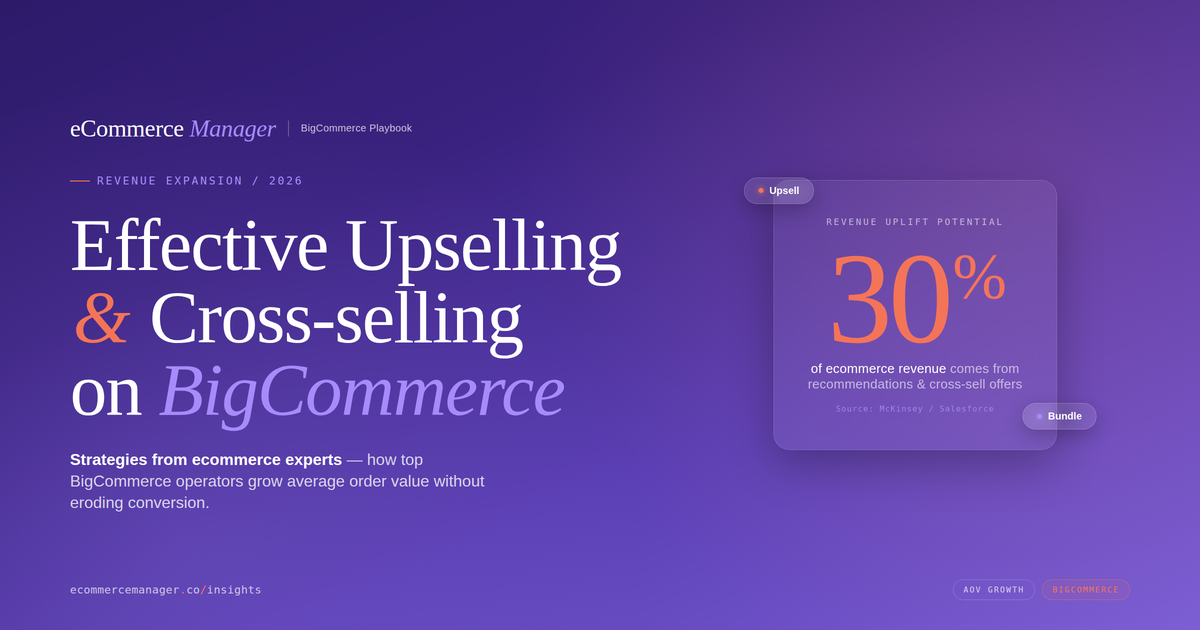
Effective Upselling and Cross-selling on BigCommerce: Strategies from E-commerce Experts
Most online stores miss significant revenue opportunities by treating upselling and cross-selling as afterthoughts rather than core conversion strategies. This article presents proven tactics from e-commerce professionals who have optimized BigCommerce stores to increase average order value without damaging customer experience. These insights cover everything from timing product recommendations correctly to automating data-driven bundles that customers actually want.
- Base Accessory Suggestions On Proven Pairings
- Sell The Routine Not The Promise
- Sequence Cross-Sells Through The Purchase Path
- Show The Job Then Curate Complements
- Use Full-Set Transparency And Trade-Ins
- Trigger SMS Loyalty Offers From Behaviors
- Time Essential Add-Ons When Intent Peaks
- Upsell Specifications To Prevent Future Friction
- Turn Post-Sale Into A One-Click Win
- Automate Programmatic Bundles From Live Data
- Position Cart Companion As Next Step
Base Accessory Suggestions On Proven Pairings
Rewrote the product recommendation logic on our highest-traffic category pages to show complementary items based on actual purchase history rather than what the default algorithm suggested, which had been showing vaguely related products that didn’t reflect how customers actually bought.
Pulled twelve months of order data and found maybe eight product combinations that appeared together in completed orders significantly more often than chance would predict. Built recommendations around those specific pairings rather than category adjacency. One product page change showed a specific accessory that roughly 40 per cent of buyers of that item had purchased within thirty days, with a line explaining that most customers found they needed it. Not a generic “frequently bought together” label, something more specific to what the combination actually accomplished.
Add-to-cart rate on that accessory from the recommendation went from somewhere around 3 per cent to about 11 per cent over the following six weeks. The difference between the old and new approach was that the recommendations reflected what real customers had actually done rather than what seemed logically related.

Sell The Routine Not The Promise
The upsell that’s worked best for us on our BigCommerce store is a routine-based bundle rather than a “customers also bought” upgrade. When someone adds our women’s probiotic to cart, we offer the prebiotic as a bundled add-on framed as “complete the routine,” not “boost results.” That framing matters in our category — FTC structure-function rules don’t let us claim the pair works better together in outcome terms, so we sell the habit instead of the amplified promise. We also align the subscription cadence so both ship together, which removes a common objection about juggling two separate reorder dates.
Two things came out of it. AOV on bundled orders runs meaningfully higher than single-SKU orders, and subscription attach rate on the second product is stronger than when we offered it as a standalone post-purchase upsell. Attaching it at cart, before checkout, converts better than a one-click post-purchase page for us.
In a regulated health category, the safest upsell is one that sells a better routine, not a bigger promise. That’s the line our advisory board and legal review both stay comfortable with.

Sequence Cross-Sells Through The Purchase Path
One strategy that has worked exceptionally well for us is a three stage cross sell approach throughout the buying journey on our website. On the product page, we recommend complementary products that naturally pair with what the customer is viewing. In the cart, we once again list those same recommendations, but also by displaying how many other shoppers currently have those items in their carts, adding social proof. Finally, during checkout, we feature lower priced impulse purchases that are easy add-ons.
This approach keeps recommendations relevant at every stage without overwhelming the customer, which resulted in our AOV increasing from $85 to $96, a huge increase for us.

Show The Job Then Curate Complements
The most effective cross-sell method we’ve found isn’t a widget — it’s putting the application on the product page and letting the companion products fall out of it naturally.
We sell industrial lubricants and chemicals, so almost nothing we ship is bought in isolation. A customer buying a 55-gallon drum of anti-wear hydraulic oil also needs a drum pump, a spill kit, filters, and often a matching gear oil for the same machine. For years we treated those as separate SKUs on separate pages and hoped the customer found them. They usually didn’t.
What changed things was video. We produced short product videos showing the oil actually being used — the drum, the pump, the equipment it goes into — and embedded them directly on the product pages. Then we built the “frequently bought together” block underneath to mirror exactly what appears in the video. The customer sees the pump in the footage, then sees the pump offered below at a bundle price. The recommendation stops feeling like an upsell and starts feeling like a checklist.
We reused the same footage across email, YouTube, paid social, and our marketplace listings, so the pairing is reinforced everywhere a buyer touches us. Consistency is what makes it work. If the video shows one setup and the product page recommends something unrelated, the customer ignores both.
Two practical lessons from doing this:
**Anchor recommendations to the job, not the category.** Algorithmic “customers also viewed” modules surfaced competing oils — which just introduced doubt. Manually curating the complements around a use case performed far better than letting the platform guess.
**Bundle around the reorder cycle.** Lubricants are consumables. When we started pairing the oil with the filters and absorbents that get replaced on the same interval, average order value moved meaningfully, and reorder frequency became more predictable. B2B buyers appreciate anything that consolidates a purchase order.
The underlying principle for any industrial or B2B store: your customer isn’t shopping a catalog, they’re solving a maintenance problem. Show them the whole job, and the cross-sell writes itself.

Use Full-Set Transparency And Trade-Ins
I sell pre-owned luxury watches, so “upselling” looks different for me than most ecommerce stores—but the principle that works best is using transparency itself as the upsell trigger.
When someone is looking at a Rolex GMT, I make sure the listing clearly shows it’s a full set—box, papers, everything included and GST already priced in. That completeness is what moves buyers from “maybe” to “let’s do it.” The full-set framing does the heavy lifting without any pressure tactics.
The cross-sell that actually works for me is trade-ins. When someone’s buying a watch, I’ll mention upfront that I accept trades at wholesale. A buyer who came in for a GMT-Master II ended up trading in their existing piece as part of the deal—what started as one transaction became two, and they got better value than selling privately on Gumtree.
The lesson: in a high-trust niche, your upsell isn’t a pop-up or a bundle—it’s the moment a customer realises you’re making the whole process easier than anywhere else. That’s what converts.

Trigger SMS Loyalty Offers From Behaviors
At RewardLion, we specialize in high-converting e-commerce integrations across platforms like BigCommerce, Shopify, and Magento. Over the past decade, my focus has been on designing dynamic sales strategies and connected operating systems that turn single purchases into ongoing customer relationships.
Our most effective strategy for BigCommerce stores is implementing automated, behavior-based customer tracking combined with a digital SMS loyalty program. By tagging customer behavior inside our unified OS, we automatically track exactly which products a buyer views or purchases, triggering customized follow-up campaigns tailored to their specific actions.
For example, when a customer purchases a primary item, our system automatically texts them a VIP-only offer for a highly relevant, high-margin accessory or complementary service right to their mobile phone. Utilizing this hands-off, touchscreen-to-mobile automation has proven to drastically increase both the frequency of customer visits and the average amount they spend per transaction.

Time Essential Add-Ons When Intent Peaks
One method that has worked for us is tying the upsell to something the customer already needs for the order they are placing, rather than a random add on. If someone is ordering custom patches, we will suggest a backing option or a companion product like a coin or keychain that fits the same event or team, so it feels like a natural extension of what they already came for.
The strategy that has worked best is timing that suggestion at the right point in the process, either during checkout or in a follow up after the order, rather than pushing it before the customer has even decided on their main product. It keeps the offer relevant instead of feeling like a distraction from what they came to buy.

Upsell Specifications To Prevent Future Friction
The method that works best for us is upselling the specification rather than bolting a second product onto the basket. For charging cables that means moving people from a five metre lead to seven or ten metres, and it works because it is the upgrade they would have picked themselves if anyone had told them what to ask.
I will answer from our own shop rather than claim a platform trick, because the tactic travels anywhere. For years our most common support message was some version of “it does not quite reach”. One customer sent me a photo of his cable pulled taut across a driveway, a foot short of the port, with his car parked at an angle to make up the gap. He had bought the cheapest length because nothing on the page had helped him think it through.
So we stopped presenting lengths as a dropdown of prices and turned it into a question instead. Where is your charge port, front, side or rear, and where is the socket on the wall? Then a plain recommendation with the extra cost shown honestly next to it. Around 25% of the buyers who used to take the five metre cable now take a longer one, and the too-short messages have all but dried up.
That is the test I would put any upsell through: would the customer thank you in a month, or feel worked over? An upsell that avoids a complaint pays twice. It lifts the order value and it removes the support ticket, the return, and the sour review that the cheaper option was quietly heading towards.

Turn Post-Sale Into A One-Click Win
Not BigCommerce specifically, but I’ve built and optimized enough e-commerce experiences across platforms to know what actually moves the needle on average order value.
The most underrated upsell lever I’ve seen work consistently is the post-purchase page. Most stores treat it as a dead end. We’ve rebuilt it as an active conversion moment—surfacing one relevant add-on with a frictionless one-click accept. No cart restart, no re-entering payment info. That low-resistance moment catches buyers when purchase intent is still warm.
For cross-selling, the mistake I see constantly is showing “related products” based on category logic instead of behavioral logic. What did similar buyers actually purchase together? That data already lives in your order history. Surface those pairings on the product page itself, not buried in the cart.
We did this kind of experience overhaul for Zuplift, a promotional products company. Their customers were buying individual items without realizing complementary products existed. Restructuring how product relationships were presented—through custom design, not a generic plugin recommendation block—directly changed browsing behavior and increased multi-item orders.

Automate Programmatic Bundles From Live Data
My perspective on driving e-commerce growth comes from years of scaling digital businesses, including designing the core systems that took a consumer electronics venture from zero to over $18 million in revenue. At S9 Consulting, we look past standard, pushy popups and focus instead on “creative technical practices” that exploit competitor gaps and leverage cross-channel data.
For platforms like BigCommerce, our most successful cross-selling strategy is automated cross-channel product bundling, where we use our proprietary Omicron platform to dissect inventory and API data to automatically group high-margin, related items. By identifying descriptive keyword elements that customers search for most, we construct optimized, multi-product bundle listings that we then push out globally using Channel Advisor.
Instead of waiting for post-purchase emails, this automated approach presents high-converting bundles right at the point of sale, naturally increasing the average order value. If you want to scale a 6-figure store into the 7-figure realm, stop treating products as isolated listings and start using integrated system workflows to bundle complementary items programmatically.

Position Cart Companion As Next Step
I started bundling a short implementation guide as an automatic add-on whenever someone bought one of my digital courses. The guide was priced low, around 15% of the main product, and it showed up on the cart page framed as the next step after finishing the course. The copy tied directly to the product already in the cart and described exactly what the buyer would be able to do with it.
I treated the add-on as a continuation of the thing the buyer had already committed to. The cart page copy positioned it as getting more out of what they were already buying.
Conversion on that add-on ran higher than any sidebar recommendation I had tested before, and average order value went up enough that I started building every new product with a companion piece designed specifically for the cart page. Each companion answered one question. What the buyer needs to do right after they finish the main product.

Related Articles
- Effective Shipping Strategies for Your BigCommerce Store
- 10 Cross-Selling and Upselling Strategies for Ecommerce Success
- BigCommerce Personalization: 7 Tips for a Customer-First Experience