

Last Updated on June 25, 2026
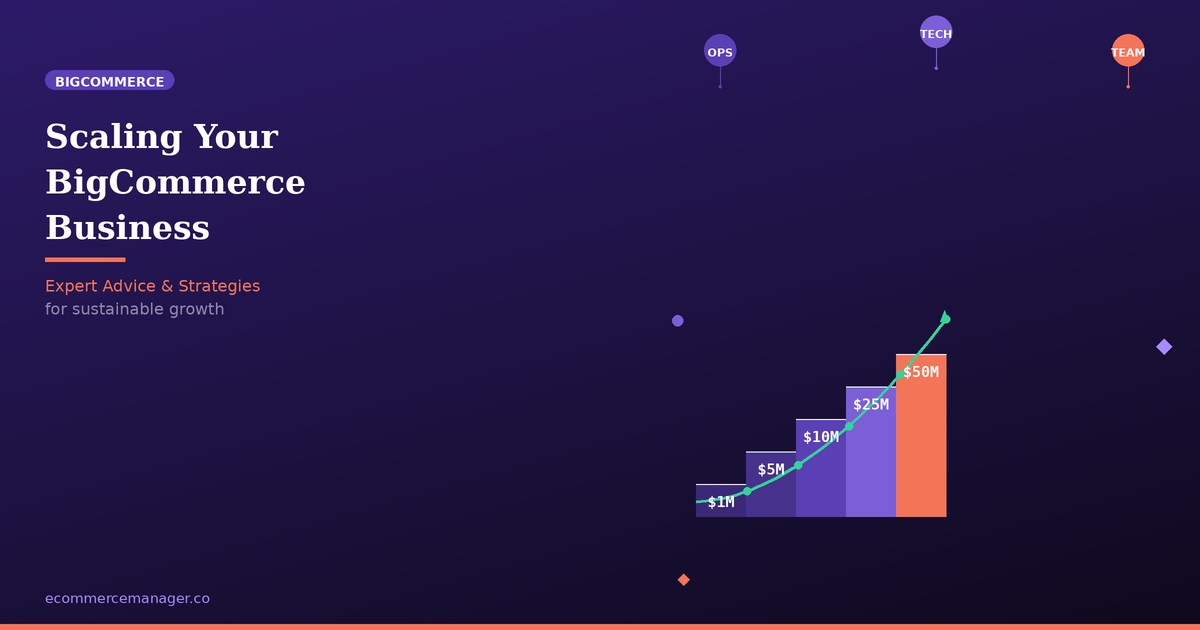
Scaling Your BigCommerce Business: Expert Advice and Strategies
Growing a BigCommerce store requires more than just good products and basic marketing tactics. This article brings together proven strategies and actionable advice from ecommerce specialists who have scaled operations successfully. Learn how to optimize everything from fulfillment and SEO to paid advertising and conversion rates while maintaining healthy unit economics.
- Prune Index Bloat First
- Structure Paid Campaigns for Predictable Acquisition
- Make Fulfillment Your Brand Advantage
- Favor Retention Over Ad Spend
- Match Product Titles to Real Queries
- Dominate Category Search Through SEO
- Fix Bottlenecks Prior to Growth
- Know SKU Economics and Financial Reality
- Leverage AI for High-Value Improvements
- Prioritize Omnichannel Automation and Global Readiness
- Boost Conversion Ahead of More Traffic
- Time-Box Backend Tests to Reduce Complexity
Prune Index Bloat First
The advice I’d give: prune before you publish. Most BigCommerce stores I’ve worked with scale by adding—new collections, new filter combinations, new blog content—and end up with thousands of indexed URLs competing against each other. In projects I’ve led, the move that lifts visibility is cutting dead weight: noindexing filter permutations, removing thin category pages, and canonicalizing duplicates.
Mechanism is simple—quality classifiers stop discounting the site, crawl budget and internal authority redistribute to pages that actually convert. The decision rule I use: if a page has no unique intent, no internal links earned, and no conversions over a meaningful window, it doesn’t deserve an index slot. If you’re stuck in a plateau, audit what’s indexed before you brief another content batch.

Structure Paid Campaigns for Predictable Acquisition
I’ve scaled dozens of multi-location and franchise e-commerce businesses through paid media, so this is very much my wheelhouse.
The single biggest lever I’ve seen for BigCommerce growth is paid traffic structure. Most businesses run one broad campaign and wonder why their ad spend feels like a leaky bucket. When we build out Meta campaigns segmented by product category and audience temperature — cold, warm, retargeting — the cost per acquisition drops fast and results become predictable.
One franchise client of ours was running a single blanket campaign across all their locations. We restructured it so each campaign had a clear goal, clean audience segments, and dedicated budget. Traffic quality improved, and more importantly, the spend started converting instead of just generating impressions.
The practical takeaway: before you increase your BigCommerce ad budget, fix the structure. More spend into a broken funnel just burns money faster. Nail your campaign architecture first, *then* scale.

Make Fulfillment Your Brand Advantage
Most BigCommerce brands I’ve worked with obsess over their storefront when they should be obsessing over what happens after someone clicks buy. When I was running my fulfillment operation, we onboarded a BigCommerce brand doing about $2M annually. They had beautiful product pages, killer marketing, but their fulfillment was a disaster. Orders took 4-7 days to ship. Customer service was drowning in “where’s my order” tickets.
We connected their BigCommerce store directly to our warehouse management system. Within 30 days, they were shipping same-day for orders placed before 2pm. Their repeat purchase rate jumped 34% in the next quarter. Why? Because fast, reliable fulfillment IS your brand experience. Nobody remembers your checkout flow, but everyone remembers waiting 10 days for a package.
The specific advice: audit your post-purchase experience before you spend another dollar on Facebook ads. Pull your actual data. What’s your average time from order to ship? What percentage of orders have tracking delays? How many customer service hours go to order status questions versus actual product support? If you’re scaling past $1M on BigCommerce, these numbers matter more than your conversion rate.
I see too many founders treat logistics as a back-office problem they’ll “fix later.” Later never comes. You end up with a Frankenstein system of spreadsheets and manual processes that breaks the moment you have a big sales spike. At Fulfill.com, we’ve connected dozens of BigCommerce merchants with 3PLs who integrate directly with their platform. The ones who treat fulfillment as a growth lever instead of a cost center are the ones who actually scale past $5M without losing their minds.
The brands winning right now aren’t just selling products. They’re delivering an experience that makes customers want to buy again. That starts the second someone places an order, not when they land on your homepage.

Favor Retention Over Ad Spend
The single best piece of advice for scaling any ecommerce business, BigCommerce included, is to scale your retention before you scale your acquisition. Most founders pour the growth budget into getting new customers and treat repeat buyers as a happy accident. It is backwards, and it is why so many stores grow revenue while profit stays flat.
The experience that taught me this: a client was spending heavily on ads to hit a growth target, and it was working on the top line while margin went nowhere. When we looked closely, first-time buyers were barely profitable after ad cost and almost nobody came back. We paused half the ad spend and put it into the unglamorous retention work – a proper post-purchase email flow, a reason to come back within 30 days, and service good enough to get people talking. Within a couple of quarters the repeat-purchase rate climbed, and because returning customers cost nothing to acquire, the same revenue suddenly carried far more profit.
The strategy in one line: a new customer is the most expensive sale you will ever make, so the money is in the second, third and fourth order. Build the machine that brings people back before you spend harder bringing new ones in. Scaling acquisition on top of weak retention just pours more water into a leaking bucket.

Match Product Titles to Real Queries
The lesson that grew an ecommerce client’s revenue the most was unglamorous: their product pages were written for the company, not the buyer. The titles and descriptions used internal product names and feature language, while customers were searching in completely different words, by use case and by problem. Nobody was typing the model number. They were typing what they wanted the product to do. We went through the catalog and rewrote every product title and the first lines of each description to match how people actually searched, and we cleaned up the product feed so the same buyer-facing language carried into Shopping and the on-site search. Two things happened. Organic traffic to the deeper product pages climbed because they finally matched real queries, and the on-site search conversion went up because people found what they meant on the first try. Revenue from organic product-page visits rose by a bit over a third across roughly three months, with no extra ad spend behind it. The advice I give anyone scaling a store: open your search query report and read the actual words customers use, then go make your product pages speak that language back to them. The gap between your words and theirs is usually the cheapest revenue you have sitting on the table.

Dominate Category Search Through SEO
If you want to scale a BigCommerce business, stop chasing tactics and start owning the search real estate around your category. Paid traffic is rented; organic visibility compounds. The single best move I’ve seen is to build a content and SEO engine that turns your product and category pages into the answer for every buyer question that exists between “I have a problem” and “add to cart.”
Here’s what’s worked for our clients at Scale By SEO. We start with a full site audit because most BigCommerce stores leak rankings through thin category copy, duplicate faceted URLs, slow LCP, and orphaned product pages. Fix the technical foundation first. Then we map keywords to the actual buyer journey, informational blog posts feeding mid-funnel comparison pages, which feed category and product pages with internal links that pass authority where it converts.
From there, consistency wins. Publishing 100+ to 300+ blog posts over a campaign, paired with steady backlink building and citation cleanup, is what moves a store from page three to the money positions. One post won’t do it. Thirty interlinked posts targeting a tight topical cluster absolutely will.
A specific strategy: pick one product category that already converts and go deep. Write the definitive buyer’s guide, ten supporting how-to posts, a comparison page, and a “best of” roundup. Interlink them. Earn backlinks to the guide, not the product page. Then watch the product page climb because it inherits the authority.
The mistake I see most often is founders rebuilding their theme or chasing a new channel instead of compounding what’s already working. Scaling isn’t novelty, it’s repetition with discipline. Audit, fix, publish, link, measure, repeat on a six-month horizon. That’s how you turn a BigCommerce store into a search-driven business instead of an ad-dependent one.
Fix Bottlenecks Prior to Growth
I run my store on a different platform rather than BigCommerce, so I will keep this to the part that holds true wherever you sell: the advice is to fix what breaks at higher volume before you go chasing the volume. Most stores scale the traffic and the marketing first, then discover the business underneath cannot take the weight.
At EV Cable Hub the thing that nearly capped our growth was the support load, not demand. Every extra order brought roughly the same questions, where is it, does this cable fit my car, can I send it back, and a small team answering those by hand hits a ceiling fast. Pouring more visitors onto that would have made the experience worse, not bigger. So before we pushed for more traffic, we wrote the buying guides that answered those questions before a customer ever emailed, and set up the routine messages to run on their own. That work is unglamorous and it is exactly what lets you grow without the wheels coming off.
The strategy that has done the most for us is owning a channel that keeps paying after you stop spending. Search is ours. We wrote the clearest answer on the internet to which charging cable suits which car, and those guides now bring in the bulk of our qualified visitors at no ongoing cost, while the same content gets pulled into AI assistants too. In the year we leaned into that approach our order volume grew by about 40% without us adding a single person to the support desk. Scale the foundations, own a channel you are not renting, and the growth becomes something you can keep up with.

Know SKU Economics and Financial Reality
From someone who has consulted several ecommerce businesses, one piece of advice is to completely understand your SKUs and unit economics for every SKU along with their KPI. When an e-commerce business is scaling, they tend to invest more in CAC without any early scenario planning on the contributions.
One of my clients scaled his businesses drastically, nearly ending up in working capital deficit. This was all because his SKUs were driving capacity, not profit. I have also seen businesses treat their books carelessly, only addressing them when the situation forces them to. Not because of neglect, but they often treat bookkeeping in a catch-up-later phase. When the damage is already done, it slowly compounds. Inaccurate records, pending reconciliations, and misclassifying expenses have a clear influence on the profit and loss statement. Financial visibility is more vital because it directly alters your strategy and growth alignment.

Leverage AI for High-Value Improvements
With over 22 years leading Zen Agency, I’ve helped businesses scale through holistic digital strategies that turn visibility into revenue.
Focusing first on AI for high-value tasks like personalized recommendations delivers fast results without full platform overhauls.
Cloud-based tools make this accessible, letting teams improve customer experiences and operations while avoiding data pitfalls.
Prioritizing privacy and internal skills early keeps growth steady and competitive on platforms like BigCommerce.

Prioritize Omnichannel Automation and Global Readiness
The top advice that I would give is to prioritise omnichannel expansion early, like BigCommerce’s native integration with Amazon, Walmart, eBay, Instagram and TikTok that allows for scaling revenue 30% faster compared to single channel stores.
What worked for us was coming up with a unified product feed synced across the marketplaces. We layered AI-driven personalised recommendations on our BigCommerce storefront. That combo enhanced average order value by 20% and decreased customer acquisition costs through retargeting. We also automated fulfilment workflows at key volume milestones—50, 500, and 5,000 orders—preventing bottlenecks as order volume grew non-linearly.
Don’t wait to go global. Allow multi-currency checkout and localised product pages early; international BigCommerce stores see increased growth potential by 40%. The platform’s headless architecture allows you to rebuild the front end (React/Vue) without touching the backend when you need custom experiences at scale.

Boost Conversion Ahead of More Traffic
For most BigCommerce stores, the biggest growth opportunity isn’t more traffic. It’s improving conversion rates before spending more on acquisition.
I’ve seen stores double revenue without doubling traffic simply by simplifying navigation, improving product pages and making the checkout process smoother. One common mistake is investing heavily in SEO or ads while visitors still struggle to find products or complete purchases.
My advice is simple: before scaling traffic, make sure your existing visitors are converting. Improving conversion rates by even a small percentage often produces a bigger impact than generating thousands of additional visitors.

Time-Box Backend Tests to Reduce Complexity
I don’t run a BigCommerce store myself, but as the founder of a platform that automates high-volume outbound campaigns, the scaling bottleneck is similar: operators choke their growth by over-engineering their backend workflows. When scaling operations–like enriching customer data, routing leads, or syncing fulfillment–we used to lose weeks mapping out massive, custom integrations.
What actually let us handle higher volume was applying a strict ‘one afternoon’ test to any new process. When we hit a bottleneck, I try to wire up a messy, 80-percent automated trigger using a tool like n8n by 5 p.m. If I can’t get that rough logic working in a few hours, the build is too tangled. We abandon it on the spot and just pay for an off-the-shelf API solution to bridge the gap immediately. Treating backend automations as rapid, time-boxed experiments rather than massive IT projects meant we spent less time maintaining custom code and more time handling actual volume.

Related Articles
- Starting Out with BigCommerce? 7 Tips for Beginners
- 7 Tips for Growing a Business on the BigCommerce Platform
- 5 Tips for Growing Your Business on Big Cartel