

Last Updated on June 25, 2026
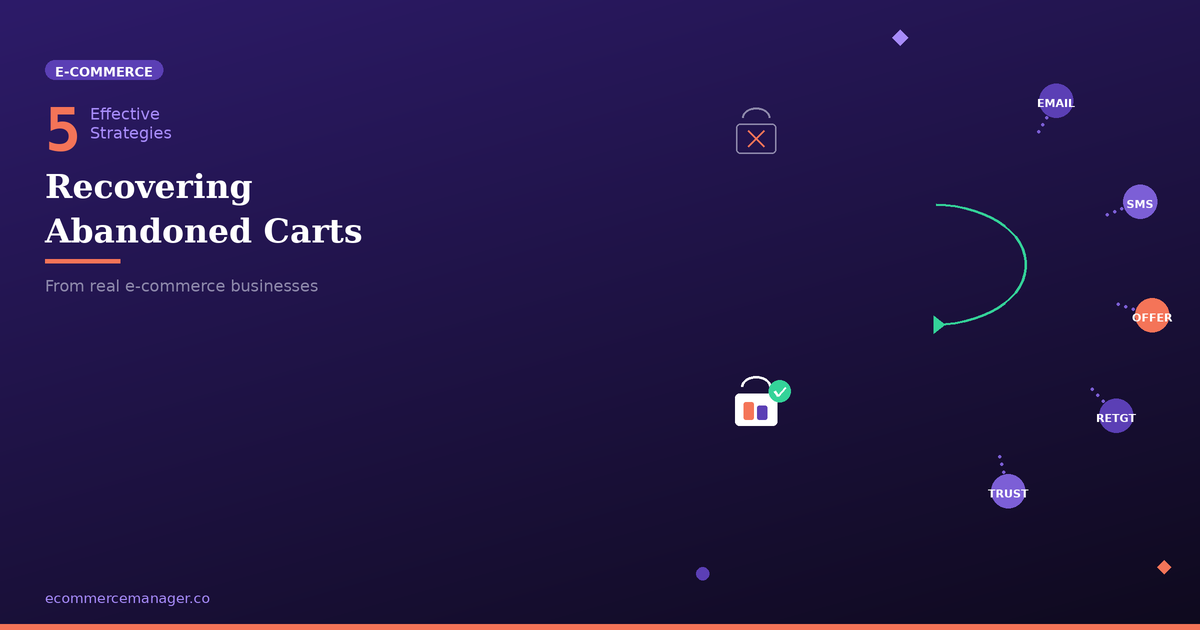
Recovering Abandoned Carts: 5 Effective Strategies from E-Commerce Businesses
Shopping carts get abandoned at alarming rates across e-commerce sites, with recent data showing nearly 70% of potential purchases never make it to checkout. This article breaks down proven strategies that successful online retailers use to win back those lost sales and convert hesitant browsers into buyers. Drawing on insights from e-commerce experts and real-world case studies, these five approaches offer practical solutions to one of retail’s most persistent challenges.
- Resolve Fit Doubts Before Purchase
- Guarantee a Shipping Date
- Emphasize Handwritten Notes and Cards
- Time a Three-Part Personalized Sequence
- Trigger Multi-Channel SMS Outreach
Resolve Fit Doubts Before Purchase
The strategy that recovers the most carts for us is not a discount, it is answering the doubt that made the person leave. At EV Cable Hub, people rarely abandon because of price. They abandon because they are not certain the cable fits their car or suits their charging setup, so they pause to go and check, and the moment passes. A money-off email aimed at that person misreads why they hesitated.
So our first recovery email does not mention a discount at all. It says something close to: “You left a Type 2 cable in your basket. If you are not sure it is right for your car, just reply with the model and we will confirm before you buy.” It gives a real person to ask rather than a coupon to chase. That single reassurance email recovers roughly 12% of abandoned carts on its own, and, crucially, the people it brings back almost never return the product, because we have already checked the fitment with them.
Only a later email in the sequence, days on, carries any incentive, and even then it is modest. The lesson I keep relearning is that for a considered purchase the cart is abandoned out of uncertainty far more than thrift. Remove the doubt, offer a human to answer it, and you recover the sale without training people to wait for a discount every time.

Guarantee a Shipping Date
We combat cart abandonment by offering a dynamic manufacturing lead time guarantee that addresses the rigid time constraints faced by professional contractors and interior designers. High-end home improvement projects are one area where cart abandonment is common, as trade professionals will compare and shop among multiple vendors solely to meet a specific installation date. When we see trade account customers or multi-room carts abandoned at the last step before purchase, we automatically send an email with a production slot lock-in that guarantees them a shipping date. Through this process, we have converted a generic automated marketing message into a tangible operational promise that eliminates the single largest obstacle to completing a project for the customer. As a result, we can capture high-value orders from these customers who would otherwise lose those dollars to local distributors.

Emphasize Handwritten Notes and Cards
One strategy I use is to emphasize the tangible unboxing experience customers will receive, since our handwritten notes and printed outfit cards resonate more than many email pushes. An effective abandoned cart message I use is short and personal: “Hi [Name], we saved your items. Complete your order and your pieces will arrive with a handwritten thank-you note and a printed styling card to help you wear them.” That copy offers a clear, tangible benefit and feels more personal than a generic follow-up, and it aligns with our focus on thoughtful, simple design.

Time a Three-Part Personalized Sequence
Personalized abandoned cart emails are the single highest-ROI automation any ecommerce store can turn on, and most stores still haven’t done it properly.
The single biggest lever in abandoned cart recovery is sequence timing and personalization, not discounts. Most stores send one generic email an hour after abandonment and wonder why it doesn’t convert. What actually works is a three-part sequence: a reminder within the hour that shows the exact items left behind, a follow-up 24 hours later that adds social proof or addresses a likely objection, and a final email at 72 hours where you might offer an incentive if you’re going to at all. The personalization matters more than the discount. At SmartrMail we saw this consistently across thousands of stores, and the data is pretty clear that relevance outperforms urgency every time. Set it up once, put it in your brand voice, and let it run. It’s the closest thing to free money in ecommerce.
“Just turn them on, tweak them, put them in your brand voice, and go do it” is genuinely my advice. At SmartrMail we saw this pattern work across 12,000 customers and 6 billion emails sent. The stores that skip personalisation in favour of a generic “you forgot something!” are leaving serious revenue behind.

Trigger Multi-Channel SMS Outreach
As the founder of RewardLion and author of How eCommerce Made Billionaires, I specialize in building automated systems that stop revenue from slipping through the cracks. The most effective strategy to recover abandoned carts is leveraging real-time behavioral tagging linked to multi-channel automation.
Using our OS, we tag prospects the moment they abandon a cart, which instantly triggers a coordinated SMS and email sequence. This ensures you reach the customer immediately on the channel they prefer, without managing disconnected tools.
An effective SMS we deploy is: “Hey [First Name], we saved the items in your cart! Reply directly to this text if you need help, or click here to complete your order: [Link].”
Any reply goes straight to an all-in-one inbox where an AI assistant or human agent can resolve objections and close the deal on autopilot.

Related Articles
- Combatting Cart Abandonment: 4 Ecommerce Strategies that Work eCommerce Manager
- Reducing Cart Abandonment: 10 Strategies for WooCommerce Stores
- November, 2024 – 4 Effective eCommerce Email Marketing Software Tools Recommended by Experts