


Last Updated on June 8, 2026
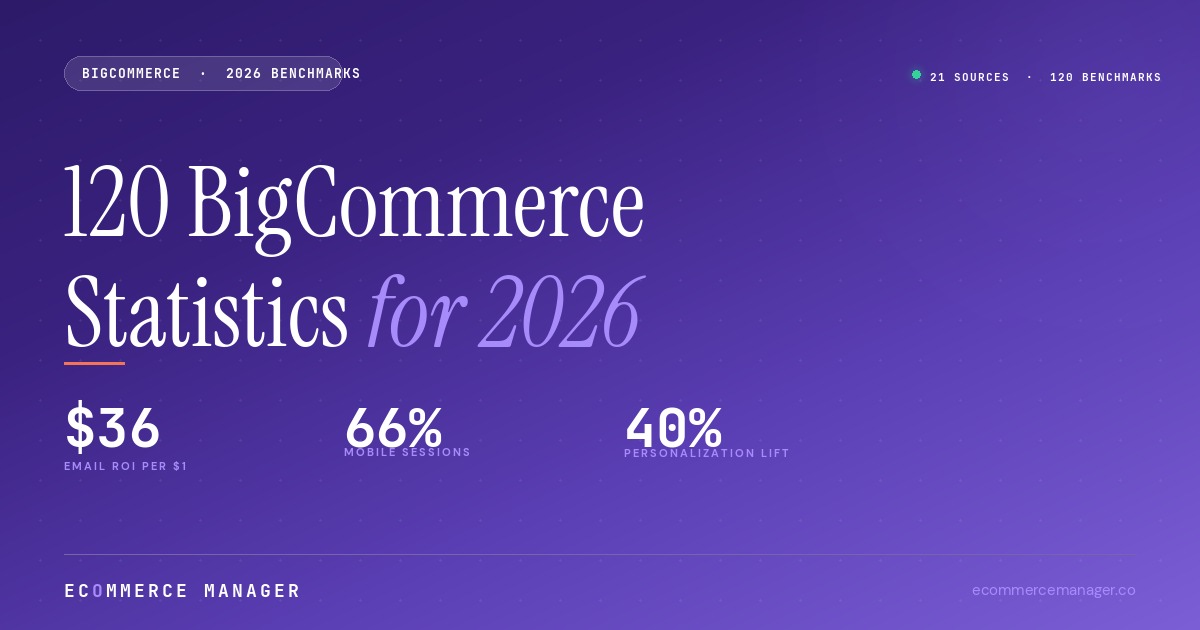
120 BigCommerce Statistics for 2026
120 numbers from 21 sources on what's working for BigCommerce merchants in 2026 — from $36 email ROI to the 66/30 mobile conversion gap and the 391% B2B portal ROI case studies operators keep citing.
On this page
Why these 120 numbers matter even if you're not on BigCommerce yet
BigCommerce sits in the platform evaluation set for most $5M–$50M DTC operators alongside Shopify, WooCommerce, and Adobe Commerce. It tends to win on B2B flexibility, headless architecture, and total cost of ownership at higher GMV bands. The benchmarks here are organized so an operator can use them whether they're scoping a migration, optimizing an existing BigCommerce stack, or just comparing channel ROI across platforms.
The structure: 120 statistics from 21 sources across consumer behavior, social, email, mobile, personalization, and AI. Each section opens with a short read on what the numbers actually say. Stats that translate directly into BigCommerce-specific decisions — headless investments, B2B portal ROI, composable architecture — are flagged where relevant.
If you only carry three numbers into a planning meeting: email returns $36 for every $1 (still the highest-ROI channel), 66% of sessions are mobile but fewer than 30% convert there, and the brands that ship hyper-personalization properly generate 40% more revenue than those that don't.
1. Consumer behavior — what BigCommerce shoppers expect in 2026
Personalization, value, and authenticity are now baseline expectations. Generic storefronts read as a liability when 80% of US shoppers expect tailored experiences and 66% will pay more for sustainability done right.
-
01By 2026, online shopping will account for about 18% of total US retail sales, reinforcing the shift of everyday purchases to ecommerce platforms like BigCommerce.
-
02Globally, ecommerce sales are expected to exceed $8 trillion in 2026, giving BigCommerce merchants access to a rapidly expanding pie.
-
03Over 2.9 billion people are expected to shop online in 2026, expanding the reachable audience for BigCommerce stores.
-
04Escalent finds over 40% of consumers will pay more for products aligned with their values, yet more than 60% still prioritize value and affordability in final decisions.
-
05A global study shows 50% of consumers seek products that reflect their unique personalities, and 65% feel society celebrates authenticity, feeding demand for niche, expressive DTC brands on platforms like BigCommerce.
-
06In 2026, personalization is the primary driver of loyalty in ecommerce, especially in B2B/B2C experiences that feel like consumer apps.
-
07Over 80% of American shoppers expect personalized shopping experiences, making generic storefronts a liability.
-
0866% of US consumers are willing to pay more for sustainable goods, turning sustainability into a pricing and differentiation lever for BigCommerce merchants.
-
09In social commerce, US sales are expected to reach nearly $70 billion by 2026, showing how central social channels are becoming to product discovery that ends on branded stores.
-
10Consumers increasingly favor value-driven consumption: they want emotional reassurance and practical value, not just the lowest price.
-
11Digital consumer behavior is shaped by mobile-first interactions, social commerce, voice search, and privacy-conscious habits, forcing BigCommerce brands to adapt beyond desktop-centric funnels.
-
12Shoppers expect integrated omnichannel journeys; connecting digital and physical experiences now improves satisfaction and loyalty.
-
13Sustainability and ethical practices are influential factors; brands that communicate values honestly resonate more with today's buyers.
-
14Consumers increasingly prioritize memorable experiences over products, shifting spending toward differentiated, story-rich brands rather than pure commodities.
-
15Community and wellness are major themes; shoppers reward brands that align with community engagement and wellness-oriented offerings.
-
16Private labels and value brands are gaining share as financial pressures rise, forcing branded sellers on BigCommerce to differentiate beyond price.
-
17Innovation in packaging and products (sizes, seasonal variants, bundles) is cited as critical to stay relevant and compete with value/private labels.
-
18Value-conscious shopping is widespread: consumers across income levels pay closer attention to price, making value communication and pricing transparency critical.
-
19Consumers are embracing hyper-personalization; in 2026, such strategies powered by data and AI are considered essential, not optional.
-
20Emerging technologies like generative AI, AR, and blockchain are reshaping how consumers interact with brands online, from product discovery to trust and verification.
Building a 2026 email and lifecycle program?
Email is still the highest-ROI channel for BigCommerce merchants — but only if first-party data is unified. The directory lists vetted Klaviyo, Omnisend, and lifecycle email partners with BigCommerce track records.
3. Email marketing — the highest-ROI channel in the BigCommerce stack
Email still posts $36 ROI per $1 spent and ranks as the top B2C channel in HubSpot's 2026 data. The catch: it only works on clean first-party data, and only 25% of B2C marketers have that.
-
01Email marketing continues to be the most effective digital channel, delivering an average ROI of $36 for every $1 spent.
-
02In HubSpot's 2026 data, 26% of marketers say email is one of the most effective channels for segmentation/personalization, tying with paid social.
-
03For B2C marketers, email is ranked as the highest-ROI channel, ahead of paid social and content marketing.
-
04Email remains central even as AI and social grow; owned channels protect BigCommerce brands against algorithm changes and rising ad costs.
-
05Personalization is a top email use case, and 45% of B2C marketers can now segment audiences for highly personalized messaging.
-
06Despite progress, many still struggle to move beyond basic segmentation into deeper, behavior-driven personalization.
-
07Email is shifting from batch-and-blast to hyper-segmented and AI-assisted, with send-time optimization and dynamic content becoming common.
-
08Appointment and lifecycle emails (welcome, replenishment, win-back) are often where BigCommerce merchants see the highest revenue per send.
-
09Email's strong ROI depends on clean first-party data; only about a quarter of B2C marketers have unified most of their data sources.
-
10AI-powered tools are used by 62% of B2C marketing leaders for content creation and optimization, including email copy and variations.
-
11Email supports customer retention and LTV, which is crucial when acquisition costs on paid social keep rising.
-
12Email is often the backbone for cross-channel orchestration, syncing with SMS, push, and retargeting to guide shoppers back to BigCommerce carts.
-
13Retail marketers see success when they combine email with intent signals (browse, cart, category interest) to tailor flows.
-
14As privacy regulations tighten, email---fueled by consented first-party data---is positioned as a future-proof channel for BigCommerce merchants.
-
15AI-assisted email can speed up creative production, allowing small teams to run more tests and learn faster.
-
16Generative AI helps create product-specific content at scale, such as variant-based recommendations and storytelling for different segments.
-
17High-performing email programs rely on clear value exchanges---discounts, exclusive access, or content---to grow lists.
-
18In omnichannel journeys, email influences buying decisions even when the final purchase happens via other channels or marketplaces.
-
19Brands using AI-enhanced customer experiences see 5—8x return on marketing spend, and email is a key canvas for those experiences.
-
20For BigCommerce merchants with B2B components, email is a critical driver for reorders and account-based nurturing, complementing self-serve portals.
4. Mobile commerce — where the 66/30 gap costs BigCommerce real revenue
Mobile is 66% of sessions and under 30% of conversions. That single ratio is one of the highest-ROI projects most BigCommerce merchants could ship — and the platform's headless and composable architecture is built specifically for it.
-
01In 2026, 66% of ecommerce sessions come from mobile, yet less than 30% of conversions happen on mobile devices---highlighting a persistent conversion gap.
-
02This mobile-desktop gap often stems from trust and UX issues; many users browse on phones but switch to desktop to buy.
-
03Voice search users in the US are expected to reach 157.1 million by 2026, a 2.5x increase from 2024, influencing how shoppers discover products on mobile.
-
04Visual search adoption for product discovery is strong among younger users, with about 22% of Gen Z and younger millennials using it to find and buy products.
-
05Mobile devices are reshaping the commerce landscape; optimizing websites and campaigns for mobile is now essential, not optional.
-
06Consumers expect mobile-first experiences: fast loading, responsive design, simple navigation, and frictionless checkout.
-
07Shoppable formats and frictionless shopping experiences are priorities for retailers in 2026, including one-click purchasing and auto-filled data.
-
08Quick commerce (rapid delivery) is projected to reach about $199.92 billion in 2026, reflecting expectations for speed in certain categories.
-
09Mobile search, social, and messaging combined now form the primary digital touchpoint mix for many shoppers.
-
10BigCommerce and similar platforms are investing in headless and composable architectures to support mobile-app and PWA experiences.
-
11Mobile is central to omnichannel journeys, with users toggling between mobile, desktop, and store visits before purchasing.
-
12Mobile-optimized content (short copy, scannable layouts, vertical images) improves engagement and lowers bounce on product pages.
-
13Voice and visual search push brands to ensure structured product data and high-quality imagery, because algorithms surface the most relevant listings.
-
14Mobile users are more likely to abandon slow or clunky sites, which directly impacts revenue for BigCommerce merchants.
-
15Many shoppers use mobile to research in-store products, reinforcing the need for consistent pricing and information across channels.
-
16Mobile wallets and BNPL options are now hygiene factors for younger demographics; lacking them can materially reduce conversion.
-
17Mobile analytics and event tracking are essential to understand
-
18Mobile-first email and landing page design is now standard; campaigns that ignore mobile view risk underperformance.
-
19In many markets, mobile is the only device for segments of the population, especially in emerging economies.
-
20As 5G coverage expands, brands can use richer media (video, AR) on mobile product pages without sacrificing performance.
Comparing BigCommerce against Shopify or Adobe Commerce?
The Platform Calculator runs all four against your actual GMV, AOV, traffic mix, and B2B/B2C split. Real 3-year TCO including app costs, transaction fees, and platform-specific gotchas.
5. Personalization — the lever behind 40% revenue growth gaps
Hyper-personalization separates the top growers from the rest by 40%+ on revenue. For BigCommerce merchants with mixed B2C and B2B traffic, the leverage is even higher — B2B portals are quietly the highest-ROI personalization surface in the stack.
-
01Organizations that grow rapidly generate 40% more revenue through hyper-personalization than slower-growing competitors.
-
0276% of consumers feel frustrated when experiences are not personalized, raising the cost of generic experiences.
-
03Companies using AI-driven personalization report conversion rates 15—25% higher than those with generic approaches.
-
0482% of businesses using AI to enhance customer experience see 5—8x return on marketing spend, showing personalization's leverage.
-
05In 2026, personalization is the primary driver of loyalty, especially in B2B experiences that feel like B2C, a major BigCommerce focus area.
-
06Consumers increasingly expect products that reflect their unique personalities, with about 50% actively seeking such products.
-
0765% of consumers believe society now celebrates them for being authentic, which pushes brands to enable richer self-expression through assortments and UX.
-
08Hyper-segmentation and personalization strategies powered by data, AI, and behavioral insights are "no longer optional" in 2026.
-
09Top-performing marketers prioritize first-party data insights (49%) and intent data (38%) to drive personalization.
-
10Only about 25% of B2C marketers have successfully centralized most data sources, limiting personalization depth for many.
-
1145% of B2C marketers can segment audiences for highly personalized messaging, showing progress but also room for improvement.
-
12AI personalization engines enable conversion lifts of 20—40% in many cases, depending on implementation and category.
-
1371% of organizations now implement account-based strategies, and
-
14ABM programs deliver an average ROI of 137% with 28% faster sales cycles, illustrating the payoff of personalization in B2B use cases supported by BigCommerce.
-
15In BigCommerce-oriented B2B ecommerce, the biggest 2026 shift is
-
16BigCommerce case studies show B2B portals can drive 391% three-year ROI with payback in seven months, partly due to better self-service personalization.
-
17Hyper-personalization is generally well received when it resonates with consumer needs, but can feel "creepy" if poorly executed.
-
18Personalization also extends to pricing, product bundles, and packaging, used to compete with private labels and value chains.
-
19As data privacy expectations rise, brands must balance relevance with transparency in how they personalize.
-
20AI-powered personalization in ecommerce is predicted to keep expanding, with AI in marketing projected to reach $22 billion by 2032, much of it in personalization tooling.
6. AI in the BigCommerce ecosystem — what's actually moving numbers
66% of marketers use AI tools daily and 63% are running generative AI in active workflows. The 2026 pattern that matters: AI plus first-party data plus personalization, applied to specific commerce surfaces rather than as a content factory.
-
0166% of marketers use AI tools daily in 2026 to steer strategic digital marketing decisions.
-
0263% of marketers are currently using generative AI in their workflows.
-
03The market size of generative AI in marketing is expected to reach $22 billion by 2032.
-
04AI in ecommerce is transforming business by enabling smarter storefronts, personalized experiences, and more efficient operations end-to-end.
-
05Businesses using AI to deliver personalized communications see up to a 30% improvement in customer retention.
-
06BigCommerce highlights AI-driven tools as a way to optimize merchandising, on-site search, and recommendations in 2026.
-
07AI-powered systems analyze browsing patterns, purchase history, and social behavior to create targeted recommendations that lift revenue.
-
08Companies using AI-driven personalization report 15—25% higher conversion and 5—8x ROI on marketing spend, reinforcing AI's leverage.
-
09AI-powered NLP and decisioning allow brands to understand intent and sentiment at scale, informing messaging and offers.
-
10AI is increasingly used to unify and interpret massive datasets, overcoming marketer challenges around fragmented data.
-
11Digital marketing success in 2026 "relies on data-driven precision and AI integration," according to Webandcrafts analysis.
-
12AI-driven insights let marketers pivot from vanity metrics to
-
13Through analysis of large consumer datasets, AI uncovers preferences and trends that support personalized experiences at scale.
-
14Emerging technologies, including generative AI and AR, are transforming consumer behavior and expectations in digital experiences.
-
15Salesforce notes 83% of sales teams using AI saw revenue growth vs 66% not using AI, highlighting the commercial impact of AI adoption.
-
1663% of marketers in Salesforce's 2026 data report current generative-AI usage, indicating mainstream penetration.
-
17In BigCommerce B2B contexts, AI supports personalized catalogs, quoting, and reordering that feel like B2C experiences.
-
18AI plays a major role in SEO and content creation, with 62% of B2C leaders using gen-AI for content optimization.
-
19AI also reshapes ad buying and bidding, as platforms automate targeting based on real-time signals and predictive models.
-
20Overall, 2026 is defined by AI + first-party data + personalization, and BigCommerce merchants that align these three pillars are best positioned to grow profitably. If you're planning to turn this into a resource (ebook, lead magnet, or internal deck), do you want a sheet-friendly table with columns like "Stat", "Metric", "Use case", "Source URL", and "Section" so you can filter and reuse these quickly?
What a smart operator does with these 120 numbers
Treat the 66/30 mobile gap as the next quarter's project. If two-thirds of sessions are mobile and under a third of conversions are, the highest-ROI work isn't more acquisition — it's making mobile actually convert. PWA, one-tap checkout, mobile wallet + BNPL, sub-2-second LCP.
Centralize first-party data before doing anything else with AI. Only 25% of B2C marketers have unified their data. Everything downstream — email personalization, AI recommendations, account-based plays — depends on this being solved first. It's unglamorous and it's the bottleneck.
If you're on BigCommerce and have any B2B revenue, build the portal. 391% three-year ROI with seven-month payback is a generational-quality number. Self-serve B2B portals are quietly the platform's strongest differentiator in 2026.
Email is not optional. $36 per $1 ROI is more than the rest of the channel mix combined for most BigCommerce merchants. Welcome, replenishment, win-back, post-purchase — the four lifecycle flows that fund everything else.
Apply AI to specific commerce surfaces, not to "content." 63% of marketers use generative AI; only the ones who applied it to merchandising, search relevance, dynamic pricing, and recommendations are seeing the 5–8x marketing ROI the case studies cite.
Frequently asked questions
Is BigCommerce still a strong platform choice in 2026?
Yes, particularly for merchants with B2B revenue, complex catalog requirements, or higher GMV bands where total cost of ownership matters more than out-of-the-box simplicity. BigCommerce continues to win on B2B portals (391% three-year ROI case studies), headless and composable architecture, and lower transaction fees compared with Shopify Plus at similar GMV. It's typically a less obvious win for sub-$2M GMV brands where Shopify's app ecosystem moves faster.
What's the highest-ROI marketing channel for BigCommerce merchants in 2026?
Email, by a meaningful margin. HubSpot's 2026 data has email returning $36 for every $1 spent, ranked as the top B2C channel ahead of paid social and content. The catch is that email ROI depends entirely on clean first-party data — and only about 25% of B2C marketers have unified theirs. Most BigCommerce merchants leave significant email revenue on the table because lifecycle flows (welcome, replenishment, win-back) aren't fully built out.
Why do BigCommerce stores convert lower on mobile than desktop?
It's an industry-wide pattern, not BigCommerce-specific. 66% of ecommerce sessions are mobile but fewer than 30% of conversions happen there. The drivers are predictable: slower page loads, missing mobile wallets and BNPL, friction-heavy checkouts, and trust signals that don't scale to small screens. Headless and PWA architectures (which BigCommerce supports natively) plus aggressive Core Web Vitals work usually close most of the gap.
How should BigCommerce merchants approach AI in 2026?
Apply AI to specific commerce surfaces rather than treating it as a generic content tool. The numbers favor merchandising and search (recommendations driving 15–25% conversion lifts), dynamic pricing (8–15% margin improvements), and demand forecasting (20–30% lower carrying costs). 66% of marketers use AI daily and 63% run generative AI in active workflows — but the brands seeing 5–8x marketing ROI tied it to specific revenue surfaces, not content production.
What's the biggest 2026 shift for B2B-focused BigCommerce stores?
B2B buyers now expect consumer-grade experiences. Account-based personalization, self-serve quoting, custom catalogs, and one-click reordering are no longer nice-to-haves. 71% of organizations now run account-based strategies, and ABM programs deliver an average 137% ROI with 28% faster sales cycles. BigCommerce's B2B-native features (price lists, payment terms, quote management, customer groups) are designed exactly for this — but they require buildout, not just activation.
The playbook top eComm operators actually read
One weekly brief. Five stories that matter. Zero fluff. Written for managers at $5M–$50M DTC brands who want to sound sharper than everyone else in the meeting.
References
- 01 Industry Analysis — LinkedIn Pulse — linkedin.com
- 02 Global Ecommerce Market Statistics 2026 — nikitha.com — nikitha.com
- 03 Escalent Consumer Research 2026 — escalent.co
- 04 B2B Ecommerce Trends 2026 Bigcommerce — ditindia.com — ditindia.com
- 05 Top 10 Digital Consumer Behavior Trends For 2025 2026 — breakthrough3x.com — breakthrough3x.com
- 06 Unpacking Consumer Marketing Trends That Will Drive Growth In 2026 — circana.com — circana.com
- 07 Generative AI Statistics — Salesforce — salesforce.com
- 08 2026 Digital Marketing Analysis — Webandcrafts — webandcrafts.com
- 09 Content Marketing Statistics — typeface.ai — typeface.ai
- 10 Digital Marketing Statistics — safaridigital.com.au — safaridigital.com.au
- 11 Marketing Statistics & Trends — HubSpot — hubspot.com
- 12 AI Statistics — Shopify — shopify.com
- 13 Consumer Buying Behavior Online Statistics — sqmagazine.co.uk — sqmagazine.co.uk
- 14 Consumer Behavior Trends — Netguru — netguru.com
- 15 AI Ecommerce Trends & Statistics — anchorgroup.tech
- 16 Ecommerce Growth Statistics — gokwik.co — gokwik.co
- 17 BigCommerce 2026 Trends & Stats — bigcommerce.com
- 18 AI Statistics — Shopify — shopify.com
- 19 Top 12 Personalization Engines For Marketing 2026 — autobound.ai — autobound.ai
- 20 Consumer Behavior Trends — Netguru — netguru.com
- 21 The Future of E-commerce Personalization — iksula.com
Make every platform decision data-backed
Join 12,000+ ecommerce managers reading the ECM newsletter every Tuesday — or browse the directory to find vetted CRO, email, retention, and AI partners with BigCommerce experience.

2. Social media — the channel BigCommerce brands underinvest in
93% of marketers use social, but most BigCommerce merchants still treat it as a posting cadence rather than a shoppable surface. With 17% of online sales projected through social in 2026, that gap has real revenue implications.