

Last Updated on June 7, 2026
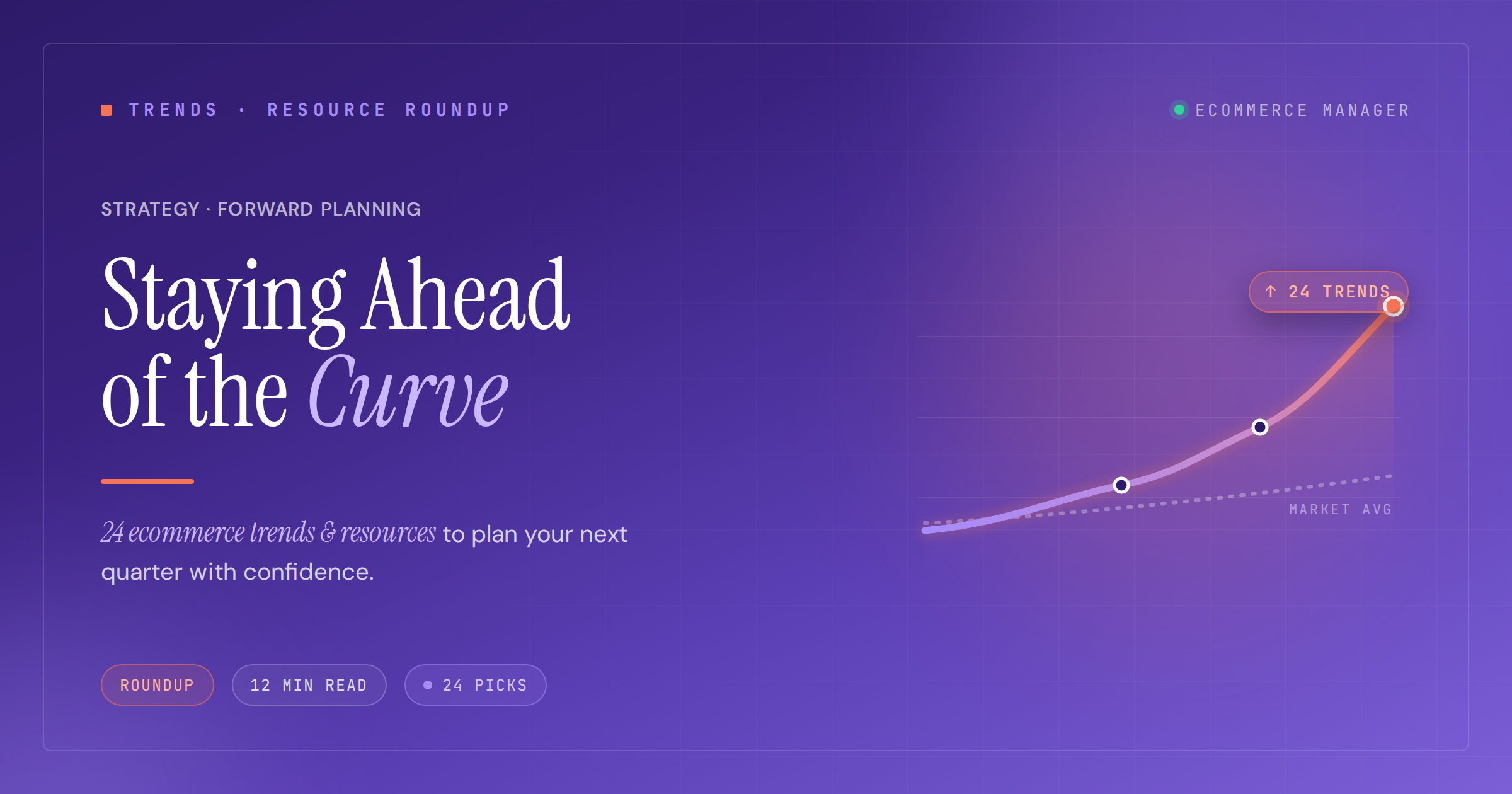
Staying Ahead of the Curve: 24 Ecommerce Trends & Resources
The ecommerce industry moves fast, and staying current requires more than skimming headlines. This article compiles 24 actionable resources and methods that successful merchants use to spot trends early, validate strategies, and outpace competitors. Each recommendation includes expert insights from practitioners, analysts, and platform specialists who share what actually works in the field.
- Use Work Truck Week as Live Research
- Rely on Manufacturer Bulletins for Accuracy
- Mine GSC Queries for Early Demand
- Review Peer Flows and Merchant Discord
- Compare Baymard Benchmarks to Actual Pages
- Validate Hypotheses and Watch Platform Notices
- Follow Official Docs for Technical Direction
- Gauge Momentum with Google Trends Then Verify
- Apply HubSpot Evidence to Lift Conversions
- Leverage a Curated Merch Report
- Trace the Money and Practitioner Patterns
- Study Earnings Calls for Forward Signals
- Lean on Private Networks for Intel
- Monitor Channels and Read Search Engine Land
- Let Real Store Data Set the Course
- Map Intent Shifts with Semrush
- Extract Buyer Language from Authentic Reviews
- Link Analytics and Ads for Truth
- Prefer Operators and Learn from Founder Talks
- Analyze Competitor Tech Stacks with Helpful Tools
- Consult Ecommerce Logistician for Logistics Insight
- Read the SERP and Set Alerts
- Draw from RewardLion Playbooks for Execution
- Buy from Rivals and Track Their Toolset
- Walk NY NOW to See What Sells
Use Work Truck Week as Live Research
My whole career has been built around the commercial fleet upfit space—launching products like BedBoss flooring and BaseAir with FoldFlex™ Technology means I have to know where the market is heading before customers even ask the question. That keeps me sharp on trends across both the product side and how fleets are actually buying and researching equipment today.
For ecommerce specifically, I pay close attention to how our customers—fleet managers, service contractors, upfitters—actually navigate our product pages and make purchasing decisions. Watching real behavior at events like Work Truck Week 2025, where I walked people through our demo vehicle in person, tells me what translates online and what doesn’t.
The one resource I’d point to is the Work Truck Show floor itself used as a live focus group. The questions people ask in person about things like our sliding no-drill partition or aluminum composite shelving tell you exactly what product content, specs, and visuals are missing from your online listings.
Treat your showroom or trade event interactions as direct ecommerce research—the gaps in customer understanding you see face-to-face are the same gaps killing your online conversion.

Rely on Manufacturer Bulletins for Accuracy
Since 2022, I have led Extreme Kartz by specializing in the technical nuances of golf cart upgrades, such as lithium battery conversions and performance controllers. My perspective is shaped by managing a national eCommerce platform where fitment accuracy and honest guidance are the primary drivers of growth.
I stay ahead of industry trends by working closely with manufacturers and fulfillment partners to identify hardware limitations before they reach consumers. This collaborative approach ensures we can provide real-world use cases for system-based solutions rather than just listing generic parts.
The primary resource I rely on is Manufacturer Technical Bulletins. These documents provide the specific compatibility and performance data necessary to build the authoritative buyer guides that our customers use to make informed purchasing decisions.

Mine GSC Queries for Early Demand
Most ecommerce trend tracking I see relies on newsletters and trade publications, which is fine for context but always lags. By the time a trend appears in a roundup, the early movers have already captured the traffic. I’d rather read the signal directly from Google Search Console and Google Trends than wait for someone else’s summary.
The single resource I rely on most is Google Search Console — specifically the Performance report filtered by query growth week-over-week across the last 90 days. I check it on Monday mornings as part of a weekly review across client accounts. It tells you which product attributes, materials, use cases, or problem framings are picking up real demand inside your category, not the industry at large. That distinction matters, because ecommerce trends are rarely universal — they show up in specific subcategories first.
A recent example: across two home goods clients, we caught “washable” and “machine washable” modifiers climbing steadily through Q3 on product types where that attribute wasn’t historically emphasized, so we restructured category filters and PDP copy to surface it. Within about three weeks, those pages were pulling impressions on the new modifiers before the trend showed up in any newsletter we read.
The mechanism is simple: query data inside the accounts I actually work on is the only source telling you what your specific customers are searching for right now, not what the market looked like last quarter. Aggregated benchmarks from Shopify or Klaviyo are useful background, but the decisions come from the account data.
I block 30 minutes Mondays to check rising queries in GSC — it’s my early-warning system.

Review Peer Flows and Merchant Discord
I gave up on “industry trend” newsletters two years ago. I read three of them every morning and noticed I was just absorbing other people’s takes on the same news, dressed differently. None of it changed how I ran the brand.
What replaced them: I subscribe to the email lists of 22 DTC brands that compete tangentially with us (men’s apparel, accessories, basics) and I read their flow emails as a customer would. Not their newsletters. Their actual transactional and lifecycle emails. Welcome series, abandoned cart, post-purchase, re-engagement. I have a folder in Gmail. Every Friday morning I spend 30 minutes reading what they sent that week and I take screenshots of anything that surprised me.
This catches real shifts before they appear in any “ecommerce trend” article. I caught the move toward 4-email welcome flows (instead of 2) about six months before it showed up in trade press. I caught the shift to text-only emails for VIP segments. I noticed which brands started letting customers reply to a thank-you email and get a real response (versus a no-reply address). When I see two or three competitors do the same thing within a few weeks, that is a trend signal worth acting on.
The one resource I do rely on, separate from competitor mailers: the Shopify Merchant Discord. Specifically the channels for brands my size ($500K-$5M annual). The conversation is unglamorous. Refund processing edge cases, carrier rate increases, fraud patterns, post-purchase upsell timing. Nobody is performing thought leadership. People are sharing what is actually breaking and what is actually working in their store this week.
The thing I avoid: “ecommerce trend predictions for 2026” articles. They are written for VC-backed retail conferences, not operators. By the time a trend is framed as a prediction, it is either already common practice among brands my size, or it never was a trend at all.

Compare Baymard Benchmarks to Actual Pages
Staying current starts with treating ecommerce like field research, not headlines. Algorithms shift, customer patience shrinks, and merchandising norms quietly expire. I watch what elite operators change before they explain why. Cart flows, financing prompts, search behavior, and post purchase messaging reveal trends earlier than reports. That habit matters more than chasing crowded predictions from conferences.
One resource I consistently rely on is Baymard Institute’s research library. Their usability findings turn vague opinions into practical merchandising decisions. Instead of trend watching passively, I compare those benchmarks against live category pages. That process exposes friction, hidden intent, and conversion leaks competitors often overlook first.

Validate Hypotheses and Watch Platform Notices
We stay current by treating “trends” like hypotheses and validating them against what we see in our own data: weekly reviews of customer tickets and reviews, cohort retention by channel, A/B tests on PDP and checkout changes, and post-purchase surveys. That keeps us from chasing noise and helps us separate platform updates or creator-driven spikes from changes that actually improve conversion, refund rates, or LTV.
One resource I rely on is Shopify’s official updates and documentation. It’s not flashy, but it’s consistently actionable: platform releases, policy changes, and guidance that affects speed, checkout, subscriptions, and attribution. We cross-check what we read there with internal testing and what our agency and tech partners are seeing before we operationalize anything.

Follow Official Docs for Technical Direction
Running an agency that spans SEO, web design, and payment processing means I have to stay sharp across a lot of moving parts — not just one slice of ecommerce.
The one resource I keep coming back to is Google Search Central. When Google updates how it crawls, indexes, or ranks pages, it directly affects the businesses I work with. I’ve seen how ignoring Core Web Vitals tanked rankings for clients in competitive spaces like home services and concrete coatings — and how fixing those technical foundations turned things around fast.
Beyond that, I stay current by watching what actually ships in the tools we use daily — Clover for POS, WooCommerce for storefronts. Product updates from the platforms you’re already using often signal where the industry is quietly heading before it becomes a trend headline.
The real insight usually comes from implementation, not theory. When you’re managing everything from first search impression to final payment for real businesses, you learn what’s working now, not six months ago.

Gauge Momentum with Google Trends Then Verify
If we had to name one resource, it would be Google Trends. We like it because it shows momentum and not just search volume. In ecommerce, timing often makes the difference between reacting late and moving early. Trend data helps us see where interest is growing, how it changes by region, and whether a signal is getting stronger or starting to fade.
We do not use it alone when making decisions. We compare those patterns with onsite search behavior, campaign results, and changes in conversions to confirm what is real. This mix makes the insight more useful and easier to act on. Google Trends is simple, public, and often underestimated, which is why it remains a practical tool in our workflow.

Apply HubSpot Evidence to Lift Conversions
Since 2009, I’ve led BMG MEDIA through 1,000+ custom website builds for companies ranging from startups to multi-billion-dollar enterprises. I stay at the forefront by treating every project as a research laboratory for what actually drives growth in a rapidly evolving digital landscape.
I focus on emerging technologies like AI-driven personalization to anticipate user needs and predictive design to simplify the shopping experience. We also monitor technical vitals closely, as data shows the probability of a bounce increases by 32% when page load speed jumps from one to three seconds.
The resource I rely on most for conversion insights and marketing data is HubSpot. Their research, such as the 111.55% conversion lift seen by changing CTA text from “Book a Demo” to “Get Started,” helps us refine high-performance strategies for our clients.
Whether we are building on Shopify or developing custom WordPress solutions, we apply these insights to eliminate distracting “noise” through minimalism. This allows us to create secure, mobile-first platforms that prioritize both user trust and measurable ROI.

Leverage a Curated Merch Report
I’ve built e-commerce ventures like Benny’s Boardroom and Mercha by focusing on how “digital natives” have replaced traditional sales calls with streamlined online research. My background across financial services and entrepreneurship helps me bridge the gap between high-tech platforms and ethical, sustainable business practices.
I stay current by monitoring the shift toward “lifestyle” branding, where products like portable chargers or organic apparel move from the boardroom to the bar. We focus on data-driven decision-making to ensure we are providing high-quality items that are “worn out, not thrown out” rather than pre-landfill junk.
My go-to resource is our curated “Merch Report,” which we use to track the adoption of eco-conscious materials like bamboo and recycled essentials. This focus is vital because data shows 48% of millennials will keep a promotional product specifically if it matches their personal style.
We recently applied these insights by pivoting from generic bulk orders to curated “merch packs” for clients like Uber and TikTok. This addressed the common frustration of slow lead times and back-and-forth emails while meeting the demand for a more memorable gifting experience.

Trace the Money and Practitioner Patterns
I stay current by watching where money moves, not just where attention goes. Trends show up in behavior before they show up in headlines, so I pay close attention to shifts in conversion rates, AOV, and retention across different channels. That tells you what’s actually sticking versus what’s just noise.
One resource I rely on is founder-led ecommerce breakdowns on LinkedIn. Not the polished posts, but the ones where operators share real numbers, failed tests, and small wins. That kind of unfiltered insight gives you patterns you can act on fast, which matters a lot more than chasing every new trend.

Study Earnings Calls for Forward Signals
The Brands That Learn Fastest Win the Market
To remain up-to-date on trends in e-commerce does not mean to consume additional information or sources of knowledge. Instead, one should focus on generating the most relevant signals. Those who best understand how to identify these trends are analysing both customer behaviour as well as changes within their respective platforms’ algorithms and their supply chains. Reading specific category-based newsletters, attending conferences specifically designed for the retail/industrial sector and understanding what successful Direct-To-Consumer (DTC) brands are currently testing is an efficient way to generate higher quality insights into industry trends than reading large trend reports produced quarterly.
A source that provides signal strength with regard to all three categories (behavioural data, platform updates, etc.) includes Earnings Calls and Investor Reports of leading eCommerce and Logistics companies, including but not limited to Amazon, Shopify and FedEx. These reports highlight areas in which capital is moving; consumer behaviour and patterns that are changing; and the technologies that are being scaled by leading eCommerce companies – sometimes six to nine months before when other media outlets report on this activity. Therefore, these reports provide forward-thinking intelligence vs. backward-thinking analytical reporting.

Lean on Private Networks for Intel
It’s more difficult today than it’s ever been because of the rate of change. There are the excellent newsletters and more standard resources for research. However, for me, I find my network to consistently be the most reliable and efficient form of information gathering. That can be direct conversations, private ecommerce groups in places like Slack or Discord. And of course, LinkedIn.

Monitor Channels and Read Search Engine Land
I’ve spent over two decades leading digital campaigns for large-scale entertainment brands like the Maloof Companies and Maverick Gaming. This experience taught me that staying current requires monitoring technical shifts across SEO, PPC, and affiliate marketing simultaneously to maintain a competitive edge.
I use my work with Marketing Magnitude and platforms like FamilyFun.Vegas to test how new branding and content strategies perform across different sectors. By leveraging my agency’s real-time tracking and reporting, I can see immediately which new search trends actually drive conversions for businesses in high-competition industries.
One resource I rely on is Search Engine Land for its deep dives into algorithm changes and platform updates. It provides the technical foresight needed to adjust digital strategies and web development practices before industry shifts impact a client’s visibility or growth.

Let Real Store Data Set the Course
Running an agency that audits ecommerce sites across Morocco, Dubai, and the US for the past five years, I stopped trying to keep up with “ecommerce trends” through articles. The signal-to-noise on trade-press content is too low. By the time a tactic is written about, half my clients are already failing at it.
What I do instead: I ask every new ecommerce client for read-only access to their Shopify or WooCommerce admin, plus their email service provider (Klaviyo, Mailchimp, or whatever they use). On day one of any engagement I export the last 12 months of their order data, average order value by month, repeat purchase rate, and email open and click trends. Then I do the same for any direct competitor whose store I can reverse-engineer through public data and signup flows. The pattern that emerges across 6 to 8 stores in the same vertical, that is the actual trend. Articles tell me what people are talking about. Data tells me what is actually changing.
Two examples this year. We saw bundled product pages outperform single-SKU PDPs across 5 of 7 fashion clients in Q1 (conversion lift average 9%). No trend article surfaced this until April. We also saw email engagement on plain-text broadcasts (no images, no buttons, no design) outperform designed templates by 23% on click rate across 4 of 5 SMB clients. Trade press still pushes “design-rich emails.”
The one resource I rely on, separate from client data: the Demand Curve newsletter. Specifically the case studies, not the takes. They show actual ad creative and the CAC numbers behind it. A Demand Curve case study is more useful than 10 ecommerce blog posts because it shows what someone tried, what it cost, and what it returned. Most “trend” content shows none of those.

Map Intent Shifts with Semrush
I’ve been building websites for over 20 years and now run J&A Digital Solutions, so the way I stay current is by watching what actually changes lead behavior, not just what’s trending on marketing Twitter. I pay closest attention to search results, mobile user behavior, booking friction, reviews, and what makes someone contact a business right now.
One resource I rely on is Semrush. I use it less for “news” and more as a live feedback tool to see what people are searching, how intent is shifting, and where competitors are gaining visibility. That matters because trends in ecommerce and local service marketing both show up first in search behavior.
A practical example: when we saw how much intent was tied to “near me” and high-conversion local searches, we leaned harder into Google Business Profile optimization, consistent listings, and one-click calls/messages instead of just making sites look better. For clients, that translated into more direct actions from people already ready to buy.
My rule is simple: if a trend doesn’t improve visibility, trust, or conversion, I don’t chase it. Most “best practices” are recycled advice, so I test changes against real leads, review quality, and whether the business owner gets more qualified conversations.

Extract Buyer Language from Authentic Reviews
20+ years in marketing and revenue strategy means I’ve watched countless ecommerce brands chase trend reports while ignoring the real signal: buyer psychology isn’t changing as fast as the tactics people keep reinventing.
The one resource I keep coming back to isn’t a newsletter or podcast — it’s the comment sections. Reddit threads, G2 reviews, Trustpilot pages for competitors. Real buyers describing *in their own words* why they almost didn’t buy, or why they churned. That language is worth more than any trend roundup.
I worked with a company that had been stuck at the same revenue ceiling for over a decade. Their tactics were fine on paper. The actual problem was that their messaging didn’t match how buyers were describing their own problem. We fixed the language first — everything else followed.
The ecommerce teams I’ve seen grow fastest are the ones treating customer objections as a content and messaging roadmap, not just a sales problem. If someone’s hesitating at checkout, that’s a certainty gap — and closing it with better copy beats any new platform or channel every time.

Link Analytics and Ads for Truth
I stay current by living in the data every day. I’ve managed $100M+ in ad spend and built ROI Amplified around 24/7 live reporting, so I’m not chasing headlines—I’m watching what actually changes conversion rates, CAC, and revenue across real ecommerce accounts.
If I had to pick one resource, it’s Google Analytics tied directly to Google Ads and ecommerce tracking. When those systems are connected, you can see which clicks turn into purchases, what traffic sources are growing, and where you’re leaking money instead of guessing based on platform hype.
That’s how we catch shifts early. On the ecommerce side, we’ve seen how small changes in UX, page speed, keyword targeting, and automation can move revenue fast; for example, our automated emails generated over twenty million dollars in revenue in 2021.
My advice: don’t ask “what’s trending?” first. Ask “what changed in my funnel this week?” Then use one source of truth to track sessions, conversion paths, and revenue by channel before you touch budget.

Prefer Operators and Learn from Founder Talks
Staying up to date on ecommerce trends means going past the surface level newsletters everyone reads. I follow operators, not commentators. The people actually running stores, testing campaigns, and sharing what’s working in real time. The one resource I rely on most is the Shopify Masters podcast. It cuts through the theory and gets founders talking about the specific levers they pulled to grow. Best practices change quarterly in this industry. If your reading list looks the same as last year, you’re behind.

Analyze Competitor Tech Stacks with Helpful Tools
With 15 years in the marketing trenches and a bald dome to prove it, I stay sharp by digging into the technical architecture of high-performing brands. I prefer “No B.S.” data over industry hype, focusing on what actually drives results for everyone from scrappy startups to established businesses.
The resource I rely on is our curated Helpful Websites directory (https://torro.io/helpful-websites), specifically tools that reveal the exact technology stack any company is using. It allows me to see which specific apps or integrations are powering the backend and UX of the world’s most successful stores in real-time.
For example, when we help e-commerce brands migrate to Shopify, we don’t just guess; we analyze competitor pain points and match them to specific platform features. By identifying the exact tools that solve speed and reliability issues for others, we can architect a strategy that makes our clients’ brands impossible to ignore.

Consult Ecommerce Logistician for Logistics Insight
For ecommerce logistics: www.ecommercelogistician.com. It covers important news and also thought leadership.

Read the SERP and Set Alerts
I’m Chris, founder of Visionary Marketing — an SEO and Google Ads agency. About a third of our clients are eCommerce brands, so staying current on trends is operational for me, not theoretical. Here’s what actually works.
The single resource I rely on most is the SERP itself. I know that sounds glib, but I mean it as a discipline. Every Monday morning I run the same 12 commercial searches across three of our biggest client verticals — fashion, homeware, and skincare — and screenshot the top 10 results. Over weeks and months, the patterns are louder than any newsletter. I see when shopping ad layouts shift, when AI Overviews start appearing, when product schema unlocks rich results, when one competitor suddenly jumps because they’ve restructured their feed. By the time a trend hits a “2026 eCommerce trends” listicle, I’ve usually been seeing it in the SERP for 6–10 weeks. The downstream feeds — Search Engine Journal, Search Engine Land, Aleyda Solis’s newsletter, Marie Haynes’s site — get me deeper context on the why. But the SERP gives me the what, first.
For pure eCommerce ops trends — pricing, retention, checkout — Lenny’s Newsletter and the eCommerceFuel community are the two I read most. Both have practitioners writing about what’s actually happening in their stores, which is rarer than it should be. Most “eCommerce trend” content is written by SaaS companies pitching their own product as the trend. Practitioner writing is the cleaner signal.
The one habit that’s done more than any subscription: pick three direct competitors of each major client, set Google Alerts on their brand and three of their key product names, and read the alerts every morning. You learn faster from watching what 9–15 actual eCommerce brands are doing each week than you do from any trend report. The trends report tells you what was happening 3 months ago. The alerts tell you what’s happening now.
Read the SERP. Watch real shops. Skip the press releases.

Draw from RewardLion Playbooks for Execution
I have spent over a decade authoring five marketing books and scaling businesses from $15,000 to $70,000 in monthly revenue using cutting-edge e-commerce strategies. My perspective is shaped by managing high-impact sales for companies that need to move from brick-and-mortar setups into fully automated, cloud-based environments.
I stay current by analyzing the performance of omnichannel systems that unify SMS, social media, and email into a single thread to ensure no lead is missed. This data-driven approach allows me to see which automation workflows are actually driving revenue growth rather than just following hype.
The one resource I rely on is the RewardLion Industry Resource Library, which contains curated campaign playbooks and competitor analysis frameworks. It acts as the “food” for a business, providing the necessary templates to ensure a marketing strategy remains sustainable and profitable.
I have seen businesses thrive by stopping the hunt for “free lunches” and instead investing in a dedicated team of specialists to manage their tech stack. Building a system that connects every aspect of the customer journey is the only way to outshine the competition today.

Buy from Rivals and Track Their Toolset
My main resource for staying current on e-commerce isn’t a newsletter or a podcast; it’s my own credit card.
Every quarter, you should buy something from a direct competitor in your category at full price, with a real shipping address and default settings on everything. The actual experience of being their customer for 90 days teaches you more about where the industry is heading than any “trends” article ever has.
You get to see their checkout flow, their post-purchase email sequence, their packaging choices, their refund process if I return it, and the apps they’ve added to their tech stack since the last time you bought.
The single best signal in there is which automation tools they’re investing in, because that’s their bet on what’s about to matter.
The one resource I rely on weekly is a self-built AI tool that scrapes my top five competitors’ sitemaps and product page schemas every Monday and emails me the diff. Trends pieces tell you what happened. Watching what your competitors actually ship tells you what’s about to.

Walk NY NOW to See What Sells
As a luxury artisan brand founder, staying current with ecommerce trends is not optional — it is survival. But I have learned to be very selective about where I get my information, because not every ecommerce trend applies to a handcrafted luxury product business.
My approach is layered and intentional.
I watch macro consumer behavior trends through Shopify’s annual Commerce Trends Report — it is free, data-rich, and gives me a genuinely clear picture of where online shopping behavior is heading. When Shopify’s data told me that consumers were increasingly prioritizing product story and brand values over price, that confirmed exactly what I was already building — a brand where the hand-carving process, the natural wood sourcing, and the artisan story are the marketing.
Beyond that, I stay deeply connected to the home decor and luxury gifting conversation through trade publications like Architectural Digest, Domino Magazine, and the NY NOW Fair trend forecasts — because for my specific category, knowing what interior designers and luxury buyers are gravitating toward is just as valuable as knowing the latest ecommerce platform update.
I also pay close attention to what is selling on Etsy’s trending pages and Pinterest’s annual trend predictions — both platforms are incredibly powerful early signals for where the handmade luxury home decor market is heading.
But if I had to name one single resource I rely on most — it is being physically present at NY NOW Fair. Nothing replaces walking the floor, talking to buyers, watching what they stop for, what they pick up, what questions they ask. That real-world intelligence is worth more than any newsletter.
Trends tell you what is popular. Buyers tell you what sells.

Related Articles
- 21 Ecommerce Data Analytics: Key Metrics to Watch – eCommerce Manager
- 22 Most Effective Tips for Streamlining Ecommerce Shipping and Fulfillment
- The State of eCommerce in 2026 – eCommerce Manager