


Last Updated on November 25, 2026
The Best Ecommerce Credit Card Processing for 2026
The honest ranking of credit card processors for DTC ecommerce. Ranked by the number that actually matters: effective rate at your real volume, not the sticker rate on their pricing page.
Let me say the quiet part out loud. Payment processing is the most margin-sensitive line item in ecommerce, and the companies selling it to you have spent fifteen years perfecting pricing that looks reasonable on a demo page and bleeds you quietly at scale. A 0.3% difference in effective rate on $2M of annual revenue is $6,000. On $10M, it's $30,000. On $50M, it's $150,000. And almost none of the merchants paying those numbers know they're overpaying, because the invoice looks like it's just "the normal rate." It isn't. This guide ranks 10 processors by the one number that actually matters for your business: the effective rate you'll pay at your real volume once all the fees are totaled. Not the headline rate. Not the one on the sales pitch. The real one.
Why This Line Item Deserves More Attention Than You're Giving It
Most founders set up payment processing once, at launch, and then never think about it again until something goes wrong. Which is understandable. You pick Stripe or Shopify Payments because that's what everyone uses, you accept the standard rate, and you move on to problems that feel more urgent. Marketing. Product. Supply chain. Anything but the thing quietly taxing every single transaction you'll ever run.
Here's what that costs you. The average DTC brand doing $5M in annual revenue pays between $145,000 and $175,000 per year in payment processing fees. At $20M, that number is $580,000 to $700,000. At $50M, you're well into seven figures, and the vendor you picked at launch is still charging you the same rate they set when you were doing $100K/year, because nobody told you to renegotiate and you never asked.
That isn't the vendor's fault, exactly. They're running a business. But it is the operator's job to actually look at this line item occasionally, benchmark it, and move to something cheaper when the math says so. The honest truth is that most DTC brands above $10M are overpaying by 0.2% to 0.6% on effective rate. Converting that into real money: a $25M brand paying 0.4% more than they should is handing their processor $100,000 a year for nothing. That's a full-time hire. Or a quarter of a product launch budget. Or just margin you don't have to give away.
Which brings us to this guide. Ten processors, ranked by how much you'll actually pay at common DTC revenue levels. The lineup includes the flat-rate names everyone knows (Stripe, Shopify Payments, PayPal, Square), the interchange-plus players that get cheaper as you scale (Helcim, Authorize.net, Adyen), the subscription-based challengers (Stax, Payment Depot), and the enterprise and cross-border specialists (Adyen, 2Checkout). All of them are fine processors. Some of them will cost you a lot less money than others for the same work.
The Three Pricing Models (And Why the Model Matters More Than the Rate)
Before you compare any processor to any other, you need to know what you're actually comparing. There are only three pricing models in this category, and the one you pick matters more than the specific vendor.
Flat-Rate (Blended)
One rate for every card type. 2.9% + $0.30 is the canonical example. Simple, predictable, and good for small merchants. Gets expensive as you scale because the processor keeps the whole markup above interchange. Stripe, Shopify Payments, Square, PayPal.
Interchange-Plus (IPP)
You pay the true interchange cost (what Visa and Mastercard charge, typically 1.5-2.1% for ecommerce) plus a small, transparent markup. Usually 0.3% + $0.10 to 0.5% + $0.15. Dramatically cheaper at volume. Helcim, Authorize.net, Adyen, Stripe Enterprise.
Subscription (Membership)
A flat monthly fee ($99-$199) plus near-zero markup on interchange. You basically pay cost-plus for every transaction. Only makes sense above $50K/month in volume. Below that, the monthly fee eats the savings. Stax, Payment Depot.
The quick version of when to use which: if you're doing under $50K/month in processing volume, stay on flat-rate. Stripe or Shopify Payments is almost always the right answer because the operational simplicity outweighs the slight overpayment. Between $50K and $500K/month, you should be on interchange-plus. The savings are real, and it starts to matter. Above $500K/month, you want interchange-plus with heavy negotiation, or in some cases a subscription model. Different math, same principle: as you scale, the cheaper models get dramatically cheaper and the flat-rate ones don't.
The Four Things That Actually Matter When You're Choosing
1. Effective rate at your real volume
Not the sticker rate. The effective rate. That's the number you get when you divide your total processing fees by your total processing volume for a given month. A processor advertising 2.9% + $0.30 charges 3.2% effective on $50 average order values. A processor advertising "interchange-plus 0.3%" charges about 2.3% effective on the same orders because interchange averages 2.0% for online card-not-present transactions. Always ask for a quote in effective rate at your real volume, not in the headline components.
2. Chargeback and dispute handling
Every processor charges $15-$25 per chargeback whether you win or lose. The real differences are in representment tools (how easy they make it to fight disputes), fraud prevention included (Stripe Radar, Shopify Fraud Protect, Adyen RevenueProtect), and the win rate you get with their tools. On a store with 1% chargeback rate doing $5M annually, that's 1,000-2,000 disputes at $20 each, plus the cost of lost revenue. Processors with good dispute tools can lift your win rate from 15% to 40%+, which on that store is $60K-$120K in recovered revenue annually.
3. Hold and reserve practices
This is the one most founders only learn about after it happens to them. Processors can freeze your money if your volume spikes, chargeback rate rises, or you enter a "high-risk" category. Stripe is famous for this. PayPal is notorious. You will not know your processor's hold policies until you trigger them, which is usually at the worst possible moment (viral product, big sale, holiday season). Ask explicitly: what triggers a hold, how long do holds last, what's the appeal process? If the answer is vague, assume the worst.
4. Platform integration quality
Native integration matters. Shopify Payments integrates with Shopify in ways no third-party processor can replicate: unified reporting, Shop Pay recognition, Shop Promise eligibility, better checkout conversion. Stripe integrates deeply with every modern stack through developer-friendly APIs. PayPal integrates with every platform but adds friction at checkout. Match the processor to your actual tech stack, not the one you might have in two years.
Complete Comparison: 10 Ecommerce Credit Card Processors
Ranked by overall DTC fit at the $1M-$10M revenue range, which is where most of this guide's readers live. "Pricing Model" tells you how fees are structured. "Effective Rate" is a realistic estimate at $3M annual revenue, $75 average order value, standard mix of credit and debit cards.
| Processor | Best For | Pricing Model | Starting Rate | Effective Rate (est) |
|---|---|---|---|---|
ST Stripe |
Developer Default | FLAT RATE | 2.9% + $0.30 | ~3.1% |
SP Shopify Payments |
Shopify Native | FLAT RATE | 2.4-2.9% + $0.30 | ~2.6% |
PP PayPal / Braintree |
Legacy Reach | FLAT RATE | 2.59% + $0.49 | ~3.3% |
SQ Square |
Hybrid Retail | FLAT RATE | 2.9% + $0.30 | ~3.1% |
AD Adyen |
Enterprise Global | INTERCHANGE+ | Interchange + $0.12 | ~2.2% |
HC Helcim |
Mid-Market Value | INTERCHANGE+ | Interchange + 0.4% + $0.08 | ~2.4% |
AN Authorize.net |
Legacy Gateway | INTERCHANGE+ | $25/mo + 2.9% + $0.30 | ~2.9% |
SX Stax |
Subscription Model | SUBSCRIPTION | $99/mo + interchange | ~2.1% |
PD Payment Depot |
Subscription Model | SUBSCRIPTION | $79/mo + interchange | ~2.0% |
2C 2Checkout (Verifone) |
Cross-Border | FLAT RATE | 3.5% + $0.35 | ~3.8% |
Effective rate assumes $3M annual revenue, $75 average order value, standard ecommerce card mix (70% credit, 30% debit, mostly Visa/Mastercard, low rewards card concentration). Your actual effective rate will vary by card mix, average order value, and chargeback rate. Rewards cards cost more at interchange. Business cards cost more than consumer. International cards cost more than domestic. International card transactions add 1-1.5% in cross-border fees that the sticker rate doesn't show. A quick way to sanity-check: pull last month's processor statement, divide total fees by total volume. That's your real effective rate today. Compare it to the column here to know whether you're overpaying.
1. Stripe — The Developer Default (Still Deserved)
Stripe
Stripe is the right answer for most DTC brands under $10M in revenue, and I say that even though the flat rate costs you real money as you grow. The reason is that Stripe does payment processing better than almost anyone from a product and developer perspective. Clean APIs. Clear documentation. Reasonable fraud tools in Stripe Radar. Reliable uptime. Clean dashboard. The whole operation feels like a modern SaaS product instead of a bank, which is what you want.
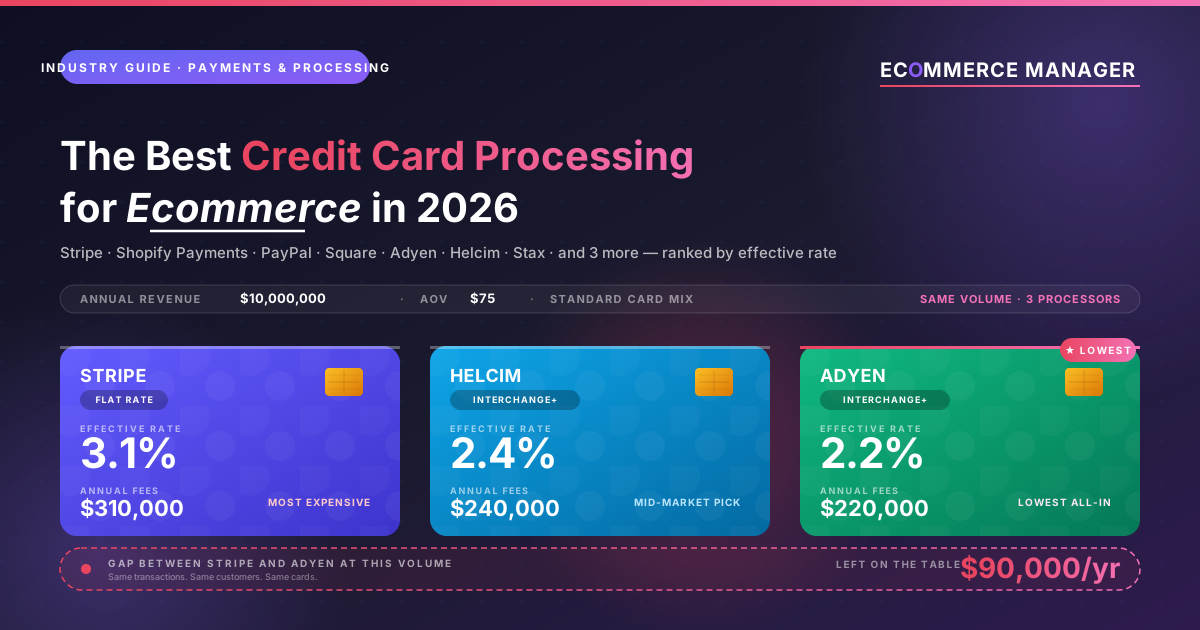
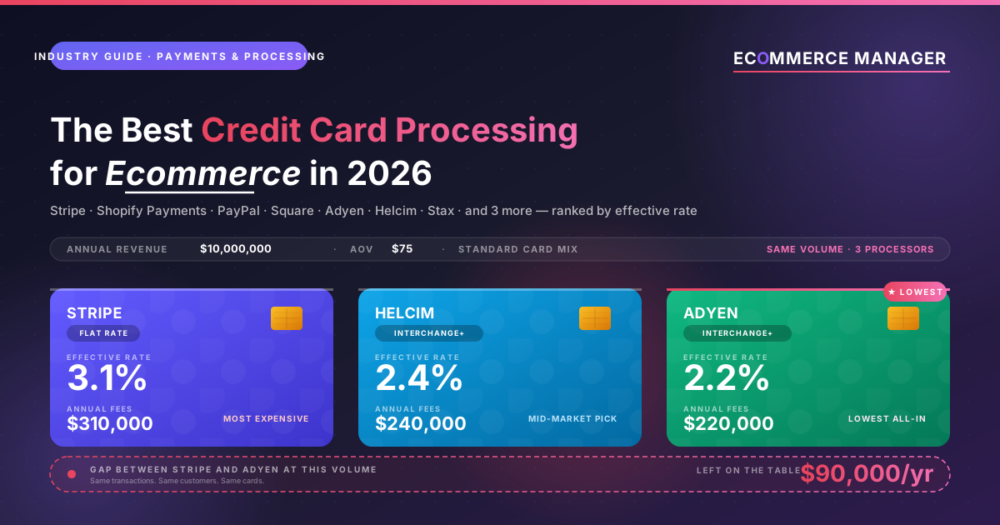
The honest limits start showing up around $5M in annual revenue. The 2.9% + $0.30 flat rate is competitive at small volumes and unfair at large ones. On $20M of revenue, you're paying Stripe about $600K/year. A comparable interchange-plus processor would charge you about $440K for the same volume. That's $160K/year sitting on the table. For some operators, Stripe's product experience is worth paying that premium. For others, it isn't. Make the call deliberately rather than by default.
A quieter issue worth mentioning: Stripe is known for freezing accounts, sometimes without warning, when risk signals trigger. Sudden volume spikes, high chargeback rates, entering a "restricted business" gray area. If your business is in any way unusual (nutraceuticals, CBD, high-ticket pre-orders, anything subscription-heavy), read Stripe's prohibited business list carefully and have a backup processor configured. Getting your account frozen during a big launch is the kind of thing that ends businesses.
2. Shopify Payments — The Obvious Choice If You're Already on Shopify
Shopify Payments
If you're on Shopify, Shopify Payments is almost always the right answer, for two reasons that aren't the rate. First, Shopify charges a 0.5% to 2% transaction fee on top of your card rate if you use a third-party processor. This penalty wipes out the savings from any processor you might switch to unless you're at enterprise scale. Second, Shop Pay and Shop Promise eligibility require Shopify Payments. Shop Pay converts 1.72x better than guest checkout according to Shopify's data, which is a real revenue lift that no alternative processor can match.
The rate itself is reasonable and gets better as you climb the Shopify tier ladder. Basic Shopify ($39/mo): 2.9% + $0.30. Shopify ($105/mo): 2.7% + $0.30. Advanced ($399/mo): 2.5% + $0.30. Shopify Plus (from $2,300/mo): 2.4% + $0.30 with negotiation room. At enterprise scale on Shopify Plus you can negotiate custom rates on Shopify Payments that match interchange-plus economics without leaving the platform.
The friction shows up in a specific scenario: you want to accept payments through a processor Shopify Payments doesn't support (rare), or you've been offered an interchange-plus deal so good that it beats Shopify Payments plus the third-party penalty (also rare, but it happens above $15M revenue). In both cases, run the math including the penalty before you switch. Ninety percent of the time it isn't worth it.
3. PayPal / Braintree — The Legacy Reach Play
PayPal / Braintree
PayPal is a complicated recommendation. The product itself isn't great. Developer experience is worse than Stripe. Checkout UX adds friction. The 2.59% + $0.49 standard rate is on the expensive side, and the $0.49 per-transaction fee hits you hard on low-AOV products. The company is famous for freezing merchant accounts on vague suspicion and taking months to resolve disputes. Operators have been complaining about these things for twenty years.
And yet. PayPal has 435 million active account holders, most of whom will convert at a higher rate when they see the PayPal button than when they have to type in card details. Offering PayPal as a checkout option (through PayPal Checkout or Braintree) typically lifts conversion rates by 2-5% for most DTC brands. That lift usually outweighs the higher fee, which is why almost nobody can actually quit PayPal even though almost everyone wants to.
The pragmatic play: offer PayPal as a checkout option alongside your primary processor (Stripe, Shopify Payments, whatever). Don't make it your only processor. Buyers who prefer PayPal will use it. Buyers who don't will use cards. You get the conversion lift without putting your whole business on PayPal's dispute policies. Braintree (owned by PayPal, sold as the developer-friendly alternative) is the way to accept both PayPal and cards through a single integration if you want that path.
4. Square — The Hybrid Retail+Online Processor
Square
Square is the right answer if your business runs on both physical retail and online, and you want unified reporting, inventory, and customer data across both channels. The rates are standard flat-rate (2.9% online, 2.6% in-person), the free Square Online store tier handles basic ecommerce needs, and the integration between online orders and the Square POS is actually unified rather than cobbled together.
For pure DTC brands with no physical retail, Square doesn't have a strong reason to exist over Stripe or Shopify Payments. The rates are the same. The developer experience is weaker. There's no meaningful advantage. Square's category win is exactly the hybrid use case: coffee shops with online ordering, boutiques with pop-ups and web stores, food trucks with Square Online. If that's you, Square is the honest right answer. If you're pure DTC, keep looking.
5. Adyen — The Enterprise Global Processor
Adyen
Adyen is the processor you graduate to when Stripe stops making financial sense. Interchange-plus pricing with a tiny $0.12 fixed markup means your effective rate drops to around 2.2% for typical ecommerce transactions, dramatically cheaper than Stripe's 3.1%. The platform handles 200+ local payment methods across 150+ currencies natively, which matters if any meaningful portion of your revenue comes from outside the US. The enterprise client list (Uber, Spotify, Netflix, Microsoft, eBay) tells you where this platform sits.
The honest tradeoffs: Adyen is enterprise-only in practice. The minimum volume commitment is typically $500K-$1M per month, and the sales cycle is long (3-6 months) and formal. The product is built for large operations, not for startups. Developer experience is competent but not Stripe-level. Dashboard is clean but functional rather than delightful. If you're doing $10M+ annually with meaningful international revenue, start the Adyen conversation. If you're under that, stay on Stripe or Shopify Payments until you grow into Adyen territory.
6. Helcim — The Honest Mid-Market Value Pick
Helcim
Helcim is the processor more mid-market DTC operators should know about. The pricing is interchange-plus 0.4% + $0.08 for online transactions with no monthly fee, no setup fee, and no cancellation fee. At $3M annual revenue, your effective rate lands around 2.4%, which is 0.7 percentage points cheaper than Stripe. On that revenue, that's $21K/year in savings for a product that works identically.
The volume discounts kick in automatically without negotiation, which is unusual and good. Hit $25K/month in volume and your markup drops. Hit $100K and it drops again. No sales rep required. No annual contract review. Just better rates as you grow. The platform integrates with Shopify, BigCommerce, WooCommerce, and most other major ecommerce systems through plugins and APIs.
The tradeoffs: Helcim is smaller than Stripe (about 25K merchants vs. millions), which means fewer third-party integrations, less familiar to your developers, and less brand recognition when you tell your CFO. The dashboard is adequate, not great. Support is responsive but not instant. Fraud tools are basic. For brands where processing cost matters more than product polish, Helcim delivers real savings. For brands where the product experience is worth paying for, Stripe still wins.
7. Authorize.net — The Legacy Gateway Still in Use Everywhere
Authorize.net
Authorize.net is one of the oldest payment gateways on the internet (launched 1996) and is now owned by Visa. If you're already on it, you probably know why: it's deeply integrated into your ecommerce platform, your accounting system, your subscription tool, and switching off is genuinely painful. If you're not on it, there's very little reason to start.
The pricing structure is confusing by modern standards. You pay a $25/month gateway fee plus either 2.9% + $0.30 (all-in with their payment processing) or interchange-plus if you connect your own merchant account. The all-in option is more expensive than Stripe for no meaningful benefit. The interchange-plus option is competitive but requires you to maintain a separate merchant account relationship, which adds operational complexity most DTC brands don't want. The one legitimate reason to use Authorize.net in 2026 is if you're already deeply integrated and the switching cost exceeds the savings. Otherwise, there are better options.
8. Stax — The Subscription-Based Processor
Stax (formerly Fattmerchant)
Stax charges you a flat monthly membership fee ($99-$199 depending on tier) plus just $0.08 markup on top of actual interchange costs. The economics work when your monthly processing volume is high enough that the membership fee divided by transaction count is less than the markup you'd pay on a flat-rate processor. For most brands that's around $50K/month in processing volume minimum, and the savings accelerate from there.
At $3M annual revenue ($250K/month processing), Stax's effective rate lands around 2.1%, compared to Stripe's 3.1%. That's $30K/year in savings. At $10M annual revenue, savings cross $100K annually. These are real numbers that justify the switching friction for brands at the right scale. The membership model also means the per-transaction cost drops as you grow, which is the opposite of how flat-rate processors behave.
The limits: Stax is explicitly wrong for small merchants. Below $50K/month in volume, you'll pay more on Stax than on Stripe because the membership fee doesn't amortize. The platform is also less polished than Stripe or Shopify Payments. Dashboards are functional. Developer tools are adequate. Support is good but not 24/7 instant. If you're at the right scale and willing to accept rougher product edges in exchange for meaningful savings, Stax is worth evaluating.
9. Payment Depot — The Even-Cheaper Subscription Alternative
Payment Depot
Payment Depot works almost identically to Stax but with slightly cheaper membership tiers and slightly higher per-transaction markup. The starter tier is $79/month with a $0.15 per-transaction markup. The growth tier at $199/month drops markup to $0.05 per transaction. For brands doing $50K-$300K in monthly processing volume, Payment Depot often wins the direct comparison with Stax on total cost.
Honest take: at this part of the market, Stax and Payment Depot are close enough that you should quote both and pick whichever lands cheaper for your specific volume and card mix. They offer similar product experiences, similar support quality, and similar platform integrations. The savings over flat-rate processors (Stripe, Shopify Payments) is where the real value lives, not in picking the "right" subscription processor between the two.
10. 2Checkout (Verifone) — The Cross-Border DTC Specialist
2Checkout (Verifone)
2Checkout (now part of Verifone) occupies a specific niche: cross-border payments where the processor handles tax compliance, currency conversion, and local payment methods as the merchant of record. For digital goods sellers, SaaS companies, and physical goods brands with meaningful international revenue, 2Checkout can dramatically reduce the operational burden of selling internationally. The merchant-of-record model means 2Checkout handles VAT, GST, and sales tax collection and remittance in 200+ countries, which is work you'd otherwise pay a specialized tax platform to do.
The honest math: 2Checkout's 3.5% + $0.35 is expensive on a per-transaction basis compared to domestic processors. The value proposition isn't the rate, it's the compliance offload. For brands where international revenue is more than 20% of total and expanding, the tax complexity that 2Checkout handles would cost you $30K-$100K annually to manage with alternative tooling. For brands with mostly US revenue, 2Checkout is overkill and the rate doesn't justify.
The Real Fee Math at Three Common DTC Revenue Levels
Here's what processing actually costs at three common DTC scales. The numbers below assume $75 average order value, standard card mix, 1% chargeback rate, and typical fraud exposure. Your real numbers will vary, but the gaps between processors are real.
The Hold and Reserve Trap That Kills Growing Brands
Here's the one nobody warns you about. When your volume spikes (viral product, big sale, holiday season, wholesale drop), some processors will put a "rolling reserve" on your account, holding back 5% to 30% of your transactions for 60-180 days to protect against future chargebacks. The money is still yours, technically. You just can't use it. For a brand doing $500K/month that suddenly hits $2M in a viral week, this can mean $400K+ frozen for six months. This is standard practice at Stripe, PayPal, and most flat-rate processors, usually without warning until it happens. Before you commit to any processor, ask explicitly what their hold policies are, what triggers them, and whether reserves are standard for your category. Get the answer in writing. Operators who've been burned by this once remember it forever, usually because it almost killed their business.
Red Flags Every Processor Buyer Should Watch For
- Long-term contracts with early termination fees. Legacy merchant service providers love three-year contracts with $300-$500 ETFs. Modern processors (Stripe, Shopify Payments, Helcim) have no contracts. Don't sign a multi-year deal unless you're getting enterprise rates that justify the lock-in.
- Vague "interchange-plus" quotes that bury the markup. Legit interchange-plus quotes state the markup clearly: "Interchange + 0.4% + $0.08." Shady ones say "we beat your current rates by 20%" without disclosing the actual markup. Always get the markup in writing.
- Unlimited rolling reserves on new accounts. Some processors reserve 5-10% of new merchant volume for 6-12 months. Fine if disclosed. Not fine if you discover it the first time a batch settles short. Ask about reserves before signing.
- Separate PCI compliance fees of $10-$30/month. Most modern processors include PCI compliance. Legacy processors often charge separately. $300/year on a sticker rate of 2.9% is hiding real margin.
- Cross-border fees not disclosed upfront. International card transactions add 1-1.5% in cross-border fees. Some processors show this clearly. Others bury it in statement footnotes. If you have international customers, this is real money.
- Chargeback fees over $25 per dispute. Standard chargeback fees are $15-$25. Processors charging $30-$75 per chargeback are extracting margin from your worst days. Push back hard on this.
- No API access on your tier. If you're paying for processing, you should have API access to your transaction data. Processors that lock API access behind higher tiers are preventing you from analyzing your own data.
How to Actually Choose Your Processor
1. What's your realistic monthly processing volume?
💳 Under $50K/month
Stripe or Shopify Payments — simplicity wins
💰 $50K-$500K/month
Helcim interchange-plus · Stax if $150K+/mo
📈 $500K-$2M/month
Adyen or negotiated Shopify Payments
🏢 $2M+/month
Adyen with heavy negotiation · Multi-processor
2. What's your platform?
Shopify: Shopify Payments is almost always the right default because of the 0.5-2% third-party penalty plus Shop Pay conversion lift. BigCommerce: Stripe or Adyen, since BigCommerce doesn't penalize third-party processors. WooCommerce: Stripe or Helcim depending on volume. Custom stack: Stripe for developer experience, Adyen for enterprise scale, Helcim for cost savings. Headless or multi-storefront: Adyen or Stripe with volume pricing.
3. What's your international exposure?
Mostly US revenue: domestic processor is fine. Stripe, Shopify Payments, Helcim all handle occasional international transactions reasonably. 20%+ international revenue: start looking at Adyen for local payment methods and currency handling. Primarily international or digital goods/SaaS: 2Checkout for the merchant-of-record tax compliance offload.
4. What's your tolerance for product tradeoffs?
Want the best product experience: Stripe. You'll pay more. Want the lowest cost: Helcim or Stax depending on volume. You'll accept rougher product edges. Want enterprise reliability and depth: Adyen. You'll negotiate for months. Want zero friction with Shopify: Shopify Payments. You'll accept standard rates. Match your tolerance to your actual priority, not to what sounds smart in a pitch deck.
The Honest Bottom Line
If I had to boil 21 minutes of this guide down to four recommendations, here they are. Under $5M revenue on Shopify: use Shopify Payments. The economics work, the integration benefits are real, and you have bigger problems to solve than processing fees. Under $5M revenue on anything else: use Stripe. The developer experience is worth the small premium, and switching costs matter more than rate optimization at that scale.
$5M to $20M revenue: pull three months of processor statements this week, calculate your real effective rate, and benchmark against Helcim's interchange-plus quote. If you're paying 0.4% more than Helcim would charge, that's real money and you should move. $20M+ revenue: Adyen or negotiated enterprise terms on Shopify Payments, with heavy attention to international mix and chargeback economics. At that scale, 0.2% of effective rate is hundreds of thousands annually.
Everywhere, always: ask about hold policies before signing. Assume your processor will freeze your money at the worst possible moment unless they've told you in writing what their triggers are. Configure a backup processor even if you never route traffic to it, so you have options if something goes wrong. The cost of a backup setup is near zero. The cost of discovering you need one during a viral launch is the business.
The one thing operators consistently get wrong in this category is treating payment processing as a solved problem after launch. It isn't. Rates change. Your volume changes. Vendors offer new tiers. Competing processors drop prices. A 20-minute quarterly check-in on your effective rate, with a fresh quote from one alternative processor, is one of the highest-ROI uses of your time as a DTC founder. The brand that reviewed this line item once in the last year is leaving between $10K and $200K on the table, depending on scale. Don't be that brand.
Running a Processor Evaluation?
The eCommerce Manager helps DTC operators pressure-test their effective rate against real quotes from competing processors. No affiliate fees, no vendor incentives, just honest rate benchmarking.
Get an Unbiased Rate Review →Author

Related Posts
The Best Ecommerce Credit Card Processing for 2026
