

Last Updated on September 29, 2026
The Best Ecommerce Software for Online Stores in 2026
If you're searching "ecommerce software" instead of "ecommerce platform," you're probably past Shopify Basic and thinking about what comes next. This guide is for that moment — mid-market operators, enterprise buyers, and technical teams evaluating what their next 3-year commitment should be.
The word "software" in a search query is quiet code for something specific — usually "I want to own more of my stack" or "I'm running an RFP and my legal team doesn't like the word 'platform.'" Either way, if you're reading this instead of a "best ecommerce platform" article, you're probably not a first-time seller. You're a mid-market operator who has outgrown their current tool, an enterprise buyer evaluating a replatform, or a technical leader trying to figure out whether to go headless. All three audiences get served by different software categories, and most guides just rank the same 10 SaaS platforms without acknowledging that. This one is scoped for the actual decision you're making: which underlying software architecture — SaaS, PaaS, headless, or open source — should power a serious online store for the next three years.
Ecommerce Software vs Platform vs Website Builder — Actually Different
Every vendor in this space uses "software," "platform," and "builder" interchangeably in their marketing because everyone wants to rank for every term. In practice, these words describe different products for different buyers:
- A website builder (Wix, Squarespace) is a drag-and-drop tool for non-technical merchants who want a store as an extension of a website. Priced under $50/month. Used by small business.
- An ecommerce platform (Shopify, BigCommerce) is a commerce-first SaaS product with a merchant-friendly admin. Priced $39-$400/month for mid-tier, $2K+ for enterprise SaaS. Used by DTC operators from $50K to $50M+ in annual revenue.
- Ecommerce software is the broader category — includes platforms plus PaaS, headless commerce, and open source stacks. Priced anywhere from free (self-hosted OSS with your own infrastructure cost) to $250K+/year. Used by operators making architectural decisions, not shopping-cart decisions.
This guide is about the third category. If you're a solo operator or under $500K/year in revenue, the small business builders guide or general commerce platform guide will serve you better. If you're evaluating a replatform decision, running an RFP, or trying to decide whether to go headless — read on.
The Four Deployment Models You're Actually Choosing Between
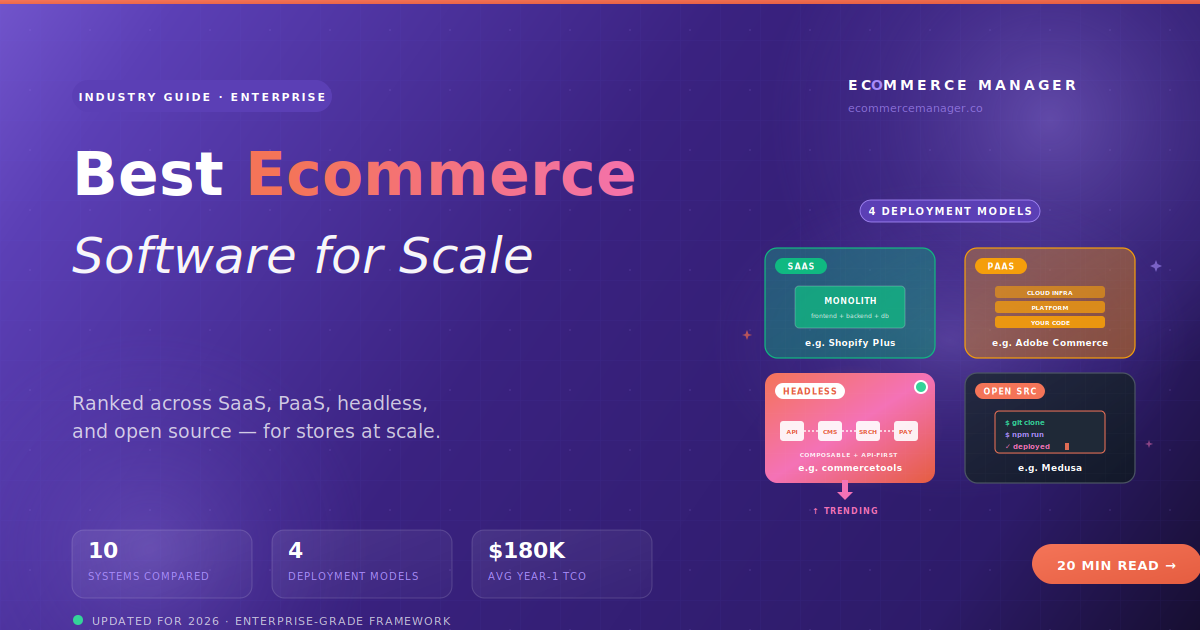
Every ecommerce software decision at scale comes down to which of these four architectures you're comfortable owning. Get this decision right and everything else follows. Get it wrong and you'll replatform again in 24 months.
SaaS (Software as a Service)
Vendor hosts everything. You pay a monthly subscription. Fastest to launch, cheapest to maintain, easiest to staff. Ceiling: less customization, transaction fees, vendor lock-in. Examples: Shopify Plus, BigCommerce Enterprise.
PaaS (Platform as a Service)
Vendor hosts the infrastructure, you own the codebase and customization. More flexibility than SaaS, more work than SaaS. Longer implementation, higher TCO. Examples: Adobe Commerce Cloud, Salesforce Commerce Cloud.
Headless / Composable
API-first commerce backend, you bring your own frontend and pick best-of-breed for search, CMS, checkout, etc. Maximum flexibility, maximum complexity. Requires engineering team. Examples: commercetools, Elastic Path, Fabric.
Open Source (Self-Hosted)
You own the code, host it yourself (or with a managed provider), and customize freely. Zero license cost, meaningful infrastructure + engineering cost. Full control. Examples: Medusa, Magento Open Source, Sylius.
The Four Criteria That Actually Decide the Winner
1. Total Cost of Ownership (not sticker price)
Shopify Plus starts at $2,300/month sticker — but a real Plus store spends $150K-$300K in year one including apps, agency implementation, custom development, and 0.15% platform fee on GMV. commercetools starts at $60K-$100K/year but requires an implementation team that costs another $200K-$500K in year one. Adobe Commerce Cloud is $22K-$125K in licensing plus another $150K-$400K in implementation. Every honest software decision here starts with a 3-year TCO model, not a subscription price.
2. Time to launch (or replatform)
Shopify Plus: 8-16 weeks for a new store, 4-6 months for a replatform. BigCommerce Enterprise: similar. Adobe Commerce: 6-12 months for greenfield, 9-18 months for replatform. Salesforce Commerce Cloud: 9-15 months. commercetools headless: 6-18 months depending on frontend maturity. Every "headless is faster" claim comes from vendors — real operators report headless takes at least as long as PaaS. Plan for the actual timeline, not the sales-pitch timeline.
3. Extensibility and API depth
SaaS has the most limits and the most polish. PaaS gives more control at the cost of maintenance. Headless has no limits but requires you to build everything not commerce-specific. Open source gives full control at full cost. Match architecture to how much your business genuinely needs to customize — not how much your engineers want to customize.
4. Ecosystem — agencies, apps, developers
Shopify Plus has thousands of trained agencies, 17,000+ apps, and easy hiring. Adobe Commerce has a mature but shrinking ecosystem. commercetools has fewer implementation partners but they're increasingly experienced. Medusa is early — talent pool is small. Ecosystem is the most underrated criterion in enterprise ecommerce decisions and the one that hurts most when you get it wrong three years later.
Complete Comparison: 10 Ecommerce Software Systems for Scale
Ranked by suitability for the mid-market to enterprise operator (roughly $5M-$500M annual revenue). "Starting Price" is the honest entry point most companies actually pay, not the marketing sticker. "Time to Launch" is realistic implementation time from signed contract to live production, per operator reports.
| Software | Model | Starting Price (real) | Time to Launch | Best For |
|---|---|---|---|---|
SP Shopify Plus |
SAAS | $2,300/mo + 0.15% GMV | 8-16 weeks | Mid-market DTC ($5M-$100M) |
AC Adobe Commerce |
PAAS | $22K-$125K/yr license | 6-12 months | Enterprise B2C + complex catalog |
BC BigCommerce Enterprise |
SAAS | $1,000-$15K/mo | 8-14 weeks | Mid-market B2B + B2C hybrid |
SC Salesforce Commerce Cloud |
PAAS | $150K+/yr (1% GMV) | 9-15 months | Enterprise B2C in Salesforce stack |
CT commercetools |
HEADLESS | $60K-$250K+/yr | 6-18 months | Composable enterprise |
SA SAP Commerce Cloud |
PAAS | $50K-$500K+/yr | 12-24 months | Enterprise B2B in SAP stack |
EP Elastic Path |
HEADLESS | $50K-$200K+/yr | 6-15 months | API-first B2B/B2C |
FB Fabric |
HEADLESS | $40K-$150K/yr | 4-10 months | Modular commerce stack |
MD Medusa |
OPEN SRC | Free (infra $2-15K/mo) | 4-10 months | Tech-forward operators |
SK Spryker |
HEADLESS | $75K-$300K/yr | 9-18 months | Enterprise B2B composable |
These are the real prices operators actually sign, not the marketing sticker. commercetools' website doesn't say "$60K-$250K+" — but that's what a typical mid-market to enterprise contract lands at once you factor in the module bundling their sales team walks you into. Same for Salesforce, SAP, and Adobe. If a vendor won't publish prices, that's a signal about how much your negotiation leverage matters — go into every RFP with a competing bid.
1. Shopify Plus — The Mid-Market SaaS Leader
Shopify Plus
Shopify Plus is the default mid-market answer because the trade it offers — meaningful customization within a SaaS ceiling, in exchange for the fastest implementation and cheapest maintenance in the category — is genuinely good for most $5M-$100M DTC brands. The Online Store 2.0 architecture (sections, blocks, JSON templates) closes most of the "we can't do that on Shopify" gaps from 2020. Shopify Functions and Hydrogen extend what's possible into headless without leaving the ecosystem. The 17,000+ app ecosystem is the largest in commerce. Hiring is easy — every ecommerce agency knows Liquid.
The trade-off: 0.15% of GMV goes to Shopify on Plus (0.2% on non-Shopify Payments), you're stuck with Shopify's checkout logic even with checkout extensions, and the moment you need genuinely custom backend logic (complex B2B, multi-warehouse orchestration, subscription complexity) you're wrestling the platform. For roughly 70% of mid-market DTC brands, that trade is exactly right. For the other 30%, look further down this list.
2. Adobe Commerce (Magento) — Enterprise Complexity, Owned
Adobe Commerce (Magento)
Adobe Commerce (the platform formerly known as Magento) remains the enterprise pick for merchants with genuinely complex catalog requirements — multi-store, multi-currency, multi-language operations with B2B quoting, tiered pricing, shared catalog structures, and requirements that would take 40+ apps to hack together on Shopify Plus. The Commerce Cloud (PaaS) tier bundles managed infrastructure, staging environments, and Adobe's ecosystem integration. It's the mature choice for large B2C brands doing $50M-$500M and B2B distributors of any size.
The honest caveats: the Magento Open Source ecosystem is shrinking as talent migrates to Shopify, Adobe has been slow to invest in Magento post-acquisition, and the developer experience is genuinely worse than modern alternatives. If you're evaluating Adobe Commerce for a new project in 2026, seriously compare against commercetools or Elastic Path before committing — the composable options often deliver better outcomes for similar money.
3. BigCommerce Enterprise — The Underrated Mid-Market SaaS
BigCommerce Enterprise
BigCommerce Enterprise is the SaaS that most mid-market operators dismiss for the wrong reasons — "isn't that the smaller Shopify?" No. BigCommerce has consistently offered deeper native B2B features than Shopify Plus, zero platform transaction fees (huge at scale), a more open API architecture that plays well with headless frontends (BigCommerce is often the SaaS backend of choice for Next.js Commerce and similar composable setups), and pricing that's often lower than Shopify Plus for equivalent GMV.
The trade-off is ecosystem: BigCommerce has ~1,300 apps to Shopify's 17,000+, agencies are less common, and Liquid developers outnumber BigCommerce developers by roughly 10x. If your business needs to lean hard on the app marketplace for niche functionality, Shopify wins. If your business does serious volume, has B2B requirements, or wants to run BigCommerce as a headless backend, BigCommerce Enterprise is genuinely competitive and often the better choice.
4. Salesforce Commerce Cloud — For Enterprises Already in Salesforce
Salesforce Commerce Cloud
Salesforce Commerce Cloud (formerly Demandware) is the enterprise B2C pick for organizations already running Salesforce Service Cloud, Marketing Cloud, and Data Cloud — the integration story across the Salesforce stack is genuinely valuable and hard to replicate elsewhere. Adidas, Puma, L'Oréal, and Ralph Lauren run on it. Native AI (Einstein), sophisticated merchandising tools, and enterprise-grade multi-brand support are all real strengths.
The honest reality: Salesforce Commerce Cloud is the most expensive option in this list once you count the 1% GMV fee (yes, one percent — read your contract), the license minimum ($150K+/year), and the required Salesforce implementation partner ($300K-$1M+ for enterprise builds). Total year-one investment often exceeds $750K. Worth it if you're running the full Salesforce stack. Overkill if you're not. Almost no one moves TO Salesforce Commerce Cloud without existing Salesforce commitments.
5. commercetools — The Headless Composable Leader
commercetools
commercetools built the category. Fully headless, API-first, MACH-compliant (Microservices, API-first, Cloud-native, Headless) commerce backend that gives enterprise teams total control over frontend, checkout, and integration decisions. Lego, Tiffany & Co., Audi, and Volkswagen run on it. If "composable commerce" made it into your board deck, this is likely the vendor already in the conversation.
The honest reality about composable commerce that vendors won't tell you: it's genuinely powerful and genuinely expensive to run well. commercetools itself is $60K-$250K+/year in licenses, but the "you bring your own everything else" architecture means you're separately paying for CMS (Contentful, Sanity), search (Algolia, Bloomreach), CDP (Segment), frontend framework, hosting, and an engineering team capable of stitching them together. Year one TCO often exceeds $500K. When it works, it works beautifully. When it doesn't — usually because the operator underestimated the operational overhead — replatforming is brutal.
6. SAP Commerce Cloud (Hybris) — Enterprise B2B in SAP Land
SAP Commerce Cloud
SAP Commerce Cloud (formerly Hybris) is the enterprise ecommerce answer for organizations where SAP is the ERP of record — usually large B2B manufacturers, distributors, and industrials where the ecommerce site needs to reflect real-time inventory, pricing, and customer contract data from SAP. The native integration with SAP S/4HANA is the primary reason to pick it. Without the SAP prerequisite, other options serve the same use cases faster and cheaper.
The trade-off: the longest implementation timelines in this list (12-24 months is normal), highest complexity, and pricing that's opaque even by enterprise standards. If you're not already in the SAP ecosystem, this is probably not your answer. If you are — it's often the shortest path to a working enterprise commerce operation with clean ERP integration.
7. Elastic Path — API-First Commerce for B2B and B2C
Elastic Path
Elastic Path sits between commercetools and traditional PaaS — headless and API-first like commercetools, but with more pre-built modules for common commerce patterns (subscriptions, B2B quoting, product bundles) that would require custom development on commercetools. Their Composable Studio provides a lower-code way to configure commerce logic without stitching microservices together from scratch. Notable customers include Pella, Intuit, and Serta Simmons.
The pragmatic sweet spot: mid-market to enterprise operators who want composable architecture but don't have the engineering team to build a commercetools implementation from primitives. Elastic Path costs meaningfully less than commercetools (usually 40-60% cheaper for equivalent scope) and gets you to production faster. For genuinely simple use cases, it may be more platform than needed. For complex B2B+B2C hybrid businesses, it's often the sweet spot.
8. Fabric — The Modular Commerce OS
Fabric
Fabric positions itself as the modular commerce OS — instead of buying a complete commerce backend, you buy the specific modules you need (product catalog, cart, checkout, orders, promotions) and integrate them via APIs. Faster to launch than commercetools, less expensive, and specifically designed for mid-market operators who want composable architecture without full enterprise complexity. GNC, Chico's, and Restoration Hardware use it in various capacities.
The trade-off: Fabric is newer than commercetools or Elastic Path, has a smaller ecosystem of implementation partners, and the composable-vs-monolith question is less clear-cut when you're buying modules from one vendor (there are fewer of the true composability benefits). But for mid-market operators who want headless flexibility without the enterprise headache — Fabric is a legitimate option worth evaluating alongside the more established composable vendors.
9. Medusa — Open Source Headless Commerce
Medusa
Medusa is the fastest-growing open-source commerce project on GitHub — a modern Node.js/TypeScript headless commerce engine that gives you full ownership of your stack without commercetools-level pricing. Modular architecture, first-class developer experience, and a growing community make it a legitimate choice for technical teams who want composable commerce without licensing costs. Genuinely credible open-source alternative to Shopify for the first time in over a decade.
The trade-off is what open-source always trades: you're responsible for hosting, security patches, upgrades, and integrations. The talent pool is smaller than Shopify or Magento but growing fast. For technical teams that value ownership and want to avoid vendor lock-in, Medusa is one of the most exciting projects in commerce. For merchants who need to hire an agency next week — the ecosystem isn't there yet compared to established options.
10. Spryker — Enterprise B2B/B2C Composable
Spryker
Spryker is the composable pick specifically for enterprises with sophisticated B2B requirements alongside B2C — manufacturers, distributors, and industrial companies who need complex quoting, contract-based pricing, multi-tier customer hierarchies, and marketplace capabilities in one system. European-founded and strong in the DACH region, growing US presence. ALDI, Toyota, and Hilti run on it.
The trade-off: like other composable options, Spryker requires meaningful engineering investment and a longer implementation timeline. But for genuinely complex B2B ecommerce operations that would strain Salesforce Commerce Cloud or Adobe Commerce, Spryker often delivers better outcomes at competitive cost. Not the right answer for pure B2C DTC brands — but a strong contender when B2B is central.
The RFP Trap Every Enterprise Ecommerce Buyer Falls Into
Every enterprise ecommerce vendor sends the same demo — a beautiful storefront running their platform, a merchandiser demonstrating a promotion in real-time, and a 40-slide deck about their architecture. Every vendor also employs a "solution engineer" whose entire job is knowing exactly which of their platform's limitations to hide during the demo. The trap: buyers evaluate on demo polish and rep responsiveness, then discover the real limitations 6 months into implementation. Fix: require every vendor to demonstrate the 3 hardest workflows in your actual business against a test dataset you provide. If they can't or won't, that's your answer.
The Replatforming Trap Nobody Warns You About
Replatforming is where enterprise ecommerce careers go to die. The trap has three parts, and it catches sophisticated operators regularly.
Part one: the timeline lie. Every vendor RFP response includes a 6-month implementation estimate. Real average is 12-18 months for a mid-market replatform, 18-30 months for enterprise. This isn't the vendor lying — it's that vendors quote the technical work, not the business change. Data migration, SEO preservation, historical order reconciliation, third-party integration rewrites, and merchant/team retraining eat 40-60% of every real replatform timeline. Plan for the real number.
Part two: the SEO cliff. Every replatform loses 15-40% of organic traffic in the first 90 days regardless of how carefully you do redirects, URL structure preservation, and technical SEO. This is normal — Google needs time to re-crawl and re-rank a rebuilt site. The stores that recover in 6 months planned for this; the ones still down 12 months later assumed they were the exception.
Part three: the year-two cost surprise. Every enterprise ecommerce vendor bundles the first-year price aggressively to win the RFP. Year two renewals frequently include 15-30% price increases, GMV-based fees kicking in at higher tiers, and "necessary" add-on modules that weren't in the initial contract. Negotiate multi-year pricing with capped escalators in the initial contract or you'll pay for it in year two.
- The vendor won't publish any pricing. Every serious enterprise vendor has custom pricing — but reasonable vendors will give you a realistic range on a discovery call. If they refuse until you're 3 meetings deep, they're profiling you for a price ceiling. Get competing bids in parallel.
- The demo runs on a beautifully polished reference site. Ask which real customer runs the setup being demoed and whether you can talk to them. Vendors that can't or won't connect you with reference customers are hiding something.
- Implementation partners are only the vendor's own team. Healthy ecosystems have independent agencies. Vendors that only sell through their own services arm have less accountability and higher rates.
- "Headless" claims without frontend framework specifics. Every legitimate headless vendor will tell you which frontend frameworks they officially support and which reference implementations exist. Vendors that hand-wave "you can use anything" are usually not truly frontend-agnostic in practice.
- Multi-year contracts required for reasonable pricing. Standard enterprise practice, but negotiate the escalators. Multi-year commitments with 15-30% annual increases baked in end up more expensive than shorter contracts with a genuine competitive bid at renewal.
How to Actually Choose Your Ecommerce Software
Skip the analyst reports and RFP templates. Answer these four questions honestly:
1. Where does your engineering team actually want to spend time?
🚀 Building differentiated commerce features
commercetools · Elastic Path · Medusa
🎯 Extending a proven commerce stack
Shopify Plus · BigCommerce Enterprise
🏗️ Enterprise integration and ERP glue
Adobe Commerce · SAP Commerce · Spryker
☁️ Salesforce ecosystem alignment
Salesforce Commerce Cloud
2. What's your honest 3-year GMV projection?
Under $10M/year: Shopify Plus is almost certainly correct. Don't overthink it. $10M-$50M: real evaluation between Shopify Plus, BigCommerce Enterprise, and Adobe Commerce depending on B2B needs. $50M-$500M: composable options (commercetools, Elastic Path, Fabric) enter serious consideration alongside Shopify Plus and Adobe. $500M+: enterprise composable and Salesforce Commerce Cloud become the honest set.
3. What are the 3 workflows that are genuinely hard in your business?
Every ecommerce operation has 2-3 workflows that are business-differentiating and painful. Complex configurable products. Multi-warehouse allocation. B2B quoting with custom pricing. Subscription with hardware+consumable bundles. Whatever they are — these are the workflows to demo against, not the vendor's beautiful reference site.
4. Are you actually ready for the operational change?
The technical implementation is 40% of a replatform. The other 60% is training merchants, retraining agencies, migrating data, rewriting integrations, and re-earning SEO. If your team can't commit to that operational change — you're not ready to replatform, regardless of which software you pick.
The Honest Bottom Line
For most mid-market DTC brands ($5M-$100M/year), Shopify Plus is the pragmatic pick — fastest to launch, cheapest to maintain, easiest to staff, and increasingly capable. BigCommerce Enterprise wins for B2B-heavy operators and headless SaaS backends. Adobe Commerce remains the answer for complex catalogs where its ownership model matters, though composable is eating its territory. Salesforce Commerce Cloud for organizations already committed to Salesforce. commercetools for enterprises with the engineering muscle to run composable well. Elastic Path and Fabric for pragmatic composable at mid-market scale. SAP Commerce Cloud and Spryker for enterprise B2B with heavy ERP integration. Medusa for tech-forward teams who want ownership.
The wrong move is picking software based on analyst reports, RFP responses, or vendor demos. The right move is honestly assessing your engineering capacity, your genuine business requirements, and your operational readiness — then choosing accordingly. Do that, and you'll pick the tool your business can actually run for the next three years. Skip it, and you'll be back reading a replatforming guide in 24 months.
Running a Replatform Decision?
The eCommerce Manager helps mid-market and enterprise operators pressure-test their software shortlist against real business requirements — no vendor incentives, no affiliate ordering.
Get an Unbiased Software Evaluation →