

Last Updated on September 29, 2026
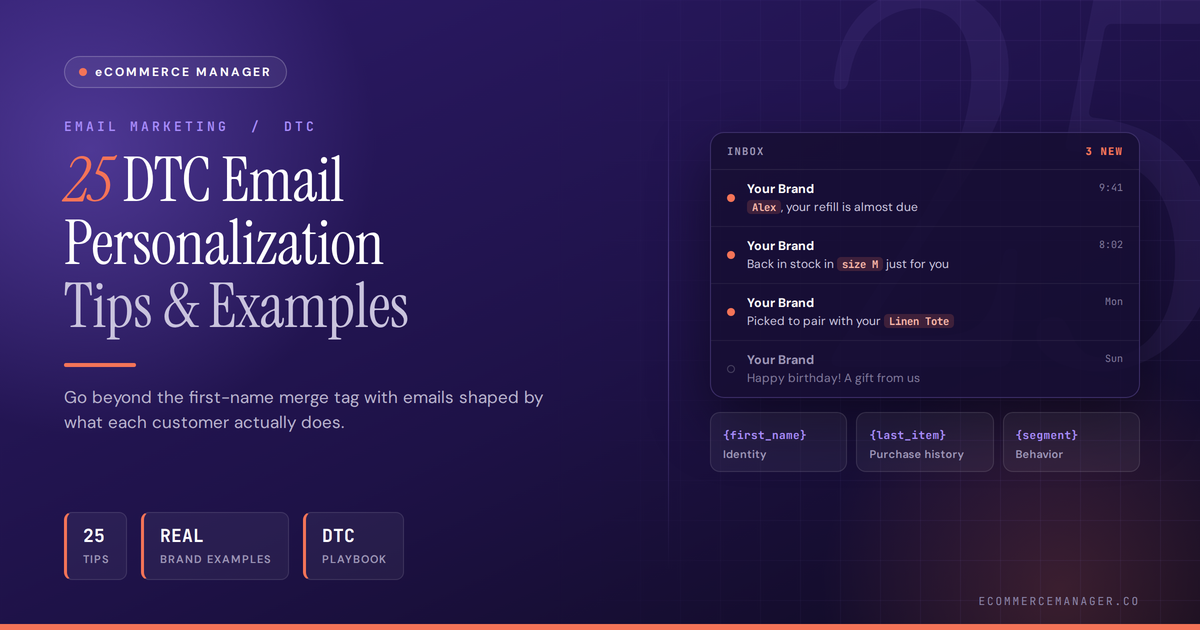
25 DTC Email Personalization Tips & Examples
Email personalization can make or break customer engagement for direct-to-consumer brands. This guide compiles 25 proven strategies and real-world examples, drawing on insights from industry experts who’ve helped brands increase open rates, conversions, and long-term loyalty. From behavioral triggers to predictive messaging, these tactics show how to turn generic campaigns into relevant conversations that drive results.
- Answer Each Customer’s Next Question
- Time Offers to Supply Lifecycles
- Track Product Usage Cycles
- Build Confidence After Browses
- Extend Ad Experiences Through Email
- Use One Relevant Signal
- Tell Stories Around Jewelry Journeys
- Pair Intent Triggers With Brand Design
- Tailor Hair Advice to Water Conditions
- Ask Customers About Their Moods
- Align Education With Usage Milestones
- Invite Guests Back With Rituals
- Tailor Tips to Local Systems
- Solve Each Cleaning Need
- Anticipate Needs With Predictive Utility
- Send Timely Reorder Reminders
- Reflect Scent Preferences in Every Send
- Guide Customers Through Service Needs
- Let Customers Define Their Needs
- Trigger Messages From Customer Behavior
- Target Style Fans With Restocks
- Collect Data for Tailored Solutions
- Match Travel Interests With Advice
- Educate Homeowners After Estimates
- Address Specific Home Comfort Issues
Answer Each Customer’s Next Question
I use personalization in DTC email by tying each message to a specific behavior or stage in the customer journey rather than just inserting a name. Segments are built around actions—first purchase category, browsing without buying, repeat purchase cadence, or product usage signals—and each email answers the question that behavior implies.
One example that resonated was a post-purchase “how to get the most from the product” email that included tips, complementary items, and a short how-to video matched to the exact variant purchased. The data supports this approach: personalized emails achieve 29% higher open rates and 41% higher click-through rates than non-personalized versions, and segmented campaigns can generate up to 760% more revenue than broadcast sends.
“Personalization works when it answers the customer’s next question, not when it repeats their name.”
The trade-off is that this requires clean event data and disciplined segmentation, but it lifts revenue per send and reduces list fatigue compared to generic blasts.

Time Offers to Supply Lifecycles
For our DTC clients at Enso Brands, the personalization that actually moves revenue isn’t first-name tokens, it’s segmenting by purchase behavior and lifecycle stage, then changing the offer itself, not just the greeting. One example: for a client selling a consumable home goods product, we split the post-purchase flow by how fast that specific product typically gets used up (based on order history data), so a customer who bought a 30-day supply got a replenishment email at day 25 with a subscribe-and-save offer, while someone who bought a 90-day supply didn’t hear from us again for weeks. Open rates on the timed replenishment email were nearly double the generic 30-day post-purchase email it replaced, and it became one of our highest-converting flows, because the timing itself was the personalization, not just the copy.

Track Product Usage Cycles
Our personalisation centres around purchase timing, not past purchases themselves. For our vitamin C serum, we noticed most customers finished the bottle around day twenty-eight, so we stopped guessing and started tracking that exact cycle per product instead of sending one generic monthly newsletter. The email that stood out most went out on day twenty-five, subject line “running low on your serum?” with a direct reorder button, no discount, no urgency language, just a quiet, useful nudge at the right moment. That single email outperformed every discount campaign we ran that quarter. It got a forty per cent open rate, compared to our usual twenty-two, and conversion nearly tripled our average. Customers weren’t being sold to; they were being reminded of something they were already about to buy anyway. It taught me personalisation isn’t about knowing someone’s name; it’s about knowing their exact rhythm with one specific product, then showing up right on schedule.
The Complete 2025 E-commerce Manager Career Guide: From Entry-Level to Executive

Build Confidence After Browses
One of our strongest emails came from abandoned browse behavior, but we avoided the usual reminder format. We reframed the message around decision confidence instead of telling people they left something behind. We recognized that shoppers often compare options before deciding. We used browsing patterns, time on site, and repeat visits to shape the message naturally.
We chose an inspirational or practical tone based on that behavior. The email worked because we respected hesitation instead of creating pressure too early. People responded because the content felt useful and relevant to their journey. We matched the message to the customer’s mindset, which helped them decide with more confidence at the right moment naturally.

Extend Ad Experiences Through Email
I’m the managing director at Blue Ridge Media Company, where we run branding, paid ads, and full email campaigns for businesses nationwide.
We build personalization into DTC emails by pulling directly from a client’s style guide and brand messaging to match the exact tone and visuals used in their ads.
One example that worked well was an email sent to users who clicked a Facebook ad for a product bundle. It opened with their specific color scheme and a headline that referenced the ad’s exact offer, then suggested the next item based on their site’s browsing path.
This kept the message consistent with the creative we already delivered for them and felt like a direct follow-up instead of a new pitch.

Use One Relevant Signal
30%+ open rates usually come from relevance, not clever copy. Personalisation in DTC email works best when it uses behaviour, timing, and product context, not just a first name in the subject line. The most useful inputs are browse history, past purchases, average order gap, and product affinity by category or use case.
A personalised email that tends to resonate is a replenishment reminder based on expected usage, sent only to people who bought a consumable product and haven’t reordered within the normal window. The email works because it references the product they bought, the time since purchase, and a practical prompt such as how many uses the product usually lasts, then links straight back to that item. I’ve found that kind of message gets more engagement than broad promotional sends because it matches a real need and arrives at a better time.
The part many brands miss is restraint. Personalisation works best when the email reflects one strong signal instead of stacking five weak ones, because over-targeting can feel invasive and under-targeting just feels generic.

Tell Stories Around Jewelry Journeys
With 33+ years in marketing across luxury jewelry brands, I’ve learned that personalization only works when it’s tied to a real moment in the customer’s journey—not just their name in a subject line.
One campaign I’m proud of at John Atencio was built around our Refer a Friend program. Instead of a generic blast, we triggered emails to customers shortly after their purchase, referencing the specific piece they bought and framing the referral as a way to share something they clearly loved. That context made the ask feel natural rather than transactional.
Another angle we lean into hard is wishlist behavior. When someone hearts a piece but doesn’t buy, we follow up acknowledging exactly what they saved—whether it’s an engagement ring from the Ring Builder or a pearl piece from a specific collection. That specificity signals we’re paying attention, which matters enormously in fine jewelry, where the purchase is deeply personal.
The biggest mistake I see in DTC email is treating personalization as a data exercise instead of a storytelling one. The goal isn’t to prove you know what someone clicked—it’s to make them feel understood at the right moment.

Pair Intent Triggers With Brand Design
Personalization in DTC email cannot just mean slapping a first name at the top of a generic broadcast. That approach is why most of the email I have seen is slop. Real personalization is behavioral. It requires triggering campaigns based on exact user actions and matching the brand voice to that specific moment of intent.
When curating a collection of the 47 best email designs of 2026, the standout examples relied heavily on behavioral context. For example, many users have adopted the Liquid Death cart abandonment structure for their own email flows. It resonates because it takes a high-intent trigger like an abandoned cart and wraps it in a highly specific, unapologetic brand experience rather than a robotic reminder. It proves that email does not have to be boring. In fact, it should be the opposite.
When you align behavioral triggers with strong design, the data follows. In one personalized flow we analyzed, 22,909 customers entered the sequence. It drove a 38 percent open rate and an 11.2 percent click rate, bringing 984 users right back into the buying journey. Email is not dead yet, but capturing that kind of engagement requires replacing outdated marketing dogma with concrete data and context-driven design.

Tailor Hair Advice to Water Conditions
We stock 4 brands, so an email from us cannot survive as a brand newsletter. The personalisation that works here is about the customer’s hair and her water, and both come from things she has already told us.
The example I would give goes out about a fortnight after a first order, and it opens by naming what her hair does on day three after washing. That comes from the photo tool and from whatever she wrote in her first support message, and it is specific enough that people reply to it as though a person had written it, which somebody on my team then has to answer. It works because by that point the doubt has moved off the product and onto whether she is using it correctly, and a general tips email cannot go near that.
The other split that earns its keep is water hardness by postcode. A customer in a hard water area needs different advice about build up from somebody in Glasgow, and the same cream will behave differently on the two of them. Sending both the same email means being wrong for one. When I have tried to personalise on things a customer never told us, browsing history, guessed interests, the replies dried up and the emails read like a shop watching somebody through a window.

Ask Customers About Their Moods
We keep personalization simple: ask one question, then actually use the answer.
The example I’d point to is a one-tap poll inside our emails. It asks something like “What mood are you going for?” — calm, focused, cozy, celebratory — and that single click does two things: it saves the answer to the customer’s profile, and it lands them on a page already tailored to what they picked. Someone who taps “calm” sees our evening wind-down scent first, not a generic product grid.
I like this approach because there’s no guessing. The customer tells you what they want in one tap, and every email after that can speak to it. We sell candles designed for different moods and times of day, so knowing whether someone is a morning-reset person or an evening wind-down person changes what we lead with.
The bigger lesson: personalization doesn’t have to mean complex segmentation from day one. One honest question with a payoff the customer sees immediately — the page they land on matches what they just said — beats quietly guessing from browsing data.
—Ben LoBue, founder of Sero Candles

Align Education With Usage Milestones
The customer has to be able to buy without having to tell the company her problem. In other words, nobody will type “I have BV” into a search field. Therefore, on the Happy V DTC side, I use behavior as my segmentation variable—what learning center article did someone read prior to purchasing? Which was the first product purchased? Where does she fall within the replenishment cycle for an 8–12 week product?
Example: Email sent to customers of Happy V who had purchased a vaginal probiotic on day 45 after buying the product. They had also read the Happy V BV education content. The subject of this email was “Week 6 is typically where most women experience a noticeable difference.” There were no claims or statements, just a reminder of how the bacteria functions from week 4 to week 8. A gentle reminder to continue using the product until the full effects can be felt. This resulted in an open rate nearly twice that of our overall list and a significant increase in second-order rates.
What caused it to be successful beyond standard personalization: The event that triggered the email was based on behavior (read content and purchase date). Behavior-based triggers keep companies within the FDA/FTC claim-function limits by educating subscribers regarding products they currently are utilizing, rather than attempting to diagnose subscribers. Each educational email goes through the same regulatory review process as each and every one of our label claims. The timing of the email matches the biological time frame. Most probiotics are stopped at the four-week mark due to a customer expecting faster results. Providing subscribers with context versus providing promotional offers during the sixth week of use can compound the customer’s ability to retain use of a product.

Invite Guests Back With Rituals
In experiential retail, personalization isn’t about product recommendations. It is all about timing and how that relates to memory loss. We know our highest-converting e-mail is not the welcoming sequence. The highest-converting e-mail we send is triggered about 30 days after a visit, based on the number of people visiting together (solo, as a couple, etc.). This e-mail references the specific ritual(s) that were booked during their initial visit. Suggesting the “next steps” for their subsequent visits are an example of how this could be implemented (a couple that completed a beer bath would receive a follow-up email suggesting they try the Sauna and Cold Plunge Add-On Package for their Round Two).
Early on, we realized that getting someone to come back twice and then again will make them an advocate for your business. If you can get someone to come in three times, you’ve created a lifelong supporter. Therefore, the most important email that we send is not the welcome email but rather the well-timed comeback while the memory is still warm. Guests who repeat their visits have a lower acquisition cost and a higher retail attachment ratio, which is when your unit economics really begin working in your favor within this category.

Tailor Tips to Local Systems
Running home services across Santa Barbara and SLO Counties, I see the same homeowner over multiple touchpoints—tune-up, smart home install, follow-up check-in. That history is gold for personalization.
The email that resonated most with our audience wasn’t triggered by a calendar date—it was triggered by what we actually installed. After a Google Nest thermostat installation, we sent a follow-up specifically referencing their system and the local temperature swings in the Santa Ynez Valley. Instead of a generic “how’s your new device?” it said something like: “Your area sees some of the biggest morning-to-afternoon temperature shifts on the Central Coast—here’s how to set your Nest schedule around that.”
The open and reply rates on that sequence were noticeably stronger than anything generic we’d sent before. Homeowners replied with actual questions, which turned into booked service calls.
The takeaway: personalize around what you already know about their home and their local environment, not just their first name. In home services, you have context most DTC brands would kill for—use it.

Solve Each Cleaning Need
I own Love My Maids in West DFW and also founded Cleaning Business Growth, so I see both sides: the actual homeowner pain points and the marketing that gets them to act.
For cleaning, personalization works best when it’s based on “why they need help,” not just their name. I segment emails by recurring service, deep cleaning, move-in/move-out, office cleaning, and local issues like DFW dust buildup.
One email that resonated was sent to deep-cleaning leads who mentioned dust, baseboards, blinds, or vents: “It sounds like your home needs a reset, not just a quick tidy.” The email explained that North Texas dust comes back fast, so a deep clean can create a better baseline before moving into weekly, biweekly, or monthly service.
My practical rule: personalize the next step. A move-out client needs reassurance about details and securing the home; a recurring client wants consistency, reminders, and knowing their cleaner understands their preferences.

Anticipate Needs With Predictive Utility
Effective DTC personalization functions as predictive utility, treating the inbox as a service layer rather than a megaphone for promotions. The highest retention rates come from layering zero-party data—explicit preferences shared by the customer—with behavioral triggers that track consumption patterns in real time. One example that consistently resonates is the smart replenishment trigger sent three to five days before a customer is predicted to run out of a consumable product. In a campaign for a wellness brand, we sent a message acknowledging the customer’s specific 30-day usage cycle and included a quick tip on maintaining the product’s shelf life. By providing value at the exact moment of a potential shortage, the email serves as a logistical reminder rather than a generic discount blast. We also deploy milestone reflection emails after a customer’s fourth or fifth purchase to acknowledge their long-term commitment. These messages summarize their brand history and suggest complementary products based on the habits of other high-loyalty customers in their segment. When a brand correctly predicts a need or validates a history of loyalty, it transitions from a vendor to a trusted part of the customer’s routine.

Send Timely Reorder Reminders
I treat personalization as remembering context, not inserting someone’s name.
For example, if a customer bought a 30-day supply of dog supplements, I’d email them around day 24 with: “Looks like Bella’s joint chews may be running low soon.” The email would link straight to the exact product and quantity they bought last time, which makes the message feel useful instead of promotional.
Here’s an example of the email that I sent:
“Hi Lisa,
Quick heads-up: based on your last order, Bella may be getting close to the end of her 30-day supply of joint chews.
You last ordered the 60-count pack, so this felt like a good time to check in before you run out.
If Bella is still using the same routine, you can reorder the exact product and quantity here:
[Product Reorder Link]
No need to search for it again. We’ve already pulled up the same option you bought last time.
If you still have plenty left, ignore this email. We’ll catch you later.
— The PETBIZS Team”

Reflect Scent Preferences in Every Send
Most of my volume moves through retail shelves at Walmart, Home Depot, Ace Hardware, and Amazon, which means I never see the shopper data behind those transactions. Everything I know about a customer comes from my own site and my own list, so personalization gets built on a narrow set of signals.
The one I lean on hardest is scent. If someone buys or repeatedly browses within a single scent family, the follow-up email shows that scent’s product image and that scent’s language, with no four-column grid of the full catalog. The behavioral trigger decides the timing, and the dynamic image block decides what the person sees when the email opens.
Underneath that sits a persona I keep written out in plain words. My buyer is a guy who wants his everyday products to work better, look better, smell better, and be a lot less boring. That sentence governs the subject line and the body copy, so the trigger picks the product and the persona picks the voice.
I keep the sender as a real person’s name with a reply address a human reads. Anything in a send that I can’t tie back to something a customer did or clearly prefers gets cut before it goes out.

Guide Customers Through Service Needs
I personalise around the customer’s situation, not just their name. In our storage and removals business, someone preparing for a move needs different support from someone storing items during a renovation. A personalised email that works well is a practical “what to prepare next” message based on the service they asked about. It feels helpful because it removes uncertainty at the right moment. That kind of personalisation is much stronger than adding superficial details that do not actually help the customer.

Let Customers Define Their Needs
We personalise on one thing a customer tells us themselves. After checkout, there is a single optional question: “Where do you charge most?” with four answers: home driveway, on the street, at work, public chargers. Nothing is scraped or guessed. About half of buyers answer it, and that one field decides which version of an email someone gets for as long as they stay on the list.
The send that landed best was an October email about running costs. Customers who charge at home got a version built on our own charging cost research, where home charging worked out at 2.5p a mile against a far higher figure on public networks, with a short note about keeping the cable off a cold, wet floor over winter. Customers who told us they park on the street got a completely different email, because a cost comparison is useless to someone with no driveway. Theirs was about carrying and storing a cable in a boot without it turning into a muddy tangle, and which length copes with a lamp post charger two cars away.
Replies were the surprise. People wrote back describing their setup, their parking arrangement, the neighbour with the extension lead, and our shift staff answered them one by one. Those conversations sold more accessories than any promotional email we have run, and they also fed the product notes we now use when someone asks which cable suits their situation. Both versions go out again every October, rewritten from what people told us the year before.

Trigger Messages From Customer Behavior
We killed our generic welcome series at my e-commerce brand and replaced it with triggered emails based on browsing behavior. Revenue from email jumped 41% in six weeks.
Here’s what actually worked. When someone abandoned their cart, we didn’t just send “you forgot something” with a discount code. We tracked which product page they spent the most time on and sent an email from “me” with a specific reason why I personally used that product. For our top-selling storage bins, the email opened with “I bought 47 of these for my warehouse before we even sold them to customers.” Then we’d explain the one feature that wasn’t obvious from photos. Real stories, not marketing copy.
The personalization that surprised me most was post-purchase timing. Instead of hammering people with “how was your order” the day after delivery, we waited until they’d actually had time to use the product. For items with a learning curve, we sent setup tips on day three and a troubleshooting guide on day seven. Open rates were double our regular campaigns because the timing matched when people actually needed help.
Running a fulfillment company taught me something counterintuitive about email personalization. Brands obsess over first names and purchase history, but they ignore the most valuable data point: delivery status. We had clients sending promotional emails to customers whose orders were stuck in transit. Disaster. The brands who synced their email platform with real-time shipping data and paused promotions until delivery confirmation saw way better engagement and fewer support tickets.
The mistake I see constantly is over-personalizing. Brands use every data point they have, and the emails feel creepy. One client mentioned a customer’s browsing session from three weeks ago in their subject line. Unsubscribe city. The best personalization feels invisible. It’s just the right message at the right time, and the customer thinks you read their mind instead of their cookies.

Target Style Fans With Restocks
We personalize DTC email by combining customer behavior, product preferences and aesthetic segments to keep messages relevant to techwear and alternative-fashion fans. We tag customers by style interest (techwear, cyberpunk, Y2K, gothic), recently browsed items and past purchases, then send targeted content and product recommendations that match those tags.
One effective email highlighted a restock of a sought-after techwear jacket to subscribers who previously viewed similar coats and had the techwear tag; the message focused on utility features, styling ideas and a limited restock note, which generated clear engagement from that niche audience.

Collect Data for Tailored Solutions
The strongest DTC email personalization I have seen sits upstream of the email tool, in the data a brand collects before a single send goes out. For a home water filtration client I designed the mechanic around a roughly $20 test kit with strips for metals: the customer photographs the strip, and the follow up then recommends a filter set assembled for the contaminants in that specific house, the same logic the Swiss vitamin brands use with a blood panel. The cheaper version of the same move is content matched to the published water quality report for the subscriber’s own state, and the response comes from the reader thinking the message was written about their house, not from a first name in the subject line. What carried it was the ask as much as the data, because the click went to a free consultation with a specialist instead of a buy button, and someone who has just learned there is copper in their water wants a diagnosis before a checkout. The counterintuitive part is that personalization worth its send is an acquisition mechanic rather than a copywriting one, and once a brand holds that one piece of data, everything a customer could buy elsewhere is by definition assembled for nobody in particular.

Match Travel Interests With Advice
Personalization Can Be Simple
When you’re thinking about how to personalize your email marketing campaigns, I’m Silvia Lupone, owner of Stingray Villa in Cozumel. There are many ways to personalize your campaign without making things too complex.
Since I use MailerLite, I can send targeted emails to individuals who have expressed an interest in learning more about Stingray Villa and Cozumel.
Instead of sending all my subscribers the same sales copy, I try to consider why each subscriber has expressed interest in visiting Stingray Villa. For instance, if one of my subscribers is looking for a scuba diving vacation, I can create an email about scuba diving. However, this email will be directed specifically toward a couple planning a dive vacation. On the other hand, an email focusing on a relaxing getaway would likely appeal to couples seeking relaxation. In addition to practical scuba-diving information (such as where to rinse and dry your gear), I can also describe what it’s like to go for a walk downtown after spending the day in the water.
An email that focuses on the specifics of a particular type of vacation will typically feel more like advice from someone who lives in that location than advertising. That’s exactly what I intend for these emails.
Travelers over the age of forty-five tend to research a destination before booking. Travelers today have access to so much more information than travelers did back in the day. When researching destinations for trips, travelers used to call travel agents or flip through travel guides. Today, travelers have unlimited information available. So truly valuable information stands out.
In short, the rule I follow is to personalize based on why the traveler chose to visit your property, not simply by using their first name.
Using a subscriber’s first name in the subject line is certainly acceptable.

Educate Homeowners After Estimates
At AirWorks, I think of personalization as education based on the actual system in the home, not “Hi {FirstName}.” As CEO of a family-run HVAC/plumbing company, I see daily how much trust is built when an email reflects what the homeowner is really dealing with.
We segment by service history: AC replacement consult, furnace repair, water softener interest, maintenance visit, etc. Then we tailor the email around the next best homeowner decision: safety, efficiency, repair vs. replacement, or protecting the investment.
One email that resonated was after an AC replacement estimate. Instead of “Ready to buy?”, we sent a personalized recap explaining why the load calculation mattered, what SEER/features meant, and what commissioning/testing we’d do before calling the job done.
The value was that it lowered pressure and increased clarity. In home services, the best personalization makes the customer feel less sold to and more equipped to make a good decision.

Address Specific Home Comfort Issues
I run New Comfort Heating and Cooling in Justice, IL, and before that spent almost a decade in HVAC operations. For DTC email, I personalize around what the tech actually saw: system age, repair history, comfort complaint, thermostat setup, and budget concerns.
One email that resonated was for homeowners who complained about “cold downstairs, hot upstairs.” Instead of a generic tune-up promo, the email said: “Your airflow issue may not be a bigger AC problem—it may be a zoning/control problem,” then explained motorized dampers, smart controls, and that zoning can lower energy bills by up to 30%.
Another useful trigger is weather plus service history. If someone had a furnace issue last winter, they don’t get a broad fall campaign; they get a short note before the first cold stretch about filter checks, blocked vents, and when strange noises mean it’s time to call a tech.
My rule is: personalize to the next decision the customer is actually facing. If the email doesn’t help them diagnose, prevent, or choose smarter, it’s probably just noise.

Related Articles
- Nurturing DTC Customer Relationships: 16 Email Marketing Strategies
- DTC Marketing: Campaigns That Resonate With Your Audience
- November, 2024 – 4 Effective eCommerce Email Marketing Software Tools Recommended by Experts