

Last Updated on August 19, 2026
Magento to Shopify Migration in 2026: The Operator's Guide
Real costs by Magento edition, the EAV mapping decisions that set your budget, documented before-and-after numbers from named brands, and the support deadlines forcing the timing. Built from agencies that run this exact route weekly.
On this page
The most one-directional migration in ecommerce
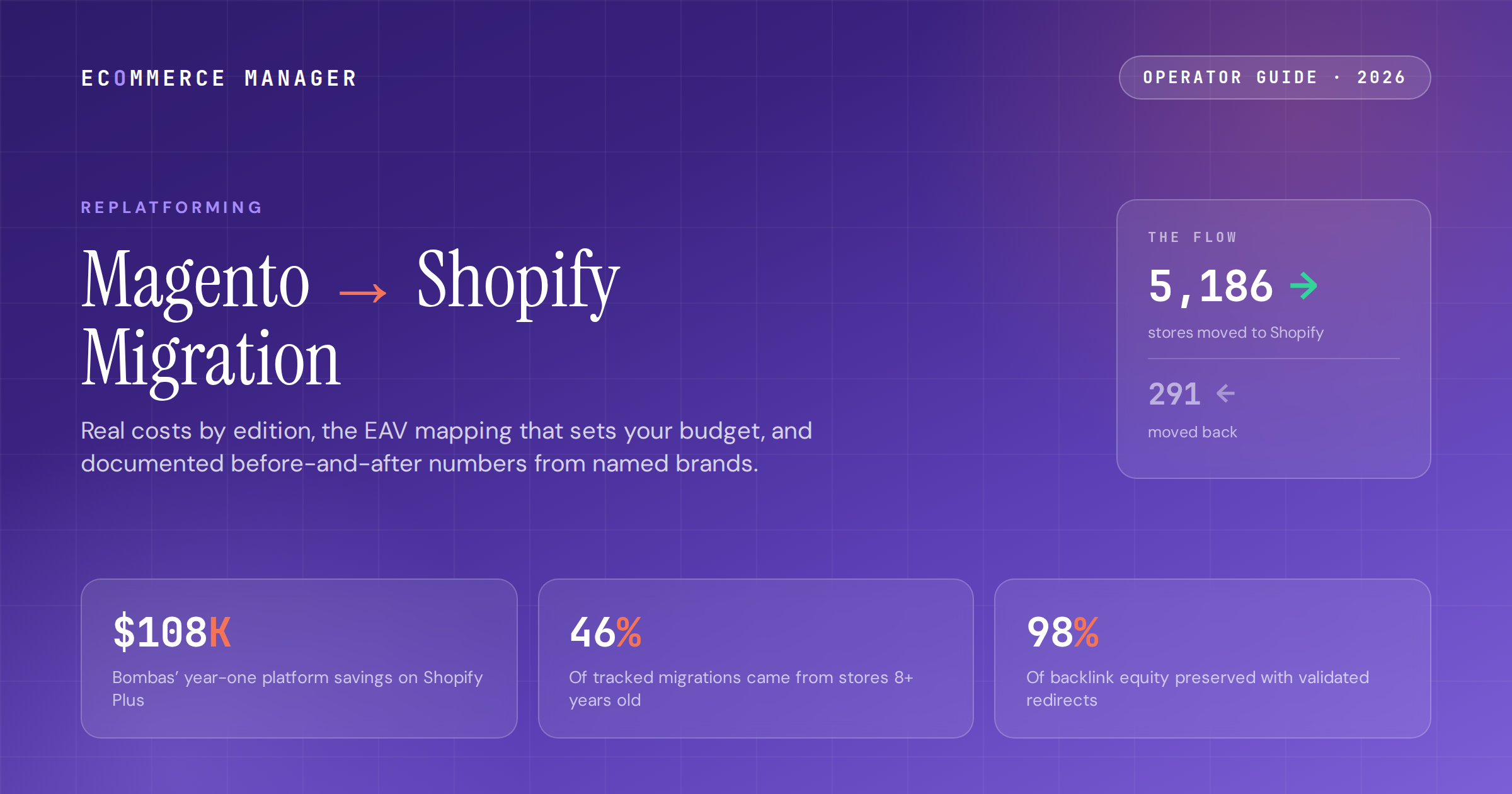
Magento to Shopify is not a debate anymore. It's a flow. Tracking data shows 5,186 Magento stores moving to Shopify against 291 going back, and in March 2026 alone, 46% of tracked migrations came from mature stores eight or more years old — a pattern Shopping Cart Migration's report calls the "Great Replatforming." The forcing functions are on a calendar. Adobe Commerce 2.4.4 support ended in April 2026, 2.4.5 ends in August, and roughly 14% of Magento stores still run Magento 1, unpatched since 2020.
The outcomes are documented with names attached. Bombas saved $108,000 in platform costs in its first year on Shopify Plus and went on to 300% year-over-year growth. Eastside Co's Magento migration recovered lost rankings and added 139,000 monthly organic sessions plus 22,000 new keywords. Inflow's checklist-driven move produced a 126% organic traffic increase. None of these happened by exporting a CSV and hoping.
They happened because Magento migrations are architectural translations, not lifts-and-shifts. EAV attributes become metafields, configurable products become variants (or break the 100-variant ceiling), customer groups become B2B catalogs, and every URL changes. This guide covers the cost by Magento edition, the mapping decisions that set the real budget, and the sequence that produced the case numbers above.
Why 2026 is the year the fence-sitters moved
Most Magento merchants didn't wake up wanting a migration. The calendar and the invoice made the decision, and the data shows both at work.
-
01The support clocks ran out this year. Adobe Commerce 2.4.4 support ended April 2026; 2.4.5 ends August 2026. Merchants on either face a mandatory upgrade project (billable dev work on Magento) or accumulating PCI compliance risk. The ~14% of Magento stores still on end-of-life Magento 1 have been carrying that risk since June 2020.
-
02The operating cost gap widened. A comparable self-hosted Magento setup runs $4,000–$15,000+/month once hosting ($1,500–$5,000/mo), security patching, and dev resources are counted, against Shopify Plus at $2,300–$2,500/month on a multi-year term. For merchants under roughly $25M in annual revenue, that gap alone frequently tips the decision.
-
03The developer market keeps tilting. Magento-certified developers are scarce and day rates keep climbing as the pool shrinks; Shopify's developer pool is an estimated 5–10x larger at lower average rates. One agency's field note: Magento teams routinely spent six days per two-week sprint on upgrades, patches, and infrastructure alone.
-
04Adobe's own moves accelerated exits. The 2025 launch of ACCS (Adobe Commerce as a Cloud Service) came with a licensing push that sent mid-market Magento Open Source merchants — previously license-free — to evaluate their options. Adobe Commerce live stores fell 15% year over year to 114,607 in Q1 2026.
-
05The scale of individual moves is growing. March 2026 tracking recorded a single Magento-to-Shopify transfer of 267,626 data entities in one month. These aren't small stores cleaning house; established brands with a decade of data are running the route. Track how the flow develops in ECM Insights.
-
06The honest counterweight: some stores should stay. Catalogs past 100K SKUs with deep EAV logic, B2B motions built on negotiated quotes and approval chains, and teams with certified Magento devs running stable builds have a defensible case for staying — the full analysis is in the ECM Adobe Commerce vs Shopify guide. This article is for everyone else.
What the move costs, by Magento edition
Magento migrations price by architecture, not SKU count. The edition you're leaving and the custom logic you're carrying set the budget.
The budget ranges
-
→Magento Open Source: $5,000–$40,000 over 6–12 weeks. Standard catalogs, limited custom modules, and a straightforward destination on core Shopify or entry Plus. Tooling (Matrixify, LitExtension, Cart2Cart) covers the data for $150–$500; the budget goes to theme rebuild, redirects, and QA.
-
→Adobe Commerce: $25,000–$150,000+ over 3–6 months, and typically a Shopify Plus destination. UK agency benchmarks put a clean mid-market cutover at £30,000–£120,000 across 8–16 weeks. B2B, multi-store, and ERP-integrated builds stretch past $250,000; the integrations, not the products, drive the number.
-
→Add the standard 25–40% contingency. The cross-industry base rate — 83% of data migration projects failing or overrunning — applies here with extra force, because EAV mapping surprises are the classic late-discovered scope. A documented failure costs $50,000–$500,000 in transition revenue, per post-mortems across 200+ DTC migrations.
-
→The other side of the ledger is well documented: Bombas saved $108K in year-one platform costs; migrated brands report 2–4x lower three-year TCO, 10–20% checkout conversion lifts, and release cycles in weeks instead of quarters. Model your own three-year numbers in the ECM platform calculator before an agency proposal models them for you.
Timing the project
-
→If you're on 2.4.5, the August 2026 support cutoff is your deadline, but a rushed migration into Q4 is worse than a patched limp through it. The clean paths are launch-by-early-October or start-in-January.
-
→Budget the timeline by complexity: 6–12 weeks for Open Source, 8–16 weeks for standard Adobe Commerce, 3–6 months when ERP, B2B, or multi-store is in scope. The data transfer is days; the mapping, rebuild, and validation are the months.
-
→One de-risking pattern from agency practice worth stealing: a canary cutover. One documented launch routed 10% of traffic to Shopify Plus on day one, caught a variant-bundle SKU mapping error in the ERP sync within hours, and fixed it while 90% of customers never saw it. Zero lost revenue.
What would Shopify actually cost your store?
Plug your GMV, AOV, and current Magento costs into the ECM Platform Calculator and get a three-year TCO comparison in under two minutes — before any agency proposal anchors the numbers.
EAV to metafields: the mapping that sets your real budget
Magento's flexibility is exactly what makes leaving it hard. Every structure below needs an explicit destination decision before any tool runs, and these decisions — not the transfer — are where projects burn time.
-
01Custom EAV attributes map to metafields, variants, or tags — and the relationship is rarely one-to-one. Shopify's metafields and metaobjects can absorb most relational attribute data, but deciding which attributes become which, deliberately and on paper, is the highest-leverage planning session in the project. Agencies consistently identify this as where Magento migrations either stay on budget or don't.
-
02Configurable products meet the 3-option, 100-variant ceiling. Magento configurables with four or more attributes must be restructured before import or Shopify drops the excess options silently. Complex bundles carry a second trap: variant-bundle SKU logic can trigger timeouts in Shopify Functions, so the working pattern is splitting bundles downstream in the ERP rather than recreating them in checkout logic.
-
03Customer groups become B2B catalogs and price lists. Since April 2026, core B2B (company accounts, catalogs, net terms) ships on every Shopify plan, which removed the old Plus-only barrier for simple wholesale. Map each Magento customer group to a catalog with price-list parity, and verify a sample of accounts sees the right prices before launch — this is the classic silent B2B migration failure.
-
04Multi-store views become Shopify Markets or expansion stores. Collapsing Magento store views carelessly into a single storefront is a documented failure mode; the decision between Markets (one store, localized) and Plus expansion stores (up to 10 storefronts) should be made on tax, catalog, and fulfillment differences, not convenience.
-
05Order history imports as read-only archives. Lifetime value, cohort reporting, and reorder attribution survive; the ability to modify or refund old orders doesn't. Brief the support team before launch. Customer passwords never transfer — the reset email is a comms project with a retention cost, so write it carefully.
-
06Every Magento extension needs a mapped equivalent, audited rather than assumed. List each module against the Shopify App Store and don't assume feature parity — the gaps you find here are your custom development scope. Run the inventory against a structured tech stack audit so nothing surfaces in week ten.
The redirect work, and what the case studies actually did
Magento migrations carry the highest SEO stakes in replatforming: years of accumulated URL equity meeting Shopify's fixed URL structure. The documented recoveries all ran the same sequence.
-
01Every URL changes, so every URL gets a 301. Shopify enforces /products/ and /collections/ paths that never match Magento's structure. Build the map from a full pre-migration crawl, rank pages by the traffic and revenue they carry, and decide the destination for every one — the practice the strongest migration agencies run before any design conversation happens.
-
02Done right, the equity survives almost entirely: roughly 98% of backlink value preserved with correct redirects. Done wrong, 30%+ of organic traffic disappears for months. An Ahrefs study's harder number looms over the whole exercise: 60% of pages that lose rankings in a migration never fully recover them.
-
03The recoveries are documented and repeatable. Eastside Co's Magento-to-Shopify project recovered rankings a botched Magento 1-to-2 upgrade had destroyed, then added 139,000 monthly organic sessions and 22,000 new keywords. Inflow's checklist-driven migration for Simms Fishing produced a 126% organic traffic increase. Both treated the migration as an SEO project with a commerce payload — the same discipline the platform-agnostic ECM migration checklist phases out step by step.
-
04Watch Magento's metadata specifically. Custom meta titles and descriptions stored in Magento attributes are the fields that most often arrive lost, truncated, or replaced with Shopify defaults. Verify your top collection, product, and blog pages against the pre-migration export, and restore anything that didn't carry.
-
05Validate before cutover, not after. Crawl the redirect map against staging, confirm your highest-traffic pages resolve correctly, and fix failures before DNS switches — cleanup during active recrawling is measurably harder. If organic drives meaningful revenue, a migration-experienced SEO specialist on this phase is the cheapest insurance in the project.
Replatforming off Magento? Get the EAV mapping right.
The ECM directory lists vetted migration specialists with verified client reviews — filtered by budget and vertical, including teams that read Magento databases rather than guess at CSVs.
The migration sequence that produced the case numbers
Compressed from the agencies that run this route weekly. Five stages, in order, with the checks that matter.
-
011. Discovery and audit (weeks 1–3): full catalog export to expose custom attributes, EAV complexity count, complete URL crawl, extension-to-app mapping, integration map (ERP, 3PL, ESP, loyalty), and a documented rollback plan. Pull baseline numbers — checkout conversion, organic sessions, page speed — from your core KPIs; the 90-day review is measured against this snapshot, not argued about.
-
022. Mapping and build (weeks 3–10): the EAV-to-metafield decisions on paper first, then theme build (Liquid for most; headless Hydrogen only with a specific reason), B2B catalog configuration with price-list parity, and integrations rebuilt in staging. Performance targets from current agency practice: INP under 200ms, LCP under 2.5 seconds on mid-tier mobile.
-
033. Data migration and validation (weeks 8–12): demo migration first, audited like an inspection — random products checked for variants and pricing, customers verified with order history attached, B2B accounts spot-checked for correct catalogs. Matrixify handles the Shopify side for most catalogs; the Admin GraphQL API covers anything custom.
-
044. Cutover (launch week): redirect map validated against staging, content formatting hand-checked, a freeze window at your lowest-traffic hour with a final delta import, then DNS. If the store is large enough to justify it, the canary pattern — a traffic percentage routed to Shopify first — turns launch-day surprises into contained incidents.
-
055. The 90-day close-out: Search Console monitored daily for two weeks, the organic dip held with nerve if the map was validated (the documented pattern: roughly 15% down in month one, recovered by month three), legacy hosting and licenses cancelled at day 30, and the review run against the Phase 1 baseline. Bombas' $108K year-one saving only counts because someone measured it.
What a smart operator does with this
Let the calendar force the decision, not the panic. The August 2026 support cutoff for Adobe Commerce 2.4.5 is real, but a rushed migration into Q4 costs more than a patched final quarter on Magento. Scope now, launch by early October or start in January, and use the audit phase to find out whether you're a $30K project or a $150K one before anyone quotes you either.
Spend your best planning hours on the translation, not the transfer. EAV attributes to metafields, configurables against the 100-variant ceiling, customer groups to B2B catalogs with price parity, store views to Markets or expansion stores. The tools that move the data are commodities; these mapping decisions are where Magento migrations stay on budget or become the 83% statistic.
Copy what the documented successes did. Bombas, the Eastside Co recovery, and the 126% Inflow case share one method: a complete URL inventory ranked by revenue, a validated redirect map before cutover, and a measured baseline that made the results provable. The 98%-of-equity-preserved outcome and the 30%-of-traffic-lost outcome are the same project with and without that work.
Frequently asked questions
How much does a Magento to Shopify migration cost in 2026?
Magento Open Source migrations run $5,000–$40,000 over 6–12 weeks. Adobe Commerce migrations run $25,000–$150,000+ over 3–6 months (UK benchmarks: £30,000–£120,000 across 8–16 weeks), and B2B, multi-store, or ERP-integrated builds exceed $250,000. Add a 25–40% contingency — 83% of data migration projects fail or overrun, and EAV mapping surprises are the classic late scope. The offsetting savings are documented: Bombas saved $108,000 in year-one platform costs, and migrated brands report 2–4x lower three-year TCO.
Should I migrate from Magento to Shopify or stay?
For most DTC stores under $10 million in annual revenue, agency consensus in 2026 is to move — self-hosted Magento runs $4,000–$15,000+ per month all-in against Shopify Plus at $2,300–$2,500, and the Magento developer pool keeps shrinking. Staying is defensible with 100,000+ SKUs and deep EAV logic, a B2B motion built on negotiated quotes and approval workflows, or a certified Magento team running a stable build. The support deadlines force timing either way: Adobe Commerce 2.4.4 support ended April 2026 and 2.4.5 ends August 2026.
How do Magento product attributes transfer to Shopify?
Through deliberate mapping, not automatically. Magento's EAV attributes become Shopify metafields, variants, or tags, and the relationship is rarely one-to-one — deciding which attributes become which is the planning session that most determines your budget. Configurable products face Shopify's 3-option, 100-variant ceiling and must be restructured before import if they exceed it, or the excess options are dropped silently. Complex bundles are best split downstream in your ERP rather than rebuilt in Shopify Functions, where variant-bundle logic can trigger timeouts.
Will migrating from Magento to Shopify hurt my SEO?
The stakes are real but the outcomes are documented on both sides. With a complete redirect map built from a full crawl and validated before cutover, roughly 98% of backlink equity is preserved, and the typical pattern is a 15% organic dip in month one with recovery by month three. Documented cases went further: one Magento migration added 139,000 monthly organic sessions and 22,000 keywords, and another produced a 126% organic traffic increase. Skipped or unvalidated redirects lose 30%+ of organic traffic, and an Ahrefs study found 60% of pages that lose rankings in a migration never fully recover them.
How long does a Magento to Shopify migration take?
Six to twelve weeks for Magento Open Source stores with standard catalogs, 8–16 weeks for typical Adobe Commerce migrations, and 3–6 months when ERP integration, B2B configuration, or multi-store architecture is in scope. The data transfer itself takes days; the EAV mapping decisions, theme rebuild, integration work, and redirect validation consume the calendar. Never launch into Q4 — target early October at the latest, or start in January. Large stores can de-risk launch with a canary cutover, routing a small traffic percentage to Shopify first.
The playbook top eComm operators actually read
One weekly brief. Five stories that matter. Zero fluff. Written for managers at $5M–$50M DTC brands who want to sound sharper than everyone else in the meeting.
References
- 01 Magento to Shopify Migration: The Complete Guide (2026) — shopify.com
- 02 Magento to Shopify Migration: The Complete 2026 Guide — shopexperts.com
- 03 Magento to Shopify Migration: Replatform Timeline (2026) — no7software.co.uk
- 04 Magento to Shopify Plus Migration Guide for Brands 2026 — krishtechnolabs.com
- 05 Magento to Shopify Migration Case Study: 63% Organic Growth — eastsideco.com
- 06 eCommerce SEO Migration Case Study: 126% Increase in Traffic — goinflow.com
- 07 Ecommerce Platform Migration: How to Replatform Without Losing Revenue — conception-labs.com
- 08 Magento to Shopify Migration in 2026: Real Cost, Timeline — askphill.com
- 09 Magento to Shopify Migration: Complete 2026 Guide — conversion-design.com
- 10 Best Magento to Shopify Migration Services in 2026–2027 — eseospace.com
- 11 Magento Market Share in 2026: Store Count, Trends, and Platform Comparison — mgt-commerce.com
- 12 Enterprise Ecommerce Platform Market Share 2026 — elogic.co
- 13 Shopify vs Magento (Adobe Commerce) Compared, 2026 — charleagency.com
- 14 E-commerce Migration Momentum: March 2026 Report — shopping-cart-migration.com
- 15 Trends, Insights and Shopify Market Share 2026 — technologychecker.io
Make your platform decision data-backed
Join 12,000+ ecommerce managers reading the ECM newsletter every Wednesday — or browse the directory to find vetted migration, CRO, and platform specialists.