

Last Updated on August 3, 2026
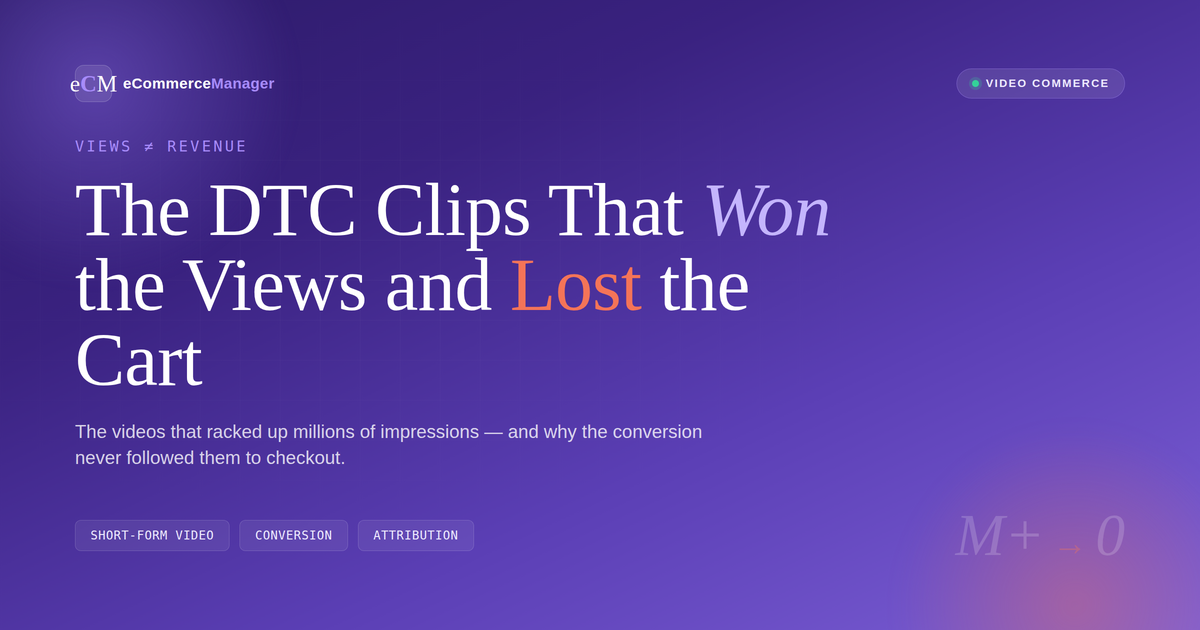
The DTC Clips That Won the Views and Lost the Cart
In February 2026, when we audited six weeks of clip performance for a direct-to-consumer skincare brand we run short-form for at FORKOFF, the two clips with the most views had sold almost nothing. The strongest clip by every number our team watched, a founder reacting to a competitor’s ingredient claim, had pulled hundreds of thousands of views and a wall of comments. It had also sent almost no one to a product page. Meanwhile a quiet forty-second clip of the founder actually demonstrating how the serum absorbed, a clip we had nearly cut for being boring, was carrying the product-page traffic and the add-to-carts on its own.
The bug was not in any single clip. The bug was that we had been picking clips for a metric the client did not pay us for.
What we actually run
We move a lot of long-form video. Founder interviews, product walkthroughs, podcast guest spots, live shopping streams, the ninety-minute recordings a DTC brand generates and never uses. The business we run is short-form clipping at volume, and the network we operate has processed more than 5 billion views of clipped content, so getting a clip to travel is not our hard problem. Getting the right clip to travel is.
For an ecommerce brand the difference is not academic. A clip that earns a million views and no carts is a cost. A clip that earns forty thousand views and a measurable bump in product-page sessions is revenue. Early on we were optimizing for the first kind without admitting it, because views are the number that feels like progress in a group chat.
What our selection actually rewarded
Our clip-selection process, human editors plus a scoring pass, ranked candidates on the signals that predict reach. Hook strength in the first two seconds. Emotional spike. Comment-bait potential. A clean quotable line. Every one of those signals is a real predictor of views, and none of them is a predictor of whether a viewer wants to buy a thirty-eight-dollar serum.
We underestimated how completely a reach proxy diverges from a revenue proxy on an ecommerce catalog. The reaction clip won on every reach signal, so it topped our shortlist, so it got the paid amplification, so it earned even more views. The demonstration clip lost on every reach signal, so it nearly did not ship. In retrospect we had built a machine that reliably found the least commercial moment in every recording and pushed it hardest.
The trigger
The fix did not come from our own dashboard. It came from the client’s. Their head of growth forwarded us a HubSpot report showing which landing sessions in the prior six weeks had actually sourced from our clips, tagged by the UTM we set on each one. The ranking was almost inverted from ours. The clips we were proudest of sat near the bottom of her attributed-revenue list. The clip we almost killed sat at the top.
She was not angry. She just asked the question that reframed the whole engagement: “These are great numbers, but which of these actually moved product?” We did not have a clean answer, because we had never wired our selection to hers.
What we changed
We stopped grading clips on reach alone and started grading them on what happened after the view.
First, we wired the measurement. Every clip now ships with a dedicated UTM, and we set up Amplitude events on the product-page visit, the add-to-cart, and the checkout start, so a clip’s job is traceable past the view count into the funnel. The client’s HubSpot already tracked the deal side, so we mapped our UTMs to her attribution model instead of running a parallel scoreboard that flattered us.
Second, we re-tagged the catalog by moment type, not just by performance. Working across 9 clients over 6 weeks, we sorted roughly 200 tagged clips into a handful of buckets: product demonstration, founder origin story, social proof, reaction, and pure entertainment. Then we looked at which buckets carried carts, not views. For these brands, demonstration and founder-story clips did the commercial work almost every time, even when their view counts were unremarkable. The reaction clips built the audience that made the demonstration clips land later. Both matter, but they are not the same job, and we had been treating them as one.
Third, we changed the brief. Every long recording now gets mined for the two or three moments that actually sell, the product doing the thing, the founder explaining why it exists, a customer saying the specific sentence a prospect needs to hear, and those get clipped and shipped first. The entertaining moments still get made, because reach feeds the funnel, but they no longer crowd out the commercial ones on the calendar. The editors do this in Descript and CapCut, and the fast first cuts still get roughed in Opus Clip, but the selection order is set by what the funnel showed us, not by what looked most viral in the timeline.
The lesson for anyone running DTC content
The mistake we made is not specific to clipping. It shows up any time a brand measures content by the metric that is easy to see instead of the one it actually sells on. Views are visible, immediate, and emotionally satisfying, and for an ecommerce business they are a leading indicator at best and a vanity number at worst. The through-line in the recordings that actually moved product was never the most viral moment. It was the two or three moments where the product was visible doing its job, or the founder said the one true thing that made a stranger trust the label.
If you run content for an ecommerce brand, the discipline is boring and it is the same discipline your performance-marketing team already lives by. Put a UTM on everything. Wire the events in whatever analytics you already run so a clip’s contribution is traceable to a cart, not just a view. Tag your library by what each moment is trying to do, and let the funnel, not the view count, decide the order you ship. On review, the clips we were proudest of and the clips that paid the bills were two different lists, and closing that gap was the most valuable thing we did for those brands all quarter. The reach was never the point. The cart was.