

Last Updated on June 25, 2026
Shopify vs BigCommerce in 2026: The Data-Driven Guide for DTC Operators
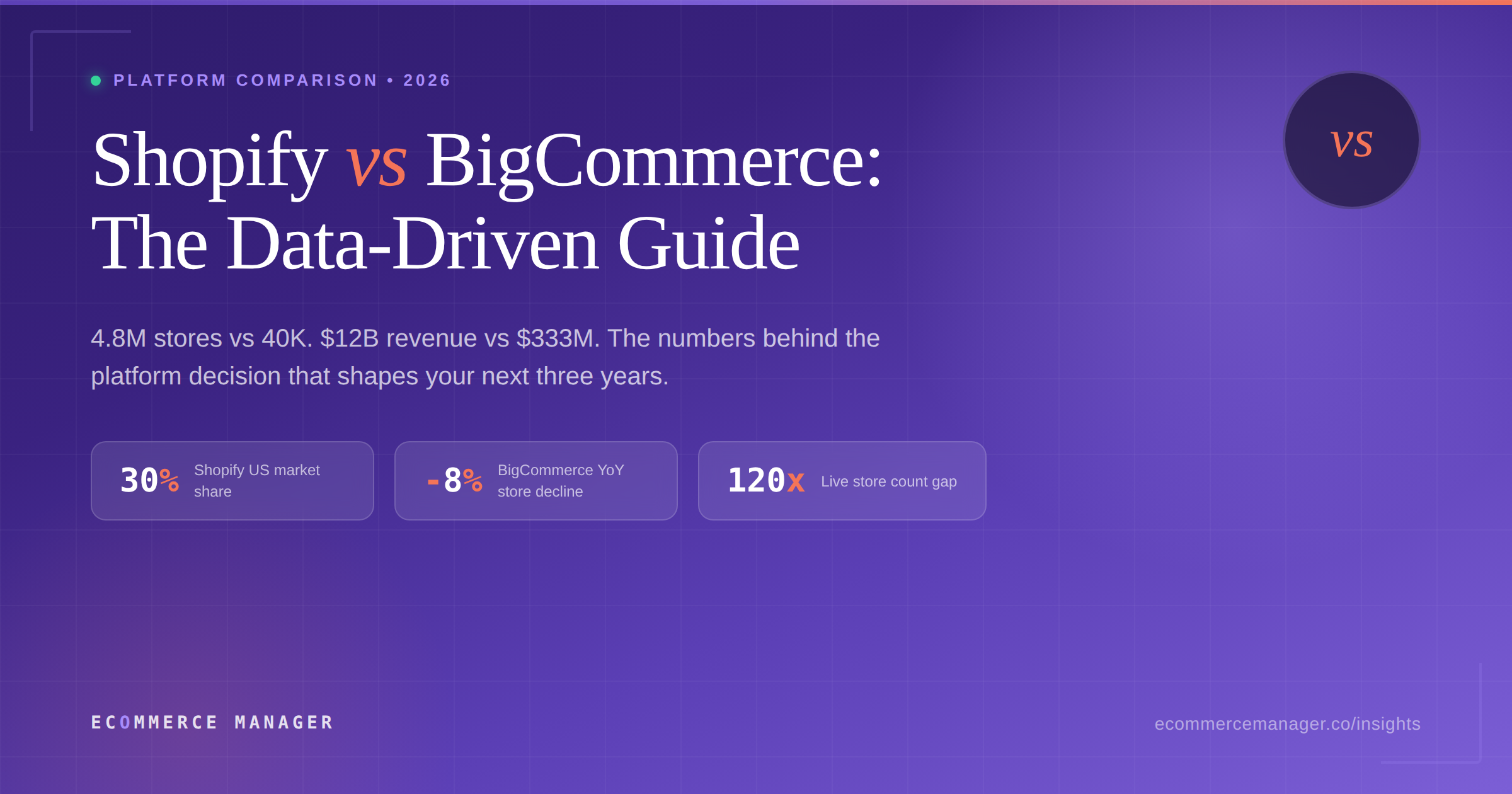
4.8 million stores vs 40,000. $12B projected revenue vs $333M. One platform just killed its zero-fee advantage. Here's what the numbers actually mean for your next platform decision.
Table of Contents
What You'll Learn
This guide breaks down Shopify and BigCommerce using Q1 2026 financial data, the June 2026 transaction fee change, April's B2B rollout, and real performance benchmarks. Every comparison is grounded in numbers you can verify, not marketing copy from either platform's homepage.
We built this for operators at $5M–$50M DTC brands making a platform decision in the next 6–12 months. If you already know what AOV and GMV mean, you're the right reader.
Market Position by the Numbers
The scale gap between these platforms has never been wider. Here's what the most recent data says.
| Metric | Shopify | BigCommerce |
|---|---|---|
| Live stores (2026) | ~4.8M | ~40,000 |
| FY2024 revenue | $8.88B | $332.9M |
| 2026 revenue projection | $12B+ | ~$350M |
| US ecommerce market share | ~30% | ~3% |
| YoY revenue growth | 26–31% | 5–8% |
| Countries served | 175+ | 150+ |
| GMV (annual) | $292B+ (2024) | $34B+ |
| Market cap (Jan 2026) | $180B+ | ~$500M |
Shopify posted 11 consecutive quarters of 25%+ revenue growth (excluding logistics) heading into 2026, generated $2 billion in free cash flow, and saw its market cap exceed $180 billion. The platform reported 29% GMV growth in its most recent fiscal year, and international revenue grew 36%.
BigCommerce is a different story. Q1 2026 revenue came in at $86.8 million, up just 5% year-over-year. The headline: the company posted its first-ever GAAP profitable quarter at $3.7 million net income. That's meaningful for sustainability, but the growth trajectory is decelerating. Active stores dropped roughly 8% YoY to around 37,000–40,000 live sites.
That store count deserves context. BigCommerce cites 130,000+ merchants, but that's a cumulative historical figure across 150 countries. The number of live, actively trading stores is a fraction of that. The platform is deliberately trading long-tail volume for higher-value accounts: enterprise customers now represent roughly 75% of total ARR.
In raw migration data, BigCommerce lost 878 merchants to competitors over 90 days in Q1 2026 while gaining 346. That 1.8:1 loss-to-gain ratio tells you where the momentum sits.
Pricing & Total Cost of Ownership
Headline pricing looks nearly identical. The real cost lives in transaction fees, app stacks, and forced plan upgrades.
| Tier | Shopify (annual billing) | BigCommerce (annual billing) |
|---|---|---|
| Entry | Basic: $29/mo | Standard: $29/mo |
| Mid | Grow: $79/mo | Plus: $79/mo |
| Advanced | Advanced: $299/mo | Pro: $299/mo |
| Enterprise | Plus: from $2,300/mo | Enterprise: custom |
At the sticker level, parity. The divergence starts here: Shopify's "thin core, lots of apps" model means a typical store runs 8–15 apps at $10–$50/month each. Real total cost of ownership can run 2–3x the plan fee. BigCommerce packs more features natively, including unlimited staff accounts, product reviews, real-time shipping quotes, and up to 600 SKU variants per product (vs Shopify's 100).
BigCommerce also ties pricing to annual sales revenue, which can force plan upgrades for fast-growing stores. If you're approaching $400K in annual revenue, you'll bump to Plus. At $150K, you'll outgrow Standard. For a brand doing $10M+ annually, both platforms push you into enterprise-tier conversations.
Shopify's own comparison data claims a 31% better TCO on average, citing 88% higher implementation costs and 32% higher platform fees on the BigCommerce side. Take that with appropriate skepticism, but the directional point stands for D2C-first stores with straightforward catalogs.
Transaction Fees: The June 2026 Shift
This is the biggest change in the Shopify vs BigCommerce landscape this year. Pay attention.
For years, BigCommerce's pitch was simple: zero transaction fees on any payment gateway. That was the line that won deals. It let merchants choose their processor without penalty, while Shopify charged 0.5–2% on non-Shopify Payments transactions.
On June 1, 2026, BigCommerce introduced an Open Payment Provider Fee on all self-service plans. Any gateway not on their approved Embedded Provider list now triggers an additional per-order platform fee. The approved list includes Stripe, PayPal/Braintree, Adyen, Checkout.com, Klarna, and Afterpay.
Two things happened simultaneously. First, merchants using Stripe or PayPal Braintree on BigCommerce still pay zero additional fees, so the practical impact is narrower than the headline. Second, the messaging damage is real. BigCommerce's structural pricing advantage against Shopify was the "no transaction fees" story. That differentiator is now gone for merchants using regional or non-approved gateways.
If you're on BigCommerce using Stripe or PayPal Braintree, the June 1 change likely doesn't affect your bottom line. If you're using a local or regional processor not on the approved list, model the actual per-order fee against your volume before making any decisions. The math matters more than the headline.
On the Shopify side, the fee structure is straightforward: use Shopify Payments and the transaction fee drops to 0%. Use any other gateway and you pay 2% on Basic, 1% on Grow, 0.6% on Advanced, and 0.2% on Plus. For brands in Shopify Payments-supported countries (and there are a lot of them), this has always been the cheaper path.
Not sure which platform fits your TCO model?
Our Platform Calculator factors in plan fees, transaction costs, app spend, and projected GMV to give you a side-by-side cost comparison.
B2B & Wholesale: The Gap Just Narrowed
B2B was BigCommerce's strongest moat. In April 2026, Shopify put a crack in it.
On April 2, 2026, Shopify extended core B2B features to every paid plan at no extra cost. That's roughly 50 wholesale capabilities that previously required Shopify Plus at $2,300/month. Non-Plus merchants now get company profiles for wholesale buyers, up to three custom catalogs with tailored pricing, volume discounts, quantity rules, vaulted credit cards, and payment terms.
The data shows this matters: Shopify reported 96% GMV growth on its B2B surface in the prior year and 41% growth in the number of merchants actively using B2B features. Merchants using Shopify B2B saw up to a 33% increase in self-serve orders within six months and up to a 4.1x increase in reorder frequency compared to D2C orders.
That said, limits exist. The three-catalog cap applies across all markets combined, not per market. If you need a US Wholesale catalog with Bronze, Silver, and Gold tiers, you've used your entire allocation. No B2B pricing carries through to Shopify POS. Unlimited catalogs and advanced features like direct catalog assignment to specific locations still require Plus.
BigCommerce B2B Edition remains deeper. It includes quoting, invoicing, company account hierarchies, buyer portals, purchasing controls, approval workflows, and unlimited price lists. Merchants can manage B2B and B2C from the same backend, and B2B merchants grew at a 12.6% CAGR from 2022 to 2024, roughly double the 6.7% rate for the broader B2B ecommerce market.
If you're running complex wholesale with 10+ pricing tiers, need ERP integrations with approval workflows, or manage a hybrid B2B/B2C operation where buyer portals and purchase order logic are table stakes, BigCommerce still has the edge. For a DTC brand that wants to add a simple wholesale channel with a few accounts and straightforward pricing, Shopify on a $39/month plan now covers the basics.
Built-In Features vs App Dependency
The philosophical difference between these platforms shows up in how they ship features.
BigCommerce ships more out of the box. Features you'd add by app on Shopify come native: variant display options, wishlists, persistent cart, bulk pricing, real-time shipping quotes from carriers, and unlimited staff accounts on every plan. The app marketplace has roughly 1,200 integrations, which is smaller than Shopify's but means less reliance on third-party tools for core functionality.
Shopify's ecosystem is massive. Over 8,000 apps in the marketplace, 196 themes (vs BigCommerce's more limited selection), and a developer community that dwarfs every other ecommerce platform. More apps also means more competition, which generally keeps quality up and prices honest. But the app-dependency model has a real cost: stacking 10+ apps creates maintenance overhead, potential performance drag, and ongoing subscription fees that can double your platform cost.
| Feature | Shopify | BigCommerce |
|---|---|---|
| Product variants per product | 100 | 600 |
| Staff accounts | 2–15 (plan-dependent) | Unlimited (all plans) |
| Multi-storefront | Plus only ($2,300+/mo) | Standard plans (up to 5) |
| Native POS | Yes (first-party) | No (third-party only) |
| Checkout customization | Plus only (Extensibility) | All plans (Checkout SDK) |
| App marketplace | 8,000+ | 1,200+ |
| URL structure control | Fixed (/products/, /collections/) | Fully customizable |
Multi-storefront is a significant gap for mid-market brands. BigCommerce offers up to five storefronts on standard plans with no separate per-store fee. On Shopify, native multi-store requires Plus at $2,300/month minimum. Plus does include nine expansion stores, so at enterprise scale the cost is bundled. But for a brand wanting two or three storefronts before growing into Plus pricing, BigCommerce is materially cheaper.
Checkout customization also diverges. BigCommerce gives open access to its checkout via the Checkout SDK on every plan. Shopify restricts deep checkout customization to Plus through Checkout Extensibility, where approved extensions run in a sandbox. Shopify's approach is more restrictive but also more maintainable: changes survive platform updates and don't break PCI compliance.
AI & Automation: Where Shopify Pulled Ahead
Both platforms invested in AI through 2025–2026, but the depth and pace aren't comparable.
Shopify Magic is free for every merchant and now includes brand voice cloning trained on your past blog and social content, automated product tagging from images, and generative copy across product descriptions, emails, and blog posts. Shopify Sidekick, expanded with Sidekick Pulse in 2026, surfaces proactive insights and can edit themes, run reports, create B2B companies, and execute admin actions through natural language.
In April 2026, Shopify also released the AI Toolkit, which lets external AI tools like Claude update products, edit pages, translate content, and modify code directly inside a Shopify store. This is infrastructure-level investment that positions Shopify at the center of agentic commerce, where AI agents can act on behalf of merchants inside the platform.
BigCommerce is integrating AI-powered tools for inventory management and SKU tracking, and plans to launch AI-driven fraud detection tools alongside BigCommerce Payments (built with PayPal) in 2026. The investment is real but narrower in scope. BigCommerce's AI play is more operational than creative or conversational.
Need help with your platform migration?
Browse vetted ecommerce agencies specializing in Shopify and BigCommerce implementations, migrations, and custom development.
Performance & Conversion Data
Conversion rates and BFCM performance tell you how each platform actually performs under load.
Shopify average store conversion sits between 1.4% and 1.8%. Stores above 3.2% rank in the top 20%, while 4.7%+ places in the top 10%. Shop Pay can increase checkout conversion by up to 50%. During BFCM 2025, Shopify merchants generated a record $14.6 billion in sales, a 27% increase from the prior year.
BigCommerce reports an average store conversion rate of 2.5%. During Cyber Week 2024, BigCommerce merchants achieved a 26% YoY GMV increase compared to the industry average of 6%. Orders grew 13% versus a 7% industry average. Average Order Value climbed 11% YoY, outperforming the prior year's 3% gain. BigCommerce's typical AOV sits around $137, with mobile AOV at $125.
The conversion comparison has nuance. BigCommerce's higher average conversion rate (2.5% vs 1.4–1.8%) likely reflects its merchant base: fewer small/hobby stores pulling the average down, and more established mid-market and enterprise merchants with optimized funnels. It's an apples-to-oranges comparison of merchant mix, not platform capability.
The Verdict: Which Platform Wins in 2026
There's no universal answer, but the data makes the decision matrix clear.
You're a D2C-first brand that wants the largest app ecosystem, the fastest time to launch, a first-party POS for retail, and AI tools that are already embedded in the admin. You're comfortable using Shopify Payments to avoid transaction fees, and your B2B needs are straightforward (three or fewer pricing tiers). Shopify commands 30% of the US ecommerce market for a reason: for most D2C stores between $5M and $50M in revenue, it's the lower-friction, higher-momentum choice.
Your business runs on complex B2B with deep wholesale workflows, you need multi-storefront on a standard plan without paying $2,300/month for Plus, your catalog exceeds 100 variants per product, or you require full checkout customization without enterprise pricing. BigCommerce's native feature density means fewer apps, fewer subscriptions, and more control. The platform's enterprise pivot is deliberate, and for mid-market B2B/B2C hybrid operations, it remains a strong contender.
BigCommerce's shrinking active store base (down 8% YoY) and the June 2026 pricing change signal a platform in transition. The GAAP profitability milestone is a positive sign of financial health, but the growth deceleration is real. If long-term ecosystem momentum matters to your decision, Shopify's trajectory is harder to argue against: 26–31% revenue growth, $180B+ market cap, and infrastructure-level investments in AI and agentic commerce.
Neither platform is going anywhere. Both are financially viable, actively developed, and serve real merchants at scale. The question is which one matches your specific operational needs, growth trajectory, and technical capabilities. Run the numbers for your store.
The Bottom Line
Shopify is the dominant platform by every scale metric: 4.8M stores, $12B+ projected 2026 revenue, 30% US market share. Its B2B expansion in April 2026 and AI toolkit investments widened the gap further.
BigCommerce remains the stronger choice for complex B2B, multi-storefront operations on standard plans, and merchants who need deep native features without app dependency. Its June 2026 transaction fee change weakened a key differentiator.
For most $5M–$50M DTC brands, Shopify is the default recommendation in 2026. BigCommerce earns the pick when B2B complexity, catalog depth, or multi-storefront economics specifically require it.
Frequently Asked Questions
Is Shopify or BigCommerce cheaper for a $10M DTC brand in 2026?
It depends on your payment gateway. If you use Shopify Payments, Shopify eliminates its transaction fee and typically costs less at scale. BigCommerce historically had zero transaction fees on any gateway, but introduced an Open Payment Provider Fee on June 1, 2026 for non-approved processors. For brands using Stripe or PayPal Braintree on BigCommerce, total cost remains competitive. Run a TCO model with your actual gateway and app stack before deciding.
Which platform is better for B2B and wholesale selling?
BigCommerce still has deeper native B2B with unlimited catalogs, quoting, invoicing, and company account hierarchies on its B2B Edition. However, Shopify closed the gap significantly in April 2026 by opening core B2B features to all paid plans, including company profiles, volume pricing, and up to three custom catalogs. For simple wholesale setups, Shopify now covers the basics. For complex multi-tier B2B with unlimited price lists, BigCommerce or Shopify Plus remain stronger options.
How big is the market share gap between Shopify and BigCommerce?
The gap is enormous. Shopify powers approximately 4.8 million live stores and holds around 30% of the US ecommerce platform market. BigCommerce has roughly 40,000 live stores and about 3% US market share. Shopify reported $8.88 billion in 2024 revenue with projections above $12 billion for 2026, while BigCommerce reported $332.9 million in FY2024 revenue. BigCommerce live stores declined 8% year-over-year in early 2026.
What changed about BigCommerce transaction fees in 2026?
On June 1, 2026, BigCommerce introduced an Open Payment Provider Fee on self-service plans. Any payment gateway not on their approved Embedded Provider list now triggers an additional per-order platform fee. Approved providers include Stripe, PayPal/Braintree, Adyen, Checkout.com, Klarna, and Afterpay. This ended BigCommerce's long-standing zero transaction fee policy, which had been a key differentiator against Shopify.
Should I migrate from BigCommerce to Shopify in 2026?
Not automatically. If you use an approved embedded payment provider on BigCommerce, the new fee does not affect you. If your store relies heavily on native B2B features, multi-storefront on standard plans, or headless architecture via BigCommerce's open APIs, those remain strong reasons to stay. Consider migrating if the new transaction fee hits a large share of your orders, you need Shopify's larger app ecosystem, or you want Shopify's first-party POS for retail. Always model the real cost and plan SEO-safe URL redirects before switching.
Platform shifts, operator insights, and data you can use
Join ecommerce operators who read our weekly newsletter for the numbers, benchmarks, and analysis that matter at $5M–$50M DTC brands.
References
- 01 Shopify Inc. FY2026 8-K Filing — sec.gov
- 02 Shopify Statistics 2026: Revenue, Share & Merchant Data — chargeflow.io
- 03 50+ Shopify Statistics for 2026 — charleagency.com
- 04 Shopify Market Share 2026: Global Data — demandsage.com
- 05 44 BigCommerce Statistics for 2026 — justpricing.com
- 06 BigCommerce Statistics 2026: Verified Facts & Data — chargeflow.io
- 07 The State of BigCommerce in 2026 — storeleads.app
- 08 Key BigCommerce Statistics for 2026 — chargebacks911.com
- 09 BigCommerce vs Shopify in 2026: What the New Fees Mean — commerce-ui.com
- 10 Shopify Brings Native B2B Features to All Plans — shopify.com
- 11 Shopify B2B on All Plans: Everything You Need to Know — wholesalehelper.io
- 12 BigCommerce vs Shopify: Transaction Fee Impact — flatlineagency.com
- 13 BigCommerce vs Shopify Platform Comparison 2026 — scandiweb.com
- 14 BigCommerce vs Shopify: Fees, Features & Verdict 2026 — getonecart.com
- 15 Shopify B2B on Every Paid Plan: What It Means for Merchants — ecommercepartners.com
- 16 Shopify Adds B2B Features for More Merchants — digitalcommerce360.com
- 17 29 BigCommerce Statistics & Trends (2026 Data) — wiserreview.com
- 18 Shopify Winter '26 Edition: B2B Features Roundup — shopify.com
Ready to make your platform decision?
Use our Platform Calculator to compare Shopify vs BigCommerce TCO for your specific store, or browse vetted agencies who specialize in migrations.