


Last Updated on June 25, 2026
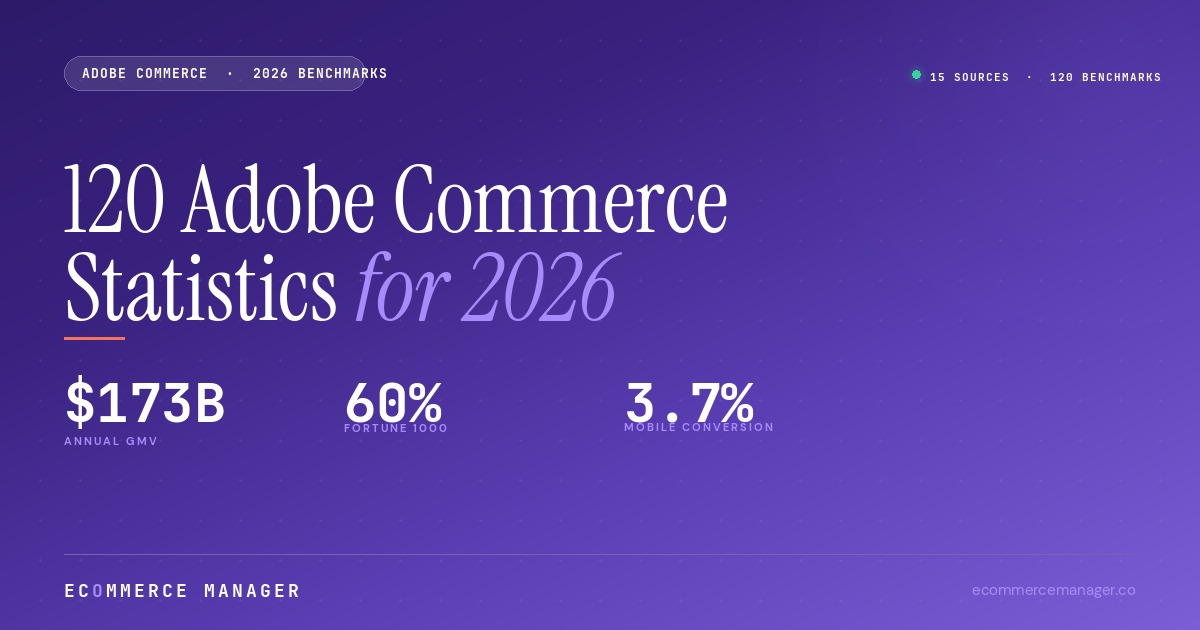
120 Adobe Commerce Statistics for 2026
Adobe Commerce powers $173B+ in annual GMV across 130,000 storefronts — including 60% of Fortune 1000 DTC brands. 120 numbers from 15 sources on Sensei AI, the PWA + headless stack, and when the platform is the right call for $5M–$50M operators.
On this page
Why Adobe Commerce belongs in the 2026 evaluation conversation
Adobe Commerce (formerly Magento) is positioned as the enterprise ecommerce platform — and the numbers back that framing. $173B in annual GMV, 130,000+ storefronts, 60% of Fortune 1000 DTC brands, including Nike, Hermès, Panasonic, and HP. Black Friday 2024 saw $6.2B in a single day with 14% YoY growth. Mobile conversion runs 3.7% versus the 2.9% industry average.
But the enterprise framing oversimplifies. Over 50% of Adobe Commerce storefronts are SMBs with annual GMV under $10M. The platform is genuinely accessible for mid-market operators — particularly through Adobe Commerce Cloud, which abstracts most of the infrastructure burden that historically made self-hosted Magento prohibitive. The 2026 evaluation question is no longer "are we big enough?" — it's "do we need what Adobe's full stack delivers?"
This guide pulls 120 statistics from 15 sources across consumer behavior, social, email, mobile, personalization, and AI. The strategic read: Adobe Commerce competes on three things — depth of B2B and complex catalog handling, the AEP + Sensei data and AI foundation, and PWA/headless mobile experiences. Where competitors win is total cost of ownership at lower GMV bands and faster time-to-launch for simpler use cases.
1. The Adobe Commerce ecosystem — enterprise scale, mid-market accessible
$173B GMV, 130,000 storefronts, and 60% of Fortune 1000 DTC brands. The number that complicates the enterprise framing: over half of Adobe Commerce stores are SMBs under $10M GMV, putting the platform genuinely within reach for mid-market operators.
-
01Adobe Commerce powers 130,000+ active storefronts worldwide as of 2025, with an estimated 8% share of the global ecommerce platform market.
-
02It facilitates about $173 billion in annual GMV in 2025, up 11.6% from $155 billion in 2024.
-
03On Black Friday 2024, Adobe Commerce merchants processed over $6.2 billion GMV in one day, a 14% year-over-year increase, showing strong peak scalability.
-
04About 60% of Fortune 1000 firms with DTC ecommerce use Adobe Commerce for storefront management, including brands like Nike, Hermès, Panasonic, and HP.
-
05Over 50% of Adobe Commerce storefronts are SMBs with annual GMV under $10 million, showing the platform is not only for large enterprises.
-
06Average order value (AOV) on Adobe Commerce reached $122 in 2025, driven by AI-driven promotions, subscriptions, and upsells.
-
07Adobe's Digital Economy Index shows mobile revenue share around 51–52% of US ecommerce in late 2024, reflecting consumer comfort with smaller screens.
-
08Adobe's 2026 AI and Digital Trends report finds 49% of customers say they would use AI to search for personalized product recommendations, making AI a mainstream part of shopping behavior.
-
0944% of customers say they would use AI to access instant customer service, indicating strong appetite for AI-mediated support.
-
10About one in four customers already turn to AI-powered platforms as their primary source when searching for information, making purchase decisions, or finding recommendations — surpassing brand sites and online reviews.
-
11For simple inquiries, the vast majority of customers prefer AI-enabled interactions or a mix of AI and human options, rather than human-only support.
-
12Roughly two-thirds of organizations say AI-powered conversational platforms are important for brand relevance, and almost as many believe future CX must be conversational-first.
-
1360% of organizations say AI-powered service and support will define breakthrough customer experience over the next 2–3 years.
-
14Many organizations expect that within 18 months, agentic AI will directly handle most customer interactions, especially in support and post-purchase service.
-
15Adobe's martech trends note that customers are already using AI to shape brand experiences, raising expectations for intelligent interactions across touchpoints.
-
16In Adobe's global survey, a majority of customers believe AI will improve their overall experience with brands, not just reduce costs.
-
17Retail trend content from Adobe highlights membership as the new loyalty, with consumers gravitating toward subscription, VIP, and membership models.
-
18Consumer trends called out for Adobe Commerce include AI personalization, AR/VR, social commerce, and headless experiences, all now expected by many shoppers.
-
19Adobe Commerce's 2026 roadmap emphasizes real-time data sharing and native integration with Adobe Experience Platform (AEP) to keep pace with always-on, data-driven consumer expectations.
-
20Customers increasingly expect streamlined brand experiences, but many organizations still lack the data foundations needed to deliver, creating an execution gap Adobe Commerce aims to close.
Building AI-driven email on the Adobe stack?
Adobe Campaign + Sensei + AEP is a powerful triangle for lifecycle marketing — but the implementation depth matters more than the licenses. The directory lists vetted Adobe Commerce email and martech partners who've shipped the work for mid-market and enterprise brands.
3. Email and lifecycle — Sensei + Adobe Campaign do the heavy lifting
AI-driven email campaigns lift open rates by up to 41% in Adobe's benchmarks. Sensei powers content personalization; Adobe Campaign orchestrates cross-channel journeys; AEP unifies the data. The stack is integrated, which is also where most of the cost goes.
-
01Adobe's AI marketing statistics note that AI-driven campaigns can increase email open rates by up to 41% in certain industries.
-
02Email is one of the channels where AI has been most widely adopted, used to transform targeting, reduce wasted spend, and strengthen engagement.
-
0367% of marketers expect AI to enable more personalized experiences, such as curated retail recommendations in email and onsite journeys.
-
0453% of senior executives using generative AI report significant improvements in team efficiency, much of it in email and campaign workflows.
-
05AI-enabled campaign workflows help speed up A/B testing and decision-making, enabling more frequent email experiments.
-
06Global AI marketing revenue was about $47 billion in 2025 and is projected to reach $107 billion by 2028, with email marketing a major beneficiary.
-
07According to Adobe's reports, 75% of US marketers say AI saves organizational costs, including time and budget in email and CRM operations.
-
0892% of businesses intend to invest in generative AI tools over the next three years, implying near-universal AI augmentation of email and lifecycle marketing.
-
09Adobe Commerce merchants commonly integrate Adobe Campaign, Marketo, or other ESPs to orchestrate personalized, cross-channel journeys anchored around email.
-
10Adobe Sensei powers AI-driven personalization of email content and recommendations, enabling 1:1 journeys based on behaviour and predicted intent.
-
11In Adobe's AI and Digital Trends, martech leaders are already using agentic or generative AI for journey design and omnichannel activation, which includes email triggers and content.
-
12Unified data is stressed as essential; AI initiatives stall without connected data and insights, making email personalization dependent on data quality.
-
13Brands using AI for churn prediction and lifecycle modelling can proactively target at-risk customers via email before they disengage.
-
14Predictive analytics in Adobe Commerce ecosystems help forecast campaign performance and customer behaviour, improving email send strategy.
-
15Adobe Commerce Analytics implementations show merchants tying email revenue and LTV back to specific channels and segments, enabling more nuanced ROI analysis.
-
16Agentic AI is expected to increasingly automate repetitive campaign tasks and workflows, freeing human teams to focus on strategy and creative.
-
17Many organizations expect half of support interactions to be handled by agentic AI within 18 months, with email as a key channel for AI-generated responses.
-
18AI is described as highly effective for data-heavy tasks like analyzing customer behaviour and predicting churn, both core to lifecycle email strategy.
-
19Adobe Commerce's roadmap includes AI-powered tools for platform health and catalog management, indirectly improving lifecycle messaging accuracy (e.g., availability, pricing).
-
20Overall, Adobe's ecosystem positions AI-enhanced email as a primary driver of personalization and retention, especially when tied to Adobe Commerce transaction data.
4. Mobile commerce — 50.8% of sales and 3.7% conversion (vs 2.9% industry)
Adobe Commerce mobile conversion runs 28% above industry average. The differentiators are documented: PWA storefronts, AEP-driven real-time personalization, native AR for high-consideration categories (AR boosts mobile conversion up to 94%).
-
01Mobile commerce now constitutes 50.8% of total Adobe Commerce sales, up from 47% in 2023.
-
02Adobe Commerce mobile conversion rates reach 3.7%, surpassing the broader industry average of about 2.9%.
-
03On Christmas Day 2024, 65% of Adobe Commerce orders came from mobile devices, illustrating mobile's dominance during peak shopping days.
-
04Adobe's Digital Economy Index shows mobile revenue share at 51.4% in October of a recent year, and Adobe expects this trend to continue upward through 2025–26.
-
05Many Adobe Commerce stores use Progressive Web Apps (PWAs) and native mobile frameworks to deliver fast, app-like experiences.
-
06PWA-driven mobile storefronts significantly boost mobile conversion rates and session engagement compared to non-optimized mobile sites.
-
07About 12% of enterprises use PWA-based endless-aisle kiosks in physical stores, connecting in-store shoppers to extended online inventory.
-
08Adobe Commerce supports headless architectures, enabling tailor-made mobile app experiences and frontend frameworks while keeping a robust commerce engine.
-
09Real-time data sharing via AEP helps keep mobile storefronts updated with inventory, pricing, and personalized content, reducing friction.
-
10Adobe Commerce's roadmap emphasizes expanded payment capabilities, including mobile-friendly wallets and global payment methods.
-
11Mobile shoppers increasingly expect BOPIS (Buy Online, Pick Up In-Store); 41% of merchants support BOPIS, yielding a 23% uplift in AOV.
-
12AI-optimized mobile search and recommendations help match customers to products faster, improving path-to-purchase efficiency.
-
13Adobe Sensei image tagging and search optimization support visual discovery on mobile, improving search relevance and product findability.
-
14AR product views in mobile environments can boost conversion rates up to 94%, especially in categories like furniture and fashion.
-
15Voice commerce integrations simplify customer interactions via digital assistants, a growing behaviour for mobile shoppers.
-
16Adobe Commerce best-practice guides stress mobile performance optimization — caching, CDN usage, image compression, and code efficiency — as essential for modern shoppers.
-
17Mobile-first UX and responsive design are considered standard requirements, not optional enhancements, for Adobe Commerce builds in 2026.
-
18The combination of AI-driven personalization, PWA, and headless mobile UX is framed as a competitive advantage in Adobe Commerce ecosystems.
-
19During peak events like Black Friday and Christmas, mobile share of Adobe Commerce orders rises above its annual average, showing how comfortable shoppers are transacting on phones.
-
20Overall, Adobe Commerce treats mobile commerce as the default mode, and its PWA + AI stack is designed to exceed typical mobile benchmarks.
Comparing Adobe Commerce against Shopify Plus or BigCommerce?
Adobe Commerce wins on B2B, complex catalogs, and full-stack data integration. Shopify Plus wins on time-to-launch and ecosystem velocity. The Platform Calculator runs all four major platforms on real 3-year TCO — including the implementation costs that vendors don't put on the demo slide.
5. Personalization — Sensei drives 6% revenue-per-visitor lift across 71% of cloud tenants
71% of Adobe Commerce cloud tenants use Sensei AI features. The measured impact is 6% revenue-per-visitor lift on average — modest-sounding, compounds significantly at enterprise scale. 56% of organizations now prioritize AI investment specifically for personalization.
-
01Over 71% of Adobe Commerce cloud tenants use Adobe Sensei AI features (recommendations, search optimization, image tagging), achieving about a 6% increase in revenue per visitor on average.
-
02AI-driven product recommendations are a best practice: Adobe advises using AI recommendations to display relevant products and enhance engagement.
-
03Adobe Commerce lets brands leverage customer data for targeted promotions and offers based on behaviour, enabling data-driven personalization.
-
04Best-practice guidance emphasises loyalty programs, wish lists, and re-order features to support customer retention and personalized experiences.
-
05Adobe Sensei helps create 1:1 customer journeys, personalizing content, recommendations, pricing, and promotions across touchpoints.
-
06Adobe's AI and Digital Trends report notes 56% of organizations prioritize AI investment in delivering more personalized customer experiences, making personalization the top AI use case.
-
0746% prioritize improving customer satisfaction, loyalty, and engagement, much of which depends on effective personalization.
-
0845% prioritize automating repetitive tasks and workflows, which includes automated personalization setups and campaign logic.
-
09Adobe's martech overview stresses that customers already use AI to shape their brand experiences, raising the bar for intelligent personalization everywhere.
-
10Many martech leaders expect half of support and post-purchase interactions to be handled by agentic AI, giving AI more data to fuel personalization.
-
11AI in ecommerce enables real-time personalization of content, recommendations, pricing, and promotions, which Adobe Sensei powers within Commerce and Experience Cloud.
-
12Predictive analytics in Adobe Commerce help forecast customer behaviour and inventory demand, informing personalized offers and merchandising.
-
13Adobe Commerce aligns with consumer trends like AI personalization, AR/VR experiences, social commerce, and headless setups to deliver future-ready shopping.
-
14Adobe Commerce roadmap highlights native integration with Adobe Experience Platform, allowing centralized profiles and real-time personalization across channels.
-
15Martech leaders are turning to agentic AI to address changing customer habits, anticipating it will play a larger role in interactions and personalization.
-
16The martech report emphasises that any agentic AI deployment will stall without connected data and insights, making data unification the backbone of personalization.
-
17Many organizations already use generative or agentic AI for journey design and omnichannel activation, aiming for personalization at scale.
-
18Adobe's AI marketing stats show 67% of respondents expect AI to enable more personalized experiences, including curated recommendations.
-
19Membership-based loyalty (subscriptions, VIP tiers) is highlighted in Adobe retail trend content as becoming "the new loyalty," often underpinned by personalised benefits and experiences.
-
20Overall, Adobe Commerce personalisation strategy centres on AI-powered recommendations, unified profiles via AEP, and predictive analytics, delivering tailored, high-value B2C journeys.
6. AI in the Adobe Commerce ecosystem — Sensei plus agentic plus generative
Adobe's AI strategy is three-layered: Sensei (predictive ML), agentic (workflow automation), generative (content). 92% of businesses plan to invest in generative AI over the next three years. The 2026 question isn't if AI matters — it's whether your data foundation can support it.
-
01Adobe's 2026 AI and Digital Trends report is based on 3,000 executives/practitioners and 4,000 customers, giving statistically robust insight into AI-driven CX.
-
02The report finds customers regularly use AI tools at work and in personal life, raising expectations for AI-mediated experiences everywhere.
-
03A majority of customers believe AI will improve their overall brand experience, not just speed up tasks.
-
04Martech leaders are already embedding generative AI across campaign workflows to operate with greater speed and precision.
-
05Generative AI investments deliver real efficiencies across content production and decision-making, addressing creative bottlenecks.
-
06Many leaders expect at least half of customer support interactions to be handled directly by agentic AI in the next 18 months.
-
07They anticipate similar agentic AI coverage for post-purchase support, moving CX toward AI-first operations.
-
08Any AI initiative will stall without connected data and insights, so Adobe advises prioritising data unification, quality, and accessibility before heavy agentic AI deployment.
-
09Adobe Sensei is described as the AI/ML framework powering automation, personalization, and predictive capabilities across Experience Cloud and Commerce.
-
10Adobe Sensei-driven ecommerce features include automated merchandising, predictive offers, and search optimization, all of which are AI-based.
-
11AI in ecommerce is framed as enabling real-time personalization, predictive analytics, and automated merchandising, now considered pillars of competitive digital strategy.
-
12Adobe's AI marketing stats show 60% of marketers use AI tools daily, and 67% of SMBs use AI in marketing, indicating mainstream adoption.
-
1392% of businesses intend to invest in generative AI tools over the next three years, ensuring AI will be deeply embedded in marketing and commerce stacks.
-
14Global AI marketing revenue is forecast to hit $107 billion by 2028, up from about $47 billion in 2025, signalling rapid growth.
-
15AI-driven campaigns can increase email open rates by up to 41%, demonstrating tangible impact on engagement.
-
1675% of US marketers say AI saves organisational costs, reinforcing AI's dual value in efficiency and performance.
-
17Adobe Commerce's 2026 roadmap emphasises AI-powered tools for catalog management, platform health monitoring, and observability, alongside developer extensibility via App Builder.
-
18The roadmap also focuses on AI-enhanced merchant experiences, simplifying administration with an improved Merchant Center.
-
19Brainvire notes that Adobe Commerce keeps pace with consumer trends such as AI personalization, AR/VR, social commerce, and headless commerce, all heavily reliant on AI capabilities.
-
20Overall, Adobe frames AI (Sensei + agentic + generative) as the engine of modern commerce, deepening customer engagement rather than merely automating tasks.
What a smart operator does with these 120 numbers
Stop dismissing Adobe Commerce as enterprise-only. 50%+ of storefronts are SMBs under $10M GMV. For mid-market brands with complex catalogs, B2B requirements, or genuine need for AEP-driven unified data, Adobe Commerce Cloud is in the actual evaluation set — not just an aspirational ceiling.
Treat the AEP + Sensei + Adobe Campaign stack as the value, not the platform itself. Adobe Commerce in isolation competes adequately with Shopify Plus and BigCommerce. Adobe Commerce as part of the full Experience Cloud — that's the differentiator. If you're not using AEP, you're paying for the brand premium without the actual edge.
Use the mobile benchmarks as your North Star. 3.7% mobile conversion vs 2.9% industry average is what good looks like in 2026. PWA storefronts, real-time AEP personalization, and AR for high-consideration categories (94% mobile conversion lift) are the documented drivers.
71% Sensei adoption with 6% revenue-per-visitor lift is the floor, not the ceiling. Brands that actively tune AI recommendations, dynamic merchandising, and predictive offers report substantially higher impact. Sensei is a tool — the configuration work is where the lift comes from.
Fix data foundations before chasing agentic AI. Adobe's own research stresses that AI initiatives stall without connected data. 92% of businesses plan to invest in generative AI over the next three years; only the ones with unified customer profiles will see returns proportionate to the spend.
Frequently asked questions
Is Adobe Commerce only for enterprise brands?
No — that framing is increasingly outdated. While 60% of Fortune 1000 DTC firms run Adobe Commerce, over half of all storefronts on the platform are SMBs with annual GMV under $10 million. Adobe Commerce Cloud (the managed cloud offering) has lowered the operational floor significantly compared to the self-hosted Magento days. For mid-market brands ($5M–$50M GMV) with complex catalogs, B2B requirements, or strategic need for unified Adobe Experience Cloud data, Adobe Commerce is a legitimate evaluation candidate rather than an aspirational one.
How does Adobe Commerce compare to Shopify Plus?
Adobe Commerce wins on B2B depth, complex catalog handling (multi-store, multi-brand, multi-currency at scale), and the AEP + Sensei + Adobe Campaign data and AI integration. Shopify Plus wins on time-to-launch, ecosystem velocity, and simpler operational overhead. Adobe Commerce mobile conversion runs 3.7% versus Shopify's roughly comparable benchmarks, but Adobe's PWA + headless story is more mature. For most $5M–$50M DTC operators, the deciding factor is whether you'll actually use the Adobe Experience Cloud capabilities or just pay for Commerce in isolation — if it's the latter, Shopify Plus typically wins on TCO.
What is Adobe Sensei and what does it actually do?
Sensei is Adobe's AI/ML framework that powers automation, personalization, and predictive capabilities across the Experience Cloud, including Commerce. In practical terms: AI-driven product recommendations, search relevance optimization, image tagging and visual search, predictive offers, automated merchandising, and dynamic pricing. 71% of Adobe Commerce cloud tenants use Sensei features and report an average 6% revenue-per-visitor lift. The number is modest-sounding but compounds significantly at enterprise scale, and the brands that actively tune Sensei rather than running default configurations see substantially higher impact.
What's the mobile commerce performance on Adobe Commerce?
Mobile makes up 50.8% of total Adobe Commerce sales (up from 47% in 2023), and platform mobile conversion runs 3.7% — significantly above the 2.9% industry average. During peak shopping days, mobile share climbs higher: 65% of Christmas Day 2024 orders came from mobile devices. The documented drivers of the outperformance are Progressive Web Apps (PWAs) for app-like mobile speed, headless architecture enabling tailored mobile frontends, AEP-driven real-time personalization, and native AR for categories like furniture and fashion where AR boosts mobile conversion up to 94%.
When does Adobe Commerce make sense versus competitors?
Three signals point toward Adobe Commerce: meaningful B2B revenue requiring quote-to-order, custom catalogs, or account-based pricing; existing or planned investment in the broader Adobe Experience Cloud (AEP, Adobe Campaign, Marketo, Workfront) where the integration delivers real synergy; or complex multi-brand/multi-region/multi-currency setups that strain Shopify Plus or BigCommerce. Three signals point away: GMV below $5M where TCO doesn't justify the platform premium; primarily simple B2C catalogs where Shopify Plus delivers comparable conversion with less operational overhead; or limited in-house technical capacity where the Adobe stack's depth becomes liability rather than advantage.
The playbook top eComm operators actually read
One weekly brief. Five stories that matter. Zero fluff. Written for managers at $5M–$50M DTC brands who want to sound sharper than everyone else in the meeting.
References
- 01 Adobe Commerce Statistics 2025 — Digiteon — digiteon.com
- 02 Adobe Digital Economy Index — business.adobe.com
- 03 Adobe 2026 AI & Digital Trends Report — business.adobe.com
- 04 Adobe Martech Digital Trends Report — business.adobe.com
- 05 Adobe Commerce Overview (Video) — youtube.com
- 06 Adobe Commerce Aligns With New Consumer Trends — Brainvire — brainvire.com
- 07 Adobe Commerce Vision Forward — Experience League — experienceleague.adobe.com
- 08 AI Marketing Trends — Adobe — adobe.com
- 09 Adobe Commerce Analytics Guide — Improvado — improvado.io
- 10 Adobe Commerce Product Overview — business.adobe.com
- 11 Adobe Sensei AI in 2026 — Wagento — wagento.com
- 12 Adobe Commerce Best Practices 2025 — NavigateCommerce — navigatecommerce.com
- 13 Driving Commerce in 2026: Replatforming — Adobe Summit — business.adobe.com
- 14 Top Adobe Commerce Highlights — Adobe Summit 2026 — business.adobe.com
- 15 Magento / Adobe Commerce CMS Usage — W3Techs — w3techs.com
Make every platform decision data-backed
Join 12,000+ ecommerce managers reading the ECM newsletter every Tuesday — or browse the directory to find vetted CRO, email, retention, and AI partners with Adobe Commerce experience.

2. Social media and social commerce — 18% of attributable revenue
57% of Adobe Commerce merchants run native social integrations with Instagram, TikTok, and Pinterest. Those integrations drive 18% of attributable revenue — a meaningful slice that depends entirely on unified analytics to measure properly.