

Last Updated on June 25, 2026
The Best Things to Sell in Ecommerce 2026
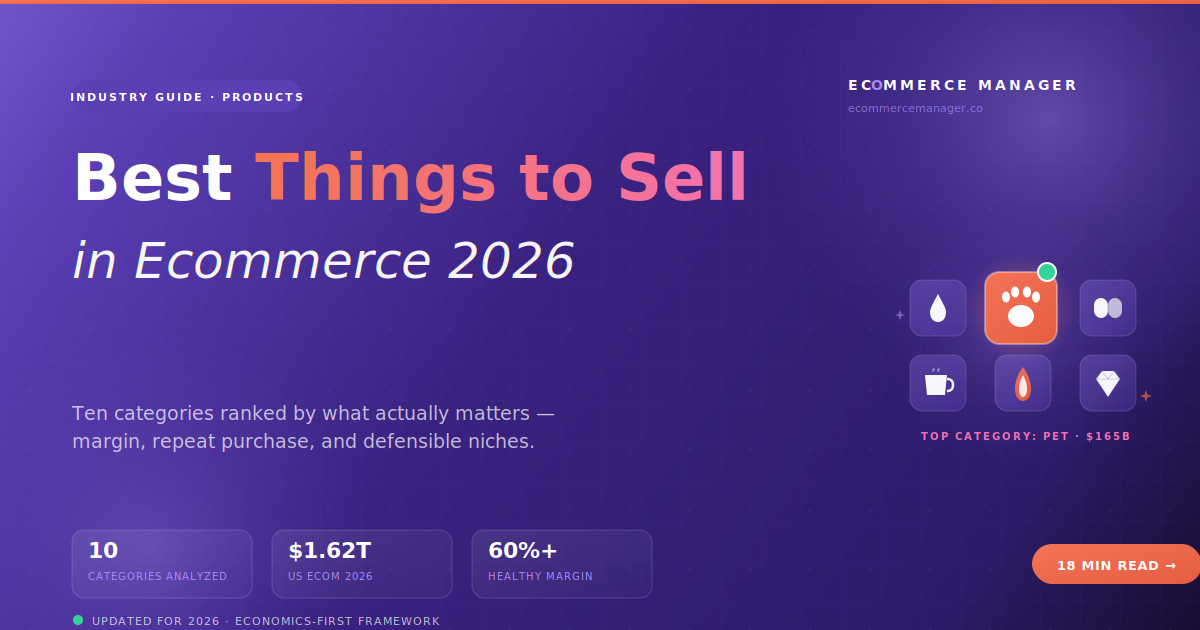
Skip the viral product lists. Here are the 10 categories with actual economics worth building a business around — judged by margin, repeat purchase, and how defensible the niche is.
Almost every "what to sell online" article on the internet is wrong in the same way. They list the products that are trending this week, ignore whether you can build a business around them, and quietly count on you not noticing the difference. This guide does the opposite. Below are 10 categories with the actual economics — margin, repeat purchase, competition — that decide whether your store survives past month six.
The "Viral Product" Trap
Here's the thing about TikTok-famous products that nobody who's actually selling them will tell you. The viral candle warmer that did $400K in sales last March did $14K in May. The flameless lighter that broke the internet in February is now sitting in a warehouse in Ohio with 8,000 units of dead stock. The "winning product" of last quarter is this quarter's clearance bin.
Trend-chasing isn't a business model — it's a series of expensive lessons that look like a business until your CAC catches up with you. The brands actually compounding revenue in 2026 picked categories where buyers come back, margins absorb rising ad costs, and competition isn't infinite. They didn't get there by hunting unicorns on Sell The Trend. They picked a category with real economics and built a brand around it.
The US ecommerce market is projected to reach $1.62 trillion in 2026, with over 230 million Americans buying online. The opportunity is real. The trick is picking a category where you can keep the profit instead of paying it all to Meta.
The Four Economics That Actually Matter
Before reading the category list, internalize this framework. A "good product to sell" isn't the one with the highest demand spike this month. It's the one that scores well on all four of these. Most viral products score well on one and fail on the other three.
Gross Margin (60%+ Target)
You need enough margin to absorb rising ad costs, returns, shipping, and discounts — and still have profit left. Anything below 50% gross is a treadmill. The category averages below show realistic benchmarks.
Repeat Purchase Potential
A second sale costs roughly 20% of what the first one did. Categories where customers buy monthly or quarterly compound. One-time-purchase categories require you to refill the top of funnel forever.
Competition Level
Too saturated and your CAC kills you. Too empty and there's no demand. The sweet spot is categories with real demand but where Amazon doesn't dominate the search results — meaning you can carve out a defensible niche position.
Defensibility / Brand Moat
Can you build a brand that customers care about, or are you reselling a commodity? Categories with emotional resonance (pet, baby, beauty) and expertise barriers (supplements, hobby gear) defend better than generic accessories.
Quick Comparison: 10 Best Ecom Categories
Side-by-side. Margin column is category-typical gross margin. Repeat Purchase reflects how often buyers come back. Competition reflects how Amazon-dominated the search results are.
| Category | Avg Gross Margin | Repeat Purchase | Competition | Best For |
|---|---|---|---|---|
✨ Beauty & Skincare |
50-70% | High | Saturated | Brand-led niches |
🐾 Pet Products |
40-60% | Very High | Moderate | Specialty & premium |
💊 Supplements |
60-75% | Very High | Crowded | Functional, expertise-led |
☕ Specialty Food/Bev |
40-55% | Very High | Moderate | Subscription brands |
🕯️ Candles & Fragrance |
55-80% | Moderate | Crowded | Premium/giftable |
👶 Baby & Kids |
45-65% | High | Moderate | Premium positioning |
🎯 Niche Hobby Gear |
50-70% | Moderate | Low-Mid | Enthusiast brands |
🌱 Sustainable Home |
45-60% | Moderate | Low-Mid | Values-led brands |
💍 Jewelry |
60-85% | Moderate | Saturated | Design-led brands |
💾 Digital Products |
85-95% | Moderate | Niche-Low | Expertise creators |
A 14% net margin on consumables with a 4x repeat purchase rate generates more lifetime profit than a 60% gross margin on a one-time gadget. Sustainable ecommerce businesses live in the repeat-purchase column, not the margin column. Both matter — but if you have to pick, repeat wins.
1. Beauty & Skincare — The Category Standard
Beauty & Skincare
Beauty is saturated, expensive to acquire customers in, and still one of the best categories in ecommerce. Here's why the math works anyway: a serum your customer likes empties in 60 days, they reorder it twice a year minimum, and they tell friends. The CAC you spent in month one pays back across 18 months of repeat orders. Compare that to selling a $40 gadget once. Skincare specifically is where the strongest brand-building has happened — Topicals, Hero, Tower 28, Glossier — because consumers see the product on their face every day and form genuine loyalty.
The trap: starting a generic moisturizer brand in 2026 is hard. The winning angle is hyper-specific (textured skin, perimenopause, acne, melanated skin, mature skin) and ingredient-led (peptides, retinaldehyde, exosomes). Generalist beauty brands aren't getting funded. Specialists are.
Best for: Founders with a clear ingredient or audience POV, not generalists.
2. Pet Products — The Quiet Compounder
Pet Products
The pet category is what investors call a "humanization play." People treat their dogs and cats like family, which means they buy organic food, premium supplements, orthopedic beds, and behavior-supportive toys at price points that would shock anyone who isn't a pet parent. The US pet industry is projected to hit $165 billion in 2026, with online pet sales growing 9x faster than in-store. The economics: a $48 bag of premium dog food repeats every 5-6 weeks. That's 8-10 reorders per year per customer. CAC pays back fast.
The trap: commodity pet supplies (generic toys, basic accessories) live on Amazon and you can't compete. Specialty wins — joint supplements for senior dogs, raw food for specific breeds, anxiety solutions, premium grooming. Niche down and price up.
Best for: Brands going specialty (breed, age, condition) — not generalists.
3. Supplements & Functional Wellness — Subscription Gold
Supplements & Functional Wellness
Supplements are the category where subscription economics actually work the way the pitch decks claim. Sleep, gut health, recovery, longevity, mood, menopause — every health category has a high-LTV supplement opportunity in 2026. The regulatory complexity that scares amateurs out (FDA compliance, GMP manufacturing, label requirements) is what protects margins for brands that take it seriously. The category isn't unsaturated — far from it — but the ones with real science, third-party testing, and a clear health POV consistently win.
The trap: generic protein and multivitamins are commodities. Functional and condition-specific supplements (Athletic Greens, AG1, Levels, Rho, Equip, Seed) are not. Build for a specific problem, build credibility, and the subscription rate will carry the unit economics.
Best for: Operators willing to invest in real R&D, third-party testing, and FDA-compliant manufacturing.
4. Specialty Food & Beverage — The Fastest-Growing Category
Specialty Food & Beverage
Food and grocery is currently the fastest-growing category in US ecommerce at +27.3% year-over-year, and specialty consumables are where DTC actually wins (mass grocery is Amazon/Walmart territory). Coffee, tea, functional beverages, sauces, snacks with a niche angle — these categories have lower margin ceilings than supplements or beauty, but the repeat purchase rate compensates. A coffee subscriber reorders every 2-4 weeks. That's 13-26 orders per year per customer.
The 2026 winners: functional beverages (Olipop, Poppi, Recess, Cure), specialty coffee (Trade, Driftaway, Bean Box), gourmet pantry (Fly By Jing, Brightland, Spicewalla), and "better-for-you" snacks. The trap: cheap private-label snacks compete with Amazon's house brands at razor margins. Specialty positioning is required.
Best for: Brands with a specific functional angle or chef/origin story.
5. Candles & Home Fragrance — Highest Margins in Physical Goods
Candles & Home Fragrance
Candles have 55-80% margins because the raw materials are stupidly cheap relative to what consumers will pay for a beautifully branded product in a heavy glass vessel. A $48 candle that costs $7 to make is the kind of unit economics every other category dreams about. The category is saturated at the entry level (every Etsy seller has a candle line), but premium brand-building — Boy Smells, Otherland, P.F. Candle Co., Loewe — consistently works.
The trade-off: repeat purchase is moderate (most people buy a candle, burn it, and don't reorder for months). The category leans on gifting heavily, which means seasonality matters. Holidays are 40-60% of annual revenue for most candle brands. Best fit for brands that can do exceptional design, scent profile, and storytelling — not for operators looking for "easy."
Best for: Founders with strong design sense and a unique scent or aesthetic POV.
6. Baby & Kids — Emotional Moats and Repeat Buys
Baby & Kids
The category economics are excellent for two reasons. First, parents won't compromise on safety, quality, or sustainability — which means premium positioning works in a way it doesn't in most apparel categories. Second, kids grow constantly, which means clothes, gear, and developmental products refresh every 3-6 months. Subscription models work (Lalo, KiwiCo, Lovevery, Frida, Bobbie). Single-product moments (strollers, monitors, car seats) carry premium AOVs because parents do meaningful research before they buy.
The trap: kids products have meaningful safety/regulatory complexity (CPSC, ASTM testing) and the legal exposure of a poorly-designed product can sink a small brand. Don't enter this category without compliance expertise. The winners (Frida, Bobbie, Lalo, Lovevery) all built around specific developmental moments or pain points — gas, sleep, feeding, sensory learning.
Best for: Operators with safety expertise and a developmental/age-stage focus.
7. Niche Hobby Gear — The Defensibility Play
Niche Hobby Gear
The most underrated category on this list. Specialty hobby gear — pickleball paddles, climbing chalk, birding optics, gaming peripherals, fly fishing tackle, woodworking tools — is where defensibility actually exists in ecom. Passionate hobbyists buy from specialists, not from generic retailers. Amazon doesn't dominate these search results because hobbyists trust enthusiast brands over algorithm picks. CAC tends to be lower because community channels (subreddits, Discord, YouTube, Facebook groups) drive traffic at near-zero cost.
The trick: pick a hobby with real population (pickleball: 36M+ players in 2026, growing 50% YoY) but where the existing brands are mediocre. The losing version is starting a generic outdoor gear store that has to compete with REI, Backcountry, and Amazon. The winning version is becoming "the pickleball paddle brand for intermediate players" or "the climbing chalk brand for sweaty hands." Specificity wins.
Best for: Operators who already participate in or love the hobby they're selling to.
8. Sustainable Home Goods — The Gen Z + Millennial Driver
Sustainable Home Goods
Sustainable products went from "nice to have" to "expected" with Gen Z and younger Millennial buyers, and the data shows they'll pay 15-30% more for credibly sustainable alternatives. The winners in 2026 (Blueland, Grove Collaborative, Public Goods, Branch Basics) all built around refill-and-reorder models that create natural repeat purchase. The category is wide — cleaning products, kitchenware, bathroom essentials, laundry, food storage — and most subcategories aren't yet dominated by clear winners.
The trap: greenwashing kills brands fast. Consumers research sustainability claims and call out fakes. Real third-party certifications, transparent supply chains, and substantive reductions (not just "we use less plastic") are required. Don't enter this category without genuine commitment — and a budget for verification.
Best for: Founders with genuine sustainability commitment and resources for certification.
9. Jewelry & Accessories — High Margin, Light Shipping
Jewelry & Accessories
Jewelry has structurally excellent unit economics — small, light (cheap to ship), high perceived value relative to cost, and infinitely brand-able. The winners on the demi-fine end (Mejuri, Missoma, Catbird) built strong brand identities around layering, everyday wear, and ethical sourcing. The fashion/costume end (BaubleBar, Kendra Scott) wins on personalization and gift moments. Margins on designer fine pieces can hit 80-85%.
The trap: generic dropshipped jewelry is everywhere, racing to the bottom on price. Differentiation is critical — through ethical sourcing (lab-grown diamonds, recycled metals), through customization (engraving, birthstones, personalization), or through design POV. Without one of those, you're competing with Temu.
Best for: Founders with design background or a clear ethical/sourcing angle.
10. Digital Products — The Best Margin in Ecommerce
Digital Products
Digital products are the highest-margin category in ecommerce, period. Templates, online courses, ebooks, AI prompts, Notion systems, design assets, music samples, stock photos — anything you create once and sell indefinitely runs at 85-95% gross margin with zero fulfillment cost. The 2026 acceleration: AI-enabled creators are shipping digital products faster than ever, and AI-related digital products (prompt libraries, custom GPTs, workflow templates) are a meaningful subcategory of their own.
The trap: digital products work when you have genuine expertise or audience. Without one, you're competing on price with Etsy templates that cost $4. The winners (Justin Welsh, Pat Walls, Dan Koe, Tiago Forte) all built around audiences first and digital products second. Repeat purchase is lower than consumables, but LTV stays strong if you build a product ladder.
Best for: Creators with audience, expertise, or both.
The Hidden Compound: Bundling and Subscriptions
Across every category above, the brands that compound fastest do two things. They bundle complementary products to raise AOV (skincare kits, supplement stacks, coffee + tea sets, pet care bundles), and they add subscription mechanics to convert one-time buyers into repeat customers. A 30% bundle take rate and a 35% subscription take rate roughly doubles unit economics versus a single-purchase model. Whatever category you pick, plan for both from day one — not as bolt-ons later.
What NOT to Sell in 2026
The flipside of the framework is just as important. Categories that look attractive in YouTube videos but have ugly economics underneath:
- Generic phone accessories. 15-25% margin, Amazon dominates search, race to the bottom on price. Only works if you have a distinctive design POV.
- Single-use TikTok viral products. The candle warmer, the flameless lighter, the ice roller, the magnetic eyelashes — all had their moment, then died. Trend-chasing isn't a business.
- Heavy or oversized items. Furniture, exercise equipment, large home goods — shipping costs destroy margins, and return rates kill you.
- Generic apparel without a niche. Saturated, high return rates (sizing), seasonal, and direct competition with Shein/Temu at the bottom and Lululemon/Gymshark at the top.
- Dropshipped electronics. Customer expectations are higher than dropshipping can deliver. Returns, warranty issues, and Amazon competition all work against you.
- CBD, vape, and other regulated products without expertise. The category economics look great until you discover you can't run paid ads, can't use most payment processors, and can't ship to half the states.
- Print-on-demand without a creative angle. POD only works with strong design IP or an audience. Generic t-shirts and tote bags are commoditized to death.
How to Actually Pick Your Category
Four questions to answer honestly before you commit a year of your life to a category:
1. Do you have an unfair advantage in this space?
The best ecommerce brands almost always have a founder who genuinely knew the category before starting the business. Beauty founders who worked in formulation. Pet brands started by vets. Coffee brands run by roasters. If you can't articulate why you have an edge over the next person who reads this article, the category isn't right for you.
2. What's the repeat purchase mechanism?
If you can't answer "what makes my customer come back in 60 days?" in one sentence, the category economics will be brutal. Categories with a natural answer (you ran out, you outgrew it, you finished it, the kid grew) compound. Categories without one require constant top-of-funnel spend.
3. Is there a defensible niche you can own?
"Skincare" is too broad. "Skincare for melanated skin in their 40s" is a niche. "Pet products" is too broad. "Joint supplements for senior dogs over 50 pounds" is a niche. The niche is what protects you from Amazon and from the next ten people entering your category next year.
4. Can you build a brand here, or are you just reselling?
If a customer can't tell whether they bought your product or a generic version, you're a reseller, not a brand. Brand-able categories have emotional resonance (pet, baby, beauty), expertise barriers (supplements, hobby gear), or design potential (jewelry, candles, sustainable goods). Categories without any of those are race-to-the-bottom plays.
🎯 If repeat purchase is critical
Beauty, Pet, Supplements, Food/Bev
💎 If margin is critical
Candles, Jewelry, Digital products
🛡️ If defensibility is critical
Niche hobby, Sustainable home
❤️ If brand-building is critical
Beauty, Baby/Kids, Pet
The Honest Bottom Line
"What should I sell?" is the wrong first question. The right one is "what category has economics I can build a business in?" Margin, repeat purchase, competition level, and defensibility — together they decide whether your store survives past month six.
The 10 categories above all clear the bar in different ways. Beauty, pet, supplements, and food repeat best. Candles, jewelry, and digital products have the strongest margins. Niche hobby and sustainable goods are most defensible. Baby and kids combine emotional moats with natural repeat. Pick the one where you have an unfair advantage, can articulate the repeat mechanism, and can build a brand that customers actually care about.
Whatever you do, don't pick a category because TikTok made it look easy.
Need Help Validating a Category?
The eCommerce Manager helps operators pressure-test category and product ideas before they commit a year and a budget to them. Honest second opinions, no agency upsells.
Get a Second Opinion →