

Last Updated on June 7, 2026
Print-on-Demand in 2026: The Operator's Guide
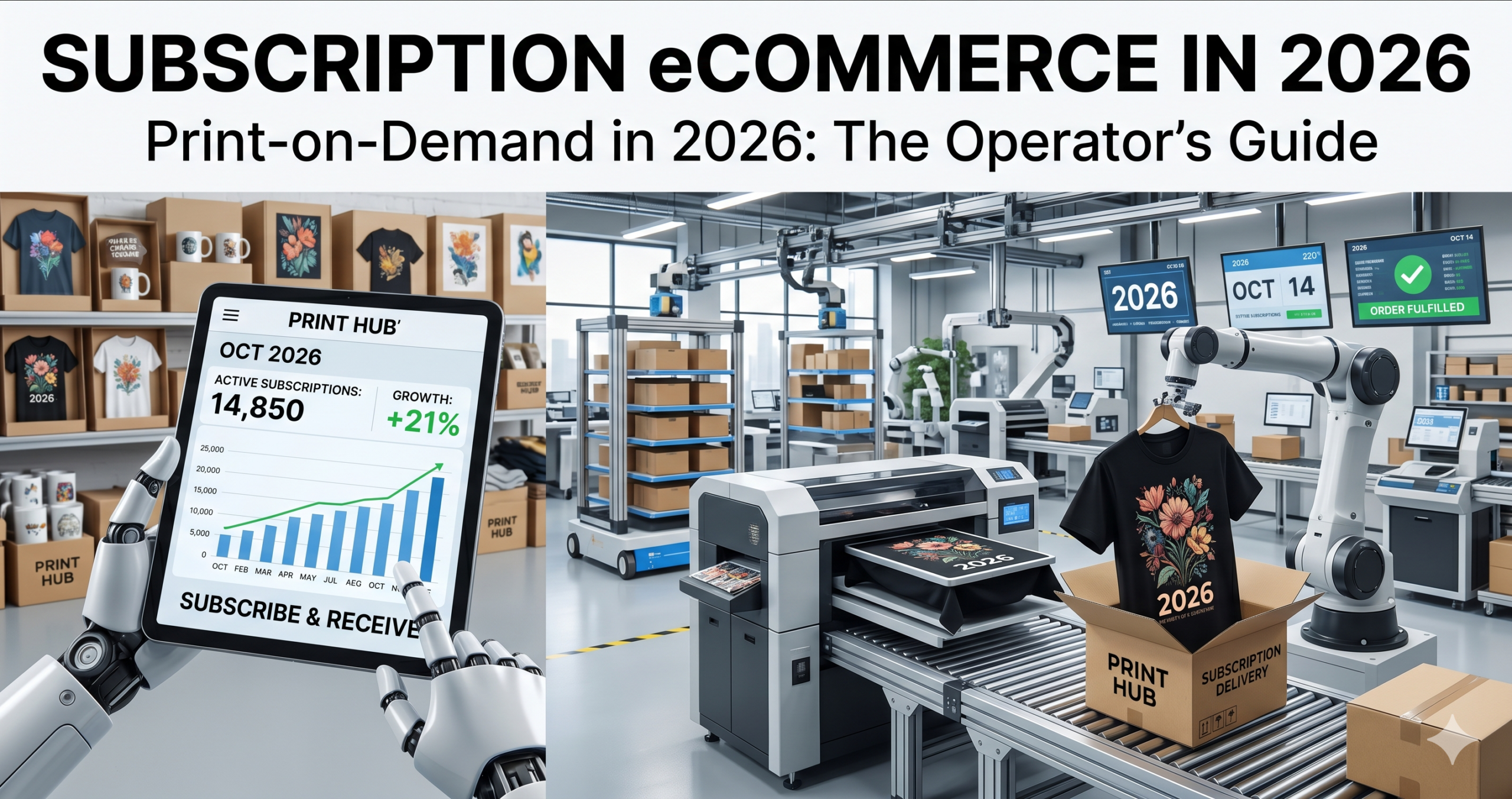
POD crossed $13B globally this year, growing 23.6% CAGR through 2033. Here's what actually works in 2026: best-selling products, real margins, the right channel mix, and a launch plan that doesn't burn cash.
On this page
The 2026 POD operator's brief
Print-on-demand crossed the line from side hustle to serious eCommerce category somewhere in 2024, and 2026 is the year that's no longer up for debate. The global market sits at $13.06 billion, growing at a 23.6% CAGR with a 2033 forecast of $57.49 billion. India alone is on a $5.4B path by 2033 at an even faster 26.2% CAGR.
The version of POD that worked five years ago, random designs on generic stores running cheap traffic, has run its course. What replaces it is recognizable to anyone who runs a $5M–$50M DTC brand: specific niches, real brand assets, contribution-margin-led decisions, and a fulfillment partner picked on consistency, not price.
This guide is the operator's version. What's actually selling, what the math looks like per order, how the three real platforms compare, which channels reward which skill sets, and a four-week launch plan you could run starting Monday.
POD isn't a side hustle anymore
The print-on-demand market hit $10.78 billion in 2025 and is on pace for $13.06 billion in 2026, according to Grand View Research. The forecast through 2033 puts it at $57.49 billion at a 23.6% CAGR. That kind of growth doesn't come from hobbyist Etsy shops. It comes from operators treating POD as a serious eCommerce category.
India is now one of the fastest-growing pieces. Grand View pegs the India POD market at $857.9 million in 2025 with a forecast of $5.419 billion by 2033, a 26.2% CAGR that's faster than the global average. For brands selling into multiple regions, that matters when you're picking a platform stack and a fulfillment network.
-
01$10.78B → $13.06B → $57.49B. Global POD's three-step climb from 2025 to 2026 to 2033 (Grand View Research). The 2026 jump alone is $2.28B.
-
0223.6% global CAGR through 2033. Most eCommerce sub-categories are growing at 8–12%. POD is on a different curve, driven by personalization, creator economies, and lower fulfillment friction.
-
03India: $857.9M in 2025 → $5.419B by 2033. A 26.2% CAGR puts India ahead of the global rate. International POD operators should be watching it the way they watched Southeast Asia three years ago.
What POD actually is
Print-on-demand is an eCommerce model where products are produced only after a customer places an order. Upload a design, attach it to a base product, connect the catalog to your store, and the POD provider prints, packs, and ships when the order comes in. You never touch inventory.
The reason the model keeps winning is structural. POD removes the three biggest sources of retail risk in one move: no bulk inventory commitment, no warehouse overhead, and no unsold stock. That's why creators, niche brands, and ops-light DTC teams keep gravitating toward it, and why Printify can credibly claim sellers can build product lines across 1,300+ items with zero upfront investment.
-
→No inventory. Cash that would've sat in a 500-unit hoodie order goes into ads, design, and content instead.
-
→No warehouse. No 3PL contract, no pick-and-pack negotiations, no storage fees. Your operations footprint is a laptop.
-
→No unsold stock. The product doesn't exist until someone buys it. Seasonal drops, limited editions, and niche tests all become essentially risk-free.
What's actually selling
POD providers list 1,300+ products, but real revenue concentrates in a handful of categories. Here's where the volume is and what each format is good for in 2026.
-
01T-shirts. The easiest entry point and still the largest category. Printful reports the global t-shirt market at $30.68 billion in 2026, with the custom t-shirt segment forecast to hit $9.82 billion by 2030. Crowded, but the demand is unambiguous.
-
02Hoodies and sweatshirts. Higher AOV than tees, better margins, and ideal for niche-community brands — schools, teams, podcasts, fitness creators. The category most likely to push your AOV past $50.
-
03Mugs and drinkware. Strong for gifting, holidays, office humor, and local brands. Low base cost, easy to bundle as an upsell with a tee.
-
04Tote bags. Lifestyle brands, bookstores, eco-conscious audiences, farmers-market crowds. Predictable margins and a forgiving design surface.
-
05Wall art and posters. Home décor, motivational quotes, sports themes, city pride, pets, custom gifts. Gelato in particular has built a global production network around this category.
-
06Hats and caps. Margin potential is real, but embroidery quality and placement tolerance vary by supplier. Always sample before scaling spend.
-
07Stickers. Low price, high attach rate. Often the cheapest way to turn a $19 tee customer into a $24 cart. A small move that adds up across thousands of orders.
Pick the right platform before you pick the product
The platform you choose shapes margins, shipping, and which categories make sense. Run a TCO comparison before committing.
The three POD platforms that matter
Most serious POD operators in 2026 use one of three providers, or two in parallel. Here's the practical breakdown.
Printful
The default choice for branded apparel and accessories. Tight integrations with Shopify, Etsy, and WooCommerce. Print quality is consistent enough to build a real brand on it. Higher base costs than Printify, but the consistency premium is usually worth it once you're scaling.
Printify
Wins on catalog breadth and supplier choice. Printify's Shopify app lists 1,300+ custom products and a network of print providers, with order management automated end-to-end. The right pick if you want to test product categories fast: pick a supplier per product line and switch when one underperforms.
Gelato
Built for global production. Strong for wall art, stationery, and international fulfillment. If you're shipping into multiple regions and want production close to the customer, Gelato's distributed network cuts shipping time in a way the others can't match.
How the math actually works
POD margins look fine on paper and brutal in reality. The model is: pick a niche, create designs, upload products to the POD platform, connect it to Shopify or Etsy or TikTok Shop, customer orders, POD prints and ships, you keep the spread. The spread is where it gets interesting.
Take a worked example. A hoodie sells for $49.99. POD base cost is $26.00. Shipping is $6.00. Gross profit before ads and fees is $17.99, roughly a 36% gross margin. Now subtract a 5% marketplace fee on Etsy, a $7–$12 CAC if you're running ads, and the occasional replacement order, and you're looking at a net contribution somewhere between $3 and $9 per order.
Most operators target 30–50% gross margins across the catalog. The pricing mistake beginners make is going low, pricing a tee at $19.99 to "compete." POD doesn't compete on price; it competes on identity. A specific design for a specific community sells at $34.99 without anyone blinking, and the unit economics suddenly work. The metrics that matter here are AOV, contribution margin per order, and repeat rate, not top-line revenue. Once you hit a few hundred orders, plugging in retention specialists to build the post-purchase email and SMS flows is usually the highest-ROI move you can make.
-
→30–50% gross margin is the operating range. Below 30%, you're subsidizing the supplier. Above 50%, you're charging premium and need branding to back it.
-
→Marketplace fees + shipping + ads can eat half of gross profit if you're not careful. Model your full P&L per SKU before scaling spend.
-
→Bundles raise contribution margin faster than price increases. A tee + sticker + tote at $49 beats a single tee at $34 on every metric that matters.
Niches that win in 2026
The strongest POD niches in 2026 are identity-driven. People aren't buying a tee. They're buying a small piece of public evidence that they belong to a tribe. That's what unlocks pricing power.
Strong niches share three traits: a clear identity ("I am this kind of person"), an emotional gifting angle ("this is for someone like me"), and enough community density to find them with content. Pets, teachers, nurses, sports fans, local pride, faith, fitness, parenting, weddings, hobbies, gaming, family reunions, and small-business merch all check those boxes.
The unlock isn't picking a big niche. It's picking a specific one. "Funny shirts for everyone" loses to "Funny pickleball shirts for women over 40" loses to "Personalized pickleball tournament gifts for local clubs." Each layer of specificity raises conversion rate and lowers ad costs, which is why narrow niches consistently outperform broad ones in DTC content data.
Where to sell — Shopify, Etsy, TikTok
Channel choice matters as much as product choice. Each platform has a different demand profile and a different operator skill set.
Shopify — brand control
Best for building a real brand asset. You own the customer data, the email list, the retargeting audiences, and the upsell flows. The catch: no built-in traffic. You're driving every visit yourself through paid social, content, or SEO. Worth it once you have a winning niche.
Etsy — built-in demand
Best for personalized gifts and handmade-style products. The platform sends you buyers actively searching for what you sell, especially strong for weddings, occasions, and seasonal gifts. The trade-off is fees, marketplace dependency, and limited customer-data access.
TikTok Shop — trend velocity
Best for trend-driven products and creator-led merchandising. Demand spikes are sharp and short. If you can move fast and produce volume of organic content, the channel pays. If you can't, it doesn't.
Amazon — scale
Best when you've already proven a product elsewhere and want distribution. Margins are thinner but volume is real. WooCommerce, eBay, and Walmart Marketplace each fill specific operator niches: WooCommerce for WordPress-native stores, eBay for collectibles, Walmart for established sellers.
Need a partner to run paid traffic or CRO?
Browse vetted agencies by specialty: CRO, paid social, retention, SEO. Filter by budget, region, and category fit.
The honest pros and cons
POD is genuinely good. It is also genuinely competitive. Here's the operator-honest version.
What POD does well
-
→Low startup cost. Most operators can launch a real store for under $500 in software, design, and sample costs.
-
→Zero inventory risk. Test 50 SKUs in a month without ever holding stock. The wrong ones just stay unsold listings.
-
→Channel flexibility. One POD account feeds Shopify, Etsy, TikTok, Amazon, and WooCommerce in parallel.
-
→Seasonal launches are essentially free. Mother's Day, Pride, holidays, sports seasons. Drop and retire designs without consequence.
Where POD hurts
-
→Margins are tighter than bulk manufacturing. You're paying a convenience premium to the supplier on every unit. Forever.
-
→Fulfillment isn't yours. Quality, shipping speed, and consistency all depend on the supplier's day-to-day execution. You absorb every complaint.
-
→The popular niches are saturated. "Dog mom" and "teacher life" are full of operators racing to the bottom on price. Specificity is the only escape.
-
→Paid ads can wipe out profit fast. Without strong creative and a clear identity hook, a $9 net order pays for one click and dies.
POD in 2026 looks different
The version of POD that worked in 2021, uploading a hundred random designs to a generic Shopify store, running cheap Facebook ads, hoping something hit, stopped working a while ago. The category has professionalized.
Winning operators are building real brands now. That means better product photography, custom mockups, niche positioning, UGC-style video, real email marketing, organic TikTok content, SEO-driven product pages, and faster fulfillment partners. The bar is closer to a traditional DTC brand than a side hustle.
AI is the other shift. Operators use it for design brainstorming, mockup generation, listing copy at scale, ad creative testing, trend research, and customer segmentation. The competitive edge isn't using AI. Everyone is. The edge is using it to compress the test-and-learn loop from weeks to days. Operators looking for help on this are increasingly reaching for specialized AI agencies rather than building in-house, and pairing them with CRO partners early so the traffic actually converts.
The 30-day launch plan
If you're starting from zero in 2026, this is the version that actually works. Four weeks. One specific niche. Ten to twenty products. Real measurement.
Week 1 — Pick the niche
One audience with strong buying intent. Dog moms, nurses, teachers, local city pride, pickleball players, bridesmaids, new parents. Specificity wins. Validate that the niche shops online and has gift-giving occasions before committing.
Week 2 — Build the first product line
Ten to twenty products is enough to test. A working starter mix: five t-shirts, three mugs, three tote bags, three hoodies, three stickers or posters. Each design has to pass the identity test. Would the target customer wear or display it specifically because it says something about them?
Week 3 — Launch the store
Shopify for brand control or Etsy for built-in demand. Pick one for the launch and add the second after week 4 if the first one is working. Either way: real product titles, SEO descriptions, custom mockups, size charts, clear shipping and return policies, and an About page that signals you're a real operation. SEO partners can compress the first 90 days of organic traffic if budget allows.
Week 4 — Start marketing
Short-form content is the highest-leverage channel for new POD brands. Post product mockups, customer use cases, gift ideas, behind-the-scenes design videos, niche memes, and seasonal drops. Measure ad spend against contribution margin per order, not gross revenue. By day 30, you should know whether the niche has legs or whether to swap and re-run.
What to actually do with this
POD in 2026 is a real eCommerce category, $13.06B globally with a 23.6% CAGR through 2033, but the easy era is over. The model still wins for operators who treat it like a serious DTC business.
Specificity drives margin. The difference between a $19.99 tee and a $34.99 tee is identity, not product. Pick one niche, get specific enough that the customer feels recognized, and the unit economics work.
Channel mix matters more than supplier choice. Etsy for built-in demand, Shopify for brand asset, TikTok Shop for velocity. Most serious operators run two in parallel by month three.
AI compresses the loop. The competitive edge isn't using AI. It's using it to test designs, copy, and creative faster than the last cycle of operators could.
Frequently asked questions
Is print-on-demand still profitable in 2026?
Yes, but the bar is higher than it used to be. Gross margins in the 30–50% range are normal once you account for base product cost, shipping, marketplace fees, and ad spend. The sellers making real money in 2026 aren't running generic shirt stores. They're building branded product lines around a specific identity, charging $30–$60 per unit instead of $19.99, and using POD as the fulfillment layer of a real ecommerce business rather than the entire business model.
How much money do you need to start a print-on-demand business?
Technically zero, since POD has no inventory cost. Realistically, plan to spend $200–$500 in the first month on a Shopify subscription, design tools or freelance designers, product samples, and small-budget testing. Profitable POD brands typically need $1,000–$3,000 in paid testing budget over the first 60 days to find which products and audiences convert before scaling spend.
What's the best platform for print-on-demand right now?
Printful is the default for branded apparel and accessories where consistency matters. Printify wins on catalog breadth, over 1,300 products across a large supplier network, and is the better option for sellers wanting to test new product types quickly. Gelato is the top pick for international sellers and wall art because of its global production network. Many operators run two providers in parallel to balance product range and quality.
Should I sell on Shopify or Etsy for print-on-demand?
Etsy gives you built-in shopper traffic and is faster to first sale, especially for personalized gifts, mugs, and wedding products. Shopify gives you customer data, email lists, retargeting, and the ability to build a real brand asset. Most serious POD operators start on Etsy to validate demand, then move to Shopify (or run both) once they have a winning niche. The Shopify play only works if you can drive traffic, typically through TikTok, paid social, or SEO.
What products sell best for print-on-demand in 2026?
T-shirts are the easiest entry point but the most competitive. Hoodies and sweatshirts carry better margins and work well for niche communities. Mugs, tote bags, and wall art convert strongly for gifting and home décor. The pattern across categories is identity-driven design: products that say something specific about who the buyer is (pickleball player, dog mom, nurse, local pride) outsell generic 'funny' designs by a wide margin.
The playbook top eComm operators actually read
One weekly brief. Five stories that matter. Zero fluff. Written for managers at $5M–$50M DTC brands who want to sound sharper than everyone else in the meeting.
References
- 01 Print On Demand Market Size, Share & Industry Report, 2033 — grandviewresearch.com
- 02 Print on Demand: Sell Custom Products – Printify on Shopify — apps.shopify.com
- 03 T-shirt market statistics and forecast — printful.com
- 04 India Print On Demand Market Size, Industry Report, 2033 — grandviewresearch.com
Run a sharper eCommerce operation
Join 12,000+ operators reading the ECM newsletter every Tuesday, or browse the directory for vetted CRO, retention, paid, and SEO partners who already know the POD playbook.