

Last Updated on June 7, 2026
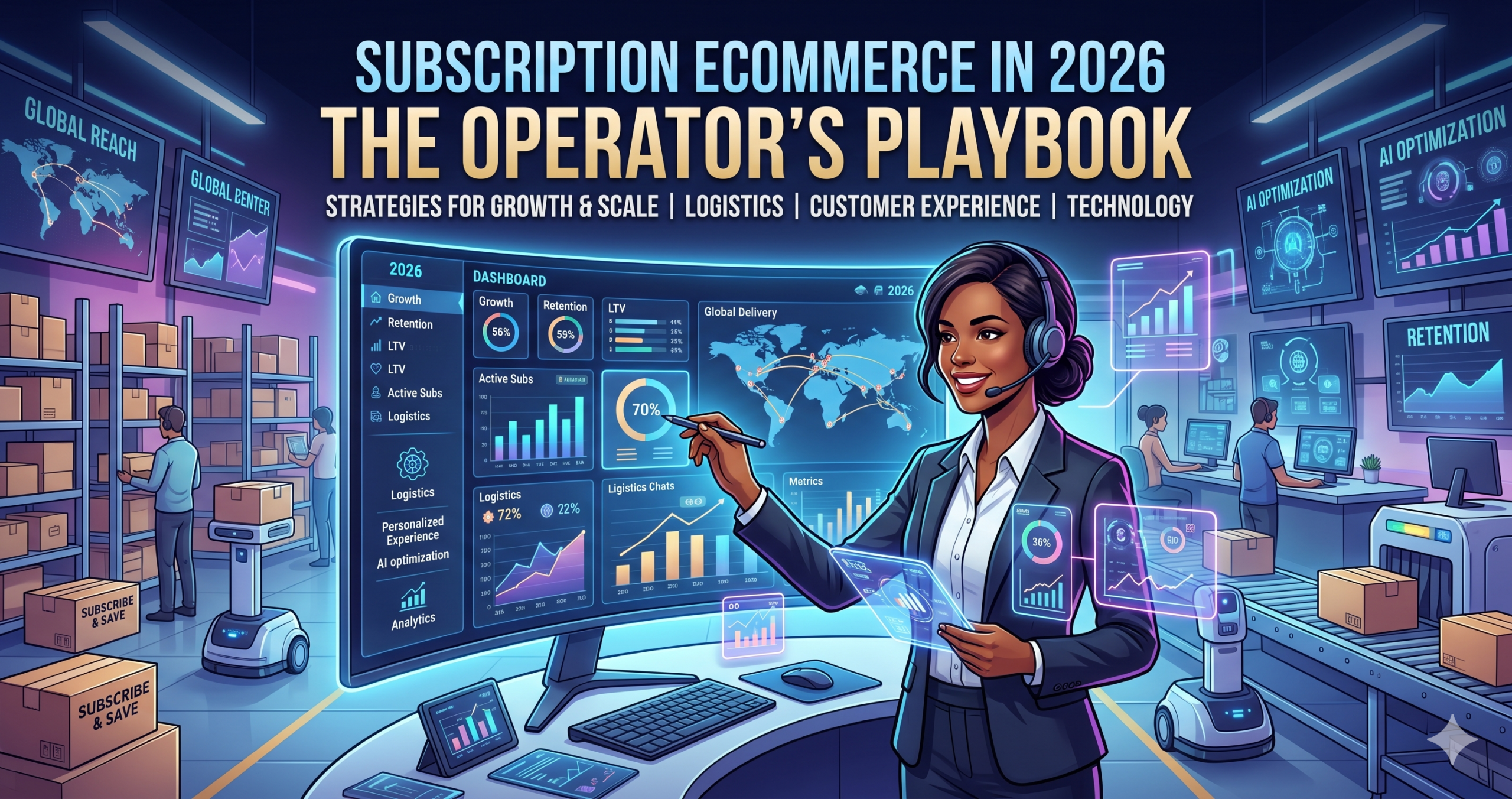
Subscription eCommerce in 2026: The Operator's Playbook
Recurring revenue is no longer a DTC tactic — it's the retention model behind everything from pet food to SaaS. Here's how the economics actually work, and where smart operators are placing their bets in 2026.
- Overview
- 1. The three subscription models
- 2. The state of subscription in 2026
- 3. Why the economics work
- 4. The brands running the playbook
- 5. Where subscription brands break
- 6. The metrics that decide profitability
- 7. AI is rewriting replenishment
- 8. The 2026 operator playbook
- 9. What comes next
- Key Takeaways
- FAQ
- References
On this page
- Overview
- 1. The three subscription models
- 2. The state of subscription in 2026
- 3. Why the economics work
- 4. The brands running the playbook
- 5. Where subscription brands break
- 6. The metrics that decide profitability
- 7. AI is rewriting replenishment
- 8. The 2026 operator playbook
- 9. What comes next
- Key Takeaways
- FAQ
- References
What changed: subscription is now a retention model, not a billing trick
Five years ago, "subscription" mostly meant a monthly box. In 2026 it covers replenishment programs, paid memberships, B2B SaaS, fashion rentals, AI-managed reorders, and a growing layer of embedded commerce that quietly rebills your card without a checkout.
For operators at $5M–$50M DTC brands, the shift matters because subscription is the cleanest answer to two of the hardest problems in the category: predictable revenue and rising acquisition costs. A subscriber who pays $40 a month for 14 months delivers $560 of revenue against the same CAC as a $40 one-time buyer. That's the entire game.
This guide covers the three core models, the 2026 numbers that actually shape investment decisions, the metrics that separate profitable subscription brands from cashflow traps, and where AI is changing the cost curve.
The three subscription models — and what they each solve for
Almost every subscription business in 2026 is a variant of three patterns. The category drives the economics; mixing them up is how brands end up with a curation cost structure on a replenishment AOV.
-
01Replenishment. Customers auto-receive products they consume on a predictable cycle: razors, vitamins, coffee, pet food, cleaning supplies, printer ink. Shopify Subscriptions, Recharge, and Skio dominate the tooling layer here. Replenishment retains best because the customer never has to remember to reorder — friction goes to zero. Dollar Shave Club, Chewy Autoship, and Amazon Subscribe & Save all sit in this bucket.
-
02Curation. Personalized or surprise selections sent on a schedule: Stitch Fix, Birchbox, FabFitFun, wine clubs, snack boxes. The model runs on emotional engagement and discovery, not utility. That's also why curation has the steepest churn curve — once the novelty wears off, a $40/month box becomes the easiest line item to cut.
-
03Membership. Customers pay for access, perks, exclusive pricing, or content: Amazon Prime, Walmart+, Costco, Shopify's own merchant tooling tiers. The recurring fee isn't the product — the increased purchase frequency it unlocks is. Membership is the hardest of the three to launch but compounds the longest because it changes the customer's default buying behavior across categories.
The 2026 numbers operators actually quote in budget meetings
These are the benchmarks worth memorizing. Most appear in board decks, investor calls, and the kinds of platform vendor pitches you'll sit through this quarter.
-
01The global subscription eCommerce market is projected to exceed $1.5 trillion by 2028, with the fastest-growth segments compounding at 60%+ CAGR.
-
02Roughly 70%+ of consumers in major markets hold at least one active subscription, and the average household maintains 4–6 simultaneous subscriptions.
-
03Average monthly churn sits at 5–10% across most DTC subscription brands, with top-quartile operators pushing it under 4%.
-
04Subscriber acquisition cost has risen more than 60% since 2020, which is why retention agencies are now winning budget that used to go to paid acquisition.
-
05Pet, beauty, health, and consumables consistently post the strongest retention; fashion curation and discovery boxes consistently post the weakest. The full KPI benchmarks library covers vertical-specific cuts.
Why the economics work — and where they don't
Subscription doesn't make a bad unit economic story good. It makes a good one durable. The math that gets quoted in pitch decks usually skips three things that decide whether the model actually compounds.
-
01Predictable revenue beats peak revenue. Recurring billing lets you forecast inventory, staffing, ad spend, and cash flow with materially less variance than transactional commerce. That predictability is what makes subscription brands financeable on terms that one-time-purchase brands can't get.
-
02LTV expansion is the whole pitch. A one-time buyer at $40 generates $40. A subscriber at $40/month for 14 months generates $560. Same CAC, 14× revenue. The trap: that math only works if churn and gross margin behave. LTV:CAC ratios below 3:1 in subscription almost always indicate a churn problem the founder isn't pricing in yet.
-
03Inventory and supply chain get easier. Recurring demand smooths forecasting accuracy, which compounds into manufacturing efficiency, lower safety stock, and tighter procurement terms. For brands with custom manufacturing or long lead times, this alone can be worth the operational cost of running subscriptions.
-
04Repeat purchase friction collapses. Search, checkout, payment, reorder — every time a customer goes through that loop is a chance to lose them. Subscription removes the loop. That's why convenience-driven categories outperform discount-driven ones over multi-year retention windows.
Pricing a subscription program against your current platform?
The Platform Calculator runs your AOV, frequency, and churn assumptions through Shopify, BigCommerce, WooCommerce, and Adobe Commerce — and shows the real 3-year TCO including subscription billing fees.
The brands running the playbook well
Each of these operators built durable subscription revenue by solving a specific problem the model is good at — not by stapling recurring billing onto a transactional product.
-
01Amazon Prime turned a shipping fee into a behavioral lock-in. Members spend substantially more annually than non-members because Prime changes the default question from "should I buy this here?" to "why wouldn't I?" The membership is the moat.
-
02Chewy Autoship compounds because pet categories are a near-perfect fit for replenishment: predictable demand, emotional stakes, and a customer who actively prefers not to think about reordering. Autoship attach rates drive the entire retention story.
-
03HelloFresh proved consumers will subscribe to recurring physical product when convenience clearly outweighs effort. It also became the cautionary tale on curation churn — keeping menu novelty fresh enough to retain past month 6 is a permanent operational tax.
-
04Dollar Shave Club is still the canonical DTC subscription case. The brand disrupted shelf retail by simplifying razor purchasing into a $5–$9 monthly recurring decision, and validated that replenishment plus brand voice could win against Gillette's distribution. Most modern equivalents are built on a Shopify or BigCommerce stack with a dedicated subscription billing layer on top.
The three failure modes — churn, CAC, and subscription fatigue
Subscription is not free money. The brands that struggled in 2024–2025 mostly failed at one of three things, and the pattern repeats often enough to flag.
-
01Churn compounds fast. 8% monthly churn means a cohort is roughly half-gone in 9 months. The leading reasons are predictable: poor onboarding, customer fatigue, inventory accumulation, weak personalization, and price increases without value justification. Most retention work is unglamorous — better cancellation flows, smarter pause options, simpler frequency changes.
-
02Acquisition costs keep climbing. Meta, Google, TikTok, and YouTube CPMs have continued their multi-year ascent. Subscription brands now lean harder on referral programs, organic search, community, influencer partnerships, and UGC because paid alone can't carry the model anymore. Organic SEO investment looks expensive on a quarterly P&L and obvious on a 3-year LTV view.
-
03Subscription fatigue is real. Consumers in 2026 are actively auditing recurring charges. "Set it and forget it" no longer works as a positioning. Brands have to keep earning the next cycle through perceived value, novelty, or genuine convenience — which is why product roadmaps and retention roadmaps are starting to merge.
The metrics that decide whether subscription is profitable
Six numbers tell you whether a subscription business is healthy. Most operators track all six; few track them with consistent definitions across finance, growth, and ops.
-
01Monthly Recurring Revenue (MRR). Predictable revenue generated per month, excluding one-time charges. The cleanest top-line number for forecasting and the one investors anchor to.
-
02Churn rate. (Customers lost ÷ starting customers) × 100. Track gross churn (anyone who canceled) and net churn (gross churn minus reactivations). The gap between them tells you how much your win-back program is doing.
-
03Customer Lifetime Value (LTV). The total projected revenue from a subscriber relationship. Calculate it cohorted by acquisition month, not blended — blended LTV hides the early-cohort bias that makes new acquisition look better than it is.
-
04Average Order Value (AOV). Revenue per recurring shipment. Subscription AOV grows mostly through upsells, bundles, and frequency optimization — not through price increases, which trigger churn at 2–3× the rate of equivalent cuts.
-
05Subscriber retention rate. The inverse of churn, but reported in cohort survival curves rather than monthly averages. Survival curves are how you spot a 90-day cliff vs. a slow bleed.
-
06CAC payback period. Months until a subscriber's gross profit covers their acquisition cost. Below 6 months is excellent; 6–12 is healthy; 12+ is a financing problem dressed as a growth strategy.
Need help fixing churn before it eats LTV?
The directory lists 40+ vetted retention agencies — Klaviyo specialists, lifecycle consultants, and subscription-ops teams who've shipped the work for $5M–$50M DTC brands.
AI is rewriting replenishment timing
The interesting AI work in subscription isn't chatbots — it's predictive scheduling. Modern subscription stacks now use behavioral data to decide when to ship, what to bundle, and when to intervene before a cancel.
-
01Replenishment prediction. A supplement brand can now forecast when a specific customer will run low based on consumption rate, household size, prior reorder timing, and engagement patterns — then auto-adjust the next ship date instead of using a fixed 30-day cadence. BigCommerce and Shopify both ship native hooks for this; most third-party subscription apps now expose them too.
-
02Churn forecasting. Models flag customers who match the behavioral pattern of recent cancellations 14–30 days before they cancel. That window is enough to trigger a personalized retention offer or a frequency-change prompt.
-
03Dynamic discounting. Instead of blanket save-offers, AI-tuned systems assign discount depth based on predicted price sensitivity and remaining LTV — protecting margin on customers who would have stayed anyway.
-
04Smart bundling and personalized recommendations. The replenishment box becomes a curated box. Same logistics, higher AOV, more reasons to stay. AI implementation partners are increasingly the bottleneck — most brands have the data, fewer have the model deployment.
The 2026 operator playbook — categories and best practices
Some categories work for subscription. Others don't. Within the ones that do, the brands that compound are the ones that get five practical things right.
Categories with the strongest retention
-
→Pet products, vitamins and supplements, coffee — all driven by predictable consumption and habit.
-
→Beauty, skincare, household essentials — replenishment cycles that align cleanly with natural use rates.
-
→Meal kits, SaaS, digital memberships — convenience-led or margin-led, both compound over multi-year horizons.
Five practices the best operators run
-
01Make cancellation easy. Friction-heavy cancel flows correlate with worse long-term retention because they damage trust. A clean exit makes a return more likely.
-
02Treat the first 60 days as the whole game. Onboarding decides cohort survival. First-shipment experience, dosing or usage education, and a clear value proof point in the first cycle outweigh any later retention tactic.
-
03Personalize the experience, not just the product. Frequency, packaging, recommendations, account controls — operators who personalize the surrounding experience hold subscribers longer than ones who personalize only the SKU.
-
04Build around convenience, not discount. Discount-led acquisition produces discount-loyal customers who churn the moment the offer ends. Convenience-led acquisition produces habits.
-
05Offer flexible controls. Skip a shipment, pause a month, change frequency, swap product — every flexibility primitive you don't ship becomes a forced cancellation. The CRO partners in the directory consistently rank account-page UX as one of the highest-ROI fixes.
Where subscription commerce is heading
Three shifts are visible enough to plan around. Each changes what subscription operators need to build over the next 24 months.
-
01AI-managed subscriptions become the default. Fixed cadences will look like a legacy choice by 2027. Customers will expect their subscription to know when they need it, not when the brand scheduled it.
-
02Autonomous purchasing agents enter the loop. Customer-side AI that orders, compares, and switches based on price and availability is no longer hypothetical. Brands need to think about whether their product is being chosen by a human or by an agent on the human's behalf — the marketing surface for each is different.
-
03Embedded subscription becomes a channel. Subscription billing increasingly lives inside marketplaces, retail-media platforms, and connected-device ecosystems instead of standalone DTC sites. Operators who treat subscription as a model rather than a website are the ones who'll capture this — and a regular tech stack audit is the cleanest way to spot where embedded channels are missing from the current setup.
What a smart operator does with this in 2026
Pick the model the category supports. Replenishment, curation, and membership have different economics. Don't run a curation cost structure on a replenishment AOV, or vice versa.
Cohort everything. Blended LTV, blended churn, and blended CAC all hide the cliff in your first 90 days. The brands that compound report metrics by acquisition cohort, not by month.
Spend the next quarter on retention, not acquisition. A 2-point improvement in monthly churn is usually worth more than the same dollars in paid acquisition — and it's harder to copy.
Pilot AI replenishment now. The brands that ship predictive cadence and AI-led save-offers in 2026 will have a 12-month head start on the ones that wait for it to be standard.
Frequently asked questions
What is subscription-based eCommerce?
Subscription-based eCommerce is any retail model where customers pay on a recurring schedule — weekly, monthly, quarterly, or annually — for products or services. The three dominant formats are replenishment (auto-shipping consumables like razors or pet food), curation (personalized boxes like Stitch Fix or wine clubs), and membership (paid access tiers like Amazon Prime or Costco). What unites them is the focus on retention and lifetime value rather than one-time conversion.
What is a healthy churn rate for a DTC subscription brand?
Most subscription brands operate at 5–10% monthly churn, but the top quartile pushes that under 5%. Pet, supplement, and consumable categories tend to retain best because demand is predictable and the product gets consumed. A 2% improvement in monthly churn can roughly double customer lifetime value over an 18-month window, which is why retention work usually pays back faster than acquisition spend.
How do you calculate subscription customer lifetime value?
The simplest formula is Average Order Value × Average Order Frequency × Average Customer Lifespan. For a brand charging $40 per month with a 14-month average lifespan, LTV is roughly $560. More sophisticated models layer in gross margin, cohort decay curves, and discount rates, but the back-of-envelope number is enough to evaluate CAC payback periods and channel efficiency.
Which subscription categories perform best in 2026?
Categories with predictable consumption and emotional attachment lead retention: pet products, vitamins and supplements, coffee, beauty replenishment, household essentials, and meal kits. SaaS and digital memberships maintain high margins because there's no physical fulfillment friction. Categories that struggle most are fashion subscriptions and curation boxes where the discovery novelty wears off after 4–6 cycles.
How is AI changing subscription commerce?
AI is moving subscriptions from fixed schedules to predictive replenishment. Models trained on consumption behavior, purchase history, and engagement signals can now forecast when a customer will run low, automatically adjust shipping cadence, and trigger retention offers before someone hits the cancel button. The brands using this well are seeing measurable churn reductions and lower support costs — but it requires clean first-party data and a platform that supports flexible billing rules.
The playbook top eComm operators actually read
One weekly brief. Five stories that matter. Zero fluff. Written for managers at $5M–$50M DTC brands who want to sound sharper than everyone else in the meeting.
References
- 01 Subscription Commerce Index 2025 — subta.com
- 02 The State of the Subscription Economy — zuora.com
- 03 Recurly Subscription Benchmarks Report — recurly.com
- 04 Thinking inside the subscription box — mckinsey.com
- 05 Antenna State of Subscriptions Report — antenna.live
- 06 Amazon Prime Membership Numbers — aboutamazon.com
- 07 Chewy Investor Relations: Autoship metrics — investor.chewy.com
- 08 DTC subscription churn benchmarks (Recharge) — rechargepayments.com
- 09 HelloFresh Annual Report — hellofreshgroup.com
Make every subscription decision data-backed
Join 12,000+ ecommerce managers reading the ECM newsletter every Tuesday — or browse the directory to find vetted retention, CRO, and subscription-ops partners.